Category: Science & Speculative Fiction

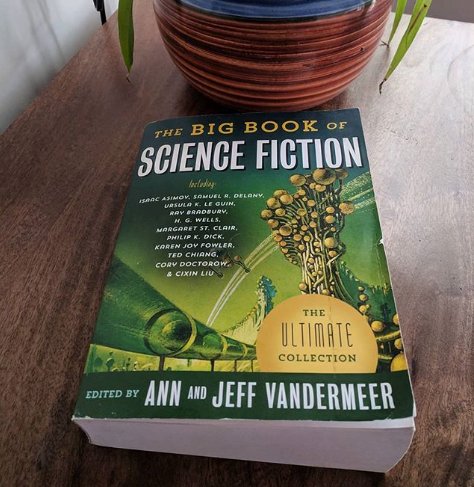
  • The Big Book of Science Fiction

    Ann and Jeff VanderMeer

    If science fiction is even remotely of interest to you, this is a veritable treasure trove! 105 stories spanning 1160 pages. Only a couple of authors get to have more than one story, and that means there is a diversity of work that’s arguably unparalleled in any collection of this nature. The stated objective of the book is indeed that – diversity. And it happens on multiple counts – non-English writings (and therefore, the variety of geographical settings – other than Antarctica, all continents are represented), gender (of authors and characters), and most importantly, the type of science fiction – dystopian, alien encounters, space operas, post-apocalypse, and even satire.
    The stories are broadly in a chronological order of when they were written. The introduction to each author before the beginning of a story is very helpful in terms of context setting.
    While I do love science fiction, I really haven’t read enough to comment on the choices of representation made by the authors. I can count on one hand the number of stories I have previously read. But at least a couple of them are my all-time favourites in fiction – Asimov’s “The Last Question” and Ted Chiang’s “Story of your life”. I also found a story – Sandkings -by an author familiar to many of us from an alternate “universe” – George R.R. Martin. An absolute thriller that I thoroughly enjoyed.
    My other favourites are these : The Triumph of Mechanics by Karl Hans Strobl, a macabre, dystopian tale with a sense of humour! Desertion by Clifford D. Simak, a story based on pantropy – modifying humans for space exploration, as opposed to changing the alien environment. Another favourite that uses this theme is Surface Tension by James Blish. Philip K. Dick’s Beyond Lies the Wub seems quite prescient about “we are what we eat”! Katherine Maclean’s The Snowball Effect is about an experiment by academia in a sociological setting that leads to a more-than-anticipated impact. William Tenn’s Liberation of Earth is a brilliant commentary on US intervention in Korea/Vietnam, even while doing a great job of reducing the collective ego of the apex species of earth! His other work The Ghost Standard, later in the book, is an absolutely delightful satire.
    Grandpa, by James H. Schmitz has alien ecology as a theme and builds the tension excruciatingly well! Stranger Station by Damon Knight is an intense first-alien-contact story that dwells on the complexities very well. Vadim Shefner’s A Modest Genius is a lovely tale of romance and invention while Sever Gansovsky’s Day of Wrath is a thriller based on biotech experimentation gone wrong. The Hands by John Baxter is a creepy tale that reminded me of Aliens.
    F.L. Wallace’s Student Body would make it to my top 5 in the book, exploring both alien contact and environmental impact really well. The feminist utopian world created by Joanna Russ in When it Changed is subtle yet impactful. Yasutaka Tsustsui’s Standing Woman is as poignant as it is surreal. Sporting with the Chid by Barrington J. Bayley is dark and builds up to a terrifying climax.
    Josephine Saxton’s The Snake Who Read Chomsky is another incisive tale on biotech experimentation with some excellent twists and turns. Reiko’s Universe Box by Kajio Shinji is somehow sad and upbeat at the same time. Greg Bear’s Blood Music combines microscopic phenomena and macroscopic impact really well. Robert Reed’s The Remoras uses a space opera setting for an excellent human drama. The last story in the book – Baby Doll by Johanna Sinisalo – is a disturbing take on sexualisation of children that falls well within the realms of possibility, sadly.
    Isaac Asimov, Ursula K. Le Guin, Ray Bradbury, H.G. Wells – the book has work by all the greats of the genre, and you are also likely to discover authors whose stories you will enjoy!
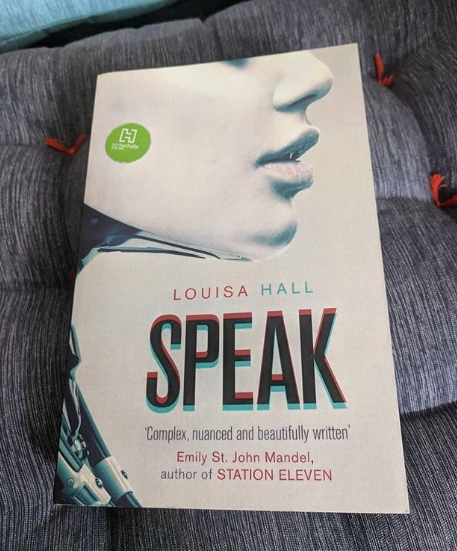
  • Speak

    Louisa Hall

    If you’re familiar with Asimov’s works, you’d know one R.Daneel Olivaw. The robot who lived closed to 20000 years and shaped the fate of humanity. If you follow the Robot and Foundation series, it’s almost like Daneel’s biography. “Speak” reminded me of that because it is almost like a biography of AI. Or rather, an AI that was the most commonly used one until its doll manifestations – babybots – are shipped away to a desert for being too human-like. That’s where the book begins, and through five different narratives, we see its progression.

    The book is as much about the narrators as it is about the evolution of the AI itself. Their voices live on through the AI, and a motley bunch they are. Mary Bradford makes her way across the ocean to Massachusetts some time in the 17th century, on a voyage (and a marriage) she doesn’t really fancy. She fills her diary with her thoughts on the soul, memories of her dog and her own confusions regarding her husband. In the 60s, the diary is read by Ruth Dettman, who convinces her husband Karl to name the (chat) bot he created MARY. They disagree on what memory could bestow on an AI (“MARY will remember your words, but it won’t ever feel them. It won’t understand them”, says Karl.) A little before that, Alan Turing writes poignant letters to his best friend’s mother. In 2035, Gaby White is a paralysed child, who cannot handle the trauma of her babybot being recalled. In 2040, Stephen Chinn, the inventor of the babybot, is a tech whizkid whose rather unfulfilling personal life is in sharp contrast to the various companionship tools and books he has given society, the climax of which is his imprisonment for a creation that was too human. MARY has been shaped by them, and their lives have been shaped by MARY.

    The strands of cause and effects are too complicated to be completely unraveled, but there is a cohesive narration that is evident. I liked the book not so much for this structure, but the sensitive portrayal of nuanced and layered emotions. There is a neat irony here – what it means to be human conveyed through AI and flawed humans who worked on it.

    Each “voice’ hits its own distinct note of poignancy, and the author’s prose handles them wonderfully well. There is a lyrical quality that adds much to the narrations. One of those books where the words reach out from the page, and make you pause and sigh before you read on. I think it worked for me because at its core, the book is about a fundamental human need – the desire for companionship, and the need to be understood.

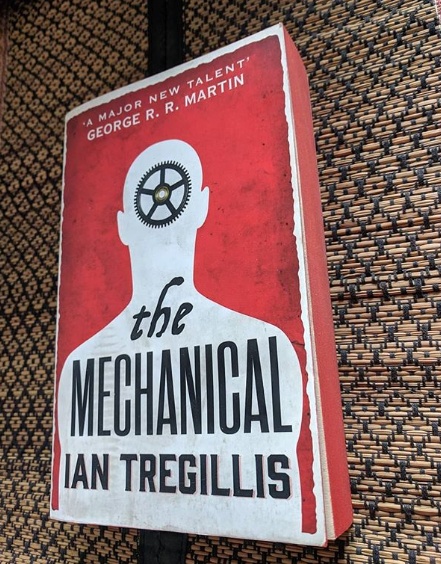
  • The Mechanical (The Alchemy Wars, #1)

    Ian Tregillis

    What a thriller! The blurb on the cover has the high priest of epic fantasy – George R R Martin – calling the author ‘a major new talent’. The book indeed delivers to the compliment, and if the first volume of the series is any indication, it promises to be an extremely interesting ride.

    I am not really sure what genre the book would fall into – speculative fiction seems to be the safe choice. Given that it seems to be set in the early 1900s, and the title, I had thought steampunk, but somewhere in the book, the author alludes to steam power not having caught on, and relegated to the pile of forgotten technologies.

    There is definitely robotics and artificial intelligence involved – “Clakkers” having been developed in the 1700s. One of the principal characters – Jax, a Clakker – reminded me a lot of R. Daneel Olivaw from the Foundation series.
    Alternate history it is, because the Dutch are the major super power – the Empire, thanks to a “monumental breakthrough” in technology by Christiaan Huygens. They are locked in a stalemate confrontation with the French, whose court is riddled with internal politics. The Dutch seem to have mastered a technology that combines clockwork with alchemy, while the French have focused on applied chemistry.

    A Protestant vs Catholic tussle is also quite evident, complete with ‘church police’ in the form of a special kind of Clakkers called Stemwinders.

    The mechanics of the plot are racy and intriguing by itself. But the author takes it up a notch with philosophy – what constitutes sentience, and free will? The ideologies of Descartes and Spinoza play a significant role, with the significance and influence of the latter being an instrumental part of the narrative.

    It is quite amazing how the author has done justice to all these themes by integrating them into the plot. I am definitely hooked!

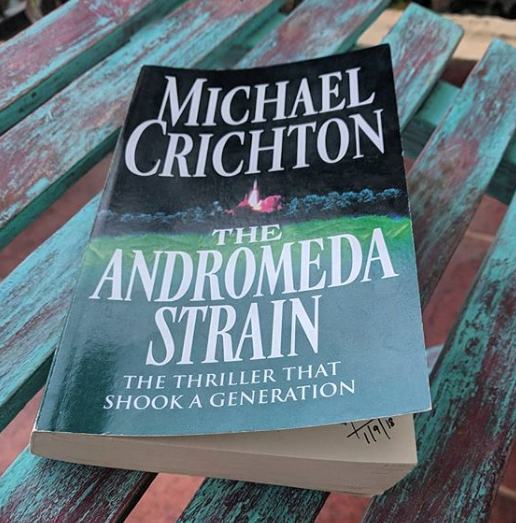
  • The Andromeda Strain

    Michael Crichton

    I am quite a bit late to the Crichton book party. For me, his name has always been associated with Jurassic Park (as a movie) and now I find that quite surprising! It took a combination of Westworld (the current series version) and a couple of “science fiction you must read” lists to get this book into my shelf.

    I really liked the premise. When one thinks of an extra terrestrial “invasion”, the usual suspects are a highly advanced species arriving in spaceships. But this book shows that first contact could actually be anything. In this case, it is less the physics of space travel, and more biology. As one character explains, any form of radiation would lose its potency over space, but a living cell can retain its characteristics if it is made with that end in mind.

    It all begins in Piedmont, Arizona, a small town where a probe has crash-landed. The probe is part of
    Project Scoop, whose objective is to collect organisms from the fringes of space for study. The fear of contamination by returning space probes has also led to the formation of Wildfire, a team that can handle a contingency at a specially created facility.

    The team is called upon to handle exactly that when something starts killing off humans in seconds. The characters who make up the team are not completely fleshed out beyond their professions, but have enough details to take them beyond names and roles. The underground facility that the team operates in is thought through in great detail and has a part to play in the climax.

    This is one of his earlier works and is quite an engaging thriller. The number of days I took to finish it is a testament to that. The pace really quickens towards the end and gives it an edge-of-the-seat feel even though the narration indicates clearly that humanity will survive. But anyway, that does not really take away from the gripping story.

  • The Paper Menagerie

    Ken Liu

    What is with these Chinese (/origin) writers? Ted Chiang’s “Stories of Your Life and Others” was the best collection of speculative fiction I had read. Then there was Liu Cixin’s “The Three Body Problem” trilogy that had a fantastic story arc even while retaining scientific accuracy. And now, Ken Liu, who had translated Liu Cixin’s work into English, and has also credited Ted Chiang as an inspiration for the last story in this book.

    All fiction, the author says in the preface, is about prizing the logic of metaphors over reality, which is irreducibly random and senseless. This is what I would call the DNA of the book, and teasing out the metaphors in some of the stories is what I considered the most exciting part of reading this book. Also mentioned in the preface is the author’s perspective that he does not pay attention to the distinction between fantasy and science fiction or genres in general, and a few stories serve as excellent examples. Good Hunting could be steampunk and fantasy, The Waves would be science fiction and fantasy, The Man who ended history could be historical fiction and science fiction. The genre is rendered irrelevant in the larger scheme of things. Everything is speculative fiction. (more…)