Category: Science & Speculative Fiction

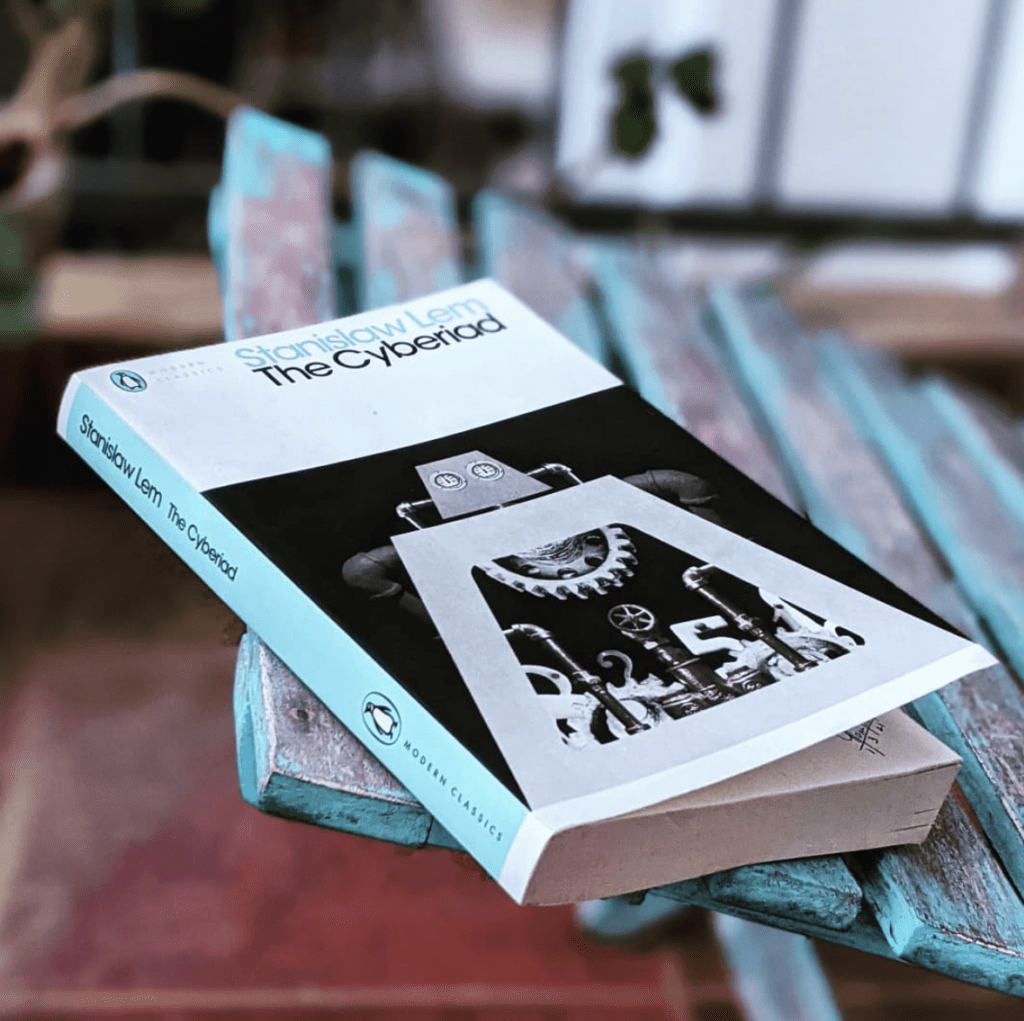
  • The Cyberiad

    Stanislaw Lem

    I discovered the book thanks to an online post that extolled Lem at the cost of my favourites like Asimov. The book was written in Polish in 1965 and translated in 1974. The introduction provides great context to the author, his work, and his relationship with his peers, especially the Americans. He was rebuffed by them, and apparently Philip K. Dick even contacted the FBI claiming Lem was a Communist agent. 

    The book is a collection of Lem’s stories most of them involving two constructors – Trurl and Klapaucius, who come up with things like “a machine that can create anything in the world, provided it starts with the latter ‘n’”. Now what happens if you tell it to create nothing? It’s definitely not by doing “nothing”. But I’ll let you read the story and find out. 

    One of my other favourites was a story within a story. In Tale of the Three Storytelling Machines – there is a character called Chlorian Theoreticus the Proph. One of his essays is The Evolution of Reason as a Two-cycle Phenomenon – a fascinating theory of how Automata and Albuminids create each other back and forth across eternity. 

    The stories, characters and expressions all actually sound quite silly (might remind you HGTG), though I enjoyed the play of words, which point to the intelligence beyond. But it’s when you scratch the surface and think about the underlying ideas and philosophy that you discover the genius of the author. They are deep and profound – sometimes a commentary on the society and politics of the time, and sometimes on the nature of the universe itself. A completely different take on science fiction from anything else I have read in the domain. Fascinating stuff. 

    P.S. A special note of appreciation for the translator, and you’ll know why after you read the verses and use of the English language. It cannot have been an easy job to reconstruct the ideas and their renditions in a new language.
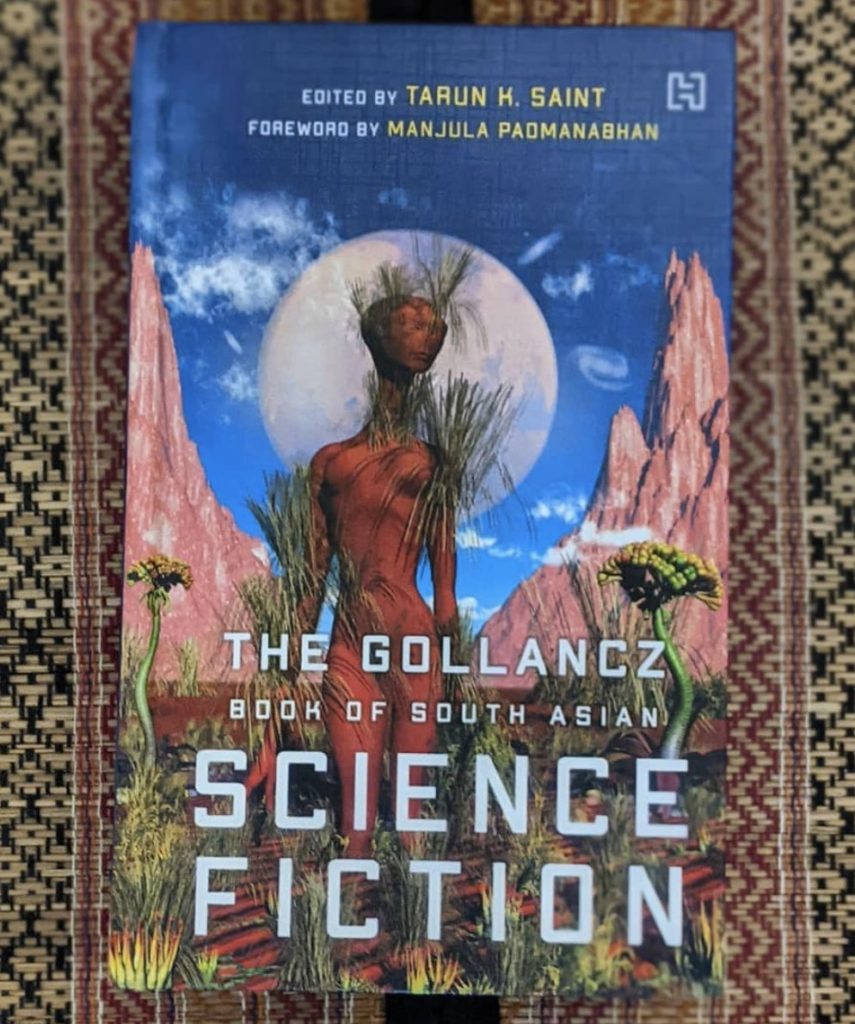
  • The Gollancz Book of South Asian Science Fiction

    Tarun K. Saint (Editor), Manjula Padmanabhan (Foreword)

    Once upon a time, the only fiction I used to read were those written by Indian authors. The reason was a relatability to the contexts and references. The only exception was science fiction, in which the situation was exactly the opposite. After I read Strange Worlds! Strange Times!, I realised that a further exploration of Science Fiction from this part of the world was warranted. And that’s how I picked up this book. Though the title has ‘South Asian”, the entries are from only India, Pakistan, and Bangladesh. It’s a collection of 28 works – mostly prose, with some poetry, and many stories actually fall under the broader ambit of speculative fiction. As with other fiction, there was an immediate affinity for many of the contexts and references in this book too. While the premise in many were promising, I really liked only a handful. 

    Harishankar Parsai’s “Inspector Matadeen on the Moon”, translated by C.M. Naim, is satire on full throttle and takes some excellent digs on the police force, bureaucracy and attitudes of citizens. Anil Menon’s “Shit Flower” has wordplay in the title itself, and continues that trend all through the story. But set in a Mumbai of the future that has suddenly lost control of its “bowels”, it also has a wonderful take on life and memories, while taking jabs at organised faith. 

    Shovon Chowdhury’s “The Man who turned into Gandhi” imagines Gandhi in contemporary times and is packed with humour and irony. Tarun Saint, also the editor of the book, authors “A Visit to Partition World”, with the story set in a “Westworld” with a Partition theme. A very interesting idea that I think might actually happen at some point! Mirror-Rorrim by Clark Prasad is an exciting thriller with its protagonists trying to solve mysteries across both identity and time. And it has Star Trek references! Manjula Padmanabhan’s Flexi-time is an intriguing mix of “Arrival” and Indian idiosyncrasies. 

    “The Other Side” by Payal Dhar features a young girl who discovers family secrets in an authoritarian future. Aliens and railways collide in the racy 15004 by Sami Ahmad Khan. The inspiration for “The Last Tiger” is evident – “modelled on the Great Leader from the early 2000s”. A satirical tale on an unusual Republic Day event involving the last tiger. Rimi B Chatterjee’s “A night with the Joking Clown” has a cyberpunk feel to it but also has a view on genders and relationships. Vandana Singh’s “Reunion”, the last story in the book, introduced me to cli-fi (climate fiction!) and made me wonder if the scenario she describes is the future. 

    Overall, if you want to to get a sense of Science/Speculative fiction from this part of the world, give it a shot. 

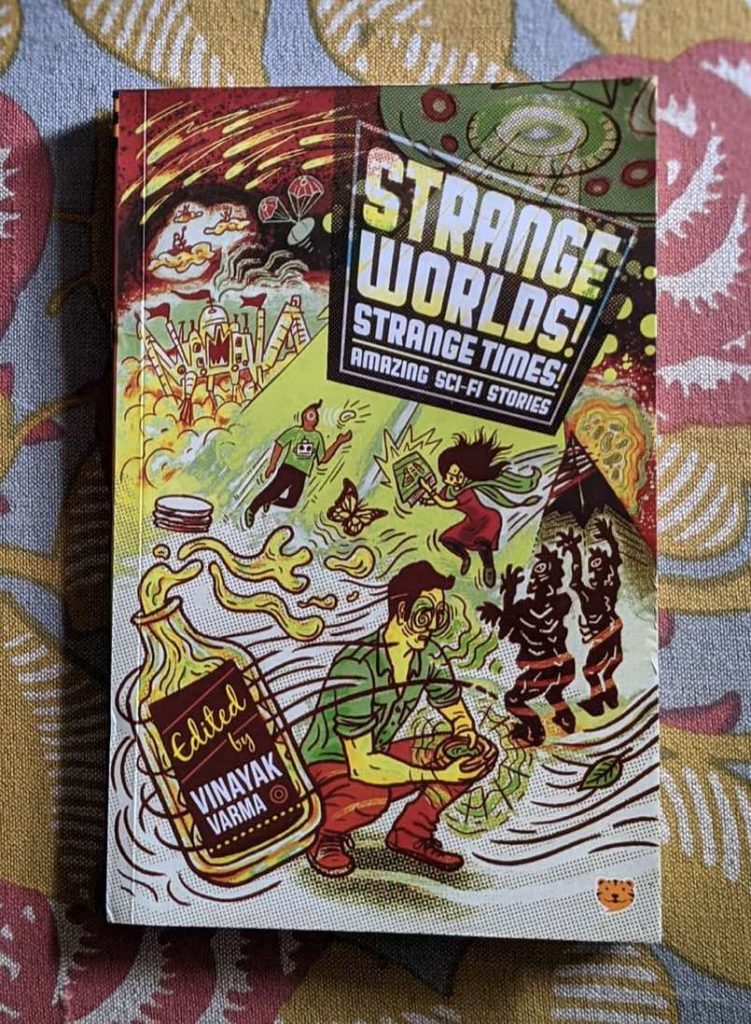
  • Strange Worlds! Strange Times!

    (edited by) Vinayak Varma

    I think I’ll just gush, because this, I guess, is what the entire “kid in a candy store” feeling is like! But to begin with, I have to confess I didn’t read the first 20 pages! It was quite a coincidence that a book with this title mysteriously arrived without them. That meant that I missed the Manjula Padmanabhan story, and dove haphazardly into the Srinath Perur one. Jerry Pinto made me gaze up at the stars again with a delightfully profound take on “outer space and inner space” – a phrase that Vandana Singh uses in the last story in the book. 

    Zac O’Yeah manages to catch Bluru’s little idiosyncrasies superbly and had me cackling away for quite a while. And then Rashmi Ruth Devadasan does the same to Chennai (?) with a dose of zombies. Vinayak Varma, who needs to be thanked separately for stitching this all up together, does a neat border town story with sniper shots at saffron and creation! 

    And there’s a (translated) J.C Bose story. Oh yes, the very same, and a fascinating back story (actually stories) on how this work came to be. I have never been much into comics (though recently Kavalier & Clay did make me think deeply on the subject) but Sunando C’s few pages of work were fascinating! A walking Taj Mahal, and telekinesis – Indrapramit Das’ imagination is evident. Shalini Srinivasan gives us a dose of reality – a parallel one, that is. And to end it all, Vandana Singh writes a brilliant story involving dimensionality (I was reminded of Liu Cixin’s sophons) 

    What made me love the book was the sheer diversity of texture and context. All the stories have an equal grounding in some part/aspect of India as they do in science/speculative fiction. And it’s almost as if the writers have let themselves go at it in total abandon. Delightful and amazing indeed! 
    P.S. Loved it so much that I sent it to three unsuspecting folks! 

  • Exhalation

    Before I start, I have to ask, when is the next collection coming out? Can’t. Wait. I read “Stories of Your Life and Others” about 2.5 years ago, and was blown not just by the quality of the stories, but by the sheer range of subjects from physics and mathematics to language and theism, not to mention artificial intelligence. Exhalation has nine stories, and each of them is a work of art.

    I tried to deconstruct Ted Chiang’s magic, and for me, it came down to three aspects – the imagination to think up the most original and profound questions, the skill to weave it into scenarios that make it relatable and accessible to the reader, and the ability to articulate his perspectives in such a way that one is forced to engage with them and construct one’s own thought exercises!

    “The Merchant and the Alchemist’s Gate” is Arabian Nights in terms of setting as well as nested storytelling but beneath all that is a dizzying tale of time travel that questions whether one can really change the past. “Exhalation”, after which the book is named, has an alien setting but with a dash of steampunk and robotics. The core of it though is what makes it profound – entropy and its inevitable conclusion. “What’s expected of us” is the first of the stories that deal with free will, and goes directly into the heart of it, with a first person narrative of one’s reaction when confronted with immutable proof that it doesn’t exist! The Lifecycle of Software Objects is an excellent take on artificial intelligence, with clear parallels to parenting, and the underlying thought that “experience is algorithmically incompressible”and that the “common sense that comes from twenty years of being in the world” cannot be achieved by compiling heuristics. The parenting theme continues in “Dacey’s Patent Automatic Nanny”, but in a different direction, definitely sadder.

    “The truth of fact, the truth of feeling” is simply brilliant, and has two stories that show the parallels when there is a fundamental shift in technology, both around memory. If I really had to choose, this one would be my favourite. The Great Silence is a poignant juxtaposition and a sharp commentary on what we’re missing out on by rampaging through other species. Omphalos is a very interesting take on creationism, and a contemplation of how it would be if humanity were really the reason for the universe, and were literally too, at the centre of it. “Anxiety is the dizziness of freedom” is the last story, and probably the most imaginative. It mixes parallel universes and free will, and delves into the meaning of the latter when many parallel “branches” (emanating from a decision) are playing out.

    No story is the same, or even similar. When I read some authors, I think to myself that if one really had to write, then this should be the benchmark. In speculative fiction – my favourite genre, Ted Chiang is that author!

  • It Can’t Happen Here

    Sinclair Lewis

    A political novel written in 1935, “It can’t happen here” is quite amazingly (almost) prescient about how an authoritarian regime could happen in the USA. Based on a populist platform that promises prosperity and a return to traditional values, Buzz Windrip first beats his (fellow) Democrat Roosevelt and then his Republican opponent.

    But though it all begins with a perfectly democratic victory, the Chief, as he is known, soon begins a “corporatist” regime with its own paramilitary force called Minute Men, and systematically starts dismantling individuals and structures that oppose him. Funnily enough, most of the public continues to support the “Corpos” despite their dictatorial moves, and when those who don’t bring up the spectre of Fascism, they’re told “It can’t happen here”. (more…)