Benjamín Labatut (translated by Adrian Nathan West)
When we cease to understand the world is one of the most unique books I’ve read in a while. Though it can broadly be classified as historical fiction, that would fail to capture the essence of the book, because the subject is science, mathematics and the deep mysteries underlying reality. Almost philosophy.
Featuring real historic figures and events, it could even be non-fiction as it explores the lives and discoveries of scientists and mathematicians who changed the way we understood the world. More interestingly, it also puts focus on the moral consequences of their work, the effect it had on themselves, and the impact it had on the world. Apparently, the scientists and their discoveries are all factual, the personal lives include some fiction.
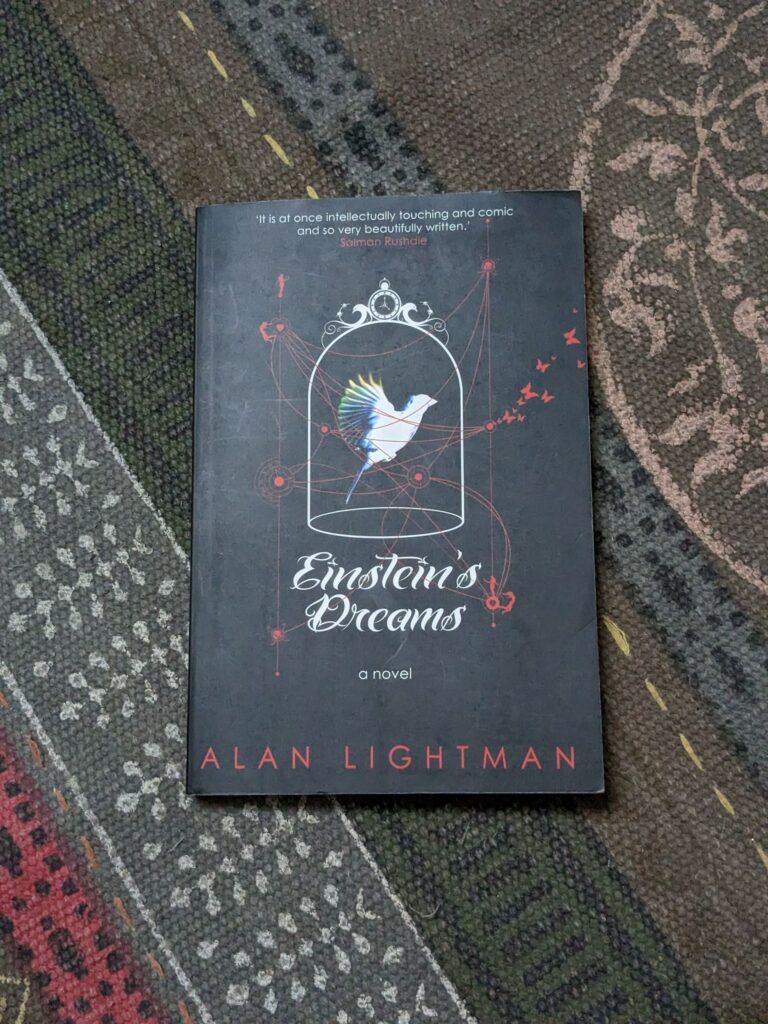
What an absolute classic Einstein’s Dreams is. I began reading, got lost, and then wanted to somehow stretch it to at least another day, and completely failed!
The book is a collection of 30 stories, set as dreams in the (fictional) mind of a young Albert Einstein as he works in the patent office in 1905, and in parallel, pursues the theory of relativity. The book also has a prelude, interludes and an epilogue featuring his friend Michele Besso.
Each story is a theme, an array of what-ifs built around the concept of time. Some of them are definitely connected to relativity but most of them are speculative fantasy. But all of them are concepts one could spend hours thinking over, exploring the nature of time and our individual and collective relationships with it.
I don’t really want to spoil the reading but some of my favourites were body time vs mechanical time, the world where cause and effect is erratic, the texture of time, the world in which some get fitful glimpses of the future, the one in which people live forever, and the world in which no one can imagine the future. The joy is as much in the prose as it is in the concepts. It reminded me of the many ways we take time for granted. And got me thinking of the many different ways in which it could have played out. The book is art and science, and as profound as it is relatable. An instant favourite, and in my Bibliofiles 2023 list.
P.S. It also somehow reminded me of Tales from the Loop.
Some favourites A world in which time is absolute is a world of consolation. For while the movements of people are unpredictable, the movement of time is predictable. Consider a world in which cause and effect are erratic…. It is a world of impulse. It is a world of sincerity. It is a world in which every word spoken speaks just to that moment, every glance given has only one meaning, each touch has no past or future, each kiss is a kiss of immediacy. If a person holds no ambition in this world, he suffers unknowingly. If a person holds ambitions, he suffers knowingly, but very slowly. The tragedy of this world is that no one is happy, whether stuck in a time of pain or joy. The tragedy of this world is that everyone is alone. For a life in the past cannot be shared with the present. Each person who gets stuck in time gets stuck alone.
I like science fiction, but I absolutely love it when it gets into worldview and philosophy! Walkaway is set in a post-scarcity world, where anyone can design and print basic necessities – food, clothing, and even shelter. And in this world, there are broadly three kinds of folks – the elite oligarchs, who as usual want power and the ability to bend the world to their rules, the ‘default’ who continue to abide by rules and work for a living, and the ‘walkaways’, who walk away from this default reality.
They aren’t walking away from society, but understanding that in the zotta (elite) world, they’re problems to be solved, not citizens. As more and more people decide to turn ‘walkaway’, the elite have a problem with the drastic social changes that follow.
Kai-Fu Lee wasn’t a name familiar to me until I heard him in a podcast where he was talking about the book. Based in China, he is considered an expert in AI, and has worked with Google, Microsoft, and Apple. The book has an interesting structure consisting of ten stories, with a commentary by Lee after every story on the subjects covered in it. The storytelling is in collaboration with Chen Quifan, a Chinese science fiction writer, and the translations have been done by a handful of folks.
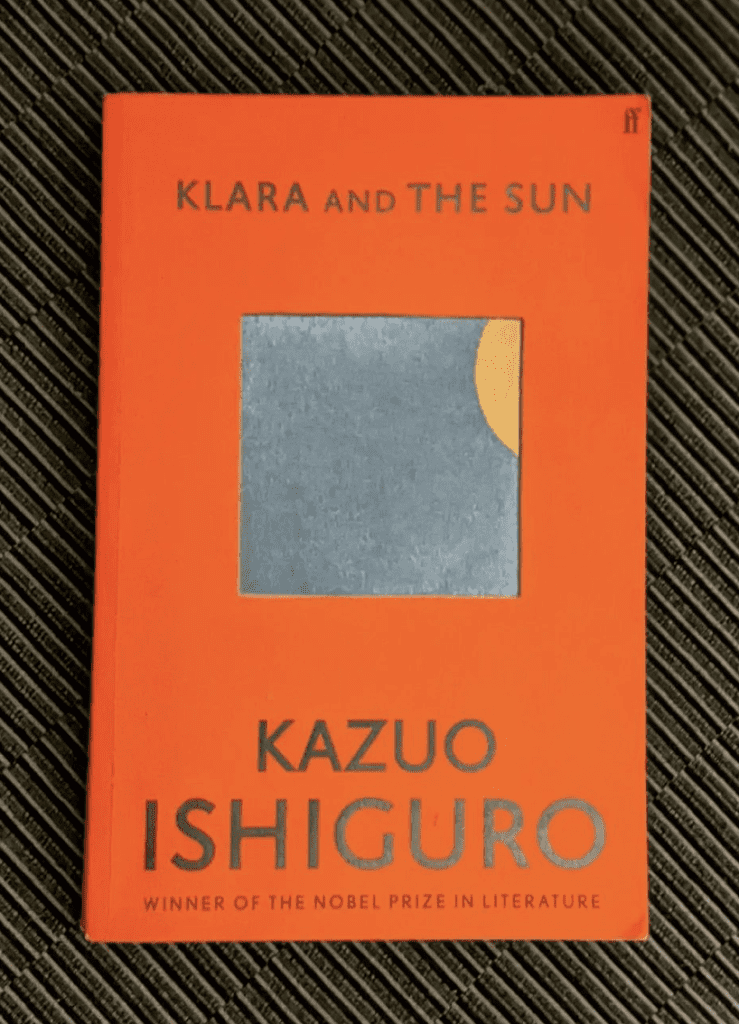
“The Buried Giant” didn’t really work for me, so I started reading with a mix of anticipation and apprehension. The lump in the throat as I turn the final pages is what I expect from a Kazuo Ishiguro book, and it most certainly delivered on that ache of profound sadness. It reminded me not just of his earlier book “Never Let Me Go”, but also of Louisa Hall’s “Speak”, which is centred around AI’s evolution around stories and storytelling through time. Klara, an “artificial friend” serves as the narrator in a dystopian future where children are “lifted” for enhancing their intelligence. The world at large seems to have a fair share of tribes and movements, as technology has caused a division of classes in which many are “post employed”. We first meet Klara in the store where she is put up for sale, as an observant MF, who loves watching the world through the store window, and who is devoted to the sun (she is solar powered). She is chosen by Josie, a 14-year old made unwell by the “lifting” process.
From then on, we see multiple themes playing out – some human, some human and AF, and some just AF. The relationship between the humans – Josie, her mother and father who are separated, their neighbour Helen and her son Rick (who is Josie’s dear friend), and Capaldi, whose studio Josie and her mother visit for her “portrait” – reveal the different “sides” of their selves that play out on different occasions, their understanding of their own fragility, and their diverse views about how society is evolving. This is closely connected to the humans’ interactions with Klara, which show their mindset towards the AFs, again polarised. Most poignant are the moments with the empathetic Manager.
But being the narrator, Klara’s own thoughts and actions are the most interesting. She sees the world in boxes (I wonder if that is connected to how we slot people), she “feels” enough for Josie to be prepared to sacrifice anything for her, and has a hatred for the Cootings Machine, both of which are all too human. Her observation also makes her very perceptive (“I understood that my presence wasn’t appropriate as it once had been,”) even though the humans around her are often not. (Spoiler sentence ahead) My favourite is the deep insight at the end, when she says that Capaldi’s belief that there was nothing special inside Josie that couldn’t be continued was flawed because he was looking in the wrong place – it wasn’t inside Josie, it was inside those who loved her.
Ishiguro has a way with prose that allows him to move the story forward without massive plot-changing interventions. And as always, he also manages to keep the reader interested with the layered narrative and wonderful insights that make us human. In this case, the book made me wonder about the time when (I am not sure it’s an “if”) AI becomes sentient/ develops consciousness – would humans be able to understand (Klara’s faith in the sun, for instance), what is the kind of loneliness the AI would face, how would it handle its obsolescence, would it also show different kinds of love (the selfish and the selfless), and yes, can it have a heart – “I don’t simply mean the organ, obviously. I’m speaking in the poetic sense”.