Category: Fiction

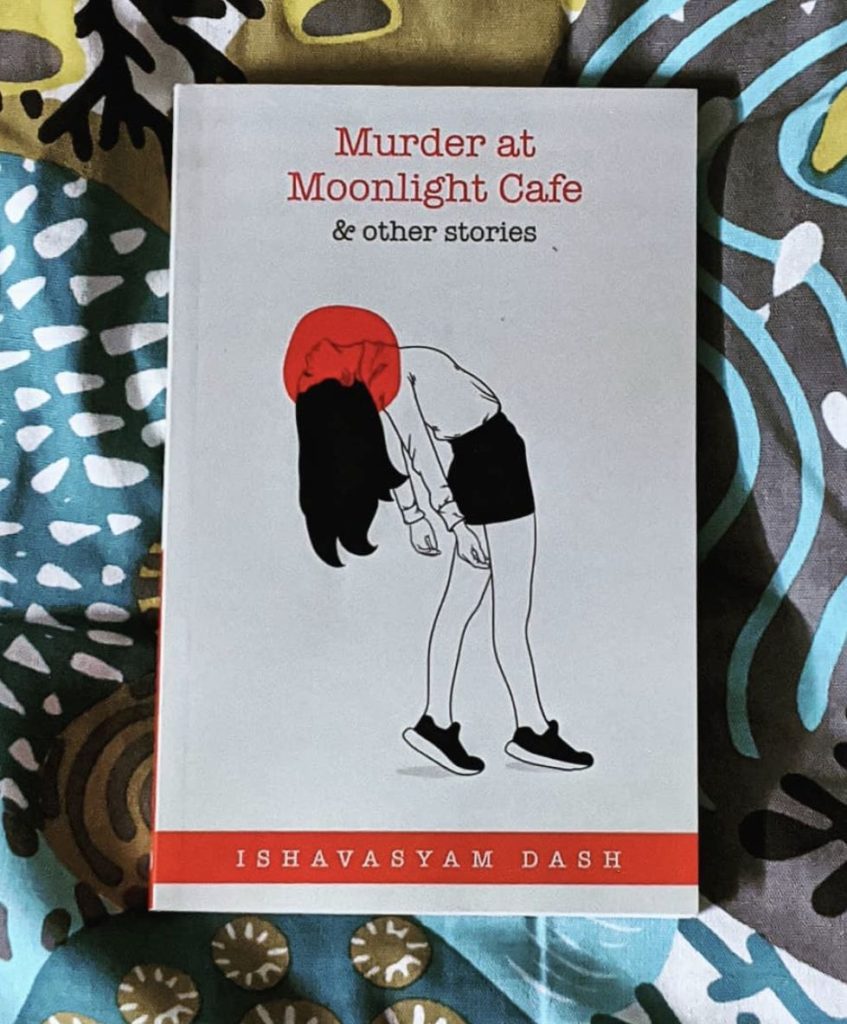
  • Murder at Moonlight Cafe

    Ishavasyam Dash

    Eleven stories that take you on a rollercoaster ride of myriad emotions. As the blurb promises, the stories provoke and entertain.

    The subjects range from mythology, fantasy and social media influencers to murder, sexuality and horror. That last one (The Itch), I thought, had the potential to spin off into a standalone book/series. There’s also a mix of narrative styles – first person, letters, a YouTube monologue. What this achieves for each story is a character, flavour, and mood that is uniquely its own. What also stands out is the complete lack of a pattern, including the pace of the narrative. Some proceed at a leisurely pace, while others pack a lot in within a few pages.

    In just around 150 pages, there are worlds and corners that you will discover. I have at least five that I liked a lot. Smoke & Mirrors and The Herpetologist for the insight into the human condition and the empathy, Mariam’s Tears for the absolutely bizarre pop in the middle of the book, The Price of Apples for its innocence and sensitivity, and Kalika for the smart dose of philosophy. Pick it up to find your favourite. 🙂

    (I know the author, but though I feel really happy for her, I can safely say there is very little bias in the review)

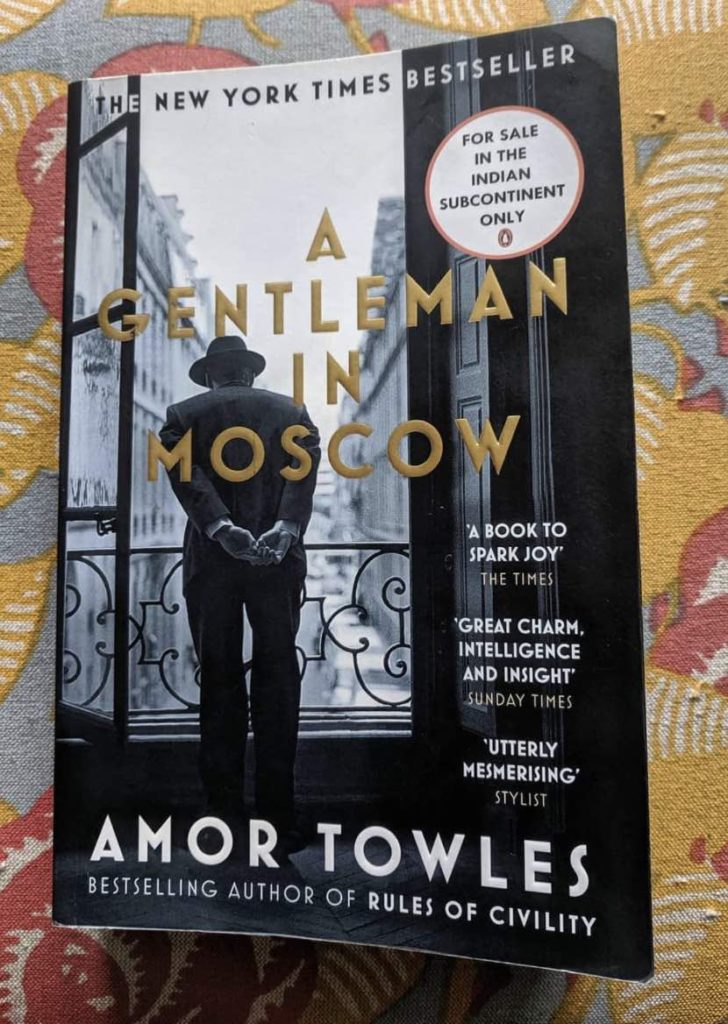
  • A Gentleman in Moscow

    Amor Towles

    I was hesitant to write anything about this book for fear that it would take away from its wonderful aftertaste. But not doing so would be an injustice too, so here goes.

    The adjective I would use to describe A Gentleman in Moscow is sublime. That applies to the story, the writing, and the protagonist – Count Alexander Ilyich Rostov. On 21st June 1922, a Bolshevik tribunal sentences him to house arrest indefinitely. The “house” is the Hotel Metropol, and he is forced to substitute his suite for an attic room. As the author insightfully notes, “the Russians were the first people to master the notion of sending a man into exile at home.”
    Russia, post-revolution, exile – it is difficult to imagine anything that’s not depressing in the 450+ pages that follow. But in the face of imminent disaster, Towles, just like his protagonist, steps up to the plate, shuns maxims, and hits the ball out of Gorky Park. (ok sorry, but bad wordplay is a sure sign of my affection) Hope has a new champion. For Count Rostov is probably a living embodiment of Marcus Aurelius’ Meditations, and from the time that he is forced to choose from his possessions what he can take along to his new residence, he embraces his future by well, counting his blessings. His poise does not miss a step as he moves from “it is not the business of a gentleman to have occupations.” to becoming a waiter, and he continues to exhibit his “essential faith that by the smallest of one’s actions one can restore some sense of order to the world.”

    But one cannot be blamed for thinking that even for such a wonderful character, the four walls of a hotel is bound to be a constraint. The Metropol, though, is a world unto itself. We discover spaces and mind spaces inside, the people who work there, and its visitors. And through the eyes of the Count and his friends, we see Russian history unfold from Lenin to Stalin to Khrushchev.

    Amor Towles’ mastery over situations and the words he uses to express them is not something I have seen much of around. It’s genuine craftsmanship. In the Count, he has created a character that brings out the essence of old world charm, and class. Instead of aristocratic snobbery, what one gets is a very human mix of upbeat bearing and wistful serenity – a character for whom one genuinely feels for. The Count has his basic lessons right – “The first was that if one did not master one’s circumstances, one was bound to be mastered by them; and the second was Montaigne’s maxim that the surest sign of wisdom is constant cheerfulness.” And it isn’t just the Count – the support characters also do a splendid job of covering a vast spectrum of predicaments, thoughts and behaviour.

    And thus it is, that when one reaches the end of the book, and lets out a sigh, one has the “feeling that this moment, this hour, this universe could not be improved upon”.

  • It Can’t Happen Here

    Sinclair Lewis

    A political novel written in 1935, “It can’t happen here” is quite amazingly (almost) prescient about how an authoritarian regime could happen in the USA. Based on a populist platform that promises prosperity and a return to traditional values, Buzz Windrip first beats his (fellow) Democrat Roosevelt and then his Republican opponent.

    But though it all begins with a perfectly democratic victory, the Chief, as he is known, soon begins a “corporatist” regime with its own paramilitary force called Minute Men, and systematically starts dismantling individuals and structures that oppose him. Funnily enough, most of the public continues to support the “Corpos” despite their dictatorial moves, and when those who don’t bring up the spectre of Fascism, they’re told “It can’t happen here”. (more…)

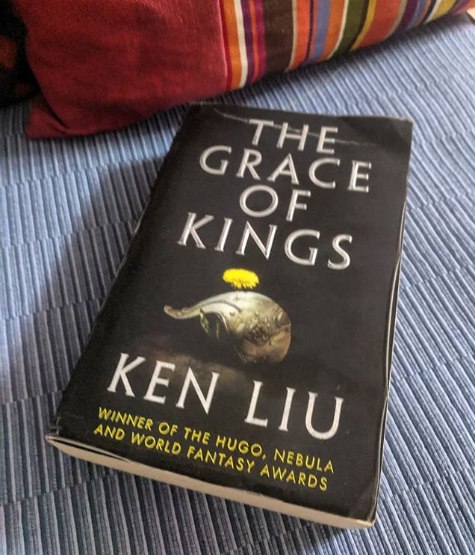
  • The Grace of Kings

    Ken Liu

    The Grace of Kings is the first part of a trilogy named The Dandelion Dynasty. I really liked The Paper Menagerie & Other Stories (by the same author), so I bought this book soon as I came to know of its existence.
    Inspired by the Han dynasty, this is “silkpunk”‘s answer to the Game of Thrones! There is an emperor, there are palace intrigues, there are rebellions, and contenders vying for the throne. But that’s probably too broad a stroke, and is unfair to the differences.

    The main contenders are polar opposites – one is a sly wastrel who becomes a bandit and has an innate charisma and goodness that wins the hearts of the people, the other is a noble brought up in exile who believes in winning battles through sheer valour in the battlefield and has very clear ideas of right and wrong. They cross paths, become brothers in arms and rebel against the emperor. The metaphor of dandelion vs chrysanthemum is the philosophical underpinning of the book, and causes the clash of ideals. Also pertinent is how the gods of the realm have their own champions and do not shy away from meddling in the affairs of mortals.

    The book has a bunch of many interesting characters and though the pages devoted to them might not be many, the roles and their significance in the story arcs are very well defined. Between a narrative pace that is unflagging, and the twists that never end, the book creates a momentum that is hard to resist! That ensures that the few grammatical errors and the seeming ease with which main characters overcome obstacles, can be ignored.

  • The Book of M

    Peng Shepherd

    When a man loses his shadow in India, it is seen as a curiosity. Until it turns out that when the shadow goes, sooner or later, memories too follow. The world, understandably, switches to panic mode, even as the contagion spreads across continents. Two years later, Ory and Max have managed to survive and create their own tiny, though dangerous world. Then Max loses her shadow, and knowing the danger posed to Ory, runs away. Ory follows, and thus begin two journeys. They’re both physical and metaphysical.

    There are two other significant narratives – that of Naz, Iranian and archer, and The One Who Gathers. The respective “road trips” quickly ups the pitch of the dystopian survival narrative, complete with street gangs, faithful fanatics, and a single destination towards which everyone is gravitating – New Orleans, the rumoured abode of The One Who Gathers.

    The premise is indeed interesting. Think about it – what does the loss of memories mean to one’s identity and sense of self? And is the sum of the person and his/her memories somehow lesser than the whole? Would a different physical body with the same memories be treated as the same person, or the other way?
    The author also manages to do a good job of fleshing out the characters, who are not just multi ethnic but differ in their sexuality too. Some of the twists and turns are inventive and Max’s recordings are poignant enough to pull at heartstrings, without any melodrama.

    However, it fails on a couple of points. The pace slackens a bit towards the middle, and it doesn’t help that the book is almost 500 pages. Additionally, though there is a bunch of folklore that do make sense in the context – from Peter Pan to Kerala’s most famous elephant – the rough edges are difficult to ignore. Add to that, seemingly random bizarreness like the Statue of Liberty attacking New York City are a little difficult to fit in.

    But that’s not too much of a put off, and once you get into the groove of the book, it makes for an interesting read.
    P.S. The hat tip to Ursula K. Le Guin’s (for A Wizard of Earthsea) is to be noted. 🙂