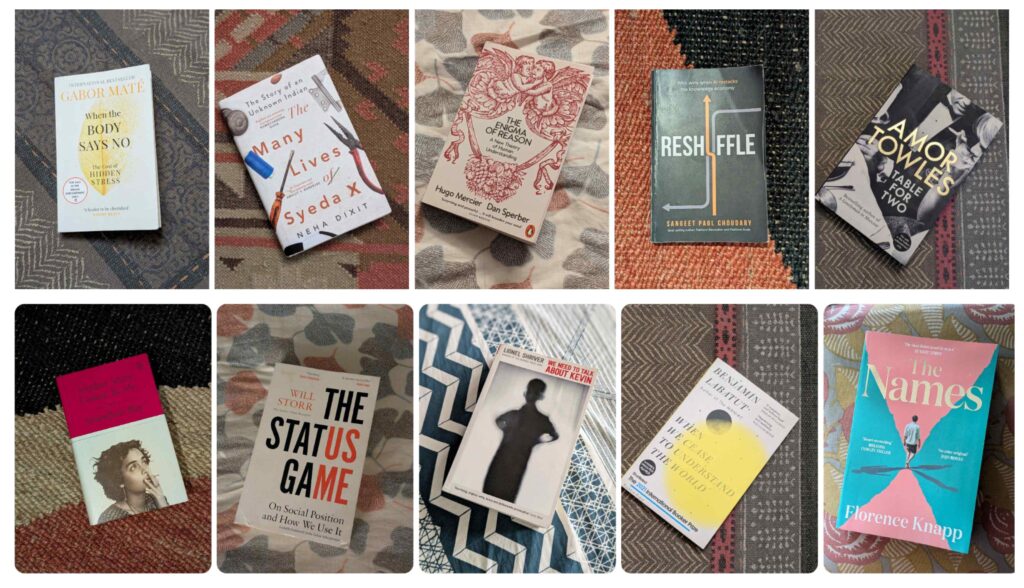
Compared to the last couple of years, I read fewer books in 2025, but I think the variety was higher. That probably explains the highest number of fiction books in a long time.
And so, once again, like 2019, 2020, 2021, 2022, 2023 , and 2024, presenting #Bibliofiles 2025’s list of ten (plus the long list). From the 58 books I read this year…
Benjamín Labatut (translated by Adrian Nathan West)
When we cease to understand the world is one of the most unique books I’ve read in a while. Though it can broadly be classified as historical fiction, that would fail to capture the essence of the book, because the subject is science, mathematics and the deep mysteries underlying reality. Almost philosophy.
Featuring real historic figures and events, it could even be non-fiction as it explores the lives and discoveries of scientists and mathematicians who changed the way we understood the world. More interestingly, it also puts focus on the moral consequences of their work, the effect it had on themselves, and the impact it had on the world. Apparently, the scientists and their discoveries are all factual, the personal lives include some fiction.
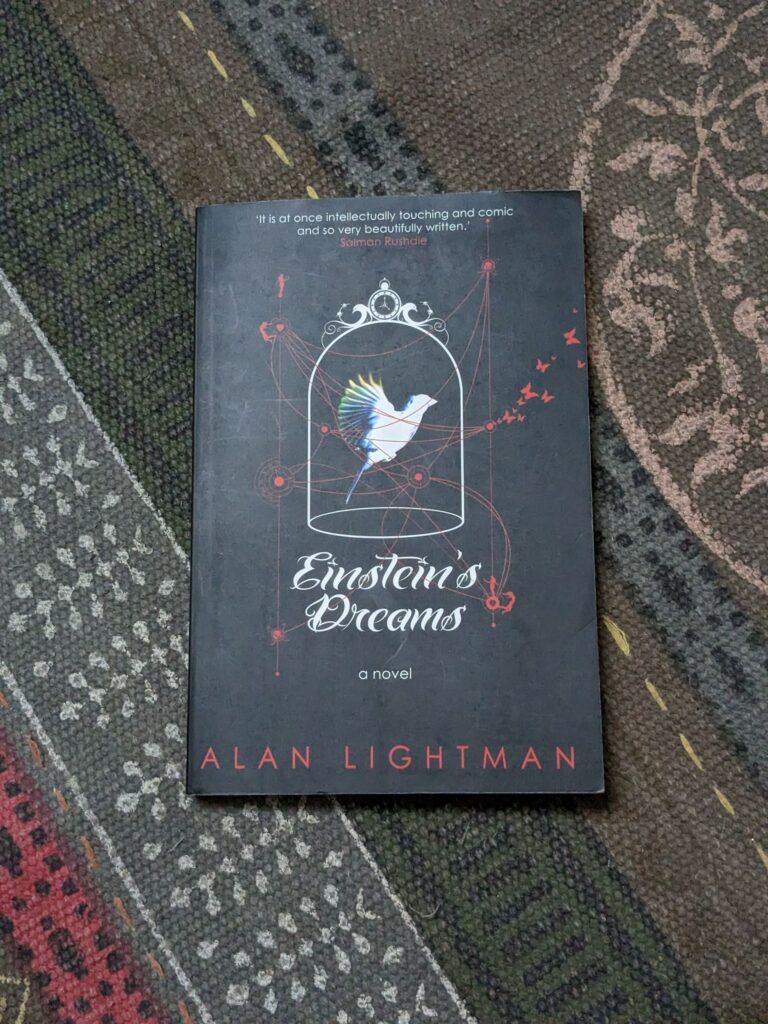
What an absolute classic Einstein’s Dreams is. I began reading, got lost, and then wanted to somehow stretch it to at least another day, and completely failed!
The book is a collection of 30 stories, set as dreams in the (fictional) mind of a young Albert Einstein as he works in the patent office in 1905, and in parallel, pursues the theory of relativity. The book also has a prelude, interludes and an epilogue featuring his friend Michele Besso.
Each story is a theme, an array of what-ifs built around the concept of time. Some of them are definitely connected to relativity but most of them are speculative fantasy. But all of them are concepts one could spend hours thinking over, exploring the nature of time and our individual and collective relationships with it.
I don’t really want to spoil the reading but some of my favourites were body time vs mechanical time, the world where cause and effect is erratic, the texture of time, the world in which some get fitful glimpses of the future, the one in which people live forever, and the world in which no one can imagine the future. The joy is as much in the prose as it is in the concepts. It reminded me of the many ways we take time for granted. And got me thinking of the many different ways in which it could have played out. The book is art and science, and as profound as it is relatable. An instant favourite, and in my Bibliofiles 2023 list.
P.S. It also somehow reminded me of Tales from the Loop.
Some favourites A world in which time is absolute is a world of consolation. For while the movements of people are unpredictable, the movement of time is predictable. Consider a world in which cause and effect are erratic…. It is a world of impulse. It is a world of sincerity. It is a world in which every word spoken speaks just to that moment, every glance given has only one meaning, each touch has no past or future, each kiss is a kiss of immediacy. If a person holds no ambition in this world, he suffers unknowingly. If a person holds ambitions, he suffers knowingly, but very slowly. The tragedy of this world is that no one is happy, whether stuck in a time of pain or joy. The tragedy of this world is that everyone is alone. For a life in the past cannot be shared with the present. Each person who gets stuck in time gets stuck alone.
I like science fiction, but I absolutely love it when it gets into worldview and philosophy! Walkaway is set in a post-scarcity world, where anyone can design and print basic necessities – food, clothing, and even shelter. And in this world, there are broadly three kinds of folks – the elite oligarchs, who as usual want power and the ability to bend the world to their rules, the ‘default’ who continue to abide by rules and work for a living, and the ‘walkaways’, who walk away from this default reality.
They aren’t walking away from society, but understanding that in the zotta (elite) world, they’re problems to be solved, not citizens. As more and more people decide to turn ‘walkaway’, the elite have a problem with the drastic social changes that follow.
Kai-Fu Lee wasn’t a name familiar to me until I heard him in a podcast where he was talking about the book. Based in China, he is considered an expert in AI, and has worked with Google, Microsoft, and Apple. The book has an interesting structure consisting of ten stories, with a commentary by Lee after every story on the subjects covered in it. The storytelling is in collaboration with Chen Quifan, a Chinese science fiction writer, and the translations have been done by a handful of folks.