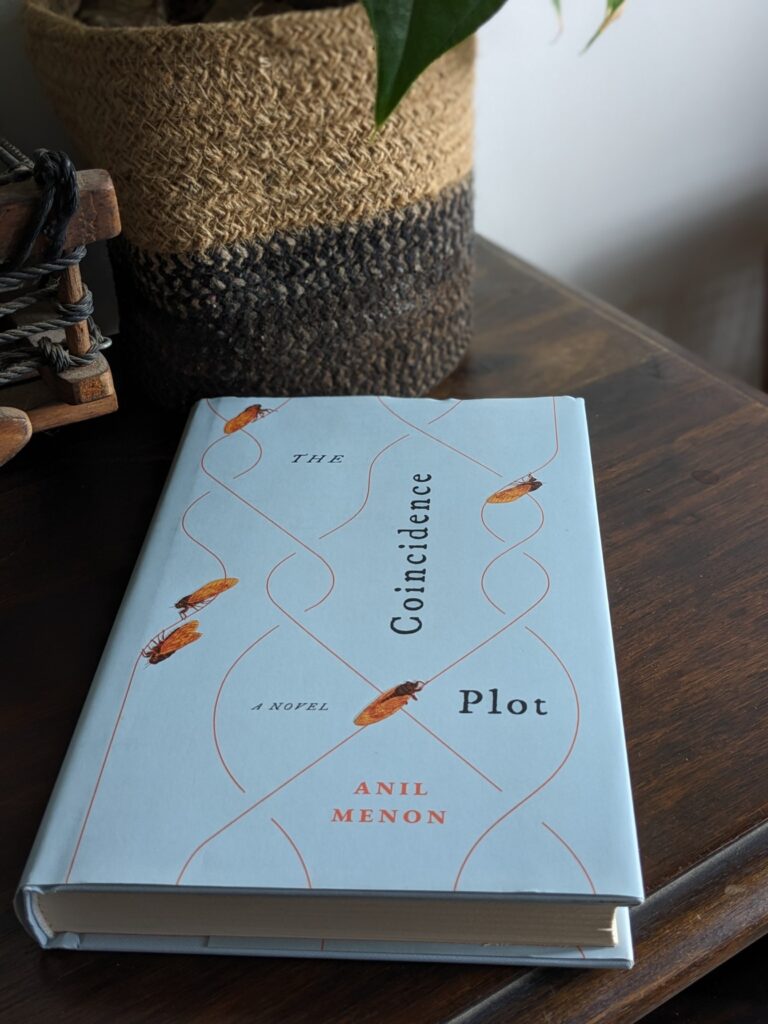
Not often in the fiction genre does one find a novel that is challenging and entertaining. The fact that I did not buy this book (D did) is a coincidence that does seem very meta. I absolutely loved The Coincidence Plot – its explorations of philosophy, the layering of its plots and characters, and the fantastic conversations that they have with each other, and sometimes, themselves.
The book is a wandering of sorts, centred around coincidences and the kind of God that exists in such a world. If that smells like Spinoza, it’s not a coincidence. The plots, subplots, and characters are all built around this theme. Starting with Artur, a mathematician escaping Nazi Germany and working on Spinoza’s thesis after his work on the uncertainty of mathematical proofs remains unfinished, to two characters working on novels to bring to existence this mathematician’s life and thoughts – “ontological proof for the existence of God”. In case I made it out to be a mind-numbing philosophy grind, it isn’t. The characters and interesting, and well-written, and so are their relationships.
It’s definitely not the standard linear book. Each chapter has two characters from a finite set, but placed across different geographical settings and time periods. As we go along, the parallels are unmistakeable, and that is not a coincidence. Anil Menon seems to know a bunch of things about a bunch of things. It allows him to create layers and depths, and when you combine that with the twin powers of a fantastic sense of humour, and a poignant sensitivity and empathy towards grief and the human condition in general, it creates a marvel. Sometimes preposterous, sometimes profound, this has been one of my favourite fiction reads in a while!
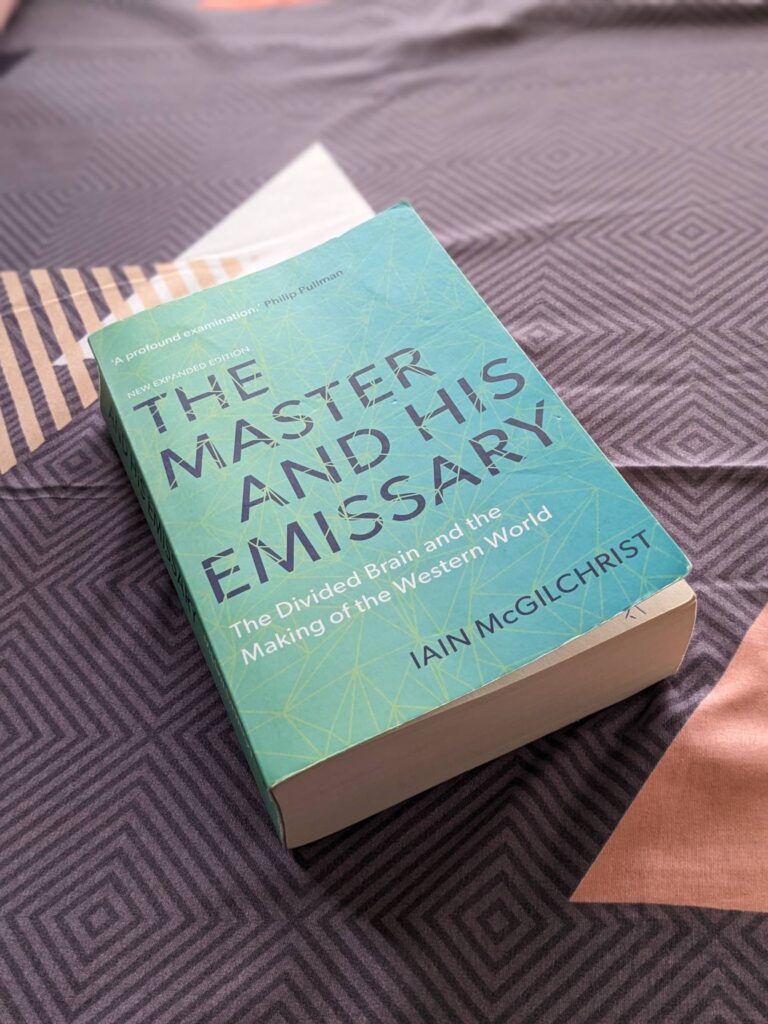
As is the case most of the time these days, I discovered The Master and His Emissary thanks to a podcast. Iain McGilchrist’s concepts seemed extremely intriguing, and now I have to admit (as he mentions early in the book) maybe intuitively consistent with my lived experience, and I had to read the book soon. Turns out that it goes directly to my all-time favourites, and was in my Bibliofiles 2023 list.
As the subtitle suggests, the book is divided into two parts – the divided brain, and the making of the Western World, each with half a dozen chapters. The first part deals with the brain itself – the asymmetry of the right and left hemispheres, their collective and individual roles, how their functioning actually leads to different perspectives, how this affected the evolution of music and then language (which can be seen as a key component in the progression of the species), the primacy of the right hemisphere, and how its emissary – the left hemisphere – has now usurped control.
The heuristic ways of looking at the hemispheres, e.g. left analytical, right creative etc, is replaced by a nuanced view. The differences between them are less about what they do and more about how they approach something. The left’s utilitarian ability to ‘grasp’ (look at how the metaphor applies to thoughts), its ability to provide simple answers and articulate them well, have all enabled it to grab control at an accelerated pace since the Industrial Revolution, and create a world where it prizes precisely these capabilities in individuals, institutions, and culture at large.
This is in many ways opposed to the right, which takes more holistic views, understands ideas and metaphors, perceives emotions better, specialises in non-verbal communication, and is humble about what it knows. The right deals with whatever is implicit, the left is tied to more explicit and more conscious processing. The right is present and pays attention to the world outside, the left re-presents. We need both hemispheres, and the right knows it, but the left thinks it knows everything. The left creates a world, and when it stops communications with the right, will not even accept reality if it counters the ‘truth’ of the world it has created. Its role was to provide a map of reality, it now thinks the map is reality, and if not, it will remake reality to fit the map.
The second part then digs into how this has manifested in the world around. It begins with the concept of mimesis (my favourite part) and how it was the crux of our leap into what we now call culture. The meta-skill that enables all other skills – imitation – possibly explains the rapid expansion of the brain in early hominids. Through the next five chapters, Iain takes us through history – from the early Greeks to the post-modern world, and how, though history has seen a see-saw in terms of the dominance of the hemispheres – Renaissance, Reformation, Enlightenment, Romanticism, and the Industrial Revolution – the impact of the last one was such that we are now in a world where a swing towards the right seems near impossible. Much like an addict, who is not even conscious that his next dose is not just another dose. ‘There is a vicious cycle between feelings of boredom, emptiness and restlessness, on the one hand, and gross stimulation and sensationalism on the other’.
The research is deep, in both sections, as evidenced by over a hundred pages of notes and bibliography. I especially appreciated the decision of not having same-page notes – it really does help the flow of reading. Iain has painstakingly tried to make a large number of diverse topics as accessible as possible. The first half is based on conclusions from scientific research and experiments across history, and various domains. The second half is itself an accordion of topics across centuries – arts, music, politics, language, and everything we call culture.
I think my bias for this book and its argument is based on my own experience. As a person and a professional who has to balance both hemispheres, I have been pulled to the left for the longest while. And in many workshops, the recommendation to me has been to let my right side ‘play’. It is only very recently that I have been able to start doing that, and I have to say that I am much happier. The Master and His Emissaryis a book I hugely recommend. It is not the easiest of reads, and I deliberately slowed down my reading speed so as to not gloss over it (though I still did in some of the arts discussions!) but it will open up how you think – the narrative you have made about yourself, and the world around you.
Quotes and ideas from The Master and His Emissary There are four main pathways to truth – science, reason, intuition, and imagination “The question is not what you look at, but what you see” ~ Henry Thoreau Attention changes what kind of thing comes into being for us : in that way it changes the world. Whether they are humans (say, employer vs friend) or things – a mountain is landmark to a navigator, a source of wealth to the prospector, and a dwelling place of gods for another. There is no ‘real’ mountain which can be distinguished from these, no one way of thinking which reveals the true mountain. Manipulospatial abilities may have provided the basis for primitive language. Function gestures become manipulative, syntax developed to form language, expression of our will. (p 111) Even in left handers, grasping actions controlled by left hemisphere, thus right hand. Language’s origin in music. Language originates as an embodied expression of emotion, that is communicated by one individual ‘inhabiting’ the emotional world of the other. A process that could have been derived from music. Grooming – music – language, all picked up by imitation. (p 123) Adam Zeman’s three principal meanings of consciousness – as a waking state, as experience, as mind (p 187) The river is not only passing across the landscape, but entering into it and changing it too, as the landscape has ‘changed’ and yet not changed the water. The landscape cannot make the river. It does not try to put a river together. It does not even say ‘yes’ to the river. It merely says ‘no’ to the water – or does not say ‘no’ to the water, whatever that it is that it does so, it allows the river to come into being. The river does not exist before the encounter. Only water exists before the encounter, and the river actually comes into benign the process of encountering the landscape, with its power to say ‘no’ or not to say ‘no’. The idea that the ‘separation’ of the two hemispheres took place in Homeric Greece. (voices of gods) (p260 -275) Gnothi seauton – know thyself In sooth I know not why I am so sad, It wearies me, you say it wearies you; But how I caught it, found it, or came by it, What stuff ’tis made of, whereof it is born, I am to learn. ~ Shakespeare, The Merchant of Venice The difference between reason and rationality. The former depends on seeing in things in context – right hemisphere. Latter is left, context-independent. Kant described marriage as an agreement between two people as to the ‘reciprocal use of each others’ sexual organs’ ‘Life is a progress from want to want, not from enjoyment to enjoyment’ ~ Sam Johnson Modern consumers everywhere are in a ‘permanent state of unfulfilled desire’ Certainty is the greatest of all illusions: whatever kind of a fundamentalism it may underwrite, that of religion or of science, it is what the ancients meant by hubris.
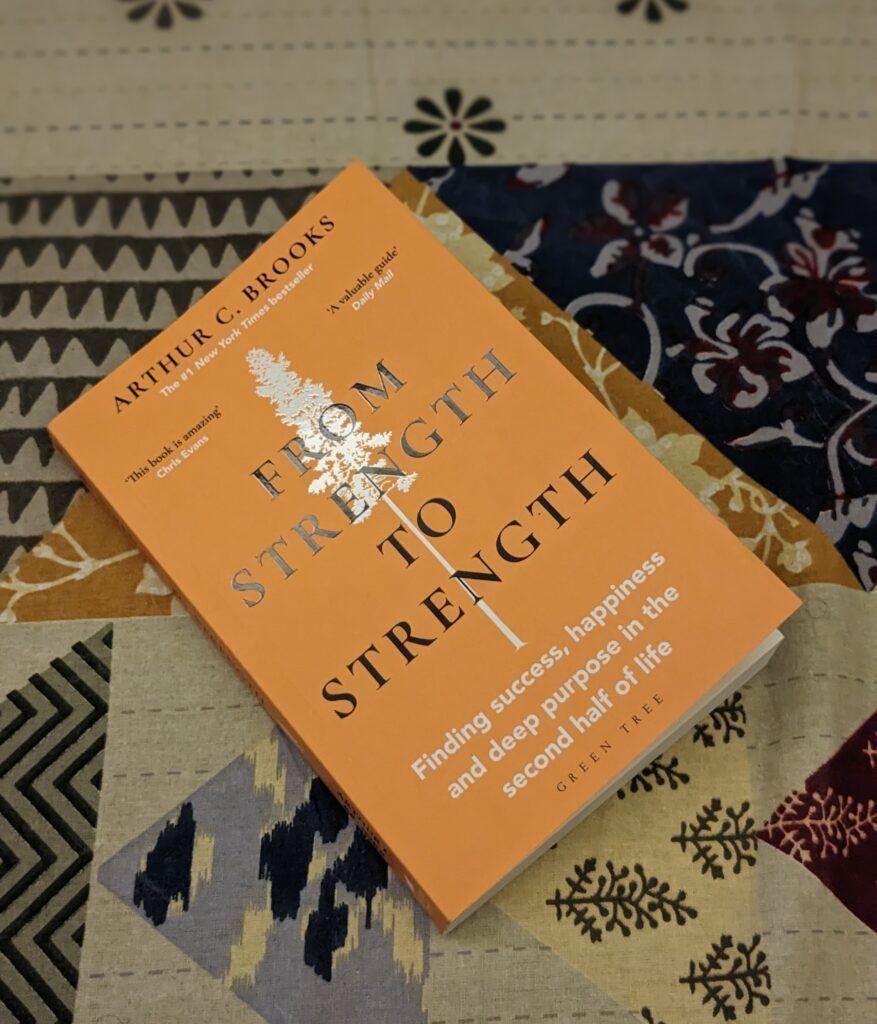
Quite a few of Arthur C. Brooks’ columns have resonated with me and also been thought-starters for some of my blog posts, so I was looking forward to ‘From Strength to Strength’. The premise is that in the first half of their lives, (most) people single-mindedly strive to be successful, often at the cost of health, relationships etc. But with age, many of the abilities that made them successful start to decline. They resent and resist this, leading to frustration and dissatisfaction. The book is about navigating the second half of one’s life when there are changes in mind and body, and the rules by which one worked and lived no longer seem to make sense. How does one get through this liminality, and thrive?
The book begins with one of his articles I had particularly liked – Your Professional Decline is Coming. I found this chapter very interesting thanks to the concepts that appear in it. For instance, “the principle of psychoprofessional gravitation”, the idea that the agony of decline is directly related to prestige previously achieved, and to one’s emotional attachment to that prestige. Also, the two kinds of intelligence – fluid intelligence, defined as the ability to reason, think flexibly, and solve novel problems, and crystallised intelligence, the ability to use a stock of knowledge learned in the past. The former is high in early adulthood, and starts to diminish in the thirties and forties. The latter starts growing from then on. Simplistically put, intelligence, and wisdom. The trick is to jump off from the first curve and on to the second in the later stages of life.
The book then moves on to how we objectify ourselves at work, and are addicted to the success it brings, making the jump to the second curve difficult. Many things are involved – pride, fear, social comparison, and a loss aversion that focuses on well, losing things like wealth, power, and fame one has amassed through hard work.
The rest of the book offers perspectives on how to get off the treadmill – mindfulness, finding friends and meaningful relationships, focusing on companionate love in marriage (rather than passionate love), facing one’s fear of death, distinguishing between intrinsic and extrinsic goals and focusing on the former, starting vanaprastha and understanding how to detach, finding a faith. I found this part not entirely different from things I have read in other books. I think I expected a bit more, but on hindsight, that’s an unfair expectation, since this is something one has to figure out independently, books and other people can only offer perspectives.
Having said that, ‘From Strength to Strength’ is a great start if you’re feeling the waves of midlife hit you. It provides context and perspectives to help you start framing the second half of life.
Notes Fear of death: “thanatophobia.”Whether paralyzing or mild, the fear of death has eight distinct dimensions: fear of being destroyed, fear of the dying process, fear of the dead, fear for significant others, fear of the unknown, fear of conscious death, fear for body after death. and fear of premature death. Edsel problem: The famous car that Ford executives loved, but consumers hated. They sell what *they* like, instead of what the consumers wants and needs. (in the context of helping people at our convenience and in our way) “The worst thing about death is the fact that when a man is dead it is impossible any longer to undo the harm you have done him, or to do the good you haven’t done him.They say: live in such a way as to be always ready to die. I would say: live in such a way that anyone can die without you having anything to regret.” Leo Tolstoy
It is difficult to slot God, Human, Animal, Machine: Technology, Metaphor, and the Search for Meaning. Meghan O’Gieblyn sets us off on a thought-provoking exploration of the intersection of faith, technology, and the human experience, and traverses many interesting paths to understand what makes us human, and our search for meaning. Descartes started us on the path to the Enlightenment by ‘separating’ the material world and our ‘soul. From then, we took pride in using scientific temperament and technology to systematically solve nature’s puzzles. And now, when the same toolkit has created machines whose learning and thinking models are increasingly ‘black boxes’, there is fear, uncertainty and probably a bit of ego.
Through chapters that are at once seamless and disparate, she navigates philosophy, technology, and theology and our different ways of understanding God, ourselves, and the world we are creating through technology. The metaphors of our time are built around technology, and AI and tech are raising questions that have for long been asked by philosophers – free will, immortality, the relationship between mind and body. Science by definition requires an objective perspective, and consciousness can only be felt, and measured inside. I can never know what it feels like to be another person. While there are many hypotheses, this is an area which science has been unable to really crack.
In ‘Pattern’ it is interesting to see the many parallels between the Bible and the belief systems of technologists, despite many of the latter being atheists. Transcendence through the Singularity and trans-humanism, just as through the Book of Revelation, the resurrection and rapture, for instance. I really liked Kurzweil’s idea of consciousness as a pattern of information that persists over time. Essentially like a stream that rushes past the rocks in its path. The actual molecules of water change, but the stream remains the ‘same’. In a letter to the author, he shares a wonderful insight that “the difference between so-called atheists and people who believe in ‘God’ is a matter of the choice of metaphor, and we could not get through our lives without having to choose metaphors for transcendent questions.” From (divine) clockmakers to computers.
In the chapter ‘Network’, the idea of emergence is discussed in the context of consciousness, and so is the work of many scientists to recreate that – experimenting with robots to see if they evolve complex behaviour from simple rules. It hasn’t really worked thus far, but I did wonder about the amount of time evolution took to ‘produce’ us.
In ‘Paradox’, there is mention of the parallels between quantum mechanics and eastern mysticism, and the idea of us being in a simulation, and/or a multiverse. It is interesting to note that all paths require a reasonable dose of faith! There is a very intriguing part that uses video games to illustrate how the first-person view makes it look like a world that is always complete as things appear when you move. But were they around when the player was not looking? Does the world “only render that which is being observed”?
‘Metonymy’ moves into materialism (science and its ability to reduce everything to causal mechanisms), dualism (mind-body), panpsychism (all things have a mind-like quality) and finally idealism (the physical world is wholly constituted by consciousness). The mind serving as a microcosm of the world’s macroscopic consciousness reminded me of Aham Brahmasmi. Towards the end of this chapter, she quotes Hannah Arendt, who wrote about scientists who believed that computers can do what a human brain cannot comprehend.
That paves the way for ‘Algorithm’, which begins with Chris Anderson’s 2008 view that data deluge has made our scientific method obsolete. It has now gotten to a state where we will accept the algorithm’s perspective probably more than our own mind’s! But as Nick Bostrom has pointed out, there is no reason for a super intelligence to share our values including benevolent concern for others. The algorithm does not necessarily worry about downstream consequences or collateral damage. And yet, even as algorithms are plagued by errors and the biases we have fed it, ‘dataism’, as Yuval Noah Harari states, is the new ideology. That if we have enough data, we can know everything, thereby increasing surveillance and tracking.
The end of this chapter has a chilling, and yet fascinating observation – “What we are abdicating, in the end, is our duty to create meaning from our empirical observations — to define for ourselves what constitutes justice, and morality, and quality of life — a task we forfeit each time we forget that meaning is an implicitly human category that cannot be reduced to quantification. To forget this truth is to use our tools to thwart our own interests, to build machines in our image that do nothing but dehumanize us.” In ‘Virality’, the final chapter, she discusses how in the digital domain, quantitative measures of success like clicks and likes have overtaken the virtue or validity of the content. There is also the funny (and yet quite true) part of how, when we treat Trump as an algorithm which has mastered social media, it all makes sense!
God Human Animal Machine is intensely thought-provoking, and O’Gieblyn manages to balance curiosity and a healthy skepticism, distilling thoughts from various streams and thinkers, to provide a coherent narrative that fuels more thinking. For all of this, the book is also deeply personal and extremely accessible. Highly recommended.
Michael J. Sandel’s ‘The Tyranny of Merit‘, which questions what has become of ‘common good’, remains a favourite because it touched upon a topic that is not found commonly in public discourse. “What Money Can’t Buy” continues that approach, and is about the invasion of market economics into areas of life that were previously considered above it – education, government, our physical body, and family life, among others. The book is about whether there is a moral limit to the reach of markets. I was reminded of “When money is made the measure of all things, it becomes the measure of all things.”
The book starts with multiple examples of what I would call the overreach of markets – upgrading a prison cell, the right to shoot an endangered black rhino, stand in line in Capitol Hill in place of a lobbyist, get paid in primary school to read a book, pay life insurance premium on behalf of an elderly person you don’t know and collect the payout after their death, and so on. Sandel points out that it is not just greed, it is the expansion of the market into spheres of life we once thought were beyond it.
“Drifting from having a market economy to being a market society.” The former is a tool for organising productive activity, the latter is one in which social relations are made over in the image of the market. In the subsequent chapters, he provides a huge set of scenarios where this is playing out. Examples of jumping the queue using money – from fast tracks in airports and supermarkets to hiring people to stand in queues in Capitol Hill or exclusive events. A rare opposite is Springsteen’s concerts whose pricing reflects that he sees it more as a social event than a market good. The principles of ‘wait in line’ and ‘don’t jump the queue’ are relics.
Monetary incentives are being used for everything from sterilisation to good grades to losing weight to immigration, and refugees (paying another country to take your share) to pollution permits and carbon credits. An insightful point is the nuance between fines and fees. Fine carries moral weight, it points out that you’re doing something wrong, fees is a transaction. Sandel notes how economics tries to stay away from ethics and quotes Levitt and Dubner, “Morality represents the way we would like the world to work, and economics represents how it actually does work.” But by getting into social aspects, this distinction starts to blur.
When money gets introduced into the social sphere, it starts crowding out morality – in China, you can hire someone to apologise on your behalf. But you needn’t go that far – cash vs a wedding gift, and the middle ground of a gift card is a good example to chew on. There is also the counter example of a town in Switzerland which agreed to be a waste site for nuclear material considering their civic duty, but promptly withdrew when each resident was offered monetary compensation. Another example is the Israeli day care, where introducing fines for parents who came late to pick up their kids increased the number of late arrivals, because it eroded the parents’ sense of responsibility by making it a transaction. Even life and death are not exempt. The good use case of insurance is transformed into what is called janitors insurance. Companies buy insurance on behalf of employees without their knowledge and cash in, creating a revenue source! Then there are viatical investments – say a person with a $100000 policy is told that he has a year to live. An investor buys that for half the price in cash, which the patient uses for treatment. The investor collects the insurance after the patient’s death! Thus people have an incentive for another person’s death! Insurance had been prohibited for centuries just to prevent this! But now, investors buy insurance of elderly people using the same tricks. It is a major industry. There are also sites that apparently allow bets on celebrities dying in a particular year.
Naming rights of public places in lieu of payment is another area of infringement. It has moved beyond stadia and sports to prisons and schools. In the latter, the corporate spin is allowed to varnish or even omit truth.
In all of this, two objections usually arise from those who oppose this- fairness and corruption. Fairness, because when money is introduced, those without it start losing access. Corruption, not in the way we normally use it, but how it degrades the original quality of the interaction. The Swiss and Israel examples point to that. Ironically economists see altruism as a valuable and rare good that depletes when used too much. And therein probably begins the warped worldview.
But as Sandel himself admits, this is a discussion on what we define as a good life, and whether that’s what we want to lead. Public discourse is increasingly becoming devoid of moral and spiritual substance and money continues its march. Call me a cynic, but I am struggling to see a way out. An excellent book to read, to at least remember how the world and humanity used to be.