The subtitle of The Experience Machine is “How our minds predict and shape reality”, and that’s what the book is about. The conventional notion of cognition, at least to me, is that it begins with sense organs perceiving and providing inputs from what we experience, and the brain quickly piecing it all together to present me a coherent picture of what is, and what I should do next. But if we go by the “predictive brain” thesis, the brain doesn’t just passively interpret the world but is constantly predicting, shaping, and refining our reality based on sensory inputs.
If I had to sum up Having and Being Had, it is Eula Biss having a conversation with capitalism -trying to understand its origins, its ethos, and its insidious and pervasive role in our lives. The only hint of structure are broad sections – consumption, work, investment, and accounting. But really, everything flows into everything else. I made up the narrative that she has ‘consumed’ her home (or the other way), she needs her work to pay for it, but also needs to make investments for her future – each piece complex in itself, their mutual relationships, and their relationship with her, and this is her account, and she has to account for everything. Everything is connected by capitalism. Having and Being Had reminded me of God, Human, Animal, Machine, which was reflections about consciousness itself.
Before getting to The Case Against Reality, we need to talk about my favourite read this year – “Being You“. The second half of that book has some reality-shattering theses. One of them is ‘We perceive the world not as it is, but as it is useful to us.’ Reality is thus an interpretation, and the entire process is not optimised for accuracy, it is designed for utility. A mechanism of making it seem real so we respond to it. Not to know the world, but to survive it! The end of the book also brings up the fascinating FEP (free energy principle) and specifically how it applies to living systems and consciousness. In this context, it boils down to this – being alive means being in a condition of low entropy. Any living system, to resist entropy, must occupy states which it expects to be in. Biology meets physics. Why am I bringing this up? Because The Case Against Reality touches upon both of these aspects I was fascinated by.
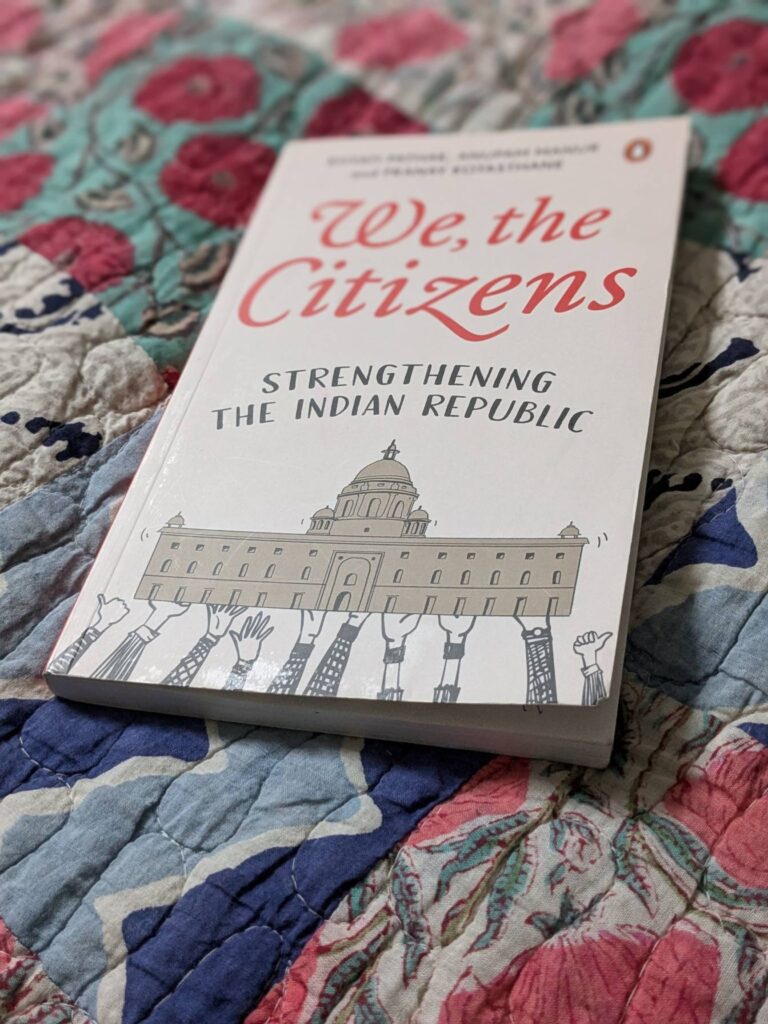
Every day we look around and blame the government for not doing the things they are supposed to do, and for being overbearing on things like taxation. We The Citizens is a wonderful little book (176 pages) that explains why things are the way they are. Full of wit and wisdom on subjects we don’t think about enough, but are important. I think the authors have done a great job of making the complex interplay of state, market, and society understandable, and that includes the illustrations that elevate the narrative many a times. A graphic narrative that decodes how public policy works (and could work) in the Indian context.
The state is good at employing force, but isn’t very efficient. The market is good at driving efficiency, but is not concerned with ensuring equity. Society is best suited to deal with behavioural changes, but it is prone to majoritarianism. The entire system is a maze of checks and balances to achieve progress while not allowing any of the elements to go out of control. The book delves into how each of these function, and should function.
The state, for instance has a toolkit of at least eight things from doing nothing to nudging to playing umpire to marginally/drastically changing incentives and so on but doesn’t always employ the right one. Munger’s “Show me the incentives and I’ll show you the outcome” brilliantly manifests in these explorations. The book provides an excellent framework to think about this based on axes of extent of intervention and state capacity. The government can fail in many ways, and the taxpayer pays for these mistakes. The best part about the book is how it uses examples to (literally) illustrate these mistakes, and how they can be avoided. All delivered with some fantastic humour.
Why are we a democratic republic and not just a democracy? Because while democracy gives the state legitimacy on coercion, the republic (constitution) guarantees the rule of law. What is the difference between a nation, state and government? The nation is an imagined community, where people don’t know each other but are still willing to sacrifice for. On the other hand, a state is a political entity. The government is the temporary manager of the state. What are public and common goods? Public goods are goods that are non-excludable and non-rival. (e.g. a lighthouse which everyone can use and its usage by one person doesn’t mean another cannot use it) On the other hand, common goods are non-excludable but rival (e.g. fish in the sea). This is why only the government produces public goods. These are the kind of significant nuances that the We The Citizens uncovers.
I cannot stress how accessible this book is. Plain English, relatable examples, and frameworks that can be applied even in other contexts. Like many good things in life, I discovered We The Citizens courtesy the better half. I’d highly recommend this to anyone even remotely curious about how the ‘system’ works. If you’re not, this can actually get you interested.
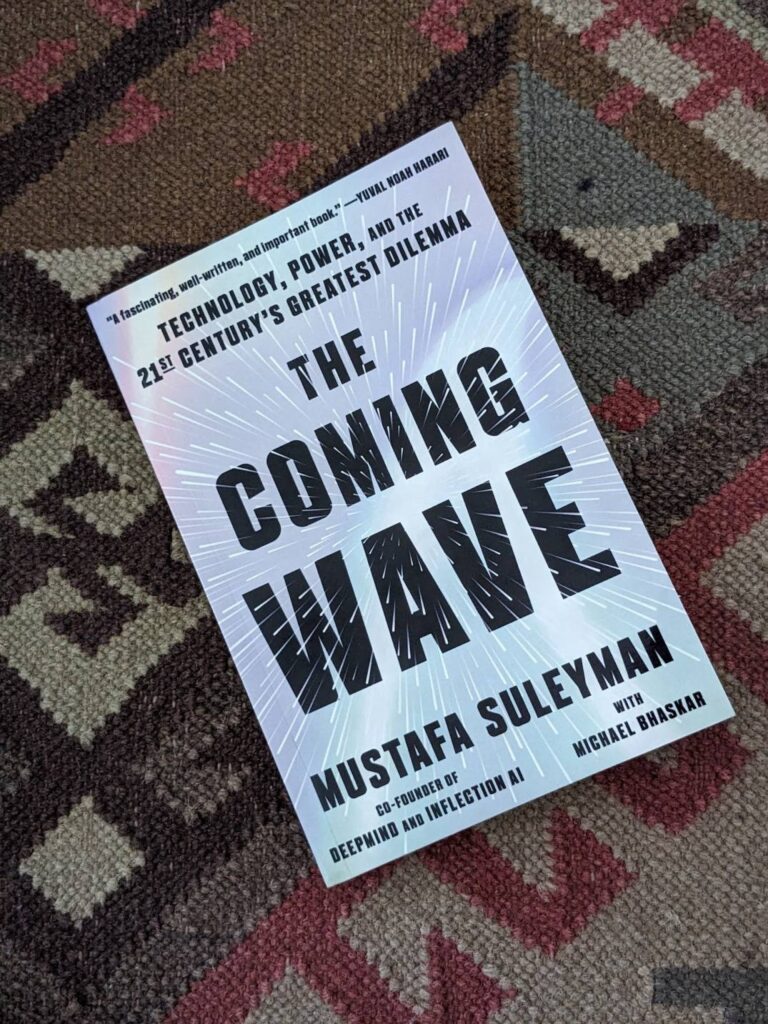
Co-founder of first DeepMind (the company behind a couple of massive leaps in AI – AlphaGo, AlphaFold, acquired by Google), then Inflection AI and now (before the book published, I think) CEO of Microsoft AI, I think there are few better people than Mustafa Suleyman to write about AI. And I suspect there will be few better moments than now. The Coming Wave was a book I was looking forward to reading, and it didn’t disappoint.
The book is divided into four sections. The first looks at the history of technology and how it spreads. The second gets into the detailing of the coming wave – two general purpose technologies – AI and synthetic biology, and associated technologies like robotics and quantum computing. This section also goes into the features and incentives that drive them. Part 3 takes a side step into the political implications of this on the nation state, the only institution that can temper the wave. The last section looks at what is the ‘containment problem’ – a wave of technology is near impossible to contain, history has ample proof, but can we still take a shot at it.
In the first section of The Coming Wave, Suleyman shows how technology has a clear, inevitable trajectory: mass diffusion in great rolling waves. New discoveries are used by people to make cheaper food, better goods, more efficient transport etc. As demand grows, competition increases, the technology becomes better and cheaper, and easier to use. From farming to the internet, history has enough examples. A big challenge is that the inventor has no way of knowing the nth order consequence (the ‘revenge effects’ of technology – fridge makers didn’t start out with the intent to punch a hole in the ozone later), and once a technology is out there, there is very little we can do to contain it. From fossil fuel emissions to opioid abuse to space junk, this is the story. The only partial exception is nuclear weapons.
There is a fascinating story in the beginning of the second section on DQN, an algorithm the DeepMind team created to play the game Breakout, and it discovered a strategy that most humans didn’t think of. The trailer for AlphaGo. The section also goes deep into synthetic biology and robotics. Apparently, one can buy a benchtop DNA synthesiser for $25k.
But this section is even more important because it brings out the four intrinsic features of this wave that compound the containment problem. One, it has a hugely asymmetric impact. Which this has happened before (cannon vs a large set of people) it has been scaled massively with the internet and now AI (a single algorithm can hold massive systems to ransom). Two, they are developing fast – hyper-evolution – providing very little time to react, let alone regulate ((look at cars vs the frequency of the versions of GPT). Third, they are omni-use (AI can be applied in multiple domains, and can come up with compounds for cure or as poison). And fourth, its degree of autonomy is beyond any previous technology.
Add to that the incentives and the containment problem just gets magnified. Geopolitics and the power involved, a global research system that has rituals rewarding open publication – curiosity and the pursuit of new ideas, financial gains, and the the most human one of all – ego.
The third section of The Coming Wave is on the impact of all this on the nation state. He calls out that technology is not value-neutral, and quotes Langdon Winner, “Technology in its various manifestations is a significant part of the human world. Its structures, processes and alterations enter into and become part of the structures, processes and alterations of human consciousness, society and politics.” From the printing press to weapons, tech has helped build the nation state. My favourite chapter in this is ‘Fragility Amplifiers’ – from robots with guns to lab leaks to 3d printing everything, even people with good intent can cause things to go wrong. “What does the social contract look like if a select group of ‘post humans’ engineer themselves to some unreachable intellectual or physical plane?”Add to it massive job displacement, and other social issues and the nation state faces challenges far beyond the standard issues of the day. The possibilities are a continuum from an extremely powerful nation state to completely decentralised groups of individuals.
In the last section, he looks at nine ways, working in cohesion to provide some sort of containment. Technical safety, audits, using choke points, maker responsibility to build in controls from the start, aligning business incentives with containment, helping governments build tech to regulate tech, international alliances for regulation and mitigation, a culture of sharing errors and learning from them, public input to make this all accountable. The tenth point he makes is that there is no silver bullet that will take us to any permanent solution. It is a narrow path which humanity must walk on. That probably is the biggest lesson.
I found The Coming Wave full of great insights and perspectives, and written in a way that makes it accessible to those outside tech. An important book for everyone to read since it’s a pragmatic look at what the future holds for the species. Part of my 2024 favourites list.
Notes 1. (Life + Intelligence) x Energy = Civilisation 2. Liverpool’s MP William Huskisson was killed under the wheels of the locomotive during the opening of the Liverpool – Manchester line, the first passenger railway because the crowd had no idea of the machine’s power! 4. How the stirrup changed everything. Fused the rider to the horse, and the ability to power through. It became a leading offense strategy, and changed Europe. Horses – church land for rearing- ties to the kingdom – feudalism. 3. Today, no matter how wealthy you are, you simply cannot buy a more powerful smartphone than is available to billions of people 4. Primum non nocere – “first, do no harm”. (Hippocratic Oath)