Category: Favourites

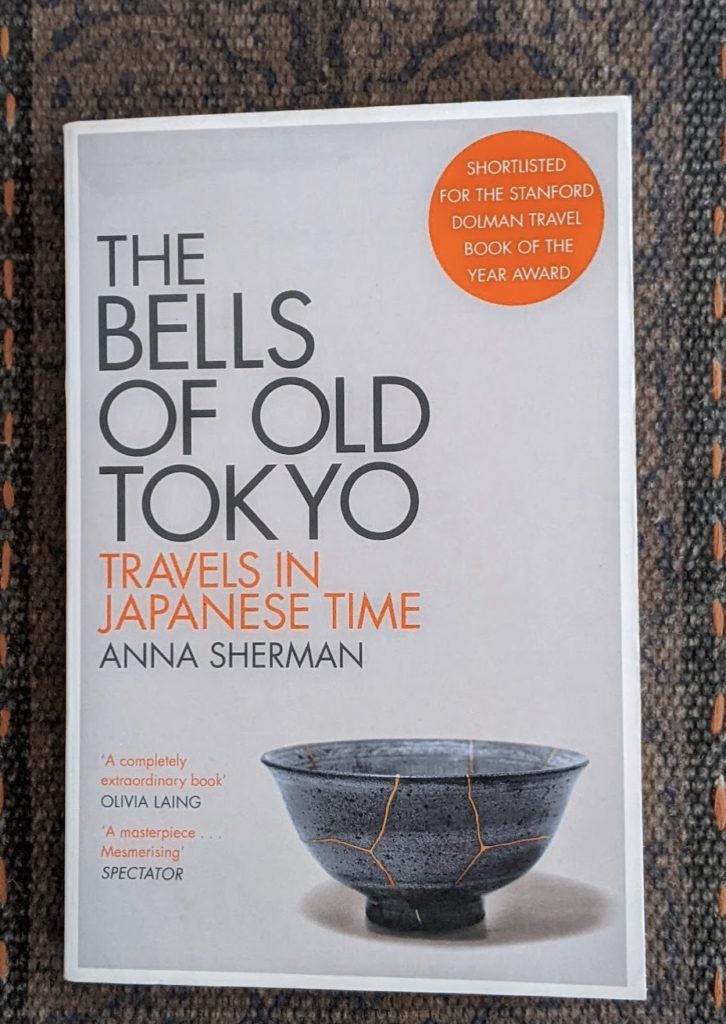
  • The Bells of Old Tokyo

    Anna Sherman

    I don’t know if I (sub)consciously avoided travelogues since 2020 because I would miss travel even more. But irrespective of that, there was something very poignant about the title itself, so I just had to pick it up. The good news is that it lived up to its promise. Anna Sherman does in this book what my favourite books about places do – let me travel in time and space. 

    The second part of the title – Meditations on Time and a City – gives a very good idea of the book’s focus. It talks about both the changes in Edo (before it came to be called Tokyo) with time, as well as its changing relationship with time itself. Like many other concepts, the Japanese have many words for time according to the context. Before its citizens started using manufactured devices to tell time, Edo’s time was told by the ringing of bells. At first, there were three, but by 1720, as the population touched a million, six more were added. And these bells are what the narrative follows. 

    With each, there are stories attached. Origin stories of the locality and the bell, and its journey through times good and bad – victories, wars, earthquakes, fires and so on. Nihonbashi – the Zero Point has its prison stories (prisoners let out during a fire would voluntarily return because they’d be found and killed otherwise). Asakusa has its beauty and murder story. Akasaka has the smallest bell, and love-hotel rooms which cater to any and all fetishes, with protocols that outsiders will find difficult to understand. Mejiro is home to the stone that honours the rebel samurai Chūya Marubashi. Nezu has a fascinating tale of clockmaking and how time shifted from personal to shared, and ‘the idea of time became mechanical.’ Ueno, where the battle in 1868 marked the end of the Tokugawa shogunate. A few months later, Edo would start making way for Tokyo. Where the bell-ringer knows he is probably the last of his kind. Kitasuna, where more than 700,000 bombs landed on 9-10 March 1945, and caused the deaths of more people than in Hiroshima and Nagasaki. 

    The book did a fantastic job of transporting me to the time and place. The words somehow gave me a visceral feeling of the place, the emotions of the different people who lived there, their daily existence, the events they have gone through, and sometimes I tended to see the place as a person too – changing, shifting, sometimes slowly and sometimes suddenly. It was like walking through the lanes. The one thing that I wish the book also had was maps so I could also get a better directional sense of where these places are.
    I think, after this book, when I do visit Tokyo (Edo), I will see it through new eyes and old stories.

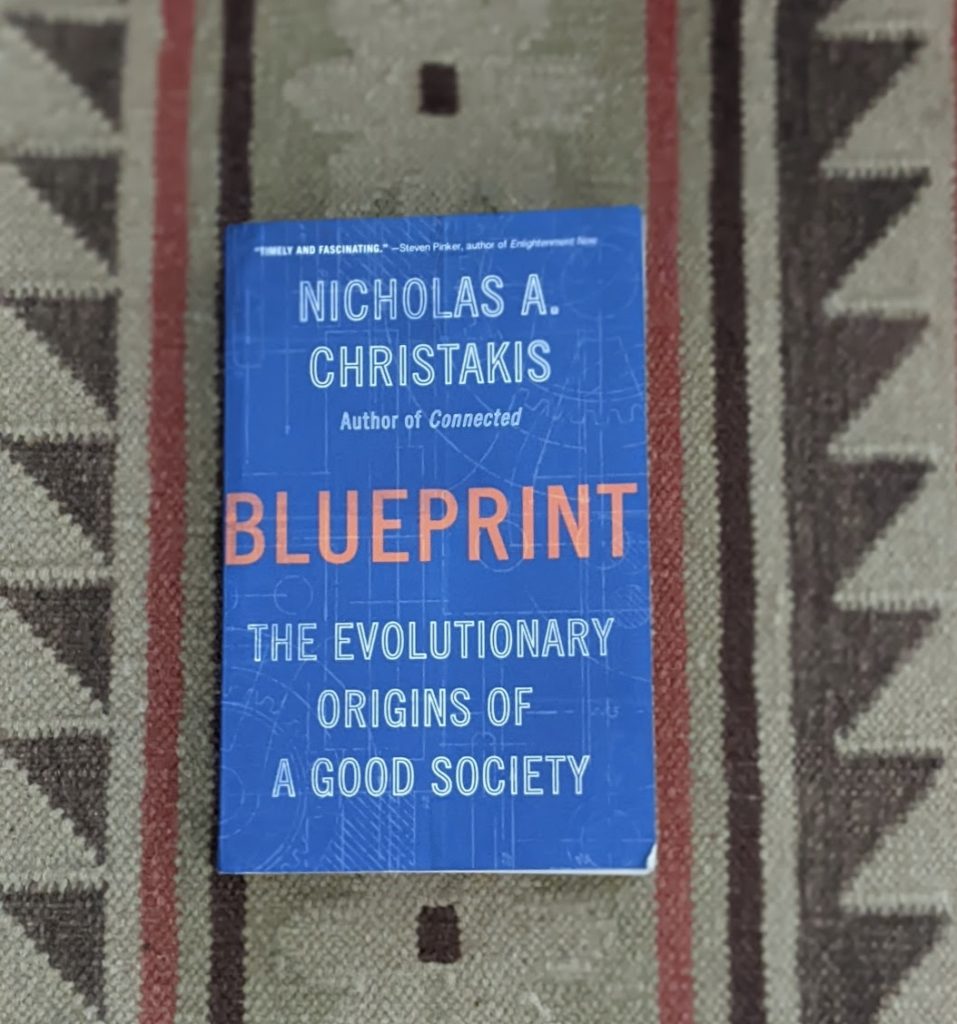
  • Blueprint

    Nicholas A. Christakis

    I had hoped to begin the year with a book that broadens my thinking, and Blueprint most definitely does. It is in different ways related to two books that I read recently – Behave, and The Dawn of Everything. The former was about why we behave the way we do, starting from neurotransmitters and hormones right back to evolution even before we became a species. The latter was about why our linear way of seeing the evolution of humanity is inherently flawed, and how that is increasingly being proved by archaeological evidence. Blueprint is about how our genes affect not only our bodies and behaviours, but also the ways in which we make societies. It also does a fantastic job of (granularly) showing how all this is evolution at play from a time far before we became a species.

    There is another way in which Blueprint resembles Behave. The first hundred pages don’t do justice to the rest of the book. While it was the complexity in the latter, in this it’s the seeming simplicity. From the preface onwards, there is a focus on balancing a couple of diverse ideas – the universality of our shared inheritance and the uniqueness of the culture we have built and the individuals we are. The objective in the early part of the book is to illustrate the “social suite” inherent in all societies – having and recognising individual identity, love for partners and offspring, friendship, social networks, cooperation, preference for one’s own group (in-group bias), (only) mild hierarchy, and social learning and teaching. So irrespective of the origins of any particular society, it follows a blueprint that evolution has provided. There are examples in intentional, unintentional (say, shipwrecks) and artificial (experiments). Having said that, one should also be conscious of context emergence – the collective having a set of properties that might be different from the components. (an excellent example is carbon atoms creating both graphite and diamonds). An interesting point on the environment humans face – the one thing that does not vary is the presence of other humans, and this has a big impact on how we have evolved. 

    With this base, he moves to how our species came to prefer pair-bonding (an internal state – loving one specific mate), after cycles of polygyny and monogamy (external state and behaviour) – either “ecologically imposed” or “culturally imposed”. At a basic level, ‘the evolutionary psychology of both men and women is to exchange love for support.’ And genes ‘affect an individual’s attraction to, and choice of, particular partners.’ Pair bonding formed the basis of attachment which then spread outwards from immediate family and kin to friends and groups. An interesting exception is the Na tribe in Tibet (10000+) in which permanent relationships between a couple are forbidden. Some of their arrangements reminded me of the Sambandhams in Kerala’s matrilineal communities. 

    In uncertain environments, friendships work great for mutual aid and co-operation, and that’s how it probably started – as a survival hedge. Kin after all, could be completion for family resources, and sometimes kin are not sufficient for large group activities like a hunt, either in terms of numbers or skills. Additionally, because of their attention to us, our friends also make us feel engaged and wanted, something relevant today as well. And this ‘social shell’ allows us to weather difficult circumstances. 

    A crucial factor in ensuring non-kin co-operation is recognising and remembering individuals is important. It’s interesting to see this skill present in many primates, as well as elephants and Cetaceans. And it’s not just this skill, but reflections of emotions, cognition, morality, and other attributes like friendship, cooperation, and transmission of knowledge by social learning. The many stories of elephants are a treat.

    The next part is what I found most interesting. Organisms manipulating the inanimate material around them. Christakis calls it an ‘exophenotype’ (Richard Dawkins called it an ‘extended phenotype’ earlier). Similar to birds building nests, spiders spinning webs and snails making shells. There are some mind-blowing examples of parasites that do this – fungi creating zombie ants, and snail flukes. In our case, the social suite is an exophenotype – an expression of genes outside of our bodies. And thus, our genes could affect other people too. Like animals manipulate physical objects, we affect the social environment around us! 

    And that is how the last sections focus on culture, and how ideas and technologies are created, and then passed on to the next generation. Genes and culture now work together on evolution. A great example is of the discovery of fire, change in eating habits, and thus a shift in the kind of dental and gastric mechanisms we have. As we gain control of the environment through our ‘culture’ (includes technology), the impact of genes might start dipping. I thought of both language and money as exophenotypes because of (respectively) the unique ability to transfer knowledge and become a universal currency that is increasingly an end and not the means, but they weren’t a part of the narrative. I was especially intrigued because he also mentions that it takes strong cultural forces to suppress the tendencies of our social suite. He does cover religion, technology and sees AI and CRISPR as phenomena that could have a massive impact. 

    The blurb tries to pitch the book as a solution to the current polarised environment, but I didn’t see a lot of that. What it does is show how a blueprint to create a good society indeed exists. That’s what made us the dominant species on the planet. What remains unanswered is whether we can still cooperate for our common good. It’s a fascinating read, and the numerous fantastic examples make it scientifically robust and supremely insightful.

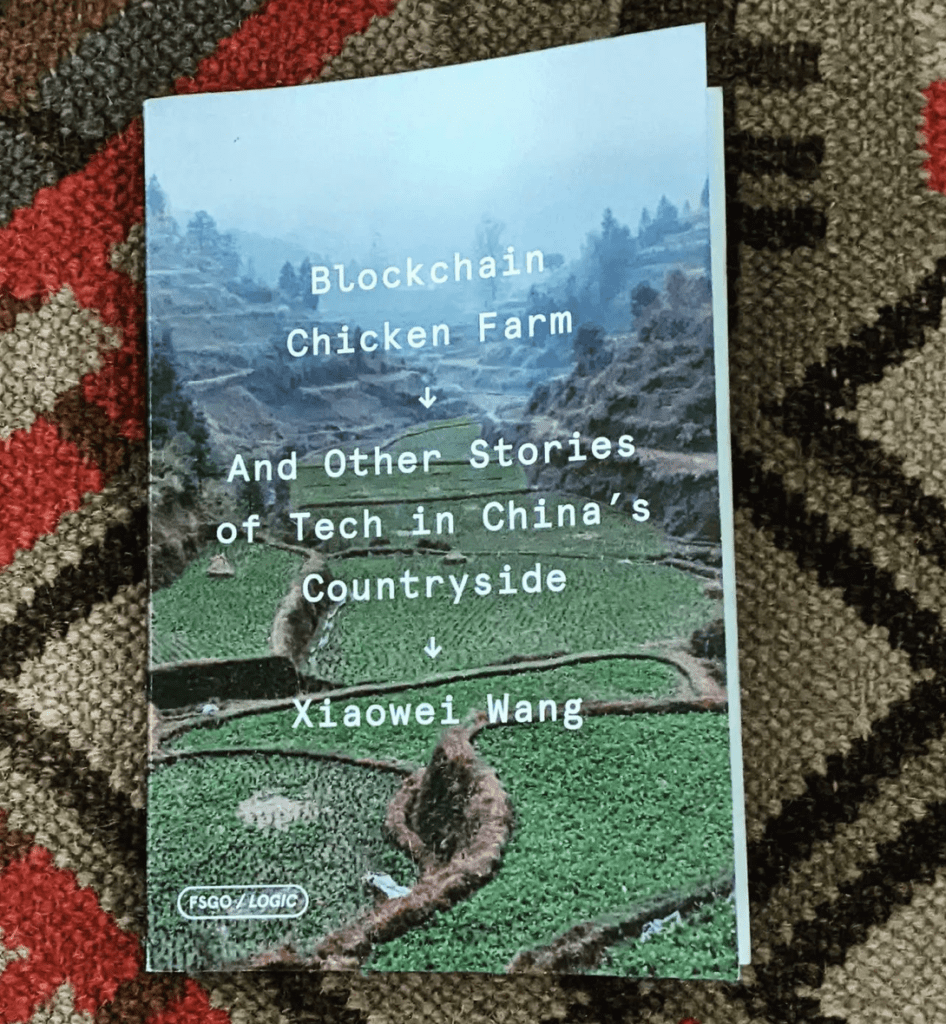
  • Blockchain Chicken Farm: And Other Stories of Tech in China’s Countryside

    Xiaowei Wang

    I bought the book because it had two keywords that interested me – blockchain and China. But as the ‘stories’ went from swine to finally pearls, I realised that the title probably doesn’t do justice to the multiple themes that surface in the book and makes it, a rich and nuanced read. 
    The introduction points us to ‘metronormativity’ – the idea that rural people and culture are ‘backward, conservative and intolerant, and that the only way to live with freedom is to leave the countryside for highly connected urban oases.’ Further, that internet, technology and media will educate and save them by allowing more experiences and chances of a better livelihood. The book is a challenge to all parts of this construct. It also pushes back on binary classifications we employ – digital/physical, natural/man-made and so on. 

    ‘Ghosts in the Machine’ sets the context as we read about how under Deng Xiaoping in the 1980’s, the country began imagining a uniquely Chinese future, and set the ball rolling for the rise of companies like Huawei and Alibaba. In parallel, there’s the rise of TVEs (Town and Village Enterprises) over the prevalent SOEs (State Owned Enterprises), and a potential ‘agrarian transition’ that would result in industrialised agriculture, which would need lesser manpower. This would have social, environmental and political ramifications. 

    ‘Blockchain farm in the middle of nowhere’ touches upon the surveillance state, non-explicit censorship, and ‘the shadowy unease that looms over public conversations.’. It begins with the foodsheds in Shanghai and moves to the contrast (or not) between the dangers of cost-cutting in the food industry, and the gloss of ‘blockchain chicken’ (Bubuji/GoGoChicken). The latter uses ‘a chicken Fitbit of sorts’ on the ankle of chicken which allows a buyer to know the provenance of a chicken, and even see streaming live footage that can be accesses via a QR code! But despite this, the future is uncertain because the tech is on hire, and overhead costs are high. Can blockchain make food safety records tamper-proof by creating a distributed system? Perhaps, but there are many challenges including legibility and thus, access. 

    In ‘When AI farms pigs’, we are introduced to Alibaba’s ET Agricultural Brain that aims to transform agriculture to ‘help create China’s pork miracle’. It brings out how, despite AI’s potential to radically help humans, the current economics of AI makes it a corporate AI model that is all about scale and efficiency. 

    ‘Buffet Life’ explores the alternate careers that Chinese youth are taking up. Case in point – drone operators. This is backed by a (state backed) system that is now bridging the gap between urban and rural education, creating the infrastructure for it and thereby also providing new means of livelihood.

    In ‘Made in China’, there is a very insightful take on what ‘innovation’ means and how it is predominantly evaluated through a Western lens. China is forging its own path in ‘innovation’, trying to break away from cheap products at industrialised scale. ‘Shanzai’ is changing its earlier connotation to an ecosystem that’s open source, and operating at hyper speed, steamrolling through the IP version favoured by the West, and forcing conversations on access and civility. The agricultural version of this approach is Rice Harmony, and its method of collective, organic rice farming. There is also the fascinating tale of Naomi Wu, a self-proclaimed cyborg, and an internet star. 

    ‘No one can predict the future’ is as much about policing as it is about community and identity, and the difference between ‘safety’ and ‘security’. It is interesting how many people working in the domain view surveillance as a technical problem to be solved without thinking of the related consequences. There is also a mention of ‘criminal villages’, the Chinese version of India’s Jamtara. 

    ‘Gone shopping in the mountain stronghold’ relates how ‘Rural Revitalisation’ relies on technology and the internet to build rural entrepreneurship ecosystems. The rural playbook of Taobao is a phenomenon, one that is transforming the rural landscape, literally and metaphorically. Others like JD.com and Pinduoduo are replicating this too. And thanks to this, there is a reverse migration to the village. But many of these platforms are unregulated, resulting in safety issues – everything from getting sick from food purchases to a cab driver raping and killing a passenger. 

    ‘Welcome to my pearl party’ is the one I found most poignant. While the story is about pearl farming in China leading to an MLM sales machinery in the US, the underlying socio-cultural dimension of it – the human need for belonging and care – is what makes it an affecting read. This also features a ‘subversive’ version of Peppa Pig, or rather it becoming a mascot for those who are rebelling against the part of society which has everything and sets the rules – shehui ren culture. 

    While these are all set in different parts of China, there are themes that I could see were universal – ‘…the plague of being old and lonely. As younger generations leave villages, hometowns and even the country to chase after careers and jobs, and the tightening noose of inequality squeezes leisure time, the elderly are left to their own devices.”

    Blockchain, and fantastic perspectives of China were indeed part of the mix, but Xiaowei Wang delivered far more. Travelogue, technology, culture and community, future and sometimes even a bit of contemplative philosophy, I really wouldn’t want to slot this book in any particular genre, and that’s probably what makes it a compelling and fulfilling read.

    P.S. In the penultimate page, the author, sitting in a HongKong bar, amidst the protests, writes about reports of a zootonic disease from mainland China causing flu-like symptoms in humans causing unease because the memory of SARS still being recent!

  • Behave : The Biology of Humans at Our Best and Worst

    Robert M. Sapolsky

    I remember Don Draper’s words from Mad Men – “When a man walks into a room, he brings his whole life with him. He has a million reasons for being anywhere, just ask him. If you listen, he’ll tell you how he got there.” Robert Sapolsky asks this to our behaviour, and tries to answer it using multiple disciplines of science. 

    At any given point in time, we are behaving in one way or another. What influences that? To understand that, he travels back in time. From the seconds before that behaviour, and the possible neurobiological explanation, to the genes we have inherited, to the early days of our non-human ancestors and the environment that shaped many of their behaviours. Hormones, environment, culture, and events from millennia ago, all offer but clues to understanding how we are today. 

    From a narrative point of view, you’re first thrown into the deep end of the pool. I found the first few chapters reasonably tough to get through, simply because between the names of neurotransmitters and hormones and their little quirks, I had to repeatedly go back and check if I had understood right (even if it’s a remote understanding!) It doesn’t help that there are footnotes on practically every page. I stopped reading them after a while. It also doesn’t help that each chapter is a rabbithole with multiple little sections.

    And finally, I know the author means well and is probably trying to keep the prose conversational, but repeated “see what I did there?” are also a bit painful. As an exception, I did find the part on genes interesting, especially how it doesn’t act in isolation and interacts with the environment. ‘Genes aren’t about inevitabilities; they’re about potentials and vulnerabilities.’

    Having said all that, once we have gotten out of the body, and moved into environment, culture, decision-making etc, the text is a lot more accessible and at least to me, supremely interesting. Behaviour and what goes into it indeed becomes fascinating as we start to see the behaviour of other species and how similar we are in some aspects. It is also awe-inspiring to behold the species we have become. And much of it purely by chance. Also mind-bending how biology affects our tendency to violence, our sense of justice and many other things whose behind-the scenes we don’t really look at. 
    I think I’ll need at least one more read to assimilate everything in the book.

    But it is indeed fascinating to know that ‘we are constantly being shaped by seemingly irrelevant stimuli, subliminal information, and internal forces we don’t know a thing about.’ ‘Our worst behaviours, once we condemn and punish are the products of our biology. The same applies to our best behaviours.’

    It’s not the easiest read, but if you persist, a lot of insights await you.

  • Uncharted

    Margaret Heffernan

    From the time imagination and projection became a part of our survival toolkit, our species has been finding more and more ways to be certain. But as the world becomes increasingly complex, certainty is more difficult to find. ‘We live in a world of irreducible uncertainty‘. So how does one think about the future, at not just the individual level, but at organisation, societal and civilisational levels? Margaret Heffernan moves through history, business narratives, science, and her own relationships to offer perspectives.

    The book is divided into three sections to take us through multiple concepts. The first section uses history to set the context for our ‘addiction to prediction’. We convert history into smooth flows of continuity and manifest destiny whereas events weren’t inevitable but a series of choices, complex and contingent. In addition to pointing out how even professional mathematicians find probability counterintuitive, she also shows how we quickly accept the propaganda of predictions and ‘leave ourselves open to those who profit by influencing our behaviour’. Even in our individual lives, everything from personality tests (MBTI) to genetic profiling is used to typecast despite humans being complex. The big danger is in confusing complex systems for a complicated process. The lessons in this section is that neither history nor genetics nor models can say with certainty how the future will unfold, and what we lose when we try to automate our way into efficiency is the system’s robustness. 

    The second section has a bunch of examples on how people, companies and societies have navigated the future. It brings out the importance of experiments, scenario planning, and creating a shared understanding. Scenarios ‘illuminate the contingencies, contradictions and trade-offs of the real world, where no one interest or single perspective is in control‘. At an individual level, there are some excellent examples of artists whose projects are defined by uncertainty. The Future Library was one I found very interesting – Katie Peterson has planted a thousand trees in a forest outside Oslo. Once a year, for a hundred years, authors will submit manuscripts commissioned for the book. It could be poems, stories, a novel, or even a sentence, but no one else can read it until a hundred years from now! This approach is in stark contrast to the ‘brand you’ concept of fixed positioning. At a broader level, there are examples of ‘cathedral projects’ like CERN, whose by-products have revolutionised multiple industries, and yes, given us the internet too! The Human Genome Project is another example. They are destined to last longer than a single human lifespan, and have to adapt to changing needs, tastes and technologies, relying on human imagination and the willingness to explore, to succeed. ‘They are voyages of discovery in uncharted territory.’ 

    The final section is all about the importance of being human, and coming full circle, how we can prepare ourselves better for the future. Using examples of individuals, companies like Nokia, and a civilisational crisis like AIDS, the author highlights how human relationships helps us solve problems which are uncertain even from a ‘where to begin’ perspective. Human ingenuity manages to create emergent solutions. The penultimate chapter is a fantastic presentation of death as a feature, not a bug, and treats it with dignity and respect. 

    This is a book that creates an excellent narrative for the times. While we extoll AI and its ability to make our lives better, the focus here is the human ability to ask better questions, share ideas, and find solutions. In our search for efficiency and metrics, we tend to forget the creativity and imagination prowess of the human mind that has brought us so far. There are no readymade solutions in the book to tackle an uncertain future, and that is the precise point it makes. It offers perspectives and possible approaches, and despite the tough and diverse subjects it deals in, is optimistic and very accessible.