Category: Favourites

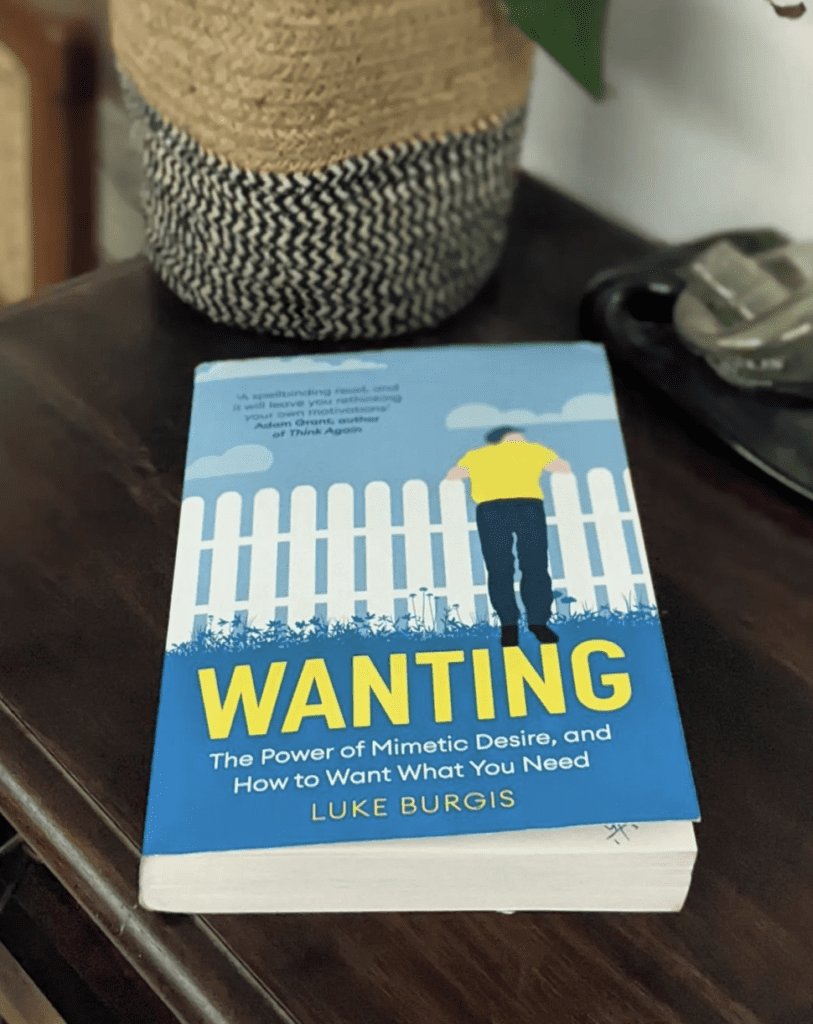
  • Wanting: The Power of Mimetic Desire, and How to Want What You Need

    Luke Burgis

    Schopenhauer is believed to have said “A man can do as he wills, but not will as he wills.” We can replace will with ‘want’ and it still holds. But we have convinced ourselves otherwise – that we desire things independently. Based on the work and philosophy of René Girard, and his own experiences, Luke Burgis sets about dismantling this notion – what the book calls the Romantic Lie – self delusion.

    If, in the free will debate, genetic and environmental determinism hasn’t made an impression on you, Girard postulates that most of what we desire is mimetic (imitative) and not intrinsic. We want what other people want. These desires are different from needs. Think of the latter as the two bottom rows of Maslow’s hierarchy and the former as the top three. And our choice of these desires are courtesy models – people or things that show us what is worth wanting. Look hard enough, and in all of your consumption and behaviour – from the choice of travel destinations to life partners, you will discover them. 

    Mimetic desire can lead us to destructive or productive cycles, and the book explores both paths. In the first part, we learn how mimetic desire starts in infancy to its evolution in adults, how it changes according to the person’s relationship with the model, how it works in groups (and causes societal conflicts) and how society has found ways (scapegoat mechanism) to diffuse it. This section has an excellent example of ‘models’ in action – Edward Bernays popularising smoking amongst women at a time when it was quite taboo. Another good example is that of a Romantic Lie – the efficient markets hypothesis – and what has been its anti-thesis consistently – Tesla. Musk clearly understands the power of mimetic desire really well. Dogecoin, anyone?

    Desire, according to René Girard, is always for something we think we lack — or else it wouldn’t be desire at all. And hence the model – the one who has what we lack. The person’s relationship with the model – either people belonging to the same time, place or social sphere (Freshmanistan, our immediate world) or outside it (Celebristan, outside our ‘world’) also has an impact on the kind of mimesis that happens. We don’t really compete with the latter, in fact we imitate them freely and openly, but with the former, we compete. [Sidebar – The use of ‘stan’ and the usage of phrases right below chapter titles indicated to me that the author probably has Taleb as one of his models]

    In a simpler world, our Freshmanistan was limited to those we actually were in touch in reality. And then came Facebook, which gave us practically infinite models. Scrolling, judging, comparing, imitating, seeking validation and praise….and feeling angsty! Burgis gives the example of one friend introducing another to baking, and how the desire to become the better baker locks them in mimetic rivalry that doesn’t end well. 

    A related part is about how the value of experts has shifted from people with a deep understanding of the subject to those with mimetic value. Just as we used to make fun of the Kardashians as ‘being famous for being famous’, we have experts who are ‘experts at being experts’. Also interesting that apparently Steve Jobs had a model too – Robert Friedland, a fellow student in college. And the example of Zappos, which was once a model, but imploded. 

    Mimetic desire spreads through culture, and creates competition and conflicts in societies. Early societies used sacrifice and the scapegoat mechanism – pinning the blame of the conflict on a specific entity – to diffuse the situation. It continues to this day – fired CEOs and coaches, ‘cancel culture’ etc. All parties silently agree that now that the conflict has been resolved, things will get better. There is an interesting perspective that the story of Jesus survived because though the mob tried to make him a scapegoat, it caused an enormous division in society, and one section called out the scapegoat mechanism – the folly of the crowd is shown to the reader of the scriptures, and hence it was unique for its time. 

    In the second part of the book, the focus is on how to break out of this cycle using techniques like disruptive empathy and intentionally discerning between thin and thick desires. Empathy is defined as the ability to share another person’s perspective without imitating or identifying with them to the extent of losing one’s own individuality. Developing thick desires, which endure and provide meaning, are a good way to not get distracted by thin, mimetic desires. Another interesting concept is ‘calculating thought’ and ‘meditative thought’. The former is the default, and the latter is slow, patient, and in the current usage of the word – nonproductive. This part also has a section on how to apply this to leadership, and ends with a perspective on the future of desire. 

    Mimetic desire permeates everything from the educational system to social media to venture capital, hijacking the original purpose of these entities. At an individual level, it impacts our work, relationships, parenting, and distorts the way we live our life. This book gives us a good perspective on making a different kind of attempt. By asking ourselves, why do we want what we want, really? 

    P.S. I tried reading Girard’s original work and couldn’t make a lot of headway. This is more accessible, and at some point, I am going to give the original work another shot.

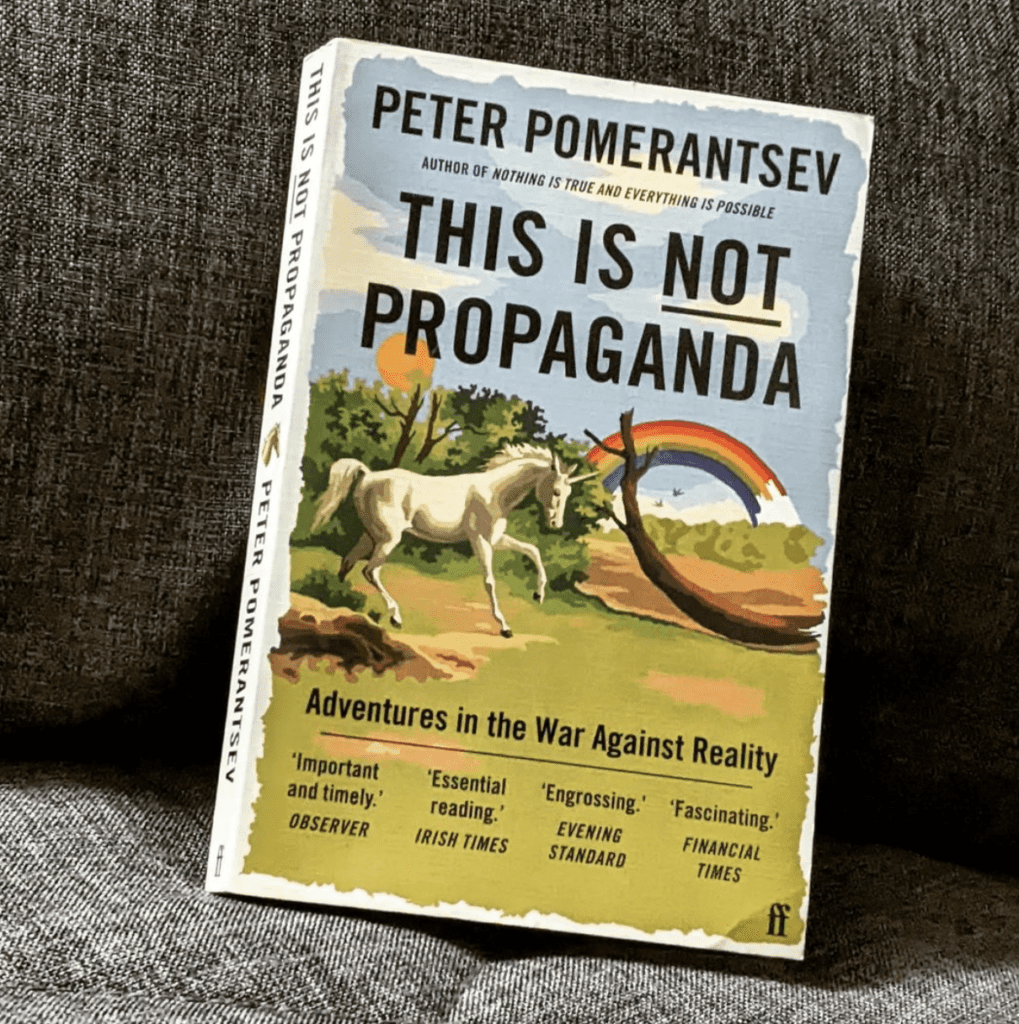
  • This is not Propaganda

    Peter Pomerantsev

    As the old joke goes, ‘Truth will prevail’, but no one said whose truth! I think if there is one book you should read to understand the sociopolitical information warfare on social media happening daily, this is it. From Mexico to Manila and London to Kiev, there is a playbook that is being followed to distort reality. The same tools that were originally used to create revolutions are now being used by autocrats to gain and hold power. More information was supposed to be more power, but it also provided new ways to silence dissent. Censorship through noise. And where did it all begin? In Russia. Peter Pomerantsev has a first-hand experience of how it all started. Forty years ago, his parents were forced out of Kiev (then part of the USSR), and their journey since then serves as a great narrative guide. 

    The book is divided into six parts. The first part uses examples like Rappler vs Duterte (Philippines’ version of Trump in the US and Bolsonaro in Brazil) and Lyudmilla Savchuk, who exposed Russia’s troll farms, to show how new instruments of information are being used to break people. Russia denies connection with the troll armies, like every other state – Turkey, Bahrain, Azerbaijan etc – that uses similar means. 

    The second moves to Latin America and EU to show how entire resistance movements have been dismantled. Clever rulers have found ways to remove the clarity around the ‘enemy’ by coopting the language and tactics as those who fight oppression. Srđa Popović knows a thing or two about the original playbook. A Serbian political activist, he was a leader of the student movement Otpor!, which was instrumental in toppling Serbian president Slobodan Milošević. He has since then trained activists in Georgia, Ukraine and Iran. It’s an irony that his manuals and courses are being used against the very purpose for which they were created, and it’s now come down to an arms race of tactics and technology between guys like Alberto Escorcia and Mexico’s corrupt politicians. Russia invaded Estonia in 2007 without setting foot in it by mimicking the entire playbook and using Estonia’s own pro-Russian citizens in protests. Another trick is to state that genuine protesters are being paid by the US. From Facebook to Discord there are people being recruited and systematic strategies being used to undermine pro-democracy efforts.

    The third part is on how one nation is able to ‘invade’ another without real contact by blurring the idea of war vs peace and domestic vs international. War is no longer in just physical space, it is hybrid, non-linear, full-spectrum (all terms used by experts) and is focused on decaying the opposing group/country from within. Information warfare is the first play and the military follows, if required. Russia’s attack on Ukraine in 2014 is the classic example. “Faced with wildly conflicting versions of reality, people selected the one that suited them.”

    The fourth explains how, without a tangible idea of the progress and future, anything goes! When Putin invaded Crimea, he first said there were no Russian soldiers there, and then later casually said there were. Replaced one reality with another. Another example – 76% of Trump’s statements in the election were mostly false or untrue! The case made for these distortions is that objectivity anyway doesn’t exist. Related to this is the glorification of the past. ‘The twentieth century began with utopia and ended with nostalgia. The twenty-first century is not characterised by the search for newness, but by the proliferation of nostalgias’. And in the era of ‘soft facts’, we can know everything happening in Aleppo and pretend to not see it.

    Pomerantsev sets a prelude for Chapter 5 with his own confused identity in childhood – British or Russian? When old notions of identity around demographics and religion get blurred, all politics now revolves around ‘identity’ they can create and use for their own ends. The story of Rashad, one of the founders of Hizb in the UK, who was early into this game but now works to dismantle it, is fascinating. This part also has the working of the Brexit campaign. Eighty types of targeted messages for 20 million people. Animal rights, environmentalism, gay rights, potholes all somehow made to connect with Brexit. And it all began in Russia. Starts by Pavlovsky for Yeltsin, but polished by Putin. 

    The final part is about the future – China, but begins with Nigel Oakes, founder of SCL, whose game was repurposed by one of its other founders to create Cambridge Analytica. China is well on its way to target people with demographic, psychographic and behavioural patterns. The book ends with a brilliant closure – of the subject as well as the personal history.

    While the wiring is clear, what remains to be seen is the second order consequences of this combination of trolls, psyops, dark ads, bots, soft facts etc. Not just at an individual or societal level, but at a species level. The book is extremely well-researched and has a narrative and language that is easily accessible. The interweaving of the personal narrative is at once sharp and seamless. This is a book I’ll hugely recommend. 

    P.S. I wish he had also covered India too, the playbook is being religiously followed here!

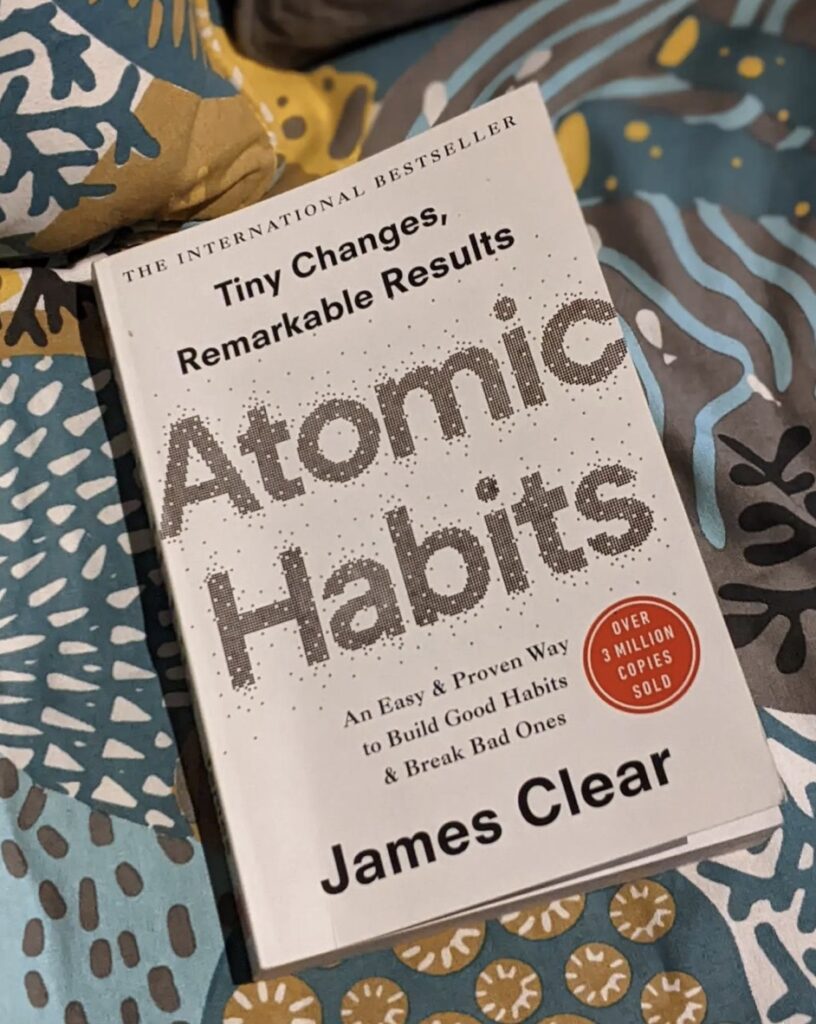
  • Atomic Habits

    James Clear

    Given that I read The Power of Habit a while back, and have been a subscriber to James Clear’s newsletter for a while, I should have read this a long time ago. But better late than never. 

    He begins by explaining how small changes can make a big difference over a period of time. Positively and negatively. ‘Habits are the compound interest of self-improvement.‘ Hence the word atomic – small, part of a larger system, and the building blocks of great results. 

    I think one of the best insights of the book is the three layers of behaviour change framework – outcomes, processes, identity. While most people focus on outcomes, systems (processes) are a better way. ‘ You do not rise to the level of your goals, You fall to the level of your systems.‘ But the best way is to focus on the ‘identity’ – the person you want to become. The first stop is to figure out one’s habits, which tend to be quite a few over a period of time. As per research, apparently 40-50% of our daily actions are habits. And many of them are not even consciously-created ones. A habit, as Clear brings up right at the beginning, is a routine or behaviour that is performed regularly – and in many cases, automatically. From an evolutionary perspective, ‘Habits are, simply, reliable solutions to recurring problems in our environment‘. And that means, nature has its own way of creating things that reduce our cognitive load. 

    He then proceeds to breaking down the process. The process of building a new habit (or getting rid of one) has four steps – cue, craving, response, and reward. Correspondingly, to create a good habit, make it obvious, make it attractive, make it easy, and make it satisfying (and their inversion to get rid of a habit). These make up the Four Laws of Behaviour Change. The remaining chapters are all about bringing this to life. From managing one’s environment to the role of friends and family, fixing procrastination, using commitment devices and motivation rituals, reducing friction, how to stick to good habits, and even automate them when possible. By the time you read the end of this part, you have a fantastic table that can be quite easily applied. 

    I liked the last 50-odd pages the most because of my own interest in the topics. The perspectives on the role of nature and nurture – ‘genes can predispose, but they don’t predetermine‘, and how to determine the game where your odds of success are higher. Habits are easier when they align to one’s natural abilities. ‘Boiling water will soften a potato but harden an egg. You can’t control whether you are a potato or an egg, but you can decide to play where it’s better to be hard or soft.’ 

    He also brings up the downsides of even good habits, the importance of reviews and realignment, and how one can break the beliefs that are holding one back. Becoming the best version of yourself requires you to periodically edit your beliefs and worldview, and expand your identity. 
    Some of the frameworks have been inspired by others (and Clear makes sure he mentions those) but through framing, easily relatable examples, and ways to implement them in daily lives, he makes application very easy. This is a must-read book, especially if you’re in your 20s and 30s. From experience, compounding is probably the most underrated phenomenon. The earlier you start, the better. ‘The costs of your good habits are in the present. The costs of your bad habits are in the future.’

  • Debt: The First 5000 Years

    David Graeber

    If it doesn’t upend deeply held beliefs and origin stories, it isn’t really a Graeber book! The story goes that from money came debit and credit, but in Debt, he argues, with excellent evidence as always, that long before money came into the picture, we had ‘human economies’ which were imprecise, informal, and had a community-focused and shared ecosystem approach. An ‘everyday communism’ in which people owed favours to each other. And then the favour was converted into a mathematically precise entity, mostly thanks to the machinations of war, and sponsored by the state. Cash, barter, and every other method of financial transaction came later, and began exclusively for scenarios where there was low trust. Debts cannot be stolen, gold and silver can. Favours are relationships. Debt is a transaction. And thus ‘the history of debt is also the history of money’. 

    He begins with the morality of debt and the paradox of two popular views – paying back what one owes is moral, and lending money as a habit/profession is evil. In the fantastic section on ‘primordial debt’, he traces the cultural narrative of humans owing debts to the God who created them, and how sacrifices were a means to try and pay a debt that could never be repaid. People also owed a debt to society in general, and governments became the custodian of it.

    Using evidence (or the lack of it) he shows how the common story of barter leading to a common currency is a myth and that it stemmed from a narrative of ‘the economy’ that was ‘separate from moral or political life’. Barter is a very recent phenomenon, and the correct order is actually credit systems (‘virtual money’ – not to be confused with digital!) – money – barter. And when money came into the picture, it served as a yardstick – of debt. A coin was an IOU. And one that the state was interested in because they wanted uniform systems of weights and measures across their kingdom. 
    He proposes that there are three moral principles on which all economic relations are founded – communism (or love if you don’t want to sound political), hierarchy, and exchange. The first was based on expectations and responsibilities from/to each other. Then there is exchange based on equality and reciprocity (these don’t lead to a ‘market’). The hierarchies, over a period of time, formalised inequalities into castes and related customs and behaviour. 

    In early civilisations – India, Sumer – there were ‘primitive money’ mechanisms, such as the ones which were used to arrange marriages, resolve blood feuds ans other social interactions where there was a debt, but which was not easy to quantify. It was common for people to get into levels of debt that forced them/their family to get into ‘peon service’, which resulted in slavery. But they could work their way out of debt. Also, early kings did a reset on a regular basis by canceling all debts. But when violence got into the picture, things changed. War converted ‘human economies’ into ‘market economies’. In war, a person ‘owes’ his/her conqueror his/her life, and the conqueror can extract anything he wants. Humans became slaves, a commodity that could be bought and sold. To be a slave was to be ‘not free’ and in debt, forever. 

    All of this last part began in the Axial Age (800BC to 600AD) when markets first started appearing as a side effect of government administration. But this soon got mixed up with war. When wars abounded, being a soldier became a profession. Coinage was a way to pay these soldiers/mercenaries. Gold and silver were mined by slaves and/or acquired during a war, and states started insisting that they serve as legal tender for all payments. A sort of ‘military-coinage-slave’ complex. This was the time that coinage was invented. First by private citizens and then appropriated by the state. Alexander was apparently responsible for killing the old credit systems. Precious metals, owned by temples and rich people thus far, started making its way into the life of common folks. 

    In parallel, historic all-time greats such as Pythagoras, Confucius and Buddha co-existed (with little knowledge of each other) and humans started reasoned enquiry into the nature of things, and practically every major religion in the world was born, trying to find new ways of thinking about ethics and morality. They rejected the violence of politics, and tried using the knowledge from impersonal markets to create a new sense of morality. But except in China, religion and market couldn’t stay together for long. 
    In the Middle Ages (600-1450 AD), when old empires collapsed and new ones began to form, hard currency began to be less commonly used, but the system of accounts and credit continued to be used. Even Europe did not revert to barter. And elsewhere in the world, new financial systems and instruments began to emerge – promissory notes and paper money (China, where the empire survived), and letters of credit and cheques (in the Islamic world). The roots of most of the worldview in finance can be traced back here. First, China’s less-than-appreciative view of capitalism. ‘Merchants were greedy and immoral’ and ‘if kept under careful administrative supervision, they could be made to serve the public good.’ There is a very interesting part about Buddhism turning to high-interest loans and altering debt-contracts to fuel its expansion! In the Islamic world, the merchant was a respected figure, pursuing honourable adventures in far lands, sealing transactions with ‘a handshake and a glance at heaven’. Despite this capitalism in its current form didn’t emerge there because the government was kept away from the markets, and the merchants ensured profits were the reward for risk. Guaranteed returns (fixed rates of interest) were a concept frowned upon in Islam. Interestingly, over in Europe, this was when Roman law was revived and ‘interest’ began to be seen as ‘a compensation for losses suffered due to delayed payment’. It was also when the Jews started getting a bad rep for charging high interest rates. Interesting side journeys include the Crusades as a way to create new markets, and Shakespeare’s ‘Merchant of Venice’ being a guilty projection of terrors directed the other way around. 

    We finally get to the Age of the Great Capitalistic Empires (1450-1971 AD) – the Atlantic slave trade and the mining of gold and silver in the Americas, which was mostly used to trade in China, India and the Far East. This prompted the return of the bullion economy and the emergence of Italian city-states which ignored the Catholic Church’s ban on usury and ultimately led to the current age of great capitalist empires. Also, a reemergence of military endeavours – ‘when Vasco da Game entered the Indian Ocean in 1498, the principle that the seas should be a zone of peaceful trade came to an immediate end’. In the Axial Age, money was a tool of the empire. When the latter collapsed, the former went with it. But now, money was autonomy and political and military powers were reorganised around it. Municipal bonds were first introduced by the Venetian government as a way to levy a compulsory loan on taxpaying citizens to fund a military campaign. It promised 5% annual interest and these bonds were negotiable, creating a market for government debt. The beginning of paper money in the Western world. But it was the creation of the Bank of England in 1694 and its bank notes that truly made paper money mainstream. 

    In 1971, Nixon announced that foreign-held US dollars would no longer be convertible to gold. And that was the end of the gold standard. Since then, American imperial power is based on a perpetual debt – a promise to its own people and nations across the world! Fiat money backed by public trust. When it needs money, it prints it! And the premise that some of us have to pay our debts and some of us don’t. 

    Thus, a book that has world history, religion, the state and the military, and yes, the origin of money. It isn’t as though I can absorb or understand all the contexts and perspectives that Graeber offers in his books. But I read it for three things – one is that he provides view that is starkly original, different and thought-provoking as compared to prevalent narratives, the second is that his research quality is so good that even though I may not comprehend everything, there are bits that are amazing information/insights, and the third is that is that he is incredibly empathetic and earnest about how things should be better for everyone.

    Debt
  • The Stranger in the Woods: The Extraordinary Story of the Last True Hermit

    Michael Finkel

    Michael Finkel begins the book with a quote attributed to Socrates – “How many things there are that I do not want.” It’s a perfect start because the subject of the book – Christopher Knight – eschewed everything that was non-essential to himself back in 1986, the year that Chernobyl happened, when he was twenty. In his first road trip, he drove till he nearly ran out of gas. “I took a small road. Then a small road of that small road. Then a trail off that.” And then he disappeared for the next twenty-seven years, in the woods of “the maine land of New England”, Maine. Living less than three miles from society, and yet inhabiting a world that was only his. 

    He ‘raided’ camps for his food, fuel, entertainment and other requirements. Books were a weakness – spy novels and science fiction to Ulysses, his favourite was ‘The Rise and Fall of the Third Reich’. Never extravagant, he only took what he absolutely needed, and felt deeply guilty about that. Reactions to him ranged from a deep admiration for the life he chose to hatred for the feeling of insecurity he created among residents. Eventually, he came to be known as the hermit. One whom no one could track, because he didn’t even leave footprints. He tried not to even give a hint that the place had been robbed, even refitting doors if it came to that! Though sensors and surveillance tools became more efficient, he managed to evade them. A camp for the disabled was ‘his private Costco’, and that’s where he was finally caught. 

    He didn’t really know why he chose to do this, but he was an introvert who found interactions with society and its rules tedious. Hermits are usually of three types – protesters, pilgrims, and pursuers. Japan has a million of the first kind – hikikomori – dubbed the lost generation. Most religions have the second kind. The third are the most modern, and they seek ‘alone time’ for what they want to do -from artistic freedom to self discovery. 

    Knight left because ‘the world was not made to accommodate people like him.’ ‘It wasn’t so much a protest as was a quest; he was like a refugee from the human race. The forest offered him shelter.‘ His plan was to eventually die in the forest. After he was apprehended, he spent some time in prison. In his own way, he tried to adjust. But he just couldn’t socialise, even his meetings with the author were awkward and full of silence. When the author saw him last, in court, after he had been living with his family for a while, he seemed compliant, where once he had been full of defiance. ‘He had seen the bottomless nonsense of our world and has decided, like most of us, to simply try to tolerate it‘. 

    I found the book deeply poignant. There is something noble about a person whose response to the way of the world was to quietly withdraw from it. Twenty seven years is a long time to survive outdoors, especially in a geography whose winters are cruel. And yet, that’s where he found peace. 

    Favourite quote: Not till we have lost the world do we begin to find ourselves ~ Henry David Thoreau