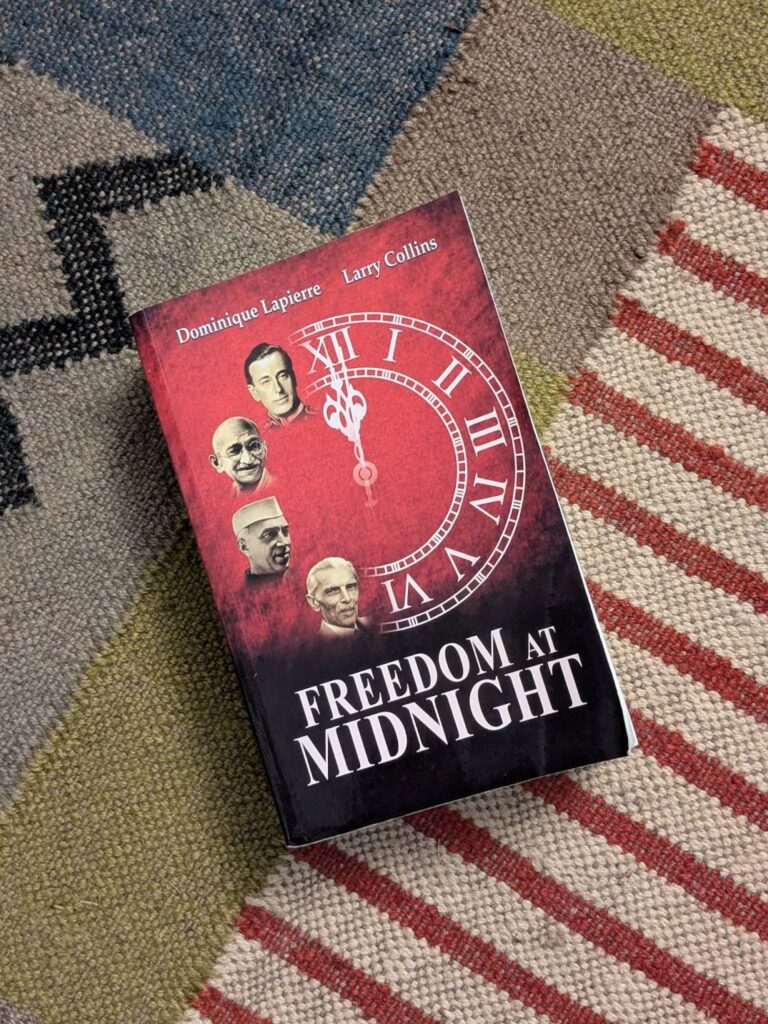
Larry Collins, Dominique Lapierre
It’s ironical that I picked up Freedom at Midnight thanks to the show, but this is how history needs to be written. Larry Collins and Dominique Lapierre have created a meticulously researched account of the final year of British rule in India – starting with the appointment of Lord Mountbatten as the last viceroy of India and ending with the funeral of Mahatma Gandhi.
But it isn’t dry history, it is almost like a cinematic view of the events that led to the partition of India and its independence in 1947. The narrative is gripping, the prose is eloquent, and the descriptions vivid enough to make one actually feel it’s playing out in real time.
Through a combination of interviews, archival research, and narrative storytelling, Freedom at Midnight brings to life the key players and tragic choices of that defining year. The Congress, the Muslim league and its leaders, the princely states and their colourful rulers, the machinery of the Raj, all come to life.
So too do the places – Delhi, Punjab, Bengal. And the British’s summer capital Simla, and how supplies and earlier, even people, were carried up steep mountains by porters each year. The book’s strength lies in its ability to weave together high-level politics and decisions with the (affected) human stories. From the opulence of the British Raj to the celebrations across the nation to the brutal massacres of partition, it is a vast canvas, both geographically and emotionally.
Freedom at Midnight is written like a thriller – the pace never slackens, even as it moves in and out of complex political drama, the horrors of large-scale violence, and the moving stories of people caught in the upheavals. If one had to pick, Lord Louis Mountbatten stands out. And so does Gandhi.
Admittedly, the prose does point to a Raj romanticism and the authors have a bias for both the gentlemen. But I don’t think that takes away from the enormity of the task at hand, and they respectively achieved. Appointed the last Viceroy of India, Mountbatten is portrayed with as charming, burdened with the unenviable task of overseeing the end of empire. Gandhi is inimitable – both saintly and stubborn, a man of deep moral conviction navigating a world descending into chaos.
Jawaharlal Nehru emerges as idealistic and modern, while Muhammad Ali Jinnah is painted in darker shades – stubborn, brilliant and aloof. The quietly important VK Menon, the strong and efficient Vallabhai Patel, an adamant Churchill, kind and gracious Lady Edwina Mountbatten, all play pivotal roles.
Freedom at Midnightvividly brings out the price of freedom – on a date hastily (in hindsight) decided by Mountbatten in the spur of the moment – the chaos of partition, the failure of political leadership to prevent communal violence, and the limits of British imperial power.
It captures the horrors of the time – the trainloads of corpses, the mass migrations, and the unspeakable violence between Hindus, Muslims, and Sikhs. It is possible to simultaneously feel for the decision-makers and the moral cross they had to bear, and for the people who faced the realities stemming from those decisions. They were all just humans, caught in a particular time in history.
Freedom at Midnight is a fascinating read with a level of detailing that’s quite astounding for the enormousness of the canvas. In my Bibliofiles 2025 long list.
(Not by design, but Freedom at Midnight is indeed a worthy book for review #400 on Goodreads)
Notes & Quotes from Freedom at Midnight
1. Mountbatten’s last act as Viceroy was to promote the wife of the Nawab of Palampur to the rank of Highness. She was an Australian and had been denied that rank because she was not of Indian blood. Years later, she asked for the author’s autograph after a lecture in Geneva. Mountbatten also used the debt 3 years later to ensure the navy kept its customs’ privileges because the Collector of Customs had previously been the Nawab’s British Resident – Sir William Croft.
2. The first British to land in India was William Hawkins, captain of the galleon Hector
3. Cows were deemed sacred to protect them from slaughter during times of famine
4. One of the people released thanks to the Irwin pact was Gurcharan Singh, right when he was about to be hanged. He became Gandhi’s follower and would be the person to hold Gandhi in his last moments. Irony!
5. Gandhi refused to save his wife because the drug would have to be administered intravenously, and that went counter to his principle – natural cures
6. “You will never know how much it costs the Congress to keep that old man in poverty” ~ Sarojini Naidu, because many in the crowds around Gandhi were Congress folks, to protect him
7. The Nizam of Hyderabad combined his passions for photography and pornography to amass what was believed to be the most extensive collection in India!
8. When Jinnah first announced the formation of Pakistan, his inability to speak Urdu meant that the only words he said in the language (after the announcement in English) was Pakistan Zindabad. Many people didn’t realise the language switch and thought he said ‘Pakistan’s in the bag’!
9. Mountbatten decided on the transfer of power date in the spur of the moment, when asked by a journalist. Same date as the unconditional surrender of the Japanese in WW2 in his previous role
10. So banal and petty was the bureaucracy of partition that dictionaries were split from A-K and L-Z and taken to separate countries!
11. The man who had articulated the idea of Pakistan was Rahmat Ali in 1933, and at that point, Jinnah vehemently refused to be party to it
12. To the orthodox Hindu, the navel is the body’s frontier – for acts above it, right hand, for acts below, the left.
13. By giving Gurdaspur to India, Radcliffe also gave it land access to Kashmir, changing that state’s destiny
14. Nehru and Patel were stunned in the early days of partition horrors. They asked Mountbatten to come back and take charge, and it became an Emergency Committee
15. Pakistan blatantly lied about the Pathan force it had sent to take over Kashmir. Ironically, their sacking and rape of the nuns of the Franciscan Missionaries of Mary delayed them and allowed the Indian army to take control.
16. India held back Pakistan’s share of the overall money – 550 million rupees, courtesy the Kashmir issue
17. Immediately after partition, there were refugees chanting “Let Gandhi die” (I am assuming Murdabad and not anything this drastic) as he fasted for peace
18. A few weeks before his assassination, Gandhi’s last fast for peace was almost fatal. His ask – a peace charter which had to be signed by all key political and social organisations – was an impossibility that the leaders managed to accomplish just in time.
19. Godse and co, tried to assassinate Gandhi once before. They failed, and part of their attempt was a bomb going off. The enquiry, led by DJ Sanjevi, was an exercise in incompetence. One of the cops, UH Rana, even had the identities of the would be assassins, but didn’t share them in time.
20. Two crucial people were missing on the day of the assassination. Sushila Nayar, his doctor who always walked ahead of him, was in Pakistan, making preparations for Gandhi’s planned visit. D.W. Mehra, the policeman who was assigned to protect him, had been called away for other duties.
21. Jinnah’s condolence message called Gandhi one of the greatest men produced by the Hindu community. When pointed out that Gandhi’s dimensions went beyond his religion, he insisted on retaining the line.
22. Jinnah’s tuberculosis diagnosis was a well-kept secret, and so was his life expectancy – a few months. If Mountbatten had known this, he would have delayed the transfer of power because he was confident of swaying the other League leaders, and Partition might have been avoided.
23. Roy Bucher prepared two funerals for Gandhi. The first was in Yeravada Jail in 1942, but Gandhi ‘declined to attend’ after somehow surviving his 21-day fast! His actual funeral was also prepared by Lt. Gen. Sir Roy Bucher.