
Author: manu prasad

  • Big brands, small ideas

    I ended last week’s post with a note that social media services provide brands a way of having their lifestream online, and weaving themselves into the consumers’ context. Last week, I read an interesting article on Six Pixels of Separation titled “Your Company is a Media Company“. It talks about how the different social media tools allow companies to publish their own content without the aid of the earlier generation’s tools and processes – newspapers, PR companies etc, and how these companies are finding new ways to tell stories. It also discusses how consumers now expect companies to be connected, listening and reacting – in a human voice. I remember touching upon this subject in a few old posts of mine – “The new media owners“, and “The Evolution of Content Marketing” a few months back.

    One of the biggest gripes that come up when big brands arrive on social media services is how they use it as just another broadcast channel for their TVCs/microsite/contest etc without adding any value to the reader/consumer. I have seen many a brand on Twitter completely disappear when their promotion ends, perhaps it came up only because ‘Twitter account, Facebook page’ were the current flavours in the marketing communication checklist. These are obviously generalisations, and the three examples that I’d discussed in the last post are obvious exceptions.

    While wondering why it has to be this way, I remembered an old post of mine, which though discussed the future role of a brand manager, had started out on a different premise. It had been triggered by a superb post by Russell Davies titled “the tyranny of the big idea“, and a couple of wonderful notes at Misentropy, which took the idea further. (All the three posts I have linked to are 1-3 years old, and I still find them great reads. What I’m trying to say is that you MUST read them)

    In the last few days, I have seen a few posts that have explored this theme, from different perspectives. Six Pixels of Separation has a post that discusses how the combination of 3 factors – a conversation based social media, real time and fragmented media would mean that marketing strategy would have to move away from the big idea and be more involved with smaller ideas basis the type of people the brand talks to, the platform of discussion, and the context. Closer to home, I read a good post  on afaqs – a question posed – whether television is hogging the resources (financial and talent) because in India it is the most preferred medium (not basis revenue) for marketers as well as the advertising fraternity. L Bhat has a very pertinent post on regional branding, and how Indian brands approach it with a one-size-fits-all approach, relying on translations which don’t do justice to the original idea, or showing contexts which have no relevance to the local audience. He notes (illustrated with examples) that brands which have developed communication specifically for the region have touched a chord with the audience. Another indicator that media fragmentation is not just about the web, let alone social media.

    With the advent of the internet, and specially social media, brands have the opportunity now to use this means of distribution to explore the long tail of audiences and marketing communication. The economies that dictate the usage of television, print etc – in terms of both production and distribution, do not really apply on the web. The NYT has an article on the rise of sentiment analysis – the social web as a ‘canary in the coalmine’, as a way to identify opinion leaders, as a forecasting tool, and so on. Its still early days yet, and we will obviously see much improvement in the current systems. In BlogAdda’s interview with Avinash Kaushik, Google’s Analytics evangelist, I had asked about the effect of the ’emotional responses’ in social media on the field of analytics. As he explains, there cannot be a single tool that can capture all data, and those who monitor this, will have to get used to the idea of multiplicity. From just deciding where communication will be distributed (and to a certain extent, consumed) to  having to track where conversations are happening in an ‘everything reviewed‘ (Transparency, Trendwatching’s September trend)  world, and then deciding the what-why – that is quite a drastic change. These are obviously not mutually exclusive, but it still is a challenge.

    The earlier models of communication (and even some elements of strategy) have perhaps been conceptualised and practised without factoring in instant two way communication, conversation among consumers, and multiple touch points. It was relatively easy for everyone concerned to have one big idea and push it into all the channels. That is perhaps what is happening as ‘social’ is seen as just another ‘media’, but it works differently. It involves a whole new set of rules, some yet to be even thought of. While there will be quite a few advantages, there will also be several challenges for the brand- to be different within the core brand idea, to add value to the different kinds of audiences in context, to decide levels of transparency and be comfortable with it, to be a ‘media company’, to be also comfortable with the rigours of listening and possibly having to react real time. There will be challenges for the brand manager, like I mentioned in the post earlier. There will be challenges for the creative agencies – when they develop ideas, they have to be medium and context specific, and also know how to respond in real time. They will also have to be churning out fresh ideas on a regular basis. There will be challenges for media agencies – to find out the maximum possible touch points relevant for the brand. And this is not just to do with the web and social media alone, but the better usage of other media too. Brands can actually be different things to different people, and be relevant. In short, a drastic overhaul of the system which currently operates, before they an get to being a media company. Being a ‘media company’ and ‘always on’ means that the ‘content’ cannot solely be made of big ideas. Possible, but impractical, I’d say, unless its an idea with several rendition and execution possibilities. From one big idea every quarter/year to a stream of small ideas. Not necessarily, perhaps, but probably so. I wonder, how many big brands and agencies will be game for playing with small ideas.. and failing sometimes?

    until next time, a tyrannosaurus hex 🙂
  • Bloody cool. They’ve earned it. Cheers.

    Ok, that was a fairly long and (to some of you) meaningless title, but that was the only way I could think of, to connect the three brands whose activities on Twitter make up this post. Since I rarely come across  praiseworthy efforts from Indian brands on Twitter, I thought it would be worthwhile to keep track of those who are making some decent attempts.

    We’ll start with Channel V, whose Rs. 5 crore makeover to a ‘Bloody Cool’ channel has been a talking point, thanks to a multimedia blitz including write ups in print, flash mobs and online activity, which could leave the viewer ‘exhausted’. I first came across them on Twitter when they RT ed a tweet of mine a couple of weeks back, and have since then seen several people on my list change their display pictures to the Channel V logo. There were two activities that they were doing on Twitter. One was basis the site ISawTheChange (loved Simpoo’s ‘Saw the chanze’ touch), where users were asked to spot the changes in an image on the site, and there were prizes to be won daily. Users had to respond on Twitter which meant that my stream also had people regularly tweeting ‘I saw the change at….’. This site also has a link to Channel V’s Facebook activities. They actually have more fans on FB!! The other activity was basis the OnYours site, and this was led to the sprouting of huge numbers of Channel V logos on my stream, as users changed their display pictures. The interesting part of this was that the user’s original display picture and the Channel V logo would be switched randomly during the period of the promotion (till Aug 22nd) Users also had the option to withdraw at any time. If they remained signed in for 5 days or more, they had a chance to win a tee. In addition to both these activities, on Aug 21st (the day before the change) Channel V also had a 12 hour (11 Pm onwards) – 48 question challenge and a chance to win more prizes. Judging by the timeline, there wasn’t a lack of participation.

    Of course, not everyone liked their in-your-face approach to ‘hijacking’ twitter (maybe a twibbon like approach would’ve been preferred), but the point was, the participation was crowd driven and if someone had to be blamed for the logo blitz, it could only be the people one followed. Channel V also used their stream to announce the details of their flash mobs and even answer the question ‘why a relaunch‘. Most importantly, they took everything in good humour, including my BC MC tweet. 🙂 They have built a fair amount of good equity on Twitter, it will be interesting to see how they take it forward. I was wondering if they’ll do a Twitter version of ‘Exhausted’, with tasks specifically created for the way Twitter operates (including pictures and videos using apps). Might be a good experiment. In fact, when i got the DM for the 12 hour quiz I mentioned earlier, I was wondering if it would be a promo for #exhausted. On the music side, they could latch on to several existing tags like #musicmonday, or even create their own #nowplaying. They could also use this to announce music launches and give video previews etc. With Twitter now getting serious about geolocation, there are bound to be some good apps coming along. They could use that to inform specific audiences about concerts/gigs happening in their city. There are, as always possibilities.

    Though I wasn’t a big fan of the initial promos on Twitter for its blog, the second brand that is doing some interesting activity now is the Cadbury Bournville brand with the #earnit tags. Interesting to note that there’s also a Bournville News operating from Birmingham, and that’s also about the Cadbury brand!! Meanwhile, our version of Bournville manages to insert the tag in context on a regular basis. From Vir Sanghvi’s articles to promising Pinstorm chocolates if they showed 5 reasons why they had #earned it, the brand manages to keep the conversation alive. What it should be perhaps working on is the integration that Channel V has been able to achieve – online as well as offline. For instance, though they do connect to Facebook, their ad on YouTube and even its spoof, I couldn’t find anything about their twitter activity on the website. And the connection to the the-dark-truth.com? In fact, with all the contests that V has been running, they could have easily tagged along and gifted some dark chocolate to the winners (at least where it is operationally feasible for Mumbai, like Mumbai?) Even though operations would be tough, it would be nice to see them running some Twitter contests (say, how have you #earnedit in 140 characters or a twitpic) and doing a gratification offline. I am sure they can at least tie up with a few retail chains to accept Bournville vouchers and give away chocolates. With people winning awards and contests on a regular basis, there is indeed potential for #earningit.

    The last interesting brand I’d like to mention is Kingfisher. Kingfisher came to my attention thanks to their timely and correct response to a user’s tweet. They managed to clarify an issue very well. Kingfisher also uses the stream to RT any mention of their brand by folks on Twitter (example) as well as give information about their events. Kingfisher does have a good opportunity to perhaps associate with tweetups in various cities by leveraging their association with F&B establishments. Again, given the amount of events that they partner, they could also further streamline their alerts using Twitter Local features later.

    In spite of the various challenges, Twitter does allow a unique way for brands to have their lifestream online. It enhances the story telling opportunities, and ways to weave themselves more into their consumers’ context. Such cases hopefully will encourage more brands to try out the service and take their brand beyond one way communication efforts.

    until next time, brandstreams and blue oceans

    Update: Just got to know that a fellow member of the Digital Marketing India group on LinkedIn – Sanjay Mehta, and his company, Social Wavelength (www.socialwavelength.com) are behind Channel V’s efforts described above. In my view, a splendid effort. 🙂

    No, there’s nothing to disclose 🙂

  • The changing face of search

    The last week saw some frenetic activity in the online space – a few events that are not just going to cause a shift in the way we search and share online, but could possibly impact the direction in which the web develops henceforth. These are very very interesting developments, and not just from a technology standpoint. Apparently, if we go by this, our brain is hard-wiring us to  love Google, Twitter and texting. That will change the way we evolve as a species. But meanwhile…

    Facebook began the week by acquiring Friendfeed (FB, FF – BFF), something I’d hoped that Twitter would do. For those not familiar with the service, its a neat aggregator of most of your activities online (blogs, twitter, facebook, delicious, flickr, YouTube…) and allows others to comment, share, like, search. Yes, most of those features that Facebook has been adding have been lifted from Friendfeed. For several reasons, the service, though extremely useful, has remained geeky.

    The integration is bound to be tricky. While Friendfeed is used mostly as an aggregator (though some publish content exclusively there), Facebook thrives on ‘original’ content. Also, there are features on FF that don’t have a parallel on FB, and perhaps users too. I have different user names on both places, and there are very few who are friends of mine on both networks, and for a reason. I wouldn’t want to import my network on FF to FB. Also, I don’t import all of my content on FB. In many ways FF was my ‘private’ aggregator,  a place where I could aggregate without making it too public. Adapting that on FB would require a lot of settings work. FF’s stream and its approach to updates is also different from FB. So it is quite possible that integration will not happen. But the Friendfeed ‘brain bank’ – people who had earlier made GMail, co-founded Google Maps, is unquestionably an asset, and one part of me won’t mind the fact that the acquisition will perhaps ensure that the innovations will reach a wider audience, and perhaps speed up the learning curve of casual social media users. The other part hopes that they will leave this version of FF intact too, even if it is as FB Labs.

    Facebook’s ‘Lite’ also caused a stir, as several users saw an announcement that they were the chosen ones to test it out, though it turned out to be an accident, but that meant that all of us got to see a preview. It turns out to be a lighter, faster-loading version of Facebook, designed to give new users (especially from countries with lesser broadband access) a simple experience to begin with.

    Facebook also launched real time search around the same time, and the ability to search shared (friends and public shared) news feeds (of the past 30 days) – status updates, photos, links, updates, Fan pages, with the option of filters, is quite a huge step. In many ways, FB is ‘forcing’ people to be more public to derive the maximum advantage out of the service. As Steve Rubel correctly points out, it has major implications on our consumption of content, making us ‘source agnostic’, which we are already, to a certain extent. Also, as he mentions, the impact of Facebook Connect in this equation means that the net is cast wider. The important factor in this, and the reason why i feel Google needs to take a long hard look at this is because there is a people filter here, in addition to the algorithm – news feeds of friends, people who have chosen to share their FB content publicly, means that it works as a kind of endorsement, a personally tested good source. That might potentially be better than Google’s spiders. I am not even bringing Twitter Search into the equation because if FB uses FF correctly and gets a majority of Twitter users to get their tweets into FB (store all but dipslay selectively), then the uniqueness of Twitter Search is gone. Besides FB has a much larger user base anyway.

    Yes, Google is watching, flexing its muscles, and developing a few new ones too. On the day that Facebook dropped its big news, Google also unveiled the next generation of its own search – Caffeine. According to them, “It’s the first step in a process that will let us push the envelope on size, indexing speed, accuracy, comprehensiveness and other dimensions.” More than an upgrade, it seems like completely new architecture, and will change the way Google indexes pages, and these changes also include real-time. Meanwhile, its also playing with new forms of product ads.

    Google is also getting a bot more serious about ‘social’, and that is perhaps the reason behind iGoogle getting a facelift with 18 new widgets on the homepage. I’m not too much of a user of this service, but according to RWW, Google is slowly unleashing the services built on OpenSocial, and trying to make iGoogle the hub of a user’s Google activities, and sigh, there’s quite a lot of them. There are Facebook like update feeds (of friends), a share-able To Do gadget, a Scrabble gadget (hmm, that’s appealing) among other things. But the integration is not complete as shown by the YouTube widget and the absence of a Reader widget. But as I always say, the potential, if they actually manage to integrate all of this, and then add Wave features on top of it, is scary. But perhaps (since the social graph – i.e. who sees your comments and shares, is different) iGoogle is not meant to be connected with others.

    The last announcement from Google was on the subject of Reader. In addition to the recent social developments, now reader items can be shared easily to other networks including Twitter, Facebook, Digg, MySpace, Blogger etc. Also, some tweaks in the ‘Mark all as read’ feature make it a lot more useful now. You can read the details here. But hey, Google, how about bringing Reader closer to real time?

    Meanwhile, in the midst of these killer shark wars, the ‘whale’ boys have their own bogeymen. In addition to the wave of DSoS attacks, and the fact that Facebook grew twice as fast in July, the Gartner Hype Cycle white paper for 2009, has stated that microblogging has tipped over the peak and are about to enter the ‘Trough of Disillusionment’. But I am not sure I agree with that. Microblogging, as Seth Godin once stated (about Twitter) is a protocol (nailed it brilliantly!!), what gets transmitted across it is a variable. Its news and links now, and who knows, a smart user/set of users might figure out something else tomorrow that would cause yet another disruption. Perhaps Gartner meant it only in the current context of usage. Twitter has just announced phase one of Project Retweet, which is aimed at changing the way the format of RT works and looks. While it does pose some inconvenience – we are used to the current RT @ format and will perhaps take some time to get used to seeing just the original tweet with a small ‘RT by’ (reminds me of Friendfeed’s ‘Like’), I am hoping that the open API means the developers will deliver to us some useful stuff (Retweets by/to me, of my tweets timelines, the lessening of clutter, as Mashable points out) But honestly, these seem to be small efforts when compared to those of Google and FB.

    Interesting indeed. Rather than conspicuous face offs, Facebook and Google are warily circling each other, and launching and tweaking services that  test out each others’ stranglehold on areas. An elaborate game of chess, that doesn’t look like it will end anytime soon. Stalemate? Though it could be argued that there is space for both, I am inclined to think that the margin of advantages between the leader and the second best will be very high. The battle is for understanding consumer intent and making a revenue stream out of it. Google did that without much competition with search, until specific competition (Bing), real time and social media made threatening noises. Facebook’s appeal was on both those fronts, and now Google is making advances there. But Google is rich and now even has a browser with which it can define the starting point and direction of a user’s web experience, while Facebook revenues are still iffy. Facebook users have shared so much of content inside the ‘walled garden’ that it’ll be difficult to get out even if they desire. Not that Google is an angel on that count.  (You must see this hilarious Onion video – Google’s opt out village) And now with Friendfeed, FB can lay its hands on Google content too – YouTube, Blogger etc can all be pulled into Facebook. But if they rub users the wrong way while trying to accelerate revenues, one can never say.

    What would I like to see? Microsoft buying out Facebook. Perhaps then, we’ll have a fight that’s really too difficult to call.

    until next time, which service is your BFF? 🙂

    Bonus Read: John Borthwick’s ‘The rise of social distribution networks‘.

  • Paper Capers

    Almost 2 months since we last discussed newspapers, so I thought its a good time to update. Rumour is that Murdoch plans to sue Google and Yahoo over news services. Fact is that he’s going to charge for news, something he’s been doing for a while with WSJ, and the ‘experiment’ is going to start with The Sunday Times. Others are set to follow his example.  “Quality journalism is not cheap,” said Murdoch. “The digital revolution has opened many new and inexpensive distribution channels but it has not made content free. We intend to charge for all our news websites.

    I, for one, am happy, because the keywords for me are ‘quality journalism’. Its perhaps a prelude to a shakedown, and the survival of only those who can adapt to a world with internet. With the width and depth of content available, the debate of ‘free vs paid’ has been going on for a while now. But perhaps the time has come to end it. Build the wall, and let’s see if people want to pay to enter. (that link is an excellent read, detailed and thought through, check it out) Opinions are bound to vary – and to be in extremes. Most people feel that it is flawed. Chris Anderson feels that at some point in the future, “maybe media will be a hobby rather than a job“,  Vivian Schiller, former senior vice president and general manager of the NYTimes.com, believes that “people will not in large numbers pay for news content online“, but there’s still space for an NYT to cut expenses and survive. Murdoch obviously believes he can get the audience to pay.

    Meanwhile, the Associated Press is planning to charge $2.50 per word if 5 words or more are quoted from its articles, with the help of a microformat. Not surprisingly, it has been widely criticised in several tones all over the web. Jeff Jarvis even has a post on ‘How (and why) to replace the AP‘, and illustrates the interesting concept of ‘reverse syndication’. Chris Ahearn, at Thomson Reuters, implores entities that are declaring war on the link economy to stop whining, and stands ready to help those who wish for an alternative to AP.

    Interestingly, Google had recently quadrupled its newspaper archives. (Locally, Dainik Jagran is now part of Google’s News Archive Partner Programme, and has a strategic deal with Google to help the group archive its bilingual daily, Inext) The average newspaper’s stance on Google is understandably ambivalent. On one hand, it is happy to get the traffic from Google, but its not happy that its only one among the websites shown, and the amount of content that Google shows. (that might prevent a reader from visiting the site) Sometime back, Google had posted its views and how, any publication can block search engines with a slight change in code.

    The reactions to this obvious ‘transition stage‘ for the newspaper industry has been taking many forms. Paywalls are boycotts are only one kind. Alternate methods of news collection like crowdsourcing+crowdfunding, public collaboration, (an interesting case, for more than this reason), nichepapers and ways in which journalists can use tools like Facebook and Twitter, are being discussed, as well as radical ideas like making the newspaper a gateway for particpative experiences, even as technological developments – touch screen ‘intelligent plastic’ roll up reader, and experiments from NYT (‘What we are reading‘) continue.

    While it would be easy to say that these are trends in the West, that are not very relevant to India at this stage, I’d still say that these are trends that media in India, especially newspapers, should be closely watching and learning from. A good read from Pradyuman Maheshwari at e4m on the same subject. While the Nielsen Online Global Survey on trust, value and engagement in advertising shows that newspapers are the most trusted form of paid advertising (in india), the TCS study on Indian urban school children show that they are extremely technology savvy and totally at ease with the web and social media.

    As stated in the TCS study “This societal trend has important implications for parents, educators, policy makers, as future employers as well as companies and brands that want to sell to tomorrow’s generation.” Some understand this, and have started experimenting with new forms of distribution. I just got  a mail asking me to check out Star Player!! The point is that one can never be sure whether the trends in the US will be replicated in India, though I’d say its more a ‘when’ question than an ‘if’, even though India’s version of the trends would be mutated, thanks to its own socio-cultural and economic pecularities. But it helps to be prepared. I read at Medianama, a few days back that the Hindu is taking Ergo, its 5 day a week publication aimed at young professionals in Chennai, online. Though the motive might have been cost saving, I’m sure it will be a great learning in understanding consumption patterns and figuring out revenue streams. I quite liked the site, powered by WordPress, with a very casual ‘About’ page, and covering some interesting stuff. It looks like an online news site, not the website of a newspaper.

    On hindsight, the collision was bound to happen. Newspapers, which subsidised news to the reading audience by making advertising pay for it. Google, which aggregated content, and served ads in context. They had to meet somewhere, and disagree on who makes how much. The concern areas for newspapers are manifold – news consumption has changed – quantitatively and qualitatively, modes of creation and distribution have changed, and Google has developed a much better advertising model. In essence, all entities in the publishing business have changed – producers, consumers, advertisers. Isn’t it inevitable that the publisher has to find a new business model? Newspapers in India still have some time on their hands, and some good tools too. With most publishing houses having multiple products that cater to specific audiences, they can actually experiment in different directions. It does cost money to create good content, the trick obviously is to figure out ways to minimise the cost and work out how much each stakeholder – reader and advertiser, is willing to pay for it. Now would definitely be a good time to start, unless you want to sound like the (as usual) hilarious Onion story – “Why did no one inform us of the imminent death of the American Newspaper industry” 🙂

    until next time, think about the link economy

  • Social Office

    A couple of days back, I happened to read this report by Jakob Nielsen (via RWW) on social networking on intranets, that throws light on the enterprise use of 2.0 tools. From the RWW article

    Neilsen’s 168-page report includes case studies from 14 companies in 6 countries, including Sprint, Sun, Intel, IBM, and Johnson & Johnson. Several times throughout the summary, he points out that when he asked these companies about their enterprise 2.0 strategy, they told him to come back in a year.

    The report, a result of research done across 14 companies in 6 countries, highlights the pitfalls of both the quick adoption as well as slow track methods of using web 2.0 in the enterprise – risk to corporate culture and loss of employees who expect quick adoption respectively. The study points out that while the tools are important, it is what it lets people do and how it helps them solve business problems that actually matter, an emphasis on the sometimes forgotten fact that the new shiny object on the www need not be of use to the organisation and even the reverse – an old tool might work best for the intent/objective. It also highlights the different aspects that need to be taken care of, while implementing the tools in the enterprise – content, training, encouraging the community, speed of integration, open communication, the need for corporate communications to adapt to the reality of real-time and so on.

    And in the end, were raised two things that I thought were the most important components in this discussion – the change in corporate culture it entails (especially the ‘knowledge is power’ tenet) and the time the implementation would take, precisely because of that (and hence the need to start right now).

    The social media strategy (if any) of many companies is either the brand’s Twitter/Facebook presence and the ROI discussions for the same, or the use of these and networks like LinkedIn for actual sales (yes, broad generalisation). When compared to the corporate culture change discussed above, these are tactical uses of social media – utilising tools, for (usually and unfortunately) broadcast or direct selling. Yes, in some rare cases, the channels are used for two way communication too. (a story on Indian IT firms)

    While many efforts are commendable, in many ways, the tactics resemble a building with a gleaming facade whose insides truly reflect the state of affairs – peeling paint, bad plumbing, poor service etc. These are bound to come out. As the Ad Contrarian wrote a couple of years back in his post titled ‘Brand Tinkering‘,

    ……………tinkering with the brand is way more fun than solving real business problems. Solving problems requires unpleasantness. Floors have to be swept and walls have to be painted. People have to be fired. Systems have to be changed. Products have to be redesigned.

    The need for a more comprehensive approach to social media, and the need for internal change is something we often discuss here. On one of the LinkedIn groups I am part of, Pallavi Bhardwaj asked a question recently. It happens to be quite pertinent to this post, albeit in a tangential way. The question was ” Do you keep a track of employees’ personal blogs?” And its not just blogs these days – microblogs, social/business networking sites, and a tribe of self expression and sharing platforms that grows daily.

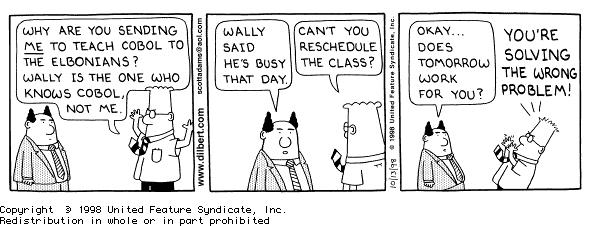
    It made me wonder if this is related to the enterprise not keeping pace with the evolution of the web and its tools? Assuming that a company monitors employee activities, does it then (in addition to/instead of) ‘deal’ with the employee or question why something was posted/shared, and address that? Does it again show the need for control, rather than understanding the need for a change in the way business is done? A short term view instead of real strategic vision? I’m not saying that the immediate ‘fire’ does not need to be handled, but is a thought being spared for what lies ahead? Maybe, if the enterprise had a thriving communication and sharing network, and an efficient response mechanism, the need for ‘policing’ would be drastically reduced? As one of my favourite Dilbert strips says,

    wrong-problem

    (meanwhile, down with the syndicate!!)

    Perhaps, the brands who are just listening on the tools like Twitter, and using the information to change the fundamentals of how they do business are the ones who stand to gain more in the long term. As part of this, they could also be creating a culture, where each person is aligned to the organisation’s goals, rather than only the narrow focus of the department he works in. We really need more like Zappos, and more ‘culture creators‘.

    until next time, enterprise..start the trek 🙂