Author: manu prasad

  • #In Business

    In spite of being the gold standard in business networking, I’ve always felt that LinkedIn has been a bit slow in adapting to the needs of its audience. Quite some time back, I’d written about the ‘news’ and ‘groups’ features, and had asked for an RSS feature for groups. That feature was incorporated earlier this year, but I thought there were several other possibilities which could’ve been incorporated, specifically in company web pages – multimedia support, aggregation etc. My benchmark of comparison was Social Median (acquired by Xing, a competitor to LinkedIn). I’d also wondered if it’d make sense for LinkedIn to perhaps acquire or at least have an association with Yammer.

    Just when I was ready to give up on LinkedIn’s possibilities (completely agreed with this), they seem to have caught a new wind. First came the redesign, with significantly better navigation, a cleaner look and lesser scrolling!! And then came the sync that everyone had been waiting for. Twitter was Linked #in (or#li) with an option to selectively share tweets on LinkedIn. Good timing, I’d say, judging by a few studies. A Palo Alto Networks study stated that enterprise usage of twitter was up by 250% in 6 months. (FB at 192%) Another report (can be classified as dipstick from the number of responses) , by the 2.0 Adoption council, seemed to indicate that social computing was making its presence felt in the enterprise.

    Most importantly, LinkedIn finally opened up its platform to developers. Bring on the apps!! (no, not Link farm ville 😐 ) RWW has a good post on the good and bad news and a few possibilities. Tweetdeck, Posterous, Ribbit, JobDASH, Box.net, all have integrations happening. The wishlists have started too. As RWW mentions, a ‘people you might know from other networks’ and filtered status updates would be great. Sandeep Gautam has a ‘Follow Friday’ like mechanism and @mentions in status updates in his list.

    On that note, I wonder whether the sync would mean that the twitter system of hashtags would become popular on LinkedIn, and a status search would find a place among the current crop of searches available on LinkedIn. An open platform would indicate that LinkedIn updates could appear on outside search. Also (like FB Connect) people would be able to interact with a site using their LinkedIn account, and the content could be taken to LinkedIn.

    A few twitter tools whose LinkedIn version I’d like to see –

    • Mr.Tweet (recommendation to connect) basis current network, interests etc
    • Alerts – not just recruiter, people and events that currently exist, but more options
    • Twitturly – to track the URLs that are being talked about
    • Trends (which might initially be a subset of Twitter trends?)
    • Twitter lists + Groups – It would require identification of Twitter list members on LinkedIn and then an option to add list members – create new groups/ add to existing groups

    The two places where I hope for a lot of action are groups and Company Pages. With an open platform, an integration of delicious and friendfeed can’t be ruled out. Company (and UGC 😀 ) videos and photos via YouTube and Flickr? And while we’re at it I’d like to have LinkedIn in the Google Reader ‘Send to’ (officially) and in future the option to choose a group/page with which a particular  link can be shared.

    With the integration of twitter and an open platform, LinkedIn has the content and context to provide better interaction between the various stakeholders of the enterprise – employees, vendors, business partners and even consumers. I see a lot of potential for LinkedIn to become a key player in the social business design (a Dachis Group concept) we keep talking about these days. Let’s hope to see more updates soon. 🙂

    until next time, business tweets 🙂

  • (Non) User Generated Content

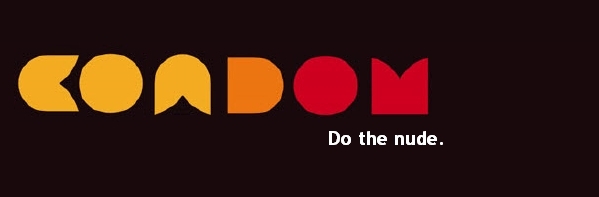
    World AIDS Day – a humble contribution

    condom

    Much to the brand’s credit, they RT ed my work, on Twitter.

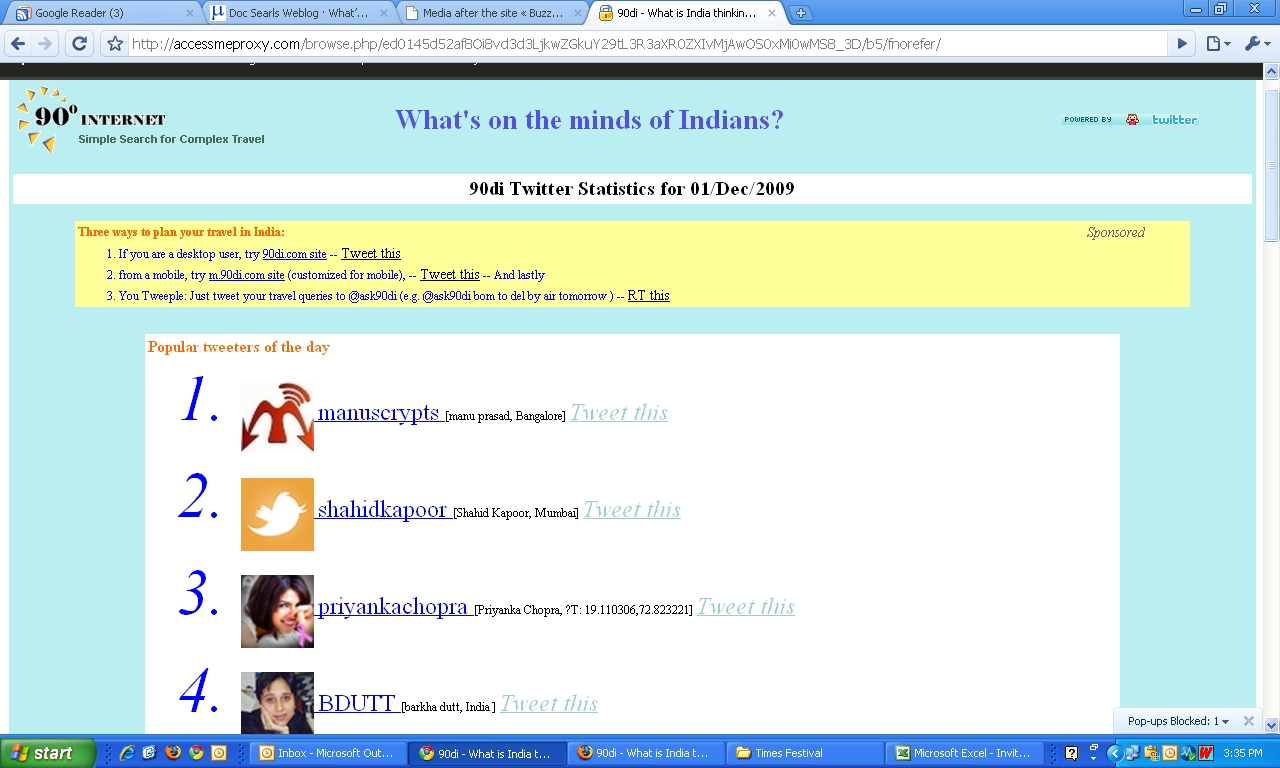
    And that little stunt led to the image being viewed some 2000+ times and my 15 seconds of fame as India’s most popular twitterer for a brief few hours, thanks to more than a 100 RTs from the twitterati. I also got a Samsung Galaxy from Tata Docomo. Ok, I made that last one up. :}

    Twitterer #1

    Yes, yes, don’t worry, I’ll still be posting here :p

  • A Dunbar’s number for brands?

    Seth Godin had a very good take on the Dunbar Number recently in the context of connections made on Twitter and Facebook. (Wikipedia: Dunbar’s Number is a theoretical cognitive limit to the number of people with whom one can maintain stable social relationships. No precise value has been proposed for Dunbar’s number, but a commonly cited approximation is 150) Godin was of the opinion that “You might be able to stretch to 200 or 400, but no, you can’t effectively engage at a tribal level with a thousand people.”

    A few months back, I’d written a post wondering whether smaller organisations were better placed to use social media effectively. This was based on a post by Chris Brogan. Smaller organisations with a flatter structure, and a culture more open to ideas. In that post, I’d questioned whether ideas becoming products/services and then further on brands, meant that the large audiences developed by brands would dictate the kind of communication used, and if mass media one way messaging became easier then. Also, I’d wondered whether larger organisations could handle the empowerment required to work in a social media environment.

    When I read the post by Godin, I wondered if there was a Dunbar number for brands, dictated by the number of people  the brand can connect with- internally as well as externally? There are two things I read recently which added to the thought. One was the idea of the Intention Economy (via Surekha) which “grows around buyers” and is “about markets, not marketing”, and which is builts beyond transactions alone – conversations, reputation, authority, respect all of which are earned by the sellers and buyers. This is a provisional idea, the other is a report from 360i (via Mashable) which states that “that a majority of social media search listings that appear for brand-related queries are created by individuals not affiliated with the brand”, an increasing trend.

    Meanwhile, another interesting thought occured to me when I read Jeremiah’s  post on #OperationBlueWater – where he proposes sharing one’s personal goal plan with online and offline social networks to help people achieve it. I wondered if organisations could ever approach this scenario- not so much as an objective, but the openness and the willingness to share and collaborate along the journey.

    With or without Dunbar’s number, brands would have to involve either consumers or employees (ideally both) to thrive in a ‘social’ world. If its employees, it means hiring people who are passionate about the stuff they’re working with. Yes, the communication has always been that way, maybe the virtual and social forces will make it happen in reality. As for consumers, in most mass advertising, we have been seeing for sometime now, what Godin describes as “politician’s glassy-eyed gaze or the celebrity’s empty stare”

    until next time, social goal setting 🙂

  • Even distribution

    The per second and per character billing wars happening in the Indian mobile space now, made me consider whether its beyond a price thing – a need for consumers to slice and splice until they get exactly what they need. I see a parallel in the flow of content too, something I discussed earlier.

    Which explains why I tweeted that I was still watching with great interest, the results of Murdoch’s arachnophobia, though it will take months. (despite having some fun with irobot.txt, and Walled Street Journal 😉 ) Now that’s a subject on which everyone’s had an opinion, so I’ll refrain. (though I’ll share the interesting Bing Theory) The other part of his announcement, where he wants to be paid for content, will obviously depend on the quality of content he can give, and whether it can be found elsewhere for free.

    Meanwhile, as a believer of the link economy, I should’ve logically said that News Corpse was the future, but I refrained. The reason was that for me, the complete mechanics of content distribution is still in an evolution stage. I wrote about brand content distribution last week, and I’m exploring similar thoughts on information in general, especially when i see studies on sharing trends like these (via Social Media Explorer), which I still think is a good indicator despite the inherent skews in sample/methodology it might have. The specific part that interested me being the low shares of Google channels and Twitter, and the larger understanding (reminder) that the web is much bigger than the social media savvy crowd. While Google News has become a great aggregator, there might be other distribution mechanisms that can be developed, keeping a paid model in mind.

    Media has long served as a distribution platform for brand communication, so its obvious that any effect on media would also force brands to think differently from what they’ve done so far. It means seeking and understanding various smaller ecosystems that are bound to develop, where media itself would be different from what we see now. In essence, brands would have to slice and splice their content to reach various audiences. Again, one can’t completely rule out the possibilities for Murdoch with niche specific audiences.

    Meanwhile, I had a good debate recently with Surekha on social media’s usage by brands- product/brand centric vs communication centric approaches. This great post (via Surekha) sums it up quite well. My contention was that ‘buzz’ (for lack of a better term) could be generated without a communication centric agenda, if brands/products were serious about social media and approached it from a business design perspective. Communication centric approaches would tend to see networks as broadcast platforms and the focus would be on ideas and execution, which may quite often be platform centric, with less thought on how sustainable it is in the long run,  especially if all parts of the organisation are not aligned to a different way of working that’s required. Also, in addition to the spurious ROI methods which are evolving, my issue with communication – centric approach is best described by Godin in Hammer Time (every function (PR/Advertising all bring their own hammers to nail social media) and Rex in “If Advertising is your middle name, your surveys will always suggest the solution is….

    (Update: Thanks Dina, for sharing this)

    It led me to wonder if brands’ usage of  FB, Twitter etc as broadcast platforms, also contributes to the way these platforms are evolving – from the concept of digital sub-prime crisis that Umair Haque has written about recently to the kind of hiring that brands do. (In this context, the Ad Contrarian’s 3 Distinctions post is also worth reading) Taking it further, is that why (simplistically put) instead of collaboration and easy interoperability, there is the scenario that Tom Reilly very interestingly describes in ‘The War for the Web‘ – war between natural monopolies  (search, social networking, classifieds etc) for adjacent areas.

    I’m hoping that like with all things web 2.0, the community will turn both the fights in a direction that is beneficial to itself, and we won’t be left replacing one system with another that develops with the same principles.

    until next time, choosing sides 🙂