
Author: manu prasad

  • Content, Media, Distribution

    I read an interesting post at Social Media Explorer titled ‘Is content marketing the new advertising‘. More than the specific subject itself, which I write about occasionally, it made me wonder about the various entities that seem to be vying for the marketer’s attention. So even if we do limit ourselves to the thought that brands (and businesses) would create their own content, how does the distribution work?

    I remember writing about this a few weeks back, and asking whether content is merely a titular king and distribution is the real power. Its ironic because much of the power of the web’s second wave is in the ability to create content and distribute it fast. But over a period of time, the platforms we use for sharing have undergone a consolidation. The presence of traditional media outlets and brands on these platforms validate this.

    Now if we zoom out further and consider the various other things that are making their presence felt – social gaming, location based services (check out the Foursquare-Pepsi and SCNGR-Coke deals, and the new contexts of advertising they’re creating), group buying; apps on iPhone/ iPad (Murdoch and Branson are making a newspaper/magazine specifically for iPad) and Android. (do add on) This is in addition to the terrains that the incumbents – Google, Facebook, Apple, Twitter will discover and develop at least for some more time, and the technological possibilities that will arise. (eg. Augmented Reality, and the return of QR codes) Each of them are building their own distribution systems, and its difficult to bundle all the ‘content’ that appears on them under one umbrella. And that’s only the digital world.

    All of this also makes me think of destination sites. I can count mine on one hand. Every other consumption is via Reader/Twitter/Facebook and occasionally email. When the web (and its consumption) is rebuilt around people and their connections, what value does a destination site (belonging to a brand) add? How does the brand deal with fragmentation? The good news for the brands is that there are many more options than ever before. Not every campaign needs to be a TVC, radio spot, newspaper ad, site banner. There are smaller, more scalable and more flexible options. The challenge is to find them, and develop things that enable them to connect with the consumers. We live in interesting times indeed.

    until next time, many kings and many thrones
  • MobStac

    [scribd id=51587969 key=key-2c8w0g1k7jvp7aoa673a mode=list]

  • A social culture?

    Even as I write this, Titan is looming on the horizon – not Saturn’s moon, but Facebook’s purported mail service, which can (potentially) stake claim on another front that Google has made much advances in, though its still only #3. And so the thoughts from last week’s post continue – on whether culture is the key differentiator that sets apart the dominant player in an era and everything else from superior technology to better marketing evolves from it.

    The two posts I had linked to last time remain relevant in a Google vs Facebook  discussion – “Google’s real problem – GTD” at GigaOm and “Facebook and Google” at Piaw’s blog. Meanwhile, Robert Scoble wrote an excellent post last week titled ‘Why Google can’t build Instagram‘, which brought out a whole lot of other perspectives on what prevents Google from innovating at a rapid pace (also probably the reason why Facebook is stealing its thunder regularly) – organisational size (something we keep discussing here), controlling the scope of products/services, an infrastructure that’s not built for a smaller social scale, the necessity to support all platforms (because they’re Google, that’s expected of them, thought this holds true for FB too), the inability to use a competitor’s graph (in this case, Facebook), the need to ship a product/service that’s near perfect (because they’re Google!) and so on. Scoble also throws in a few pointers on how Google could still innovate, and I thought some of Android’s success could be attributed to one of those – sending it out and allowing developers to build on top of it. You can get another interesting perspective on Google and scale here. (via Mahendra)

    The other understanding I developed was that with scale, even the organisation’s vision could change, (though the reverse is what we see regularly) and that would affect everything from competitor landscape to culture. So the challenge is to keep people hooked on – employees and users.

    I’ve come across excellent posts on both these. The organisational aspect is the core theme of Gautam’s blog, and so its not surprising that I’ve seen two posts in the recent past that tackle this subject – Inspiring People, and Making Work Meaningful. The other must read in this context is the 2010 Shift Index, specifically the ‘Passion and Performance’ part. From a consumer perspective, few people can articulate it better (especially since a toon is usually more popular than a 1000 words) than Tom Fishburne, and again, two relevant posts – App  of dreams (as a devout Angry Birds player, I identify completely) and The Antisocial Network.

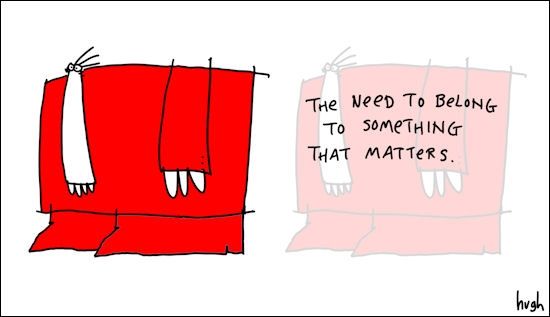
    Despite approaching it from two different sets of stakeholders, the common thread is easy to spot – that brands/organisations need to figure out a reason for existence that goes beyond their business mission and balance sheets. This would then help them identify the ‘something’ that people – both employees and consumers  can identify with and would want to belong to. Coincidentally, this is the drawing I got on my Gaping Void subscription today. 🙂

    (Hugh credits Mark Earls for first voicing this thought)

    Not very long ago, Google spearheaded a revolution of sorts, by creating an algorithm that connected a web user with the information he sought. The only thing that topped it was the business model they built on it. Many have attempted it before and after them, but there was only one Google. The world changing mojo seems to have been transferred to Facebook these days, and even to Twitter to a certain extent, as, in different ways, they connect us to people we know/want to know in various contexts. Information sharing then becomes one of the applications of this connection. This phenomenon is called (by) many names, including social media. 😀

    Perhaps brands and organisations fail to understand the philosophy of social platforms/interaction and get lost in the applications. A bit like wanting to build a social layer on top of everything you have created so far and meanwhile, firing an employee for telling the world he got a bonus and raise 😉

    until next time, titanic shifts 🙂

    Bonus read: The Heart of Innovation via Dina

  • LifeMojo

    [scribd id=51587976 key=key-1q958gd49kyvyku2ff4h mode=list]

  • Place and Time

    After Facebook announced its plans to use its social graph to become the mayor of Location (via Places API, deals) and also become the ubiquitous sign in on the mobile platform, Mahendra, Arjun Ram and I had an interesting discussion on Twitter. It started because Arjun and I were wondering when Facebook Places would come to India, but also moved on to the impact of these announcements on Foursquare and even Google.

    Now in terms of world domination plans, Google is hardly a sitting duck and has been trying to gain a foothold in ‘social’ for a while now, with little success to report so far. But Android has been making huge strides and that should be some consolation. In our twitter discussion, I mentioned that what Facebook had done with this horizontal approach to the mobile platform (OS/hardware independent and just dependent on you being online) is a parallel to what Google did with Android, except this is a way more compelling move.

    Towards the end of our chat, I wondered whether, a couple of years later, we’ll be speaking the same way about Facebook as we are about Google now. Its difficult to imagine how, especially when Facebook’s strategy is about adding a social element to every online activity. Like I said, i have no clue on what the frontier might be, but then again, at one point, I did think, perhaps naively that Google had world domination all sorted out.  That was until Facebook started its march.

    Sometime back I’d written about whether every era has an organisation which best captures the culture that would enable success in the era. The time between eras is fast shrinking – IBM, Microsoft, Google, Facebook (?) (no, i haven’t forgotten Apple, just ignoring it) and I eagerly await the next breakout star. But I’m also trying to see if there’s something that connects the dominant forces – something that is not unique and not dependent on the time they were the gold standard in.

    Two posts I read recently gave me some understanding of why Facebook seems to be advancing faster. “Google’s real problem – GTD?” (Getting Things Done) at GigaOm and “Facebook and Google” at Piaw’s blog. Both pointed to cultural differences and the way the organisations deal with human resources. And so I wonder, is it inevitable that culture changes with scale, and how much can it change before things go downhill? Is there a way to stem that ‘rot’? I read a post about Amazon recently, that shows how Amazon deals with the various companies it acquires. More on ‘culture’ next week.

    until next time, search..social..surprise 🙂