Author: manu prasad

  • The purpose of brand

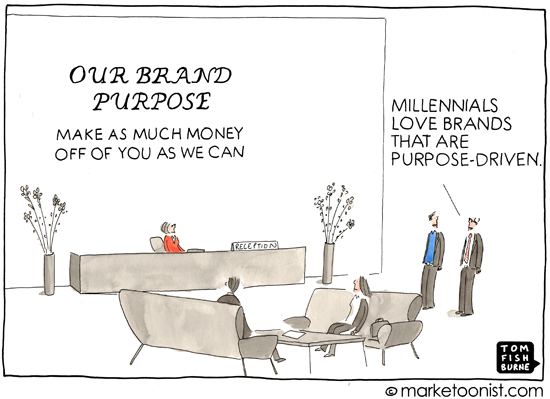
    The Guardian had an interesting post recently, titled “Brand is becoming meaningless“, it (brand) is being replaced by a company purpose that the organisation can rally around. Yes, there is a study that this is linked to, and quotes. To paraphrase, brand is the effect, not the cause, and that has made it lose its fashionable shine.  Someone should tell Maggi this, they just lost $200 mn in brand value, even as the corresponding goods value is ‘only’ $50 mn! (via) Now, just so we are clear, I am not completely against this thought, all the more because this is something I have been writing about for a while now.

    131028.brandpurpose

    (via) (more…)

  • In an ambient future…

    Digi-Capital claims that by 2020, Virtual and Augmented Reality combined would have hit $150 bn, eclipsing mobile. What is interesting is that a recent Juniper report predicts an $80 bn market for wearables by 2020. (via) If I read that together, by 2020 we would have witnessed three interface cycles – mobile, wearables and AR+VR. The shelf life of interfaces is shrinking, much like other business cycles. In fact, in Trendwatching’s No Interface trend brief, you can get a preview of this. I’d think that by 2020 web access would be much better than what we have now, and with other technology like IoT advancing sufficiently, we would be poised for ambient interfaces to consume and create what we do on the web and mobile now.

    It is widely believed that Google is only a challenger in the  mobile and wearable domains – to Facebook and Apple, despite Android. With Facebook’s Oculus move and Glass’ demise, it would seem that the interface that follows the two above would also see a fight. In an insightful post, Ben Evans asks “What does Google need on mobile?” He notes that all of Google’s play is about reach – to collect and surface data. Mobile, and specifically apps, challenge this and create a world of perfect complexity. He ends with saying that Google needs to win at search,  whatever that means and wherever and however far from PageRank that leads you. Christian Hernandez goes further in his post ‘Into the Age of Context‘. He points out that the glue that connects mobile, social and sensor trends is data, but to take it to the next level, it needs machine learning and AI. He sees Google Now as the perfect example of The Age of Context. (more…)

  • The Entrepreneur and the Professional

    A fantastic article in The Atlantic titled ‘The Case Against Credentialism‘ traces the social-cultural and academic  roots of America’s current business dynamics. The part that interested me most was what the author calls the tension between the two cultures – the entrepreneurial and the professional. While both are cultures of achievement, the basic tenet of the latter is that he who goes further in school will go further in life.

    It gave me an impetus to write about this in the Indian context. Nothing as exhaustive, but a little note based on my experiences thus far, with much generalisation. My skin in the game is that it affects me personally and professionally. (more…)

  • Time, Chaos, and Organisational Change

    The first chapter of The Age of Spiritual Machines, by Ray Kurzweil, is titled The Law of Time and Chaos. The law has two strands- The Law of Increasing Chaos and The Law of Increasing Returns, and together they dictate that in a process, the time interval between salient events (i.e. events that change the nature of the process, or significantly affect the future of the process) expands or contracts along with the amount of chaos.  In the book, this is used to explain evolution. Evolution draws upon the chaos in the larger system in which it takes place for its options for diversity, and evolution builds on its own increasing order. Therefore, in an evolutionary process, order increases exponentially, time speeds up, and the returns accelerate.

    It becomes very interesting when I put this in the context of organisations and the business environment they operate in. The business environment consists of various other organisations (exactly like life forms in evolution) and therefore the time interval between salient events (a new ‘disruption’) is becoming shorter. On the flip side, the organisation (akin to evolution of a single organism) is becoming more complex, and thus the time interval between salient events (their own breakthrough developments/innovations) increases. (more…)

  • Wallet Wars

    Recently, thanks to Uber having to comply with RBI regulations, I was forced to introduce myself to Paytm. The entire signing up episode reminded me of a post I had written in early 2014 – “The overhaul of currency“, though that dwelt more on the broad changes and implications rather than the functional aspects. Mobile payment systems have been on a fast evolutionary path for a while now. (a bit dated, but I found this infographic to be a good primer)

    I also remembered a Seth Godin post from 2009 that called Twitter a protocol. On the web, the subsequent discussion then was that just as we were transferring links and messages on the platform, we would soon be transferring money too. That took a while coming though – it was only in late 2014 that Twitter released a payment service.  A week before that, a hacked screenshot had begun rumours of Facebook’s Messenger having the wherewithal for money transfer. But they were both late entrants in a market that was already crowded with the likes of Paypal, Google, banks, credit card companies and so on. Apple Pay would join later. (more…)