
Author: manu prasad

  • Brand – ego vs evolution

    In my previous post on brands, I had briefly touched upon the brand’s integrity of intent as an imperative to its success. I brought up two approaches to it – one based on self image and the other based on self actualisation. The first is a target, the second is exploration. While I was agnostic to the approach earlier, the book I am reading now – Matt Ridley’s The Evolution of Everything – has given me a bias for the latter.

    This is why – evolution has been the longest running phenomenon ever, beating anything made by man quite easily. Because before there was mind, there was matter, whether it was perceived or not. That includes even the idea of God, which is probably the best brand ever built. Arguably, evolution’s success can be attributed to its having no end goal in mind. Can that work for a brand? (more…)
  • Brand with a worldview – Part 2

    I think my first thoughts on the subject appeared in 2012 – Mean better than average, featuring Cleartrip, who had put a non-customer in place with sarcasm after a polite conversation failed. It took another 5 years for a redux in Feels & Fields in Marketing. The framing was that if the end game was for the brand to be the first choice when a consumer thinks of the category, what would be the strategy in a world of attention scarcity? Using the powers of targeting and personalisation to catch the customer at the right time and place (medium + stage of a funnel) with the right messaging, or having a world view that is so relatable to a kind of customer that the brand becomes entrenched in his/her mind? Or both?

    I followed it up with  Brand with a worldview, which had examples from the Super Bowl 2017 ads, many of which had an overt or covert political stance. My inference was that we are largely irrational creatures, and absolutely prone to confirmation biases. We’d love our brands to echo our world view… Smart money would be on brands that can use data to glean consumer sentiment beyond domain, and leverage that understanding when forming a world view.

    This post takes the thought forward, and I have framed it quite simplistically with 3 aspects – customer, competition, and company. We also have a hot example to embellish the hypothesis – Nike! Tons have been written about its latest adventures, but let’s just overdo it anyway. (more…)

  • Choices & Automation

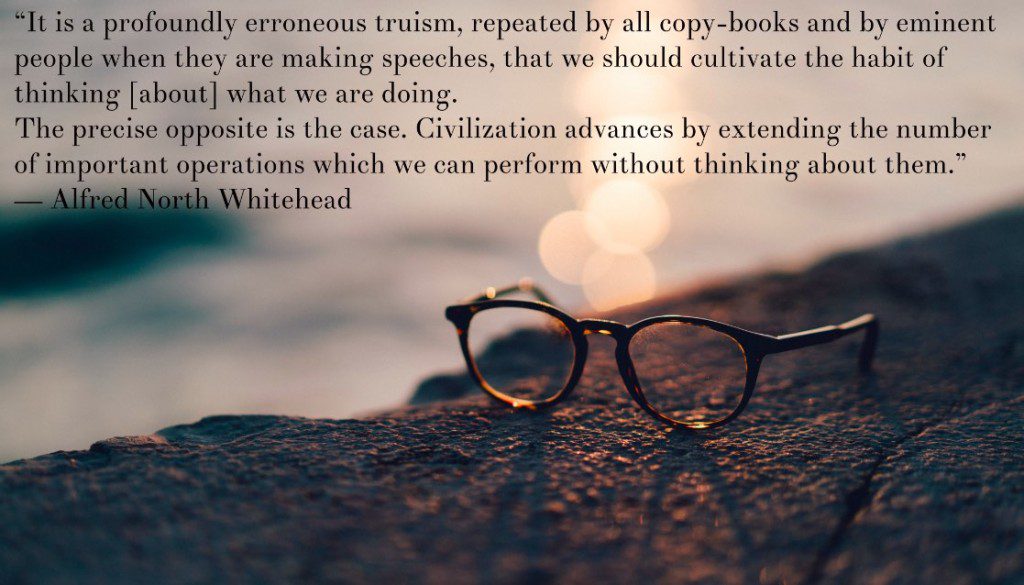
    Taylor Pearson wrote an excellent primer on blockchain a while ago. While explaining why blockchain matters, he quoted something by Alfred North Whitehead

    Untitled 1

    Photo by Joshua Newton on Unsplash

    (more…)

  • The abstraction of trust

    Usually, I use evolution. But that indicates a forward movement, and in this case, I am not so sure now! I had a thought on how the notion of trust in transactions has changed, and felt that I should document it, even if it’s in a super simplistic way!

    1. It began with a producer/consumer – consumer/producer relationship in the form of barter.

    2. A central currency suddenly opened up trade and now it could just be producer – consumer

    3. That also meant that a middleman could enter the system, hence a producer – seller – consumer (more…)

  • Re: Org

    Timehop, which takes me on a nostalgia trip everyday, reminded me recently that it has been a year since I wrote The Change Imperative. The opening slide features a quote – “If you don’t like change, you’re going to like irrelevance even less“- attributed to Gen. Eric Shinseki. In the times we work in, I believe this cannot be overstated, not just for individuals but for organisations as well. Even as business dynamics force changes on the external manifestation of an organisation – the brand – any organisation that faces a client/consumer will also be forced to adapt its internal structure and practices to suit changing needs.

    For a long while now, I have been ambivalent about processes. I have worked in an era, and in organisations, where processes had a way of getting things done. But in parallel, I have also felt that many a time, processes have a way of forgetting what they were made for. The output overshadows the outcome. Over the last few months, my surmisal has been that, to use a Taleb classification, processes can make an organisation robust, but not anti-fragile. This very informative post by Aaron Dignan of Undercurrent – The Last Re-Org You’ll Ever Do -highlights many ways that organisations have tried to change standard structures and practices, and even suggests a six step path to reorganisation. (more…)