CleanFanatic unites its twin passions of cleaning and entrepreneurial spirit to keep your household free of allergens and dust. In conversation with founder Nishant Prasad.
[scribd id=88426097 key=key-14po262f6xdijmxh4kw6 mode=list]

CleanFanatic unites its twin passions of cleaning and entrepreneurial spirit to keep your household free of allergens and dust. In conversation with founder Nishant Prasad.
[scribd id=88426097 key=key-14po262f6xdijmxh4kw6 mode=list]
Idea Brahma combines cloud computing with mobile technologies to provide innovative solutions in healthcare and education. In conversation with co-founder V V Ravindra
[scribd id=87378982 key=key-2i45vkq6x7wpjntogq5s mode=list]
In ‘Is Kindness a Strategy?’, Jeffrey F. Rayport shares the story of an American Airlines employee who ingeniously helped a passenger catch a flight though he was late, by using the express lane for ‘invalid’ guests. He mentions that many colleagues of the employee might not be happy with her way of dealing with the passenger. He also writes about Ritz-Carlton’s use of “service recovery” – a company’s ability to respond quickly, decisively, and effectively to a service problem of its own making — is a powerful way to increase loyalty among existing customers. He rightly draws the distinction between the two approaches – they vary on who’s at fault, the customer or the company, and asks what any business might stand to gain if it oriented its associates to look out aggressively for opportunities to perform true acts of kindness for their customers.
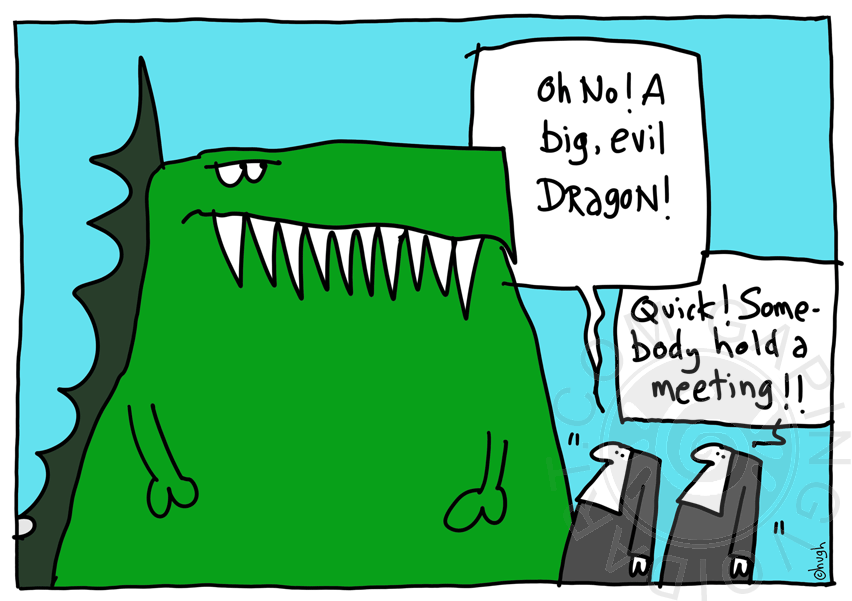 In my mailbox, a few minutes earlier, I had seen this, in which Hugh MacLeod takes a (what I considered a) legit shot at meetings. As always, the toon says it all. When confronted with a business problem, (generally) the organisation’s first impulse is to meet, discuss, analyse and arrive at a consensus… probably 24 hours later. Yes, even when it involves a real-time platform.
As I was writing last week’s post on culture, I was asking myself on the ingredients that make up a great organisational culture. Based on the above, I’d say Empowerment. When you have hired a professional to do a job that he has skills in, he/she should be empowered to apply his judgment to situations and not have to go through red tape or meetings involving people with minimal perspective on the matter. The first tenet of Zappos’ famous core values is “Deliver WOW through service”. In the same breath, Tony Hsieh also talks about “investing in a corporate culture that allows employees freedom and space” and follows it up with “If you get the culture right, then most of the other stuff, like great customer service or building a brand will just happen naturally.” On a related note, their unique hiring policy ensures that their sales staff don’t need scripts, they are trusted enough. It also ensures that an excellent culture is built by finding a fit between what makes the individual and the organisation tick. Empowering the employee so that he grows and so does the organisation.
until next time, power trips
Fully automated vending machines that serve freshly brewed authentic filter coffee, that’s the business Aromas of Coorg is into. In conversation with co founder Radhakrishnan M.
[scribd id=86451170 key=key-70nv6akkcvvf11mocv6 mode=list]