
Author: manu prasad

  • Until the customer is king..

    Instagram just released v3.0. One of the biggest changes in this version is the introduction of Photo Maps, which quite obviously, plots your photos on a map. The default is opt-in, not opt-out, though they’ve done their bit to give the user control over data.  I updated despite reading this Wired article on the privacy implications and the bug that briefly exposed private photos!

    I’d written my first post that referred to Big Data recently, and the day after that, I read this very interesting post that talked about various applications including an algorithm that can identify cities based on their unique architectural elements and other distinguising characteristics. But a few weeks earlier, WSJ had an interesting post that talked of how large corporations see big data as a means to get personal with customers using information gathered by placing tracking files in people’s browsers and smartphone apps without their knowledge—so they can be stalked wherever they go, with their “experiences” on commercial websites “personalized” for them. The post describes not just its real world analogies but practices as well, and predicts a future where the user will declare your own policies, preferences and terms of engagement—and do it in ways that can be automated both for you and the companies you engage. An entire ecosystem across apps and corporations built in a consumer centric fashion.

    But as the post itself admits, the move toward individual empowerment is a long, gradual revolution. Until then, we need to define our own limits of sharing, fully understanding that it is a give and take. Not just what and where, but whom too – since all it takes a RT or a ‘Share – Public’ for something shared in a close circle to go public. How much of privacy would I give up to open myself to opportunities, or get an experience that is tailored to my needs and convenience. On the other side, a modern corporation needs to understand the choice the consumer is making and use the information to not just provide genuine value, but also make it easier for both entities to adapt to the rapidly changing landscape.

    until next time, kingmakers
  • The path to mediocrity

    Seth Godin wrote a post on the masses vs great design, and how the brands we love refuse to become democracies. Yet, on an everyday basis, and across product offerings – from web design to entertainment, I see brands clearly pandering to the ‘masses’. And they’re not going to disappear in at least the medium term, because they spend resources in wooing and keeping consumers, though these consumers are hardly ‘loyal’. The undemocratic approach that Godin mentions is for the rare breed of confident, gritty, focused brands which have answered their why, what, how and when very well.

    On HBR Blogs, I found an article by Bill Taylor – “Bad Service can be good business” a very interesting read. It showed two different scenarios where the headline is applicable -companies who try to keep the costs down to the barest minimum and charge a premium for anything but the basic (the author quotes Ryanair as an example) and companies whose offerings are so compelling, and whose reach is so vast, that making the investments required to deliver high-touch service would be making a big strategic mistake. He cites new media companies like Facebook, Twitter etc as examples.

    Most of the companies I was referring to in the first paragraph are trying to be one of the above. But they play an in-between game, starting at some point and thinking that they’ll figure out a way to get to their destination. But IMO, it can’t happen that way, because once you set expectations, you fall into the ‘trap’ of fulfilling them, without really figuring what your brand stands for. You’re forced to play the reactive game, watching your competitive landscape and fencing with them. As you progress, you’re drawn further away from the active game of pursuing a goal with focus. The trap, hence, is mediocrity, and it is surprising to see it these days because the web and social platforms specifically are a great way to find that slice of audience which will give the brand a chance to deliver that focused product/service. I’m not talking of superficiality here, but the DNA of the brand, and the organisation, the strand around which everything is built. I’m also not saying that all mass brands are mediocre. In the purpose that they have defined for their brand, Ryanair is anything but mediocre. Despite the seeming difference in the two scenarios from earlier, they are bound by a commonality – clarity of thought, which inspires clarity in everything that the brand does.

    until next time, clear blue ocean

  • The Yellow Cycle

    Ever wanted to gift something totally out of the ordinary to a loved one? Then you must check out The Yellow Cycle. In conversation with co-founder Neha Arora

    [scribd id=102709947 key=key-lkmwoxmxt4fbohf3ir2 mode=list]

  • Data: Growing up

    The Facebook story might be facing rough weather, but that hasn’t stopped the social network from pushing out new and interesting things. It launched “Page Post Targeting Enhanced” – features that make it a media platform offering sharper slices to marketers (easily) by allowing filters based on gender, interests, relationship status etc. It has also rolled out Facebook Stories that highlights “people using Facebook in extraordinary ways”. Venture Beat has a very smart take on how this can be the future of news by intersecting two of the most interesting contexts – location and interest. As a media platform, one can imagine the advertising potential.

    Twitter already has local (city specific) trends, though, from experience, many people seem to think that they’re viewing national trends when Twitter is actually showing them local trends. Twitter already has Promoted Tweets and is enhancing features that allow better targeting.

    Media buying in the age of traditional media consisted of a plan being prepared (and negotiated) after evaluating the reach, cost and other parameters of various options across platforms – print, OOH, TV, Radio etc. The (reach) data has always been contested, and the (post) measurement is more of a myth than reality. New media platforms, on the other hand, are significantly better in terms of transparency and in addition, have better native and 3rd party tools for self publishing, distributing and measuring. The data is one click away from the marketer. After a certain tipping point of reach that these media achieve, traditional media would be forced to provide this level of accessibility, and then, IMO, the value provided by media agencies would be reduced significantly, as tools would make it easier for the marketer to plan real time and measure too, across platforms.

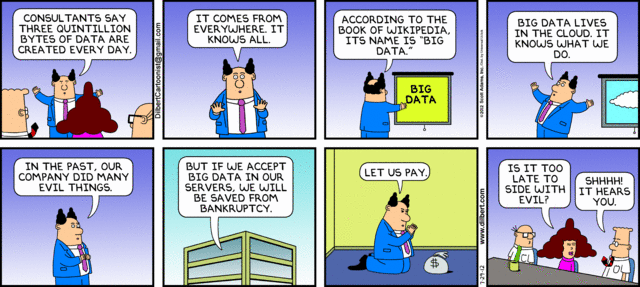
    In essence, data that the marketer needs, to make informed choices on the why/what/how/when of platforms, is easily becoming available.  The data that really needs to be converted into information is now flowing in the reverse direction – from the consumer and his actions across platforms to ______. And this data is not just for marketing, its use is across the board and affects product, customer care, operations, technology and so on. It is Big Data, the players are evolving, and the next stage in this ever changing game has begun.

    until next time, don’t worry, it’s already a buzzword. 😉

  • Raw Talent

    Last year, when I wrote about transmedia, one of the examples I had used was WWE. Perhaps it is because pro wrestling is usually given a pass by mainstream media, except when there are celebrity appearances, that WWE has made significant investments in building a social media presence – Facebook (almost a crore fans) , Twitter, Pinterest, Instagram and more recently YouTube.

    Last week, it celebrated 1000 episodes on television, Charlie Sheen was their social media ambassador for the event. During the show, they also interviewed the fan who was their 100 millionth social media follower across networks. They begin and continue storylines on Twitter, and gets stars to make hashtag trends – The Rock being the best example. Stars have also used social media to further the TV time they got – Zack Ryder’s exposure shot up several notches after his YouTube show became a hit.

    And now, as per announcements, they plan to go further. It has added Tout to the list of platforms used, thus allowing video interactions with fans. The app’s sudden popularity owes much to the WWE marketing push. They also plan to increase the duration of the show from 2 to 3 hours, with hashtags and polls allowing viewers to influence the content of the show – practically live. A huge gamble. And there’s no surety of a #win. But that’s probably not the point. The lesson here (and what I admire them for) is how an old school wrestling promotion has consistently adapted to changing media scenarios and platforms – from selling live events, to running TV shows and pay-per-views and now on to social media, without forsaking the earlier endeavours. It continues to live dangerously, and thus thrives. It requires tremendous conviction in their product, their employees and their audience, called the WWE Universe.

    They might not make it to case studies, but that kind of cold shouldering is what they are used to by now. They probably don’t need it anyway. 100 million fans/followers – in essence, they are their own media. That’s not something a lot of brands can boast of.

    until next time, Raw is War #youremember (Barring occasional forced breaks, I’ve been watching since 1994) 🙂