Author: manu prasad

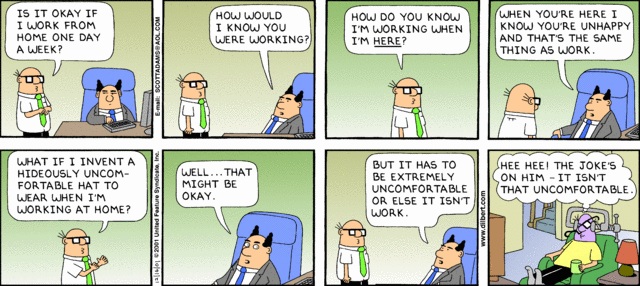
  • Work from….

    (image courtesy: Dilbert)

    Sometime back, Marissa Mayer [disclosure: I’m a giggles fan 😉 ] created quite a flutter with her decision to get Yahoos to stop their work-from-home arrangements. This seems a performance linked decision and across the web, you will find various perspectives on it. This mix of perspectives continue on the employee side as well. Working-from-home brings its own set of pros and cons, and one can debate it from both sides.

    As with most everything, there can hardly be a single solution that fits all, and there are various subjective elements on the employee and employer sides that need to be considered. This is especially so in the social era, when corporations will be compelled to align business objectives with a purpose that consumers and employees can identify with, and work cohesively towards.  (more…)

  • Happy Wholly

    There are 2 versions of this post! If you’re reading this version, pretty much nothing has changed for you, especially if you’ve subscribed to the blog. If you’re a visitor, you’ll see a little more content – things that have thus far resided at the Work blog. I decided to unify the two blogs after a lot of thought. Lots of aspects were considered, since the other blog is a pretty opinionated 6 year old! But in the end, there’s only one me, and while I might have more identities across the web, the unified blog will represent most of what I have to say!

    I’ll be removing the Networked Blogs app soon, and integrating better with the Facebook Page I created a long time back, but never really used! Will have that up and running by next week, so do ‘Like’ 🙂 I have already changed the feed urls, so those on an RSS diet don’t need to do a thing. I will be creating a combined feed, and options for individual categories as well in the next few weeks.

    And of course, what shift without renovation? So we’ll have a new design coming up – nothing drastic, but a little better connected to www.manuprasad.com, which will continue to be the identity aggregator, but in a different avatar! Soon!

    until next time, over and in 🙂

  • The more things change….

    Just a couple of weeks back, I’d written about influence and context, and last week the twitterverse had some excitement delivered courtesy Disney. I couldn’t experience it first hand, but got quite a lot of perspective thanks to Karthik’s post and the comments that followed.

    Personally, instances such as Disney serve as a great filter for keeping track of the trust quotient. I don’t expect agencies/brands/celebrities to be unbiased or disclose, but once upon a time, it was natural for regular twitterati to do that. But times have changed, and all of this is personal philosophy, so I’ll move on.

    On hindsight, and when comparing the patterns of evolution of traditional and social media, the current scenario seems inevitable! Platform – Community – Audience -Brand – Ads (hashtags) – and when ads became noise, brands differentiate by bringing in a fresh voice. (celebrities/micro celebrities) Where we are now is with an army of mini TOIs, relatively more genuine-sounding, and significantly less costly. There are quirks, of course. For instance, brands don’t have to pay the platform to be present, and can incentivise the community to provide publicity. On the flip side, brands are also ‘being held to ransom’ (previous post) by ‘influencers’ and we’ll probably see guns for hire being used by rival brands pretty soon. [Just last week, we saw a tweet from a person working at a competitor stating that she liked shopping at Myntra. One of the various scenarios we considered was a #conspiracytheory – that the moment we used the tweet in some way, the person would prove to be a non-employee and we’d be accused of playing dirty]

    At one point, I really thought (or hoped) social would be new wine, but it has more or less ended up a new bottle. If we continue the evolution pattern, the future is easy to imagine. Context will disappear, and noise will magnify, until the next disruption. But I still have some hope, because the nature of the platforms (and the tools that are getting built) are such that a user can, at least to an extent, mould it according to the way in which he wants to consume it.

    That does take me back to what I said in the last post – people will actively build their own trusted sources. And the real opportunity for brands is still to become a trusted source. Yes, I do think it’s possible, and we have a relaunched buzzword on cue – social business. In fact, there are probably brands doing it already, spending resources to build the foundations so that the hashtag (or its equivalent in the future) is not manufactured for its own sake, but is organically and genuinely built by contextually relevant influencers who can be publicly rewarded for helping the brand meet its business objectives.

    But wait, that was where social platforms started too. Which leads me to wonder if the future of brands and media will always work in cycles, and end up near square one!

    until next time, the more they remain the same…

    zp8497586rq

  • What have I been up to?

    The nice folk at Social Samosa gave me a chance to describe exactly what I do for a living currently. You can read about Myntra’s strategy on social platforms in an interview here. 🙂

    In other news, I just got back from a Philippines vacation. More about that on the other blog.

    PS: Added a Media page since there have been a few quotes happening lately 😉

  • Influence & Context

    Last week, I read two stories on influencers on sites that influence me. 😀 Since that’s a topic that has been seen here before (1,2,3) and it’s been a while since I’ve written about it, a couple of cents.

    YourStory’s post, I cheered, despite failing on their influencer scale, (of 5000 twitter followers) because it asked a very pertinent question – “Are brands being  held at ransom by Social Media Influencers?” I completely agree with Mekin’s tweet (cited there) on how it takes the twitterati only a few minutes to demolish years of hard work. Anyone who handles a brand account would relate to that. Expecting ‘influencers’ to mature and watch what they say is like expecting, say, a response from the nation’s leader. The other way to handle it is to be really good at what you do as a brand, be sure of yourself, be transparent, so that you can back up your tweets (no, not that kind of backup) with facts. (more)

    LHI’s post was about brands leveraging social influencers. Prasant (of LHI, but didn’t write this post) had commented in the YourStory post about contextual influence, and I quite agree with his views. In fact, my stance remains the same as when I wrote this. To sum it up, (in general, there are of course exceptions including whole domains) brands tend to treat influencers just as they treat traditional media. The more reach, the better, who cares about context? No offense meant, but I am not really influenced by the gentleman in the LHI story. Mercedes needn’t care about that because I’m not really their audience. But the entire episode makes a very good story, so if that was the intent, and not necessarily the person’s influence, opportunity well spotted, and a PR job well done!

    But if brands do treat influencers as media, how long will this party last, especially when people are already trying to correct their filter failure? (noise in the stream) Mass media’s  indisputable role in creating perception have been blunted in the web and social eras. Arguable, but I think, in a while, we’ll see a kind of flip. Folks would start figuring out their go-to people, when making consumption decisions. I already do that – in fact, I realised that with a few exceptions, everyone on this list is a go-to person for me! Not all of them have 5k followers, but in their domains, they’re #likeaboss. What has social contributed here – 90% of them were unknown to me before blogging/twitter, but if I am asked for a recommendation in their domains, I don’t have to think twice. I trust them, and this has been built over various interactions across time.

    In essence, using influencers would boil down to the intent of brands – mass reach or targeted reach (in this context) – for each activity. There are tons of ways to get reach on social media, in many ways it has already begun to resemble its media predecessors, but trusted sources remains a precious commodity. If brands earn and retain the trust of influencers in their domain – and they could only do that if they are really good at what they do – think of how it could help them when it comes to responding to those ransom calls.

    until next time, an affluence of followers 🙂