
Author: manu prasad

  • That used to be my brand?

    Almost every brand that one comes across these days is targeting the youth, and thats across categories. Of course, some brands have been doing it forever, and some have just joined the party, maybe because the increasing incomes have forced them to define their target audience, so communication can be made in sync.

    Now youth, honestly is a very vague term. For some, its actually ‘youth’, say 18-25, and for some, its more ‘young at heart’ which means it can go upto 35. I’m not saying thats really old, all I’m saying is that with a workforce thats getting younger as every year passes, 35 ain’t young. But thats not the point of the post.

    A person aged say 50 now, got his first whiff of liberalisation when he was 33. And those were the days when employees still contemplated one life-one organisation. And in the seventeen years since, things have changed drastically – more brands, more options, and more costs. Did he have enough time to be able to react or cope or build a corpus enough to enable himself to lead a decent lifestyle? Judging by the number of products that cater to the current 50 year old, i guess not.

    But this generation (30 year olds now) is aware of this and also aware that even this can change in a flash, and that they need to be prepared. They are very familiar with brands and the costs associated with their lifestyle tastes. So, will the brands in say, 10 years time also start catering to a 40 year old who was once their target audience? Will Levis, which i buy now, have a design for me when I’ll be 50, because i don’t see any brand now that does? (Enlighten me if i have missed it, please)

    Because, unlike the current hapless senior citizens, who didn’t know what hit them, the future senior citizens would be a prosperous lot, with at least some money to burn. Please don’t get me wrong here,  I am not saying all senior citizens are poor, but I do come across a lot of them who look at the brands, the malls, the clothes and the accessories with a melancholic expression that acknowledges a changed world, and their inability to make sense out of it or cope with it.

    until next time, this provoked the thought
  • Pro Social

    No, this is not about me being gung ho about social networks, this is more about job search portals and social networks for business, specifically LinkedIn.

    The context is that i saw a huge ad of Shine (HT’s new jobsite) in the paper today, and my inbox had a mail that asked me to check out ‘Where is my boss’. Shine has a contest running promising the winner a month’s salary. They’re also doing a salary survey, whose results are promised soon – finally, scientific proof that i am underpaid 😉

    I’m not sure where exactly WIMB is being pitched. The site says “Get instant interview calls from Bosses all over the world! Set your online status as Available for live interviews.” Wonder if it’ll actually happen. Otherwise, the features seem to be the same as what a naukri/monster gives.

    Like this post mentioned, I also wondered why HT would seek to create a new brand, especially when it has something running in the same genre. One possibility is that they want this to be seen beyond a normal job classifieds poral. This is perhaps validated by what they say on the page “We recognize that your job is an integral part of your career, but we believe that your career is far bigger than the job itself! It is more about gaining the right perspective, building your skills and enhancing competency. And that’s what Shine is all about! ” Hmm, that makes it a wannabe LinkedIn, but stopping short of networking.

    So, what works? I still think all of them serve their purpose. When one is looking for a job, any job in their category (and there are tonnes of people who do just that) the portals like naukri/monster would work fine. However, if one is pretty clear about the specifics of the job he’s looking for, then a site like LinkedIn will help him connect with the right people. LinkedIn’s ‘questions’ and discussions also helps air one’s views on topics of interest, thereby adding flavor to a normal resume.

    I’m not quite sure if the normal social networks can be a serious threat to a job networking site. To me, its a problem of context. I’m on FB to play scrabble, poke friends, join the Bollywood group etc. Yes, it does tell a person a lot about me, but is that the kind of info a person would be looking for while hiring? Doesn’t a LinkedIn fit the bill much better?

    Until next time, or is it social pro 🙂

    PS. If Yahoo decided to launch Shine in India, wouldn’t the existing shine take its shine off?

  • Interesting Times

    All my favourite sites absolutely trashed Indiatimes’ attempts at social networking – ITimes. I didn’t log into the site myself, and I doubt if i will, until either something drastic happens to facebook or itimes brings in such a revolutionary feature that it totally blows me out of my stasis. And from what I read in the Contensutra article, that has not happened, at least not yet. To be fair, though the reviews have been scathing, I saw some comments at Contentsutra, which gave iTimes a chance.

    I’m sure the Times group will soon launch a blitzkrieg to promote the site through print, radio, mobile, Indiatimes which pretty much covers media options. Oh, okay Times OOH, Zoom, Times Now also, happy? The possibilities are endless, from using social media as a platform to fight serious issues (and campaigns like Lead India) (Read this) to building Bollywood/fashion based communities based on Zoom content and everything in between. The only snag is how much of good integration have we seen with the existing properties?

    The WATBlog post mentions how internationally, its usually the tech guys who build web properties and the big media guys come in later. I think it has a lot to do (sigh, again) with interent access. The internet has been adopted by the mass there, and they can actually build a brand on the web. But lack of penetration here means that either the techies need huge pockets and backing (eg.Ibibo – Naspers) or they have to wait for a looong time for the critical mass – revenues. The alternate scenario is happening where a media company has the money and the media (reach) to promote a web property. The problem, i guess is when they use existing/sub standard resources, and apply learnings from other media, which just won’t work.

    In the larger picture, remember that HT bought Desi Martini, so we might see the same players fighting on a different platform. And so, while it does sound like an Apple platform for news sharing, we’re in for some interesting times.

    until next time, whats next twitimes? 😉

  • The future of the Internet in India

    is mobile. That’s a feeling I’ve been getting for quite sometime. Take a look at the figures

    Internet – 46 million according to the iCube report 2007

    Mobile – 250 miilion, according to TRAI

    I read two articles today which pushed me in this direction. One was Indiagames’ new mobile distribution deal, and the other was TringMe opening up its API for developers. While the first supports the title of the post, the second might seem contra, but i feel the development will happen more on the mobile front.

    From a consumer standpoint, i see a convenience factor. While I am more a web fan than a mobile one, the sheer fact that i always have my mobile with me as opposed to my broadband connection explains the accessibility parameter. Yes, the amount of stuff i can access, and the small screen are deterrents, but i feel its a matter of time before that gets resolved. And yes, Facebook’s on Blackberry too, so…. 🙂

    From a brand point of view, while the net does give a filtered reach, the population which would use the net on mobile would be just as filtered. Most of the stuff being done on the net, from vanilla contests to rich applications, I’m sure can be adapted to the mobile platform. And what better platform for a brand than an always on consumer’s mobile? Unlike the net, I can push stuff onto the consumer (all those malls now proclaim ‘Bluetooth Zone’. I dont think they’re aiming at my laptop, maybe because i wasnt carrying it?)

    A convergence will happen, and for now, unless broadband suddenly starts coming out of taps, in India, it sees like the offspring will look more like a mobile than a comp. Wht d u thnk?

    until next time, mob justice?

  • Social Icing

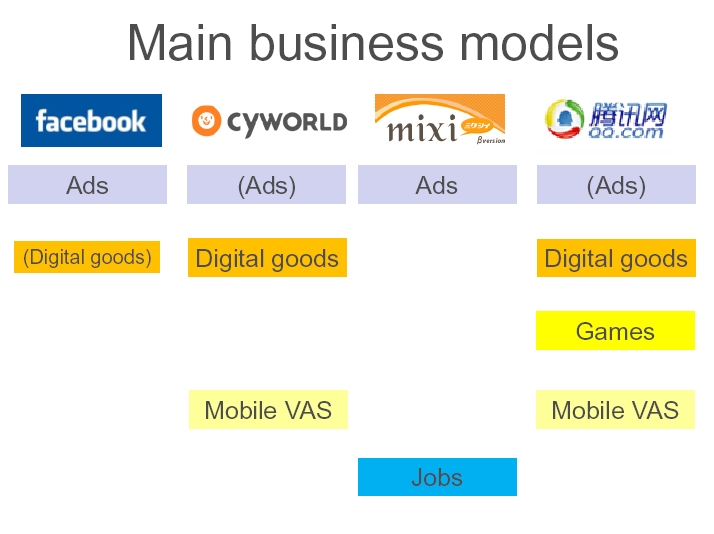
    Continuing from what i wrote earlier, the social networks we’re familiar with (assuming you don’t use our friendly neighbourhood sites – cyworld, qq, mixi) have a revenue mix of ads and virtual goods. However, as the chart below will show you, this is not the only way to monetise a social network, as the chart below will show you.

    clipboard01.jpg

    Courtesy – http://www.plus8star.com/ 

    Now, should that make our familiar networks hmm, disoriented? :D. Not exactly, because the population is there, even if its lesser than the other sites. The word of caution, is that the audience reaction to monetisation can never really be predicted.

    Social media is indeed popular, though it is felt that it lacks metrics which are so important for monetisation.That however, has not stopped brands from using the networks in a variety of ways. From making groups to building applications and so on, brands have cashed in on the network’s popularity to hook the customer on one more platform. This, for example is a post on social media marketing strategies.

    The common newspaper ad sales motto is that they lease their relationship with their customers to paying third parties. While the digital scene has diverged from traditional media in a lot of ways, I’m not quite sure why this can’t be made true for social media. I agree that a lot of applications are also a value addition to the site since they keep the visitors glued, but that can’t be the case always.

    For instance, look at this application on Facebook by Coca Cola. I doubt if Facebook is making any money from Coke. But the basic questions are ‘Whose platform is Coke using?’ and ‘Whose audience is Coke using?’. And so, why can’t this be a way for Facebook to make money? By all means, allow developers to make applications, but if brands are involved, no harm in asking them to pay. Use part of the revenues to keep users happy by providing better features. That’d be the icing.

    until next time, socialism 2.0