Author: manu prasad

  • Mo Brand Ambassadors

    I just realised that I totally forgot about Abhi B (or Shaky B, depending on your levels of dislike. Oh ok, I’ll stop. Can’t even be a bit nasty on my own blog 😐 ) in this post, where i talked about brand ambassadors for mobile handsets, among other things. But we’re not going to continue on the same lines of discussion here.

    I happened to see the new TVC for MotoRokr E8. The ad is a continuation of the earlier Moto ad (watch the complete one here, I have only seen the edit, this is super cool) Any ad that starts off with a spoof of ‘Rendezvous with Simi’ has to be an attention grabber, and going forward this one doesn’t disappoint. The sudden blaring of ‘Appidi podu’ from the Tamil movie ‘Gilli’ was shocking, the first time, and funny, every time I watched. The film briefing with the ‘heroin’ and ‘desh ka jhanda’, followed by the regular awards ceremony, all are a spoof of life. The icing on the cake is ‘Come on Ab, shake a lil’, followed by the abso Tamil dance steps.

    The other I have been seeing is the Aamir Khan ad for Monaco – Life Namkeen Banaiye, the one where he plays a prank on the serious team coach, by putting a sticker with scratches on a brand new vehicle. The humour wasn’t really good, in the same vein as this one earlier, but more importantly something else was lacking, and that brings us to the point of the post.

    Usage of brand ambassadors. The first one worked for me primarily because the humour was good. More importantly, a lot of it was Abhishek laughing at his own expense, as well as the fraternity he is part of. And because its Abhishek, (and I’m a huge non fan), you end up having a good laugh, because while he’s always trying to be goofy, this time he succeeds. Great usage of a brand ambassador.

    On the other hand, Aamir Khan. There was a time when this ad would have worked, exactly saat saal pehle, when ‘Dil Chahta Hain’ released. Aamir’s character was a riot, complete with exactly the Monaco kind of pranks, actually better. Maybe even later, after the release of RDB. But post the SRK-dog fiasco, and the constant baiting of co-stars including Salman, and the yet to be launched Harman Baweja, let’s just say the Aamir brand of humour (in case it exists) isn’t exactly popular.

    I doubt if stars are taken only for the visibility. Usually there is also a dna fit with the brand or at least a characteristic of the star that the brand would like to exploit. If that is indeed true, then Monaco’s choice is a bit too salty.

    Incidentally, what did you think of the new Reynolds ad, the one where they use Sachin’s one day and test avtaar colors to show the different pen characteristics? A bit labored, but a smart idea nevertheless, i thought.

    until next time, mo rockr, mo na ko
  • Ad-vanced Processing

    No, don’t go away, this is not a tech post.  And stop sniggering, one day I will write a tech post.  Hell, if Laloo can blog…There’s been a spate of celebrity blogs recently – started perhaps with Aamir Khan, then Big B, Salman Khan and a couple of days back, Karan Johar. The fad, I think will soon run out of steam.

    But there’s a very interesting twist I saw to the celebrity-in-the-internet space today, and felt it was very well weaved into a brand’s strategy. The brand is a processor – AMD, and it has chosen Viswananthan Anand as its brand ambassador. On a broad level, the processor-chess-intelligence connection is itself a good one. The TVC idea is a neat analogy, showing Anand try his hand at cricket, failing, and then saying that in a cricket crazy nation, he chose to pursue chess because he was good at it. From an analogy point, cricket is Intel, and the message is that one should choose a processor according to one’s requirements, and not because everyone else follows a trend.

    Coming back, a site has been launched – askvishy.com. As the name suggests, the site gets Anand to clear perceptions about computers, and also offers help in choosing computers according to requirements.There’s also some kind of contest there, but didn’t participate because they asked for the address in stage 1 itself.

    In essence, a well thought out campaign, that uses the brand ambassador well, but only a first step towards what should be a prolonged strike at the far-and-ahead market leader. Intel can’t afford to stay inside anymore.

    until next time, AMD is no more wishy washy

  • Trust they’re connecting people

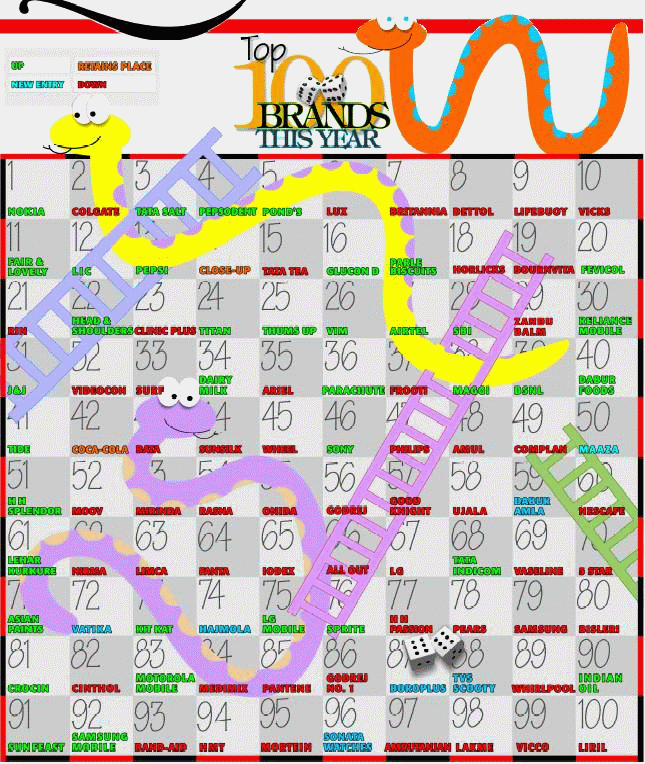
    I just realised that I totally missed this one – The Brand Equity Most Trusted Brands Survey, at least writing about it. Unforgivable, but let me try to redeem myself by attempting a post now. Bottomline, Colgate has been dislodged from the numero uno position by Nokia, no mean task, that, and it is a testament to the inevitability of this medium (not the brand)  reaching the top of the media chain in a future that’s closer than it appears now.

    Since I have been lax on the topic and enough has been debated on it, I did some epaper reading and have focused on a few things I thought would make an interesting read. For those who missed the entire top 100 list, here it is

    I think Nokia’s climb to the top has been mainly because unlike the poor toothpaste, its not a single product or even single service/utility (oh come on, it easily transcends  a pure play communication device, its also a camera, a music player and so on). This not only heps it give different USPs to different kinds of people, but also helps them in communication (to appeal to different kinds of audiences across SEC categories).

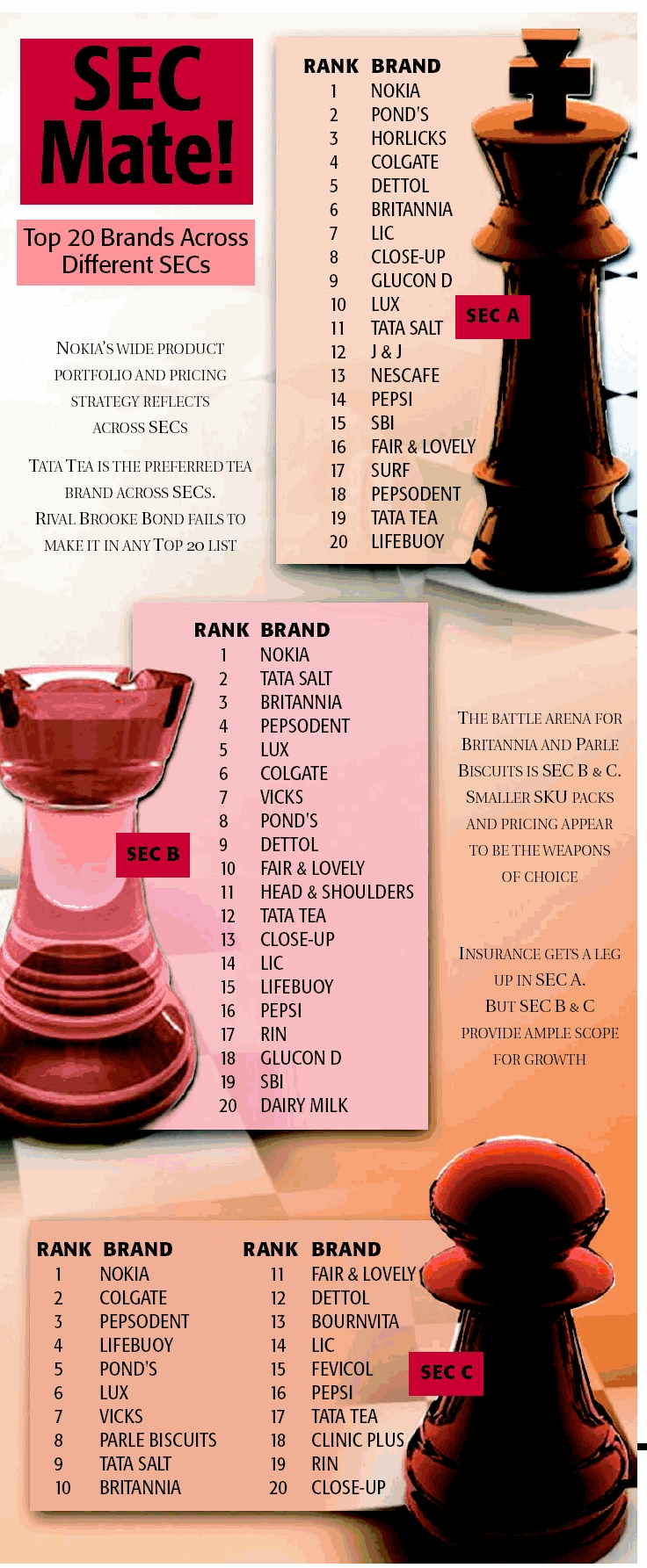
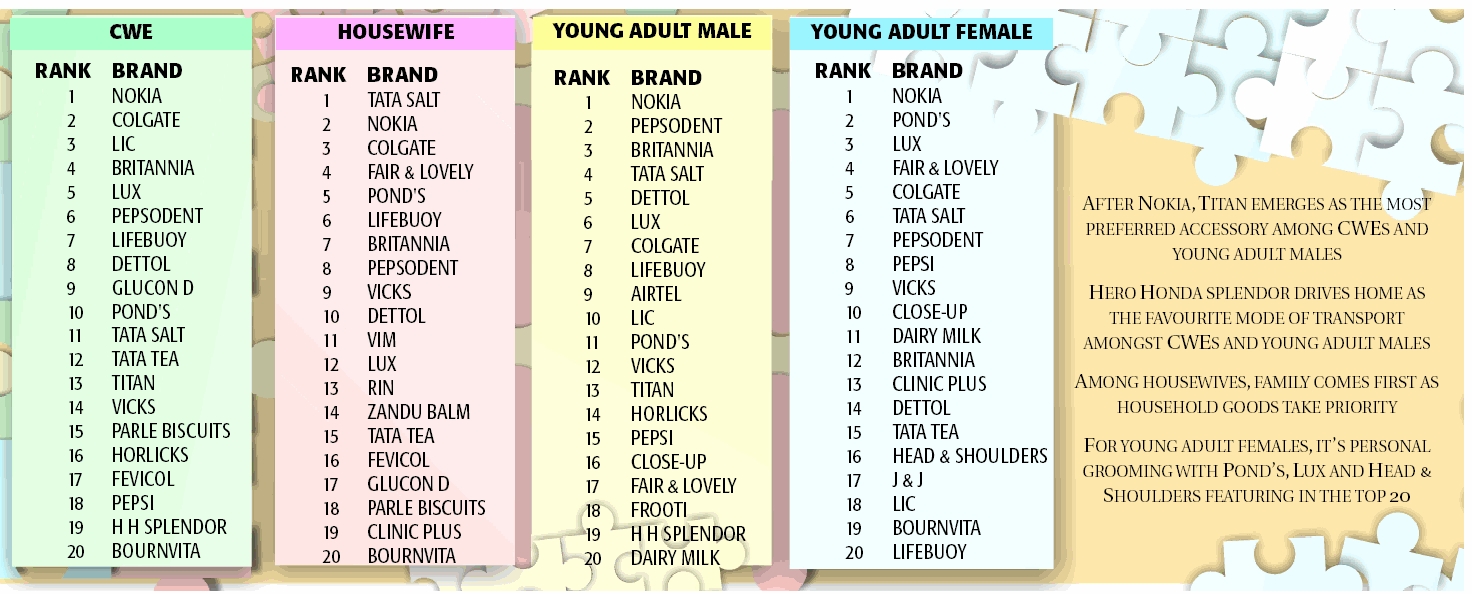
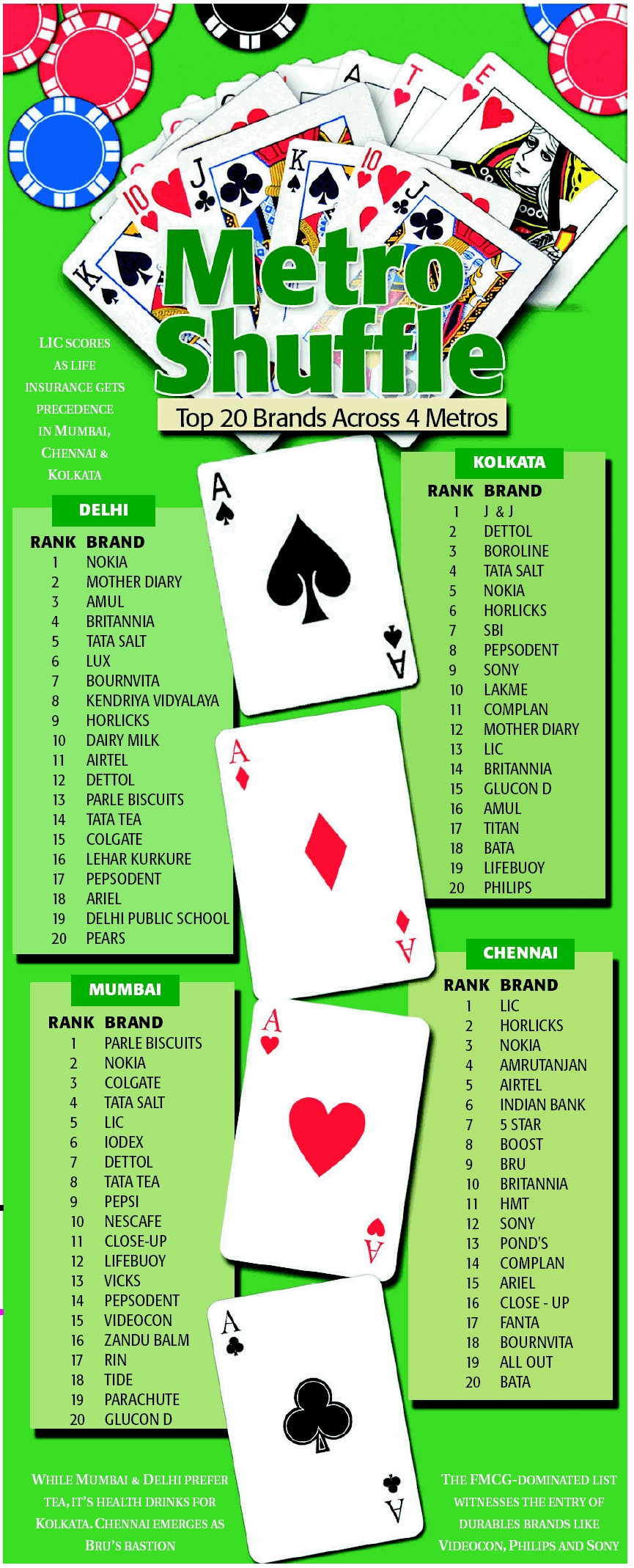
    Speaking of SECs, here are the results based on income, SEC and respondent type, and by metros

    Other than trivia like the fact that Fevicol doesnt have a mazboot jod with SEC A and the ones mentioned in the image itself, the lists in the SEC split seem to be just a reworking of the top 100 order. As far as the income split goes, quite understandingly the income class below Rs.2500 are in a lot of pain. What else explains Crocin’s jump from #81 in the top 100 list to #10 (okay, bad one 🙂 ) You know, these lists would make one think that this is one of the most hygienic and healthy countries in the world, look at the number of personal care and cleaning products and health+ food brands out there. Sigh, now if only trust would lead to usage 😉 In the ‘respondent type’ list, its amusing to see ‘Fair and Lovely’ at #17 in the young adult male list. 🙂

    Its interesting to see education occupying two spots in the Delhi list, the top three brands in Kolkata having something to do with the skin, Mumbai having a cleanliness fetish, and Chennai not having it (must be the water problems). Yes, I am glossing over, but a detailed look will take time 🙂

    Meanwhile, Brand Equity has also given the methodology in selecting brands. A couple of thoughts on this. Considering that we’re hunting for the most trusted brands, shouldn’t we also have a media category (all media, or is it a problem because of possible bias allegations?) When do things like retail chains (CCD, Big Bazaar, FoodWorld), familiar brands like say, Levis and gang, India Post, Indian Railways, IRCTC etc make an entry? And i know this won’t happen any time now, but will computer (hardware manufacturers as well as things like Windows/Linux and entities like rediff) make it into the top 100 list in at least 5 years?

    Meanwhile, I really don’t see anyone being able to challenge Nokia, unless simultaneously, a telecom brand (service) really becomes a pan india player (is already there) with excellent service and other mobile manufacturers give Nokia some really tough competition. The other possibility is when public utilities like power, water supply etc start having private players (not in an infrastructure capacity, but as a branded utility). Whatcha think?

    until next time, in brands we trust

    All images are courtesy Brand Equity, the Economic Times dated 11th June 08

    Update: Guess who makes it to the top in the US.

  • Local Portals

    I came across this today – a local site for Kolkata – I Love Kolkata.com, powered by the ABP group. The site for Kolkata Mirror had been launched a while back, though the paper itself has not been launched in the market. The first two pages of a google search threw up only one other contender for a complete city portal – that was Calcutta Web.

    As far as design goes, ILK is quite ahead of the other two. I also liked the ILK usage, which also means ‘people of a specific kind’, in addition to being an acronym for ‘I Love Kolkata’. The site has the regular news coverage, and blogs as well as city info. In comparison, the KM site does look a bit haphazard, but as per the WAT article, this is only a ‘primitive avatar’. The Calcutta Web site is way down on the design parameter, and is an aggregator of news from all the city’s newspapers and has city info.

    But wait, this is not about design. What i want to discuss is the content. While its a given that a newspaper site should have the news stories it carries in its print edition, does it always have to try to be a city portal and a blog platform. In its print version, the newspaper is a one stop shop for most readers and their first source of info on most things to do with the city. For the newspaper too, classifieds are a big source of revenue. But, will a net user rely or expect the news site to carry information like say listings or dine out options, or will he rely on a vertical like eventsbangalore or burrp for that? Yes, it does dependent on the maturity level of the user, but thats a dynamic thing.

    User generated content. Will only discuss blogs for now. Will an existing blogger switch to a newspaper blogging platform? Will the new user stick on to it after he discovers that there are platforms for whom constant improvement of services is a competency, unlike newspaper sites that lets you create blogs. The other point to note before taking a decision on this is an informal but very informative research done here. While the figures are the result of a lot of mashups, and may not be spot on, the fundamental logic is right. According to this, the percentage of creators is a dismal 4%. India seems to be a country of spectators. At this stage of the internet in India, is is wise to waste pixel space on a non core competency?

    Yes, in evolved internet landscapes, it is possible to have excellent user blogs like this, on a newspaper based site, or even something as ‘adventurous’ as this. But in india, is it better for media websites to stick to a CNN IBN model? That would give some exclusive content, with a built in quality control. Once the net evolves, UGC can be scaled up accordingly. For now, isn’t it better to use the web as a base to build solid equity and credibility on a digital platform and figure out ways to use the interactivity factor that the net provides to showcase different perspectives on existing content?

    Now, you might say that in a news overloaded internet space, why would anyone want to visit a newspaper site for news. I guess, traditional media still rides on a credibility factor.

    until next time, click to print, no its the other way 🙂

    PS. Saw another local portal in the making for Bangalore – mybangalore.com

  • Mobilisation

    For those in India who look forward to the internet taking a major stake in ad spends, this (via PluggdIn) cannot be music to your ears. While the internet spend has grown by over 90% in 2007, as far as absolutes go, its a mere 2% in the overall media spend. And with the total figures increasing for all media, its a case of the rich getting richer, and the poor getting much lesser than what they deserve. Ironically, The Times Group finds a place among the top spenders on the net.

    In this report, mobile has been included under digital which has internet, search and mobile. I think its only a matter of time before it becomes a separate category altogether. Like i have written earlier, the mobile is poised to become the internet’s saviour in India. Which is one of the reasons why I’d consider this news very significant – Yahoo has announced a tie up with Idea and MTNL for mobile advertising as well as One search. The SMS search was launched late last year. And if we go by the interesting stuff that Yahoo has been doing globally, the space is bound to throw up some fun stuff considering that Yahoo can leverage all its content from mail to messenger to social media on this platform. (Remember the Reliance-Yahoo Messenger ad?)

    Meanwhile, their friends at Google have not been idle either. Their SMS search was launched just before Yahoo. Their deal with Airtel was also well hyped and they have also launched a voice based local search earlier this year. (while on that, this one – Ubona is an interesting service in Bangalore)

    Also, its not just the web giants who are fighting for the mobile advertising pie. One example would be Nokia’s acquisition of Enpocket, which already services a few clients in India. And in this context, one cannot afford to ignore the major happening in october (hopefully) and the impact it would have on internet access via mobile.

    until next time, net losses