Author: manu prasad

  • @ #WIN14

    BlogAdda and I go a long way back, practically to around the time they were born, and when I was asked to be a speaker at #WIN14, there really was no question of not going. The icing on the cake was being a part of this excellent list of speakers!

    My favourite talk of the day was delivered by one Kavi Arasu, who, first virtually and then really, has become a very good friend. As I tweeted

    Meanwhile, I was part of a session whose subject was ‘Influence of Blogging’ and my fellow speakers were Lakshmipathy Bhat and Anaggh! The areas I tried to cover in 15 minutes were the changing nature of influence, its effect on brands, how blogs can help in that context and how bloggers can create a market for themselves.  (does that explain the breathlessness? 😀 ) Do take a look and let me know your feedback.

    Shekhar Kapur made his presence felt in the second half by being his usual articulate self. His analogy of crests and troughs, and tsunamis, to explain media cycles, time, and social was just fantastic. He had the audience spellbound, and deservedly so.

    It was wonderful to meet people,  some of whom I knew online, but had never met – Anaggh, Maneesh, Kalyan, Ankita, Rakesh, and others whom I got acquainted with at the event   – Ravi Subramaniam, Ashwin Mushran, (what a fantastic compering role he played!) Anuradha Goyal, Amit Agarwal, Sampath Iyengar and Anil P.

    A big thanks to BlogAdda for putting together a great event (photos) and having me over, and to Courtyard by Marriott, who were great hosts!

  • Brand Agility

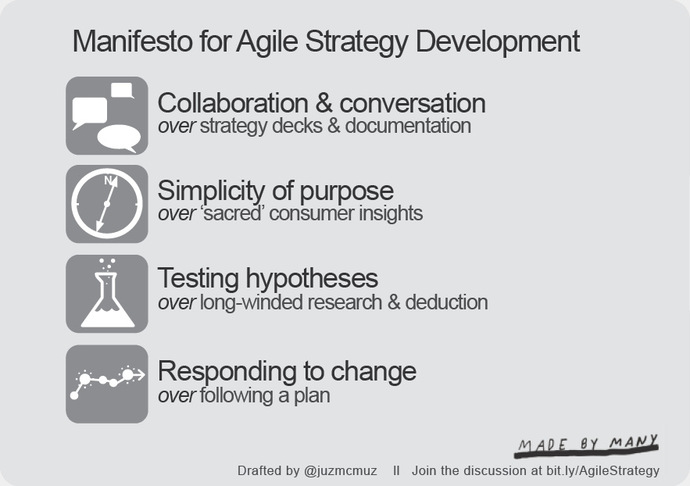
    One of the movements that I’d mentioned in the drivers for brand/marketing in 2014 and beyond is agile marketing. In my mind, there are various factors that are contributing to this eventuality like fragmentation of media platforms and the phenomenal amount of data being created and consumed to begin with.

    Simulations, testing, analysing data, and quickly adapting are the basics of this approach to marketing. In terms of ‘ingredients’ to play with, I’d still go with the traditional 4Ps of the marketing mix- Product, (includes packaging) Price, Place (I include the internet with Platform) and Promotion, with Purpose being an umbrella addition. The input and the output, I have categorised into business dynamics, using the other favourite marketing letter – C. These are consumer, competition, channel, content and context, and the cohesive narrative that is created. I’m trying to evolve a framework from these, while watching brands actually practice it – with or without a theoretical structure to the approach.

    One of the brands I’ve noticed doing a good job using many of these ingredients and the I/O is Uber. That’s despite the recent surge pricing bad press. In fact, I’d see this as an example of their ability and willingness to adapt. In the US, they’ve been honing their craft for a while – free rides for students during the Boston school bus driver strike was the first occurrence I noticed, and then soon after, the delightful hat tip to pop culture on National Cat Day in a tie up with Cheezburger.

    They launched in India recently, and true to form, wasted no time in launching the UberSLEIGH during Christmas in Delhi, Bangalore and Hyderabad –  a tie up with Goonj. From a critical agile marketing evaluation perspective, it would be easy to argue that Christmas is a recurring annual event that brands plan for. But auto-rickshaw strikes are relatively less predictable. A fortnight later, on January 6th, Uber slashed rates by 75% in Bangalore in response to a strike. What is easy to see is the anatomy of an agile strategy. To me, it seems that they are well on their way to developing a flexible marketing framework that helps them take advantage of any variations in the ‘input-output’ factors I’d mentioned earlier – in this case, pricing product and place in response to consumer and context.

    Newer brands might have an advantage in developing these frameworks because of minimal ‘baggage’ in their brand philosophy. But then again, the advantage for existing brands might be their existing role in a consumer’s life. Traditionally, brands have attempted to build a unique/distinguishable/identifiable ‘idea’ of itself in the mind of the consumer, with different forms of the promise+identity+attributes+personality framework and (relatively) limited broadcast media options. Iterations cycles were lengthy and included brand tracks and insights which resulted in large campaigns. Several things have changed now. Consumers have shorter attention spans and are increasingly fragmented in their consumption habits. Social platforms have caused brands to cede control over the conversations – any consumer’s experience can potentially create the perception for millions of potential customers. Platforms for reaching the consumer are exploding, and each have their protocols. The potential amount of data from all of this is huge! The challenge for brands is to stay relevant across contexts and create a cohesive narrative, and this requires an evolution in marketing processes. Like I’ve written before, if technology is invading marketing, then perhaps agile – which is a popular approach among that kind – is the way to go!

    manifesto_agile_strategy_development_3_content

    until next time, sprints and marathons

  • Social’s second chance

    For context, I believe the first chance was brand/marketing. That potential has pretty much been converted into a banal, mostly campaign oriented, traditional media (with better targeting thanks to various contexts) approach, though thankfully, we have do some rebel strongholds. I can clearly see this within the Big Shift construct – the third wave is about how organisations/institutions respond to knowledge and the flow of information, and what I see now is the typical marketing organisation conveniently converting social into a media framework that it seemingly understands and has worked with for a long while. The big boys – Facebook, Twitter, YouTube – have all created advertising products that cater to this thinking. Viva la broadcast!

    But I’d like to think that all is not lost. Social changed to social media when it approached brand in the same way its media predecessors did. I see this as a phase which will last until social media saturates itself and becomes just another standard media platform. That leads me to think – if each domain (HR, Product) treats social in the same piecemeal way, it is bound to fail across them all.  When this does happen, at least some organisations will realise that a larger structural change is afoot and the institutional response needs to be more strategic. “The Next Social Imperative” made me realise that social has been attempting to work on top of business processes, but it needs to work the other way to even begin this journey. (also, strongly reminded of Tac Anderson’s post in this context back in 2010!) The driver will be market dynamics but the good news for organisations is that many in the existing workforce have the potential to become navigators of this change.

    How does the workforce systemically play a part? Stowe Boyd’s insightful “The Future of Work : 4 trends for 2014” has at least two trends (consumerisation of work and me-isation of productivity and performance) that clearly point to this shift and its harbingers. Consumer technologies (and more so, the philosophy behind them) and a different kind of workflow can actually make an organisation more consumer centric than the silo approach currently followed. Steven Sinofsky’s long but superb post on the theory and manifestation of this paradigm shift is a must read on this subject. A very interesting manifestation of this shift I saw recently is Zappos’ move towards holacracy – a comprehensive ‘operating system’ for organisational governance that focuses on purpose and accountability without a top-down, hierarchical management structure.

    This could be the first step towards ‘social business’, and I’m thinking of social business as a platform. (a fantastic read on platforms) The organisation and its purpose would actually work as a platform to channelise and augment the connection between employees and consumers. This purpose would also convert a job into work than an employee is connected to, and on the other side, it would help the consumer get closer to a brand he believes in. This is also when epics happen. Social (and other) technologies would play enablers for a more fundamental change in the structure and nature of work, and allow organisations to harness data, connections and transactions towards a shared purpose. More a transition than a disruption. Different organisations, I think, would evolve differently – some would not evolve at all. This is more hope than anything else, but I do believe that social technology has it in itself to be transformational, and not just transactional.

    until next time, back to a socialist, communist workforce 😉

    quote-Peter-Drucker-so-much-of-what-we-call-management-108215

  • La Tagliatella

    First published in Bangalore Mirror

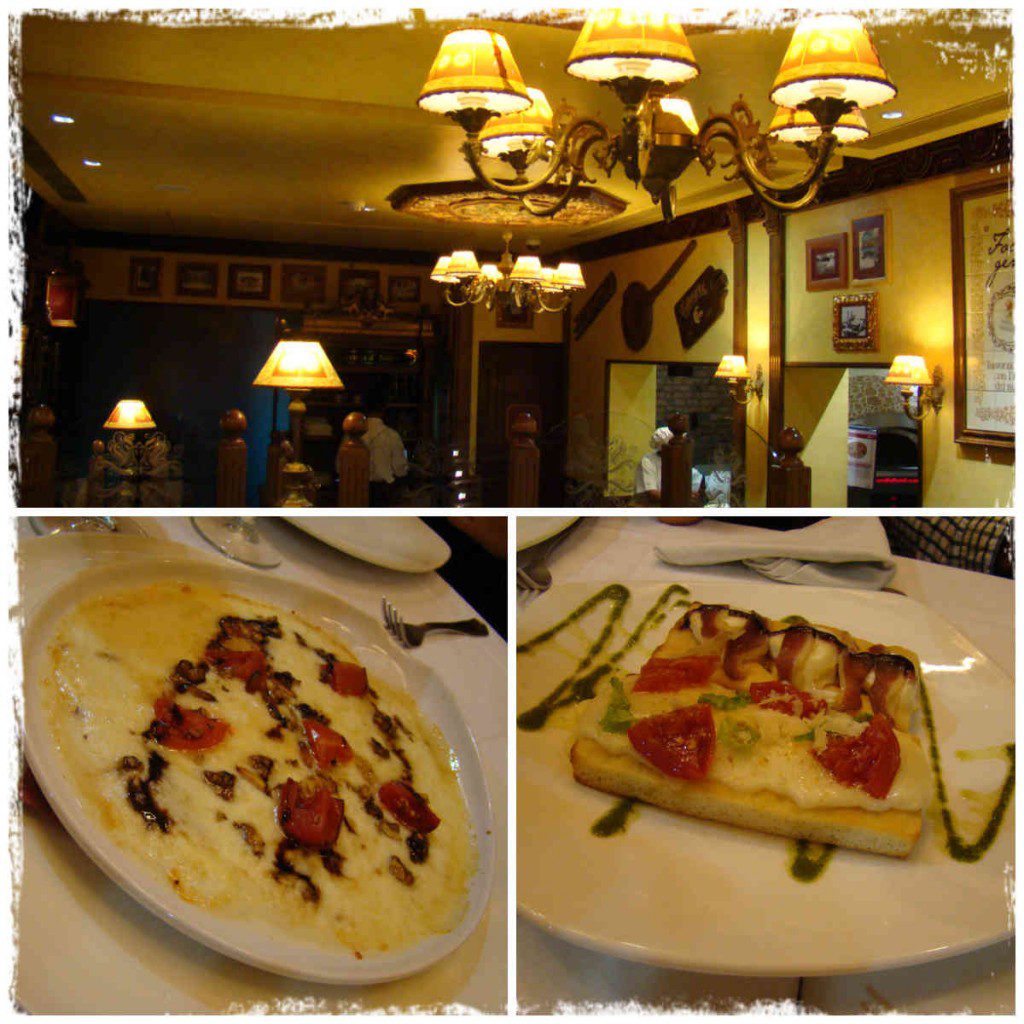
    Something about the consonants in the name of the restaurant reminded me of The Godfather – turned out to be the Tattaglia family, one of New York’s ‘Five Families’ in the novel. The establishment on 100 feet Road, Indiranagar (map) obviously has no connection, and is actually named after a kind of pasta. Yes, there is valet parking. There is something about the façade and the view of the brightly lit interior from the outside that conveys opulence. This is only enhanced once you step inside – gold and yellow dominate the décor, with red thrown in for good measure, and the chandeliers and the framed pictures only add to the effect, though occasionally it tends towards gaudiness. But just when you begin to think you’re in the protective warmth of a palatial bungalow, the culinary illustrations, the display of cooking instruments, the pricing and the temperature manage to bring you back to the cold reality of a fine dining restaurant. There was a lot of chatter happening on our table – some of it was because of the menu, which had a variety of choices, and it took several rounds of discussions before we could reach a consensus, but most of it was courtesy the intense cold. When we asked for it to be reduced, we were given a central air conditioning story. It did seem that the entire air conditioning was centred on our table! The rain meant that we couldn’t use the alfresco option available.

    The starter options consist of a couple of soups, half a dozen salads, and some antipasti. We skipped the first two and launched into a Focacce liguri and a Mozzarelletta. The flat bread and its toppings turned out to be quite picturesque, but even the collective presence of duck ham, parmigiano cheese and provolone cheese wasn’t enough to take the dish beyond ordinariness. In contrast, the simplistic combination of mozzarella melted with nuts and sweet tomato, though not very appealing to the eye, made a mark on other senses – smell and taste. It was totally melt-in-the-mouth, with the nuts offering a texture counterpoint. The wine list is fairly exhaustive on paper, but that is a common menu, and in Bangalore, they have chosen to serve only wine. They had run out of bottles of the white wines we preferred, so we settled for ‘pints’ of red and white wine, and were left rather unimpressed with both!

    collage1

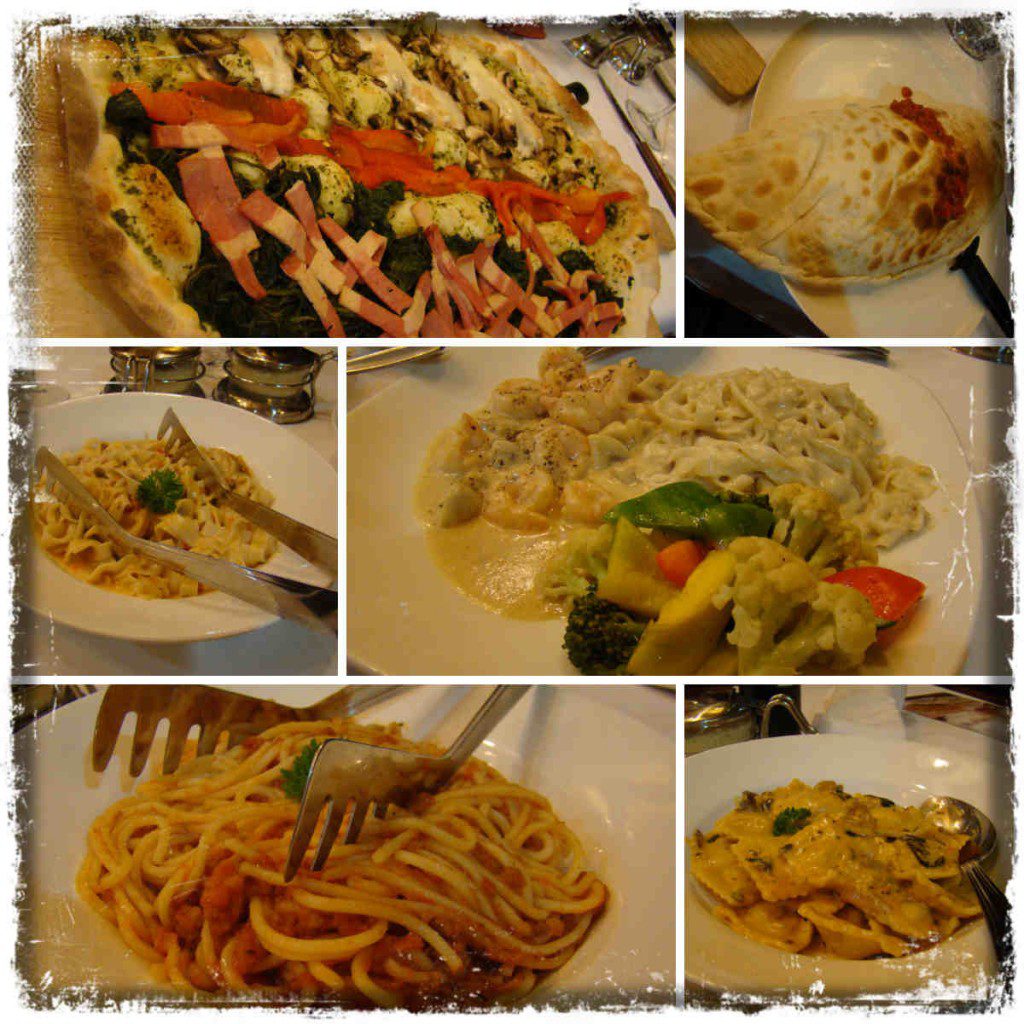
    The sheer variety of pasta choices is something to pay attention to – from spaghetti and ravioli to Sorrentino and Taglierini, I could count about twenty. Together with the condiments, there are potentially hundreds of combinations! Add to that pizzas and calzones! We began with a Tagliatella pizza – thin crusted and fairly large with pesto, mushrooms, taleggio cheese, turkey bacon and spinach. This is probably shuddh Italian judging by the relative blandness, and despite that consideration, it failed to impress. The Calzone Verde was a lot of hot air as they weren’t really generous with the mozzarella, mushrooms and pesto stuffing. We then tried the Gamberetti di Funghi which turned out to be an excellent dish with well cooked pasta and prawns. On weekdays, they have a ‘1111 for 2’ menu, in which we can choose 3 pastas from 9 options. That turned out to be quite a blessing and we sampled the Spaghetti Bolognese, Sorrentino with Vera Casalinga sauce and the Tagliatelle with Tremenda sauce. The spaghetti nosed ahead, though I thought if the Tagliatelle wasn’t a tad overcooked, it might have won, the cream sauce was quite good. I liked the Sorrentino as well, but the table was evenly divided on the parmigiano-reggiano and Iberian pork dish.

     collage2

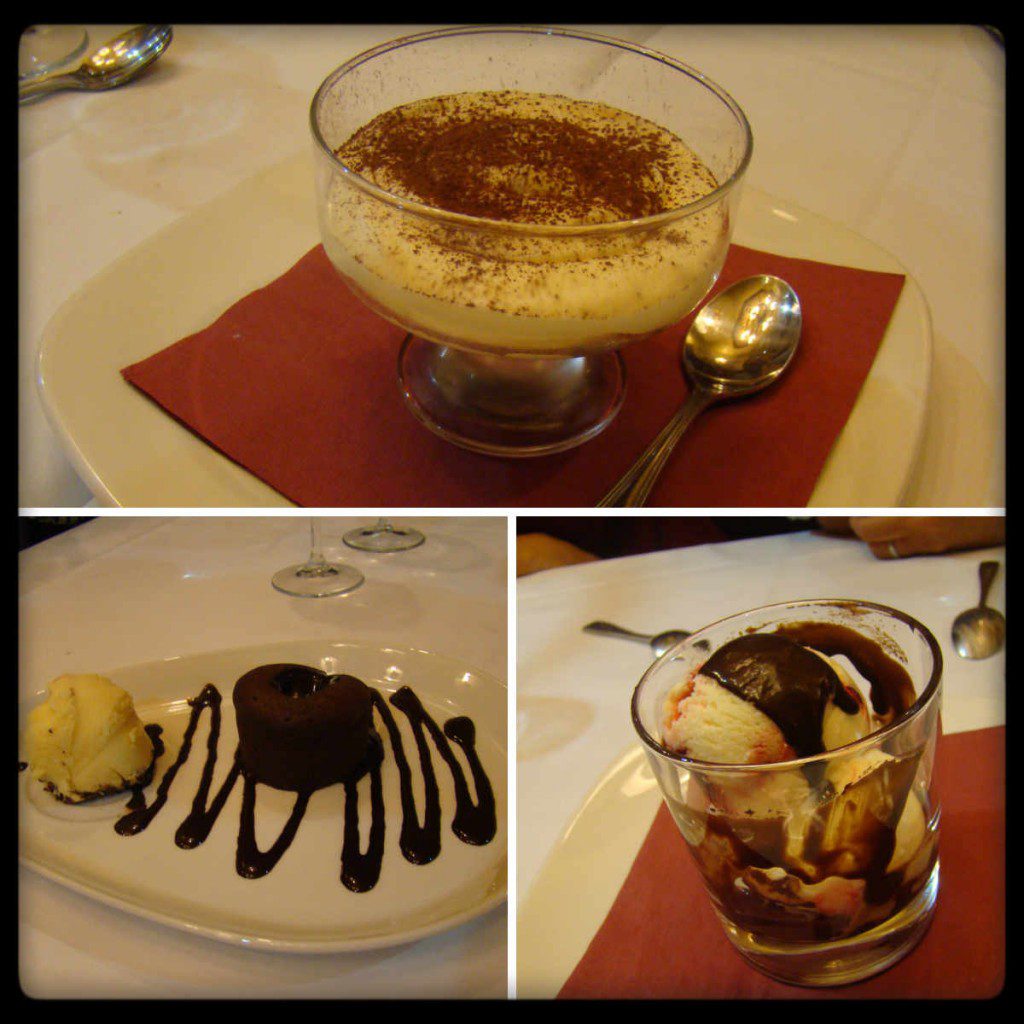
    There are plenty of dessert options, but as usual I got unlucky with the exact one I wanted! We tried the Tiramisu, which was phenomenally good and the best dish of the day. The Tutto Cioccolato seemed a little too similar to the standard lava cakes available around. Coppa Fior di Latte al Cioccolat oFuso – Mascarpone ice cream with hot chocolate cream – was also just average.

    collage3

    For about Rs.2700, you could share a drink, a non veg starter, a non veg main course dish and a dessert. (Inclusive of taxes and service charge) La Tagliatella is an international chain and prides itself on the authenticity and freshness of the ingredients used. That probably explains the pricing to an extent, but somehow the experience itself didn’t really justify the bill. So, unless the gap between value and cost is bridged, the bill would make it very easy for a customer to suspect a Godfather like extortion!

    La Tagliatella, 766, Amrest Bunglow, HAL 2nd Stage, 100 feet road, Indiranagar, Ph: 080 60506066/77

  • Brand, Marketing – 2014 and beyond

    These are not really trends or predictions, it’s more a set of drivers and their impact on the domain of brand marketing.

    Technology: Disruption is an abused word, but I think technology is the biggest disruption that marketing has experienced. Yes, it has been so every time a new medium cropped up, but this wave is special. In this largish bucket, I’m dumping everything from the Internet of Things (IoT, which, in addition to really smarter devices and spaces, will also, I hope, give the entire domain of social a reboot) to 3D printing (HP’s entry, scheduled for mid 2014, should push this further in the mainstream journey) to wearable tech/techsessories (Google Glass is the poster boy, though development is happening on various fronts) to Social TV. (a classic example of how social adds itself as a layer to existing media platforms and augments it)  I also add to this the advancements in devices – specifically mobile, which is already forcing marketers to quickly rework their strategy to adapt. The reason I used the word disruption is because by fostering a new kind of phenomenon like say, the collaborative economy, and getting ready to challenge traditional manufacturing, technology is going beyond its role as an enabler and changing brand experiences.

    Marketing Technology: While the first point was about technology in a relatively generic sense, this is is about the application of technology and associated tools in the marketing domain. This is everything from marketing automation to web content management to advertising technology and so many, many more things which will probably make a move towards mainstream in 2014. This very popular image would give you a vastness of this domain. With the kind of data that phenomena like IoT and wearable tech will spew out, and the levels of customisation that customers expect, everyone, across domain would have to at least attempt Amazonian levels of efficiency.  Also, increasingly, technology will help us integrate offline with digital. (example)

    We can scream buzzword, but big data exists, and we’re only taking baby steps towards harnessing it. I can already see the first levels of it in social media advertising, where intelligent tools and dashboards allow not just better and real time targeting but also better analytics on everything from planning to attribution, to aid decision making. Extrapolate this to multiple media platforms, devices, delivery channels within each and think of the possibilities. I think the domain will move much faster because of two reasons – one, the fragmentation of marketing channels and the impossibility of managing it with only manpower resources, and two, the marketer’s ROI obsession. To quote Scott Brinker, “software is the new fabric of marketing” I see the ‘big’ in big data moving on two paths simultaneously – qualitatively big that would help in personalisation, and quantitatively big that would help in scaling. (mass customisation for larger audience sets, better targeted)

    Agile Marketing: Yes, we have borrowed it from the software development guys. No, it’s not really new, nor is it surprising because if marketing is getting a technology influx, it is only obvious that software processes might be a good way to approach marketing. Everything that I have written above will ensure that by design or not, marketers will increasingly be forced to adopt this methodology as the days of predictable media platforms draw to a close. In a dynamic business environment, where new platforms are popping up regularly, and even known platforms are changing their rules constantly, the only way to cope, let alone thrive, would be to run various simulations continuously,  iterate and develop incrementally, break silos and communicate effectively, and have flexible frameworks that can be more responsive to the speed of the change cycles.  What I hope to see this year – at least at an early stage – are software/tools that are customised to the requirements of marketing. But irrespective of that, get ready to sprint! (read more)

    Promotainment: Roughly, the phenomenon formerly known as advertising. Thanks to everything above, creativity will need to be channeled differently. In YouTube’s top trends for 2013, three branded videos managed to capture a place for themselves. But this only covers part of the story. Mere entertainment will not be enough to bond with the consumer, for sufficient pull to happen, brands will have to define a purpose (business and beyond) that will resonate with consumers, and treat it differently according to contexts. These contexts could be platforms, locations, topical opportunities and a host of other things, with each experience adding to the perceptions of the consumer. Experiences and ‘content’ need to be created for each of these contexts, and brands need to reboot the way they handle communication. (The Making of a Content Brand) The other key player in this mix is privacy – everything from transience (eg. Snapchat) to the ‘negotiation’ with consumers on what information they share to get what benefit. Customisation as per contexts and audiences and yet cohesive within the larger purpose framework. Not an easy challenge. (A wonderful take on this, and more from Vyshnavi Doss – Brand Avatars)

    Marketing Organisation: I came across the fascinating Big Shift concept and the three ‘waves‘ – foundation, flow and impact – only recently. The third wave is how organisations respond to the fundamental shifts in knowledge and the flow of information that are characteristic of the first two waves. While this is a larger institutional shift, its impact will also felt in the structure of the marketing organisation. Add to this, the transformation required for agile methodologies and a fundamentally different content marketing process, and the existing marketing silos have no choice but to evolve. Technologists, ROI drivers, specialists in different kinds of brand experiences – real time, real (offline) and otherwise, data wizards to analyse the tons of data streaming in, CRM folks, creative people and many more will be part of this new structure that realigns the marketing domain to fit the new business landscape dynamics. (a good illustration)

    These subjects, and in my mind, one of its results –  social business – will form the majority of this blog’s content in 2014. We’re at the cusp of an extremely interesting era in brand marketing, thanks to radical shifts in pretty much everything happening around us – what I keep referring to as institutional realignment. Here’s to an exciting year ahead!

    einstein

     until next time, have a wonderful 2014!