I caught this in the Farnam Street newsletter, and went about looking for the source. An HBR article from 2014 titled Making Business Personal, which also writes at length what and how certain organisations overcome this.

I caught this in the Farnam Street newsletter, and went about looking for the source. An HBR article from 2014 titled Making Business Personal, which also writes at length what and how certain organisations overcome this.
Abraham Eraly
History is not usually kind on its readers, and changing that is probably the biggest advantage this book has to offer. The author makes history accessible through a largely simple narrative and writing style. While he has taught history, I don’t think he is a historian. Thus it isn’t based on what one might call ‘original research’ but more an aggregation of sources. Indeed, the book cites a large number of sources for the information it gives.
The ‘seeding’ begins long before humans arrived on the scene, when plate tectonics created the land mass that is now called the Indian subcontinent. The geological results – the Himalayas that act as a barrier, the fertility of the land etc – have had huge implications on how the civilisation in this part of the world has evolved.
The book moves on to the Indus Valley civilisation, the influx of the Aryans and the Rig Vedic times, the later Vedic times, and in the process, touching upon quite a few popular misconceptions. This entire shift is obviously significant from a civilisational and cultural point of view, but it is also interesting to see the theatre of action shift from the Indus to the Ganga. The societal and cultural milieu is also explained well, using the texts of the time – the Vedas and Upanishads. (more…)
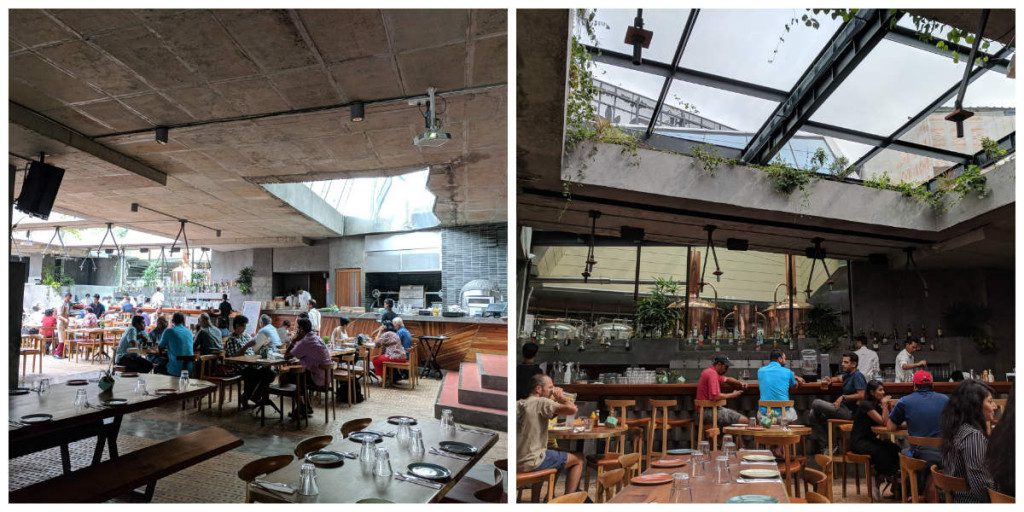
That local food in a rustic setting thought? Kill it. Oota is in the same building as Windmills Craftworks (map) and run by the same folks, so while the cuisine is definitely what the name suggests – Karnataka – the setting is absolutely fine dining. The clincher is when they explain the non existence of cutlery with “should be eaten with hand for the complete experience” and let you know that if you do feel uncomfortable with that, they could get you cutlery. In fact, I did see a person at a table nearby wrestling with a Maddur Vade armed with a fork. Sigh.
The ambiance is absolutely classy, with lots of rich wood finish, bright cushions, show lamps hanging from the ceiling interspersed with actual lights, and an annapakshi vessel on the table.
On our way to the airport, for what would be one of our shortest trips to Kerala, I told D that I didn’t see myself making this journey a decade from now. At least not framed in the way we do it these days – a trip home. I was wrong – it happened way sooner than a decade.
It wasn’t a comment made lightly – after all, to borrow a phrase, I was referring to a city which had all the places that made up a couple of decades of my life.
What does one go home for? The obvious answer is easy – to spend time with people who matter in one’s life. To note – even that changes during one’s lifetime. But if I have to dig a bit deeper, Rana Dasgupta’s words make sense – when one becomes homesick, it is not a place that one seeks, but oneself, back in time. And when one does that, the props matter. The places, the faces, all reminders of different phases. When they no longer exist, the place is no longer a cure for homesickness. (more…)