Author: manuscrypts

  • Kampot

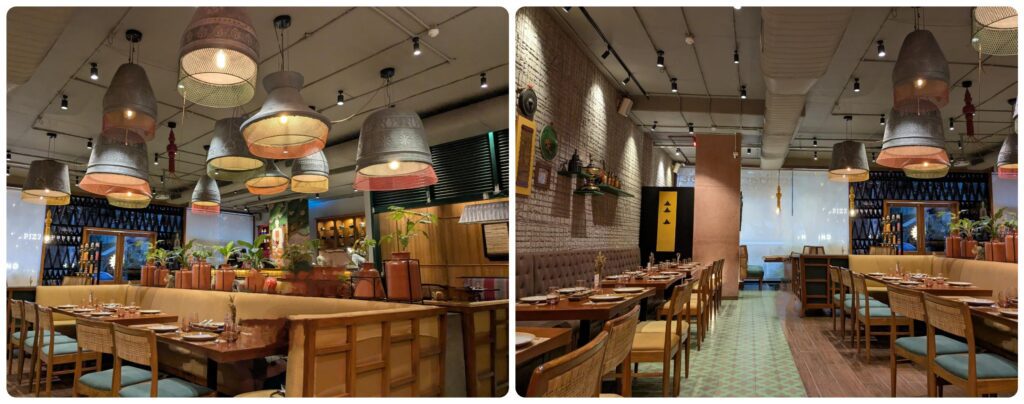
    We came across Kampot when we visited Mannheim. The name itself was alluring, since Cambodia is one of our earliest and most cherished travels, and home to one of D’s all-time favourite dishes – Fish Amok. Given the constraints on the things you can do inside Ecoworld, they have done a fair job with the ambience. The menu turned out to be a lot more Asian, which I am guessing is a smarter choice if the idea is to get a crowd.

    Kampot

    We started with a Tom Kha Head Soup. The flavours and texture were totally off with this one, which we might have guessed anyway given the colour. Closer to the other Tom – yum that is, than what we expected. Next up was the Holy Basil Sambal Chicken, and again, the memories of sambal in Indonesia are strong enough for me to recognise non-sambal. That fiery bite was completely missing in the dish. The soup actually was spicier!

    Kampot

    For mains, D went with the Miso Ramen with Soba Noodles and Chicken, and I thought going Vietnamese might be a good idea after Thailand and Indonesia had failed. Of the two, D’s Miso was easily better in terms of flavour but definitely not the best we have had. The Pho was a disaster, and I didn’t even bother to finish it.

    Kampot

    On hindsight, this was stupid given everything that had transpired, but we decided to try a Kampot Coffee. Since this is their own concoction, I don’t really have a benchmark to compare against. So all I’ll say is that I regretted it soon as I took the first sip.

    Kampot

    We paid close to Rs.2700 for this mistake. The service was pleasant but tardy. After having sampled multiple eateries in The Bay, Ecoworld, I think the building has found a way to decrease the quality of dining experience. For instance, Irish House and Punjab Grill. I’ll soon be able to update with Mannheim too. For now, I’d avoid.

    Kampot, The Bay @ Ecoworld, ORR Ph: 9606025113

  • The Weirdest People in the World: How the West Became Psychologically Peculiar and Particularly Prosperous

    Joseph Henrich

    As an anthropologist, Joseph Henrich realised that much of the published work (and hence commentary) on human psychology (and social sciences at large) were based on work with experimental subjects who were based in or around Western universities. And when attempts were made to replicate these results with people in Africa/Asia, some of them even elites, it came to light that the subject pool was biased. They were WEIRD – Western, educated, industrialised, rich, democratic – and though only a small part of the species, are disproportionately represented in culture and thinking. How did this happen? That’s what The Weirdest People in the World is all about.

    He sets the stage with the influence of Protestantism in this. Its credo of the individual’s personal relationship with God spurred the belief that a person should read the Bible (sola scriptura), increasing literacy in the process. But beyond this, he points out that religious convictions shape decision-making, psychology, society and culture at large.

    But what is the WEIRD psychology? Broadly individualism and personal motivation (self focus, guilt over shame, dispositional thinking – based on intent not context, low conformity, self regulation and control and patience, time thrift, value of labour, desire for control and choice); impersonal pro-sociality (impartial principles, trust, honesty and cooperation with strangers and impersonal institutions, emphasising mental states in moral judgment, not revengeful but willing to punish third parties for not sticking to principles, reduced in-group favouritism, free will, belief in moral truths like physics principles, linear time), and perceptual and cognitive abilities and biases (analytical over holistic thinking, attention to foreground and not surroundings, endowment effect, overconfidence on own abilities)

    To understand how people became WEIRD, he brings up the importance of cultural learning in evolutionary psychology. “Unlike other animals, we have evolved genetically to rely on learning from others to acquire an immense amount of behavioural information, including motivations, heuristics, and beliefs that are central to our survival and reproduction.” From our own motor patterns to projectile technology and food processing to grammar and social norms. Cultural learning adaptively rewires our brains and biology to calibrate them for navigating our culturally constructed worlds. This is cumulative cultural evolution.

    It started off with kinship altruism, which other primates too possess, and extended to pair bonding and marriage, which is the most primeval of the institutions we have created. Preferred sexual access and a guarantee of paternity in return for protection and providing for the family. This paternity certainty and norms to cement it is where we start differing from most other primates. This also creates in-laws (affines) forming connections with more people who are not genetically related. From there on, basic communal rituals like dance, drills etc also bind people together with “mind hacks” through mimicry and a suggestion that others are like us and have an affection for us.

    The next big shift was agriculture, which necessitated securing and holding lands. This needed co-operation and gave an edge to those communities with more social norms – rituals, beliefs etc. Fierce competition between groups generated a coevolutionary interaction between agriculture and societal complexity. And so, though farming was less productive and even less nutritious than hunting and gathering at an individual level, between sedentism and productivity of the unskilled (young) labour, farmer communities just reproduced more quickly and removed/assimilated hunter-gatherers.

    Further inter-group competition led to clans which were kin-based institutions. These then became chiefdoms and premodern states. Built on norms and beliefs. And then non-kin based institutions developed between the elites and others to create stratified societies. e.g armies, tax collection.
    In the meanwhile, religion, based on our supernatural beliefs and worldviews, started scaling cultural evolution by creating ‘doctrinal’ rituals – prayers, hymns, parables etc and being transmitted by successful people – prophets and community leaders. These gave people a sense of unified commitment (conforming) and further evolved with identity markers- dresses, ornaments, taboos etc. By powerfully shaping behaviour and psychology, religion played a key role in forming higher-level political and economic institutions.

    Thus begins another central point in the book – the role of the Church (and its MFP – Marriage and Family Program) in creating WEIRD people. The Church systematically started breaking the foundational kin-based societies using prohibitions and canon laws (marriage, adoption, divorce, polygamy, wills etc) over many centuries in Europe, ‘threatening’ people with divine retribution (in the afterlife) and excommunication (immediate). By allowing rich patrons to ‘pay’ with money and church-building, the Church continued to grow at the expense of the kin networks.

    With more and more people marrying and working outside the kin network, cultural evolution started favouring a psychology that was more individualistic, analytically-oriented, guilt-ridden (as opposed to shame – guilt depends on one’s own standards and self-evaluation while shame depends on societal standards and public judgement) and intention focused (in judging others) as opposed to being bound by tradition, elder authority, and general conformity.

    An important part is how monogamy became a norm though logically polygynous works for both men and women (because women could be second wife to the best hunter rather than only wife to an average hunter). It evolved because it can give religious groups and societies an advantage in intergroup competition. By suppressing male-male competition an altering family structure, monogamous marriage shifts men’s psychology in ways that tend to reduce crime, violence, and zero-sum thinking while promoting broader trust, long term investments and steady economic accumulation. Basically a testosterone-suppression system to reduce intra group competition. Between this and suppressed fertility (increased age of marriage, no pressure from kin, education for women) nuclear families started to focus on investing in their child – nutrition and education.

    These changes also led to urbanisation as people travelled to places where they could find mates, vocation etc and expanded impersonal networks (trust in strangers as opposed to interpersonal kin networks) based on interests and worldviews, leading to universities, guilds and charter towns, who competed with each other to attract people. A pre cursor to the transition to political parties in later centuries. Another factor at play was wars. Though intuitively, one might think it derails progress, it actually builds intra group bonding and spurs technological advancements.

    A rising middle class started demanding more rights, freedoms and privileges, leading to refinement of ideas, and acceptance of concepts like ownership and laws. Between this, impersonal networks and commerce, attributes like patience, time thrift (fascinating how clocks developed and changed the notion of time – wages per hour, need for efficiency, common market hours, contracts), self-regulation and positive-sum thinking (everyone can gain by advancements, I don’t need to be selfish or envious) began being appreciated as qualities one would want in self and other people, in order to distinguish themselves and prosper. These mindsets explains the kind of representative governments, laws, and the innovation and economic growth since then. The Industrial Revolution, for example, was fuelled by the expanding size and interconnectedness of Europe’s collective brain. In the political sphere, Protestantism, also a part of the larger religious cultural evolution, encouraged democratic institutions. Unlike the hierarchical Church, it requires communities to develop self-governing religious organisations using democratic principles. The cultural evolution can also explain things like patent concentration (in countries and regions) and economic characteristics at large in the contemporary era.

    I can now easily see how the same principles apply to even India in the last say, five decades – better connectivity, educational institutions, urbanisation, reduction of kin bonds, and how that makes the 1% in the country closer to WEIRD than their own ancestors. This is a fascinating book supported by a ton of data and studies, and my only complaint is that like many other academics, Henrich too succumbs to the tendency of extensive usage of the latter at the risk of the narrative flow (instead of an appendix). But I’d still recommend it and between this, “Being You” (reality as a controlled hallucination and the brain only seeking to survive/control), and “The Master and His Emissary” (the hijacking of the narrative by the left brain especially since the Industrial Revolution), there emerges a phenomenally insightful view of the brain, its motivations and the interaction with cultural evolution. I really must repeat all these three soonest!

    The Weirdest People in the World is a fascinating read and is in my favourite reads of 2024.

    The Weirdest People In The World | Joseph Henrich
  • In considerate mode

    Delivery guys riding on the wrong side of the road, kids behind you kicking your seat on a flight, speaking on the phone loudly in a public space – these are a few of my favourite peeves. I am sure you have yours too. That’s why this post on LinkedIn caught my attention – “things pissing me off” in situations where people aren’t following rules is something I could relate to.

    Barring a few exceptions where I am absolutely not able to tolerate what I believe is ‘inconsiderate behaviour’, I don’t engage. But engage or not, these instances also reveal my snap judgements. e.g. what an inconsiderate idiot, speaking loudly during a movie. I judge myself the most, but also try to intellectually understand my motivations.

    That’s why I found this particular episode of The Knowledge Project – in which Shane Parrish speaks to Todd Herman – fascinating. Around the 49th min mark, Shane asks Todd if he has a hard time relating to average people, people who just didn’t want to be the best at what they do. I could relate to it in my professional context – another pet peeve. Todd admits how despite having matured, he still has to watch out as his ego still tries to stack them as ‘average’. Todd explains that he does this because he over-indexes what he personally finds important. e.g. a career-driven person might judge someone who prioritises being a parent.

    I battle my own bugbears – punctuality, work ethic, grammar and spelling errors etc. That image below is my team taking revenge on my birthday cake. Cheapos! 😂

    The point is that others are not average/ inconsiderate people, they are at best average/inconsiderate in the thing I am over-indexing for! There are many contexts and reasons why they don’t behave in a way I think they should . As I commented on LinkedIn, I have realised that being able to afford consideration (or applying oneself) is a privilege.

    But that was level 1. When I dug deeper, I saw my real problem. When that ‘idiot’ is not following my worldview (‘ideology’) – whether it is ‘considerate behaviour’ or being conscious of spelling mistakes – it raises (in my own mind) doubts on the objective correctness of my ‘ideology’. Will Storr has a  brilliant insight – “for humans, ideology is territory”. We fight for ideas like animals fight for land.

    At this point, we have evolved to an extent where we hold hundreds of “shoulds” and “shouldn’ts” in our heads. And we expect the world to comply – from nationalism to having pets/kids to the usage of the Oxford comma and so on. Any deviation from our ‘ideology’ is treated as a judgement against us. No wonder every interaction has the potential for conflict. We are defenders of our own little faiths that make up our identity. What we could practice, when we have the privilege, is to step back and think about the little judgements we make, in work and life scenarios, and then react with empathy, because it is not a personal attack.

    There have been many posts on this blog about morality, and recently, I found two quotes that connect it to judgement and empathy.

    “The drug of morality poisons empathy” ~ Will Storr (again)
    “Compassion is the basis of morality.” ~ Arthur Schopenhauer

    I found these to be an educative lesson on how I look at my subjective morality, and how I behave with others in real life.

  • Same As Ever

    Morgan Housel

    The Psychology of Money” is acknowledged as a game changer. It gave me fresh perspectives, validation, and the confidence to continue on the path I had set out on financially. So it wasn’t surprising that I was looking forward to Same As Ever.

    To begin with, I think you shouldn’t expect the refreshing sense you’d get from the previous book. This is even more so if you’ve been reading the Collab Blog. The book’s cover promises ‘timeless lessons on risk, opportunity, and living a good life’ and to some extent, delivers on all. There are many extremely good insights and the pithy ways in which Housel articulates profound truths continue to be a source of ‘aha’.

    What I missed though was the smooth flow of the previous book. It doesn’t help that many of the chapters seem to be force fitted into a narrative, and many anecdotes and other content are from the blog. Housel does go for a structure but I think it might have helped if this were presented as just a series of essays. He does say that these are standalone but then also proceeds to try connections at the end of each chapter. The overall experience therefore is a little jarring.

    Having said that, Same As Ever is a useful book to read, with some great but lesser-known anecdotes, and indeed, timeless insights.

    Notes and Quotes
    “Risk is what’s left over after you think you’ve thought of everything” ~ Carl Richards
    “Invest in preparedness, not in prediction” ~ Nassim Nicholas Taleb
    Money brings happiness the same way drugs bring pleasure: incredible if done right, dangerous if used to mask a weakness, and disastrous when no amount is enough.
    “The majority of Americans were likely than their descendants to be dogged by the frightening sense of insecurity that comes from being jostled by forces – economic, political, international – beyond one’s ken. Their horizons were close to them.” ~ Frederick Lewis Allen (1900)
    People don’t want accuracy. They want certainty.
    If you have the right answer, you may or may not get ahead. If you’ve the wrong answer but you’re a good storyteller, you’ll probably get ahead (for a while). If you’ve the right answer and you’re a good storyteller you’ll most certainly get ahead.
    “Humour is a good way to show you’re smart without bragging” ~ Mark Twain
    “The higher the monkey climbs a tree, the more you can see his ass” ~ T. Boone Pickens
    “A mind that is stretched by new experience can never go back to its old dimensions” ~ Oliver Wendell Holmes

    Same As Ever
  • Bar Spirit Forward

    Let’s just say that at some point, the presence of Bar Spirit Forward on my feed became intense enough for it to outweigh the laziness of transporting ourselves from Whitefield to Lavelle Road. The place is housed next to a nostalgic favourite from almost a couple of decades ago – The Rice Bowl. The entrance is subtle enough to make you wonder if you’re in the right place. It’s all part of the play.

    Bar Spirit Forward

    Make sure you reserve in advance so you get a warm welcome. 🙂

    The decor is all world charm and sophistication, with the wicker and plush leather giving it the well-heeled elegance it’s probably aiming for.

    That being said, it helps to also have tongue firmly in cheek lest we take it all too seriously.

    Bar Spirit Forward

    An Umami Old Fashioned is what I began with. The ingredients were a mouthful – Jim Beam ,Vermouth, Amaro, Cherry Brine, Brown Koji Boy Cacao Miso, Bitters – but thankfully, those many cooks didn’t spoil the broth. I’d rate it high amongst the OFs I’ve had.

    Bar Spirit Forward

    D had a 3 Gin Vesper which had gin heavyweights – Monkey 47, Tanqueray 10, Greater Than with Short Story vodka, Lillet Blanc, Dry Vermouth – which came frozen and poured straight from an icy bottle, served with blue cheese stuffed olive.

    Bar Spirit Forward

    We didn’t begin well in terms of food. Not that there was anything particularly wrong with the Dak Bulgogi, but the smokey grilled chicken with scallions and sesame wasn’t something that gave you a foodgasm either.

    Bar Spirit Forward

    The surprise package was the Lemony Roasted Cashews. Spicy and insanely addictive. Not to mention phenomenally good value for money. No, I’m not nuts, give it a try!

    Bar Spirit Forward

    The Chicken Della Vittoria was a creamy, slurpy, wholesome affair and we throughly enjoyed the flavours and texture of the hot chicken stew.

    Bar Spirit Forward

    Show me a person who can resist that Bailey’s Hot Chocolate Cake, and I’ll happily take their share. A great loaded dessert to end the meal.

    Bar Spirit Forward

    The service is pleasant enough, one must expect a certain level of snootiness. The place was surprisingly a bit noisy thanks particularly to a loud middle-aged party of three, who were unfortunately at a table near ours. Thankfully they left in a bit. We loved the ambience and the food and didn’t grudge the Rs.4000+ bill we got. I’d recommend at least one visit.

    Bar Spirit Forward, Lavelle Road, Shantala Nagar Ph: 077956 54575