It’s that time of life, when there are a bunch of reunion invites – school(s), engineering, MBA. The sudden influx makes me realise that it’s halftime. We are pausing – to collect our thoughts, to take a deep breath. I wonder aloud to D if the journey is like a mountain, and halftime puts you closer to the peak. The way is downhill and you can read that in more ways than one. Maybe that prompts folks to look back at the journey and savour the moments – the significance and insignificance, the hits and misses, the gains and losses. Or maybe it’s just a moment taken to catch our balance in a world that’s changing at a dizzying pace, and to seek the anchor of certainty that the unchanging past provides.
Author: manuscrypts
-
Aurum Brew Works
After the horror story that was Vapour, we had sworn off Sarjapur Road. But a peaceful Saturday evening, combined with a reasonably good experience at Sarjapur Social a few weeks ago, and favourable reviews of the new microbrewery, got us back to the area and specifically Aurum Brew Works.
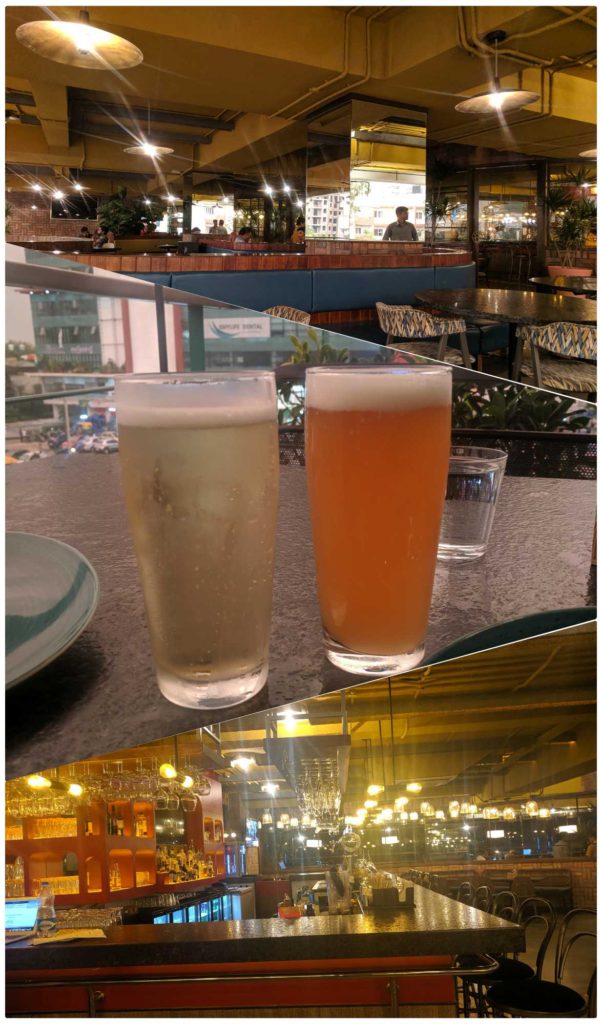
The dingy access lift got us panicking a bit on whether we had gotten it wrong, but we were fine once we were in. We chose to sit outside – the weather was pleasant and there was a skyline view to be enjoyed.
Not all the craft beers were available. We tried the Amber Lager, Witbier and the Cider. The last one was seasonal and was just ok. The Lager was the best of the lot and the Witbier was quite good too.
-
Guns Germs & Steel
Jared Diamond
One of my favourite books in recent times has been Sapiens – it did a fantastic job of showing how the species ascended to the apex position in evolutionary biology. A vertical journey, so to speak. But why didn’t all humans, spread across various continents, develop equally in terms of civilisation and technology? To use the book’s blurb, “why has human history unfolded so differently across the globe?” In the modern world, why does an Africa or even a large part of Asia have to work hard to catch up with the western world? That’s what the book seeks to answer.
It does that by asking very interesting questions. For instance, why is it that the Spanish conquered South American empires, and not the other way? The book doesn’t stop at the proximate answers – horses, weapons, germs etc- but keeps asking a series of questions for the answers that come up. Even beyond the time that recorded human history begins. To when the species first made their appearance on the planet – in Africa- and how slowly they made their way to different parts of the globe.
Primarily, four factors have ultimately caused the disparity in the fortunes of various peoples- how early they started, the difference in the environment and biogeography of the areas they populated (what plants and animals there could be domesticated to scale up food production and create the surplus needed for new skills and ideas to develop), the spread of ideas (the fascinating aspect of how the axis of the continent – except for Eurasia, all continents have a north south axis – plays a large role in why a large number of major civilisations and developments occurred in this part of the world), and the densities of population that allowed competing societies within continents to come up with radical ideas.
In addition, there are also related interesting ideas. For example, how invention is actually the mother of necessity (examples of how some inventions had been made before, but are credited to the person/s who made the right tweak at the right time for others to adopt it in large numbers) and how some non-intuitive solutions have endured (e.g. the QWERTY keyboard).
All of this make for a fascinating, if not easy read. Even though it was published a couple of decades ago, I think it is an important book for this time because it shows how evolutionary determinism is not just about genes, but the environment as well.
P.S. I do wish he had spent some pages on how the British could conquer India. The only clue he does drop is how India’s environment might have created a caste system which prevented the creation and proliferation of ideas it otherwise might have had.
-
Uno Chicago Bar & Grill
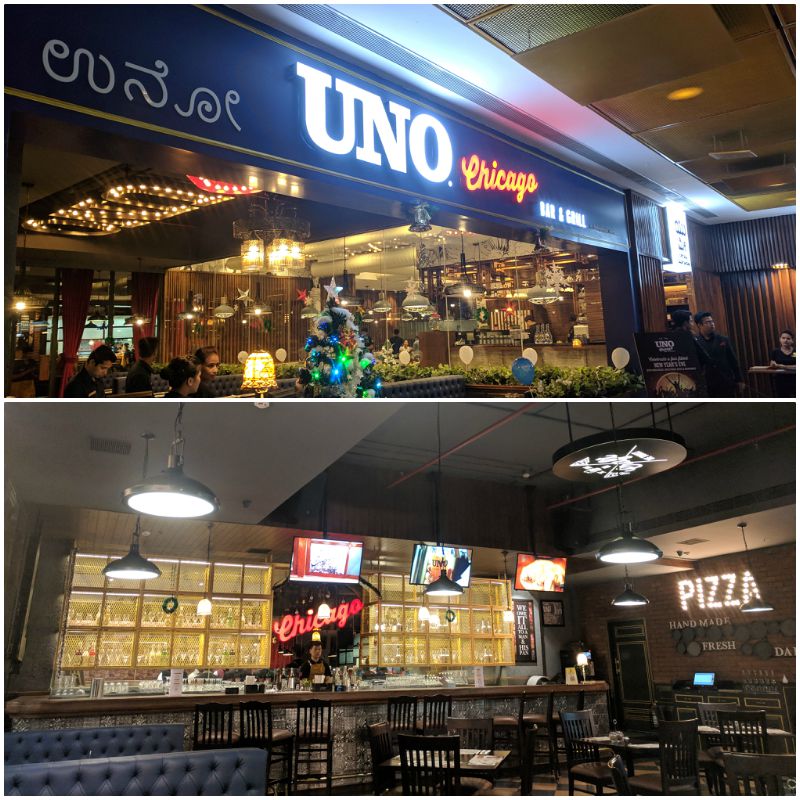
Some movies exist only so that a few good songs can be released into the universe. That’s roughly the way malls and eateries work for me too. Sometimes. Whitefield’s latest mall is thus host to Uno Chicago Bar & Grill. We visited twice – the first when the bar wasn’t functional, and then later, when we also decided to try out the Cinepolis that has opened at the mall. Uno is sandwiched between Punjab Grill and You Mee on the ground floor of Forum Shantiniketan.
It has three sections – one facing the mall atrium, another indoor, and a third that is a bit more open and faces the apartments behind the mall. The first section has diner-like seating, albeit more plush. The second is a mix of that and standard chairs, and the third has bar stools as well, with some cobblestone flooring too.

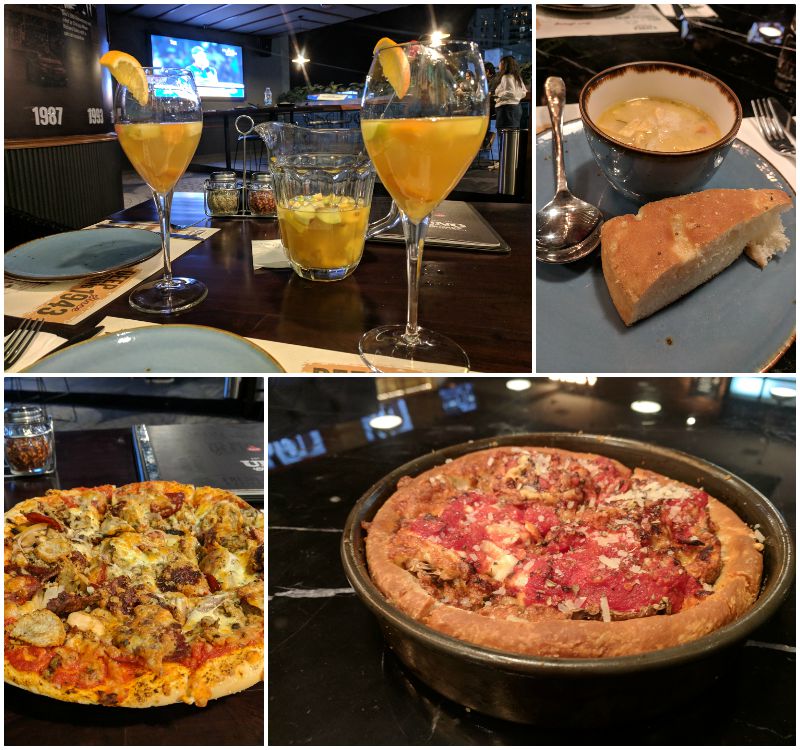
The white wine sangria they served us on the second visit was reasonably disastrous. Chunks of fruits meant that we kept wondering whether a fruit salad had been mixed with wine! Far from our Toscano benchmark for the sangria pitcher. The Chicken & Jalapeno Chowder though, is worth a try, though for the best experience, you might want to wait till winter. Thick, creamy, chicken soup with jalapeños and tortilla strips for some nice texture.
We tried two pizzas. The Windy City Works was a thin crust pizza with pepperoni, pork sausage, chicken meatballs and bacon bits. They were generous with all the toppings and the crust was excellent too. But the outlet is known for its deep dish pizza, and that’s why we had to try the Chicago Meat Market pizza with lamb mince, chicken pepperoni, grilled chicken, chicken chorizo and parmesan. The small size proved quite sufficient for our appetites. No arguing the flavours here and the “double decker” levels of flavours is indeed quite unique.
The welcoming committee does its job well, but the service takes some persuasion. The wallet will be left considerably lighter. We got close to Rs.1200 with just a soup and a pizza the first time, and a little over Rs.2700 the second time thanks to the Sangria pitcher.
Uno Chicago Bar & Grill, Upper Ground Floor, Forum Shantiniketan, Whitefield, Ph: +91 9667540036
-
A Man Called Ove
Fredrik Backman
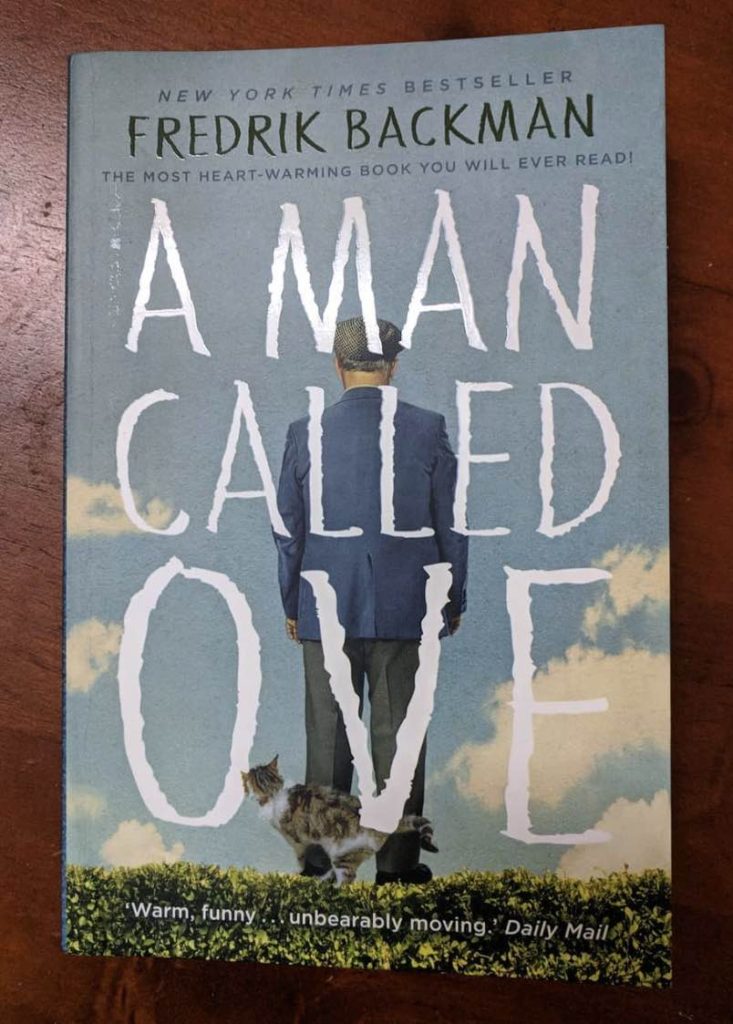
This was a book selected by D (my much better half) as part of our once-in-two-months book shopping. So naturally, I couldn’t just read it, I had to read into it. The message was simple, I had a lot of character similarities with Ove. It was less to do with his literally hands-on approach to fixing things and more to do with “right has to be right”, but the similarities in personality were obvious enough right from the beginning for me to LOL.
This is probably the only book that has made me go from smile to laugh to moist eyes in a span of 30 pages. Smile because I understood Ove’s perspective and why he does the things he does. As it turns out, Ove isn’t bitter. “He just didn’t go around grinning the whole time!” Laugh because the insults and reactions are hilarious and creatively sharp. And cry because. Oh wait, that’d be a spoiler, so no.
The slow reveal of Ove’s not-so-typical heart of gold, as people keep popping into his life, is really done well. And it’s not just Ove, the other characters, especially Parvaneh, have been written very well. In general, the main reason the book worked for me, outside of the excellent humour, was its solid understanding of its protagonist’s condition, and its commentary of the changing nature of society and its mores. There is something profound that is being delivered here – on life, youth and aging, death – but with a gentle touch. That’s probably what makes the book so heartwarming and such a pleasure to read.