Recently, Badshah took the rap for allegedly paying for fake views on a music video, in a bid to break a YouTube viewership record. I’m surprised that a lot of folks were surprised! Whether it’s social media (FB, Instagram, Snapchat etc) or media networks (YouTube, TikTok, and largely Twitter too), digital ecosystems have been built around reach. Just like traditional media was. Reach that is then sold to brands and advertisers. Reach that is usually also a poor surrogate for efficiency and effectiveness. That’s why all this reminds me of Goodhart’s law – when a measure becomes a target, it ceases to be a good measure. The unintended but predictable consequences of optimising for the measure. So why do brands still do it? Hey, everyone has KRAs and no time for real outcomes. Output is good enough. Influencer marketing does just that. Besides, a case can even be made for credibility in the audience’s mind. But that’s a separate story. (more…)
Author: manuscrypts
-
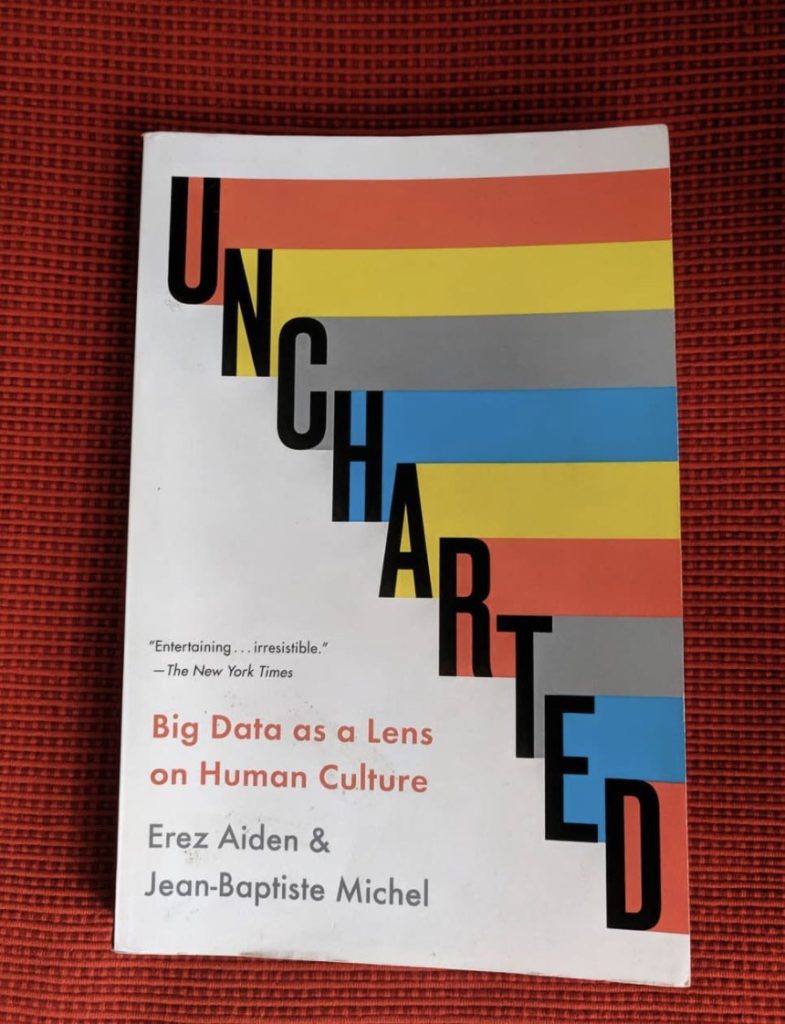
Uncharted: Big Data as a Lens on Human Culture
Erez Aiden, Jean-Baptiste Michel
The book was published in 2013, relatively the early days of what has come to be a fairly common buzzword. Therefore, it is probably unfair to expect this book to have the understanding or perspectives that the field has accumulated in the last few years.
Having said that, I still think my expectation from the book was higher. It stemmed mostly from the title, and I thought there was tremendous scope there. We now consume, produce and share tons of data on a daily basis. What could it say about us at a societal level? Wouldn’t that be a great way to study how our culture has evolved as a species and perhaps differently in various parts of the world? How do ideas spread, how many of them are universal, and do some have more velocity than others? But hold on. While this book does try to give some answers, it is solely based on the authors’ experiments with datasets using Google Books Ngram Viewer.
This is a formidable tool – 30 million books digitized by Google. But it is limited too. These are only books published, and a subset of them. Books are only a small representation of culture, and by virtue of publishing being gated (in the past) would carry inherent biases. To be fair, the authors are aware of this and bring it up towards the end. It also raises the concerns that have now grown louder – who owns the data, who has access, what is it being used for?
So, if you go by the title, you might be a little disappointed, but it is an interesting story well told and made accessible. It does provide many, many interesting trends and findings across disparate things like technology, popularity, grammar. You would like it especially if you’re interested in language – words, their usage, grammar etc.
-
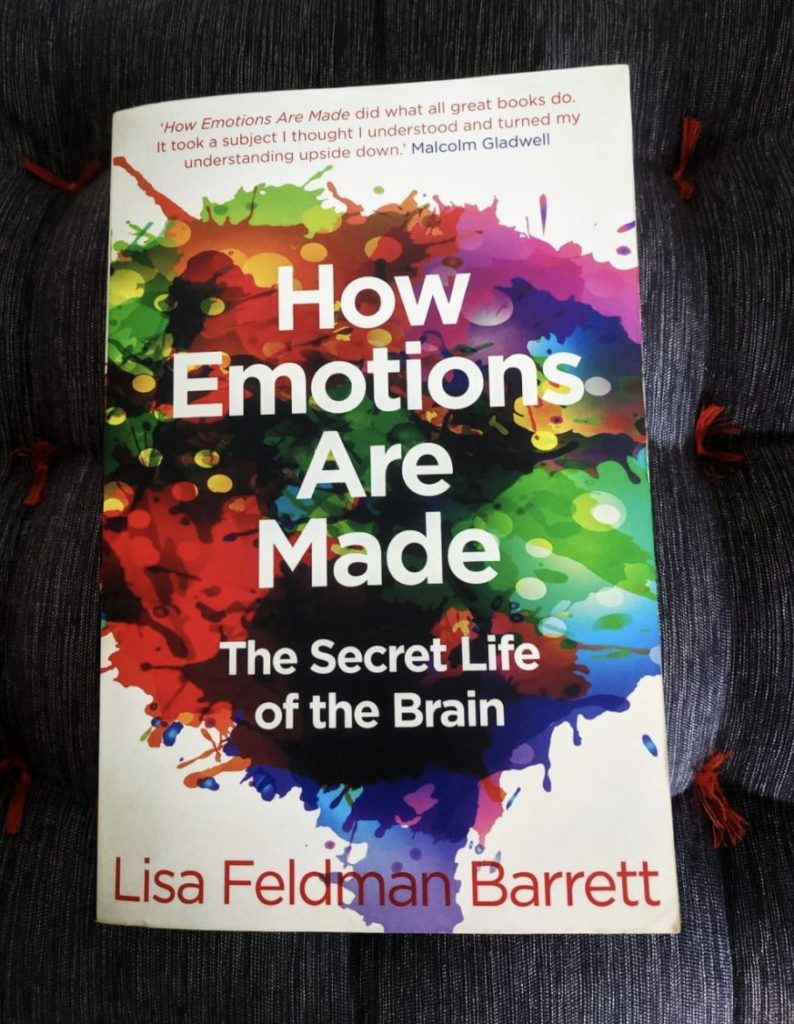
How Emotions Are Made
Lisa Feldman Barrett
Just when I thought I was getting some stability (in my thinking) on the free will vs determinism debate, here comes fresh food for thought. As per ‘How Emotions Are Made’, while the combination of genetic and environmental factors do determine our behaviour, free will has a definite play.
The core theme of the book is a constructionist theory of how emotions are made, as opposed to a classic theory. The classical view assumes that each emotion has a unique ‘fingerprint’, as against the opposing view that variation is the norm. This has implications not just on how we physically manifest our emotions but on our understanding of how the nervous system operates as well. And finally, the classical view believes that emotions are inborn and universal. But the alternate view is that emotions are formed based on shared concepts, influenced by social reality and culture.
The view of the brain as a tiered system (survival, emotion, cognition) is one of the first myths that the author breaks. Further, as opposed to being the result of a stimulus-response mechanism, emotions are a result of the brain simulating and predicting, based on a bunch of factors. What we call emotions – anger, fear, happiness etc- are concepts that get created and honed in the brain. Concepts, goals, words all help the brain frame any new stimulus it receives and then predict. By reframing concepts and looking at them more objectively, we can reshape what emotions are surfaced, and thus exercise free will.
Towards the middle of the book, the author sets up the answer for “are emotions real” with the classic philosophical question of “If a tree falls in a forest and no one is around to hear it, does it make a sound?”. The answer is that both fall under the “perceiver-dependent” category. Emotions are thus, a social reality and become real because of collective intentionality and our ability to communicate using words.
This understanding of emotions, and how much we control/are in control has implications on a lot of things ranging from our daily behaviour to the way the judiciary system works and how we deliver justice.
‘How Emotions Are Made’ is refreshing because of the alternate perspectives, all of which are backed by science. The author makes it a point to call out hypotheses where it’s not. The language is technical only when needed and explanations are lucid. In all, it is a fascinating book that has made me rethink a lot of what I thought I knew about myself and the world. Not an easy read, but absolutely worth the time. And that’s why it made it to my 2019 favourites.

-
Comfort Zoned
I think it was in a Taleb book that I read that writing was born because of accounting. In my case, as I have chronicled here earlier (2010, 2017), my account books pretty much tell the story of our life. Towards the end of the second post, I wrote “the days of our lives have found a rhythm, a familiarity….Wild zigzags giving way to smooth curves and then straight lines.” This is because our routines, and therefore, expenses were predictable. The last few months have obviously meant a few changes, but the ballpark is the same. This stability has also meant that the usage of xls/sheets have increased at the expense of the book. I suspect this change is permanent, and it does make me sad.
What it has also made me think about is the subject of the “comfort zone”. My work domain is marketing, and there’s no way I am getting into any comfort zone there. But for all practical purposes, in my personal life, my perception is that I have hit a comfort zone. Many of my posts in the Flawsophy section have been about my own approach on living one’s life – happiness, success, signalling, the idea of freedom in daily life – and learnings and changes. I think it’ll show that I have a fair idea of our needs and wants, what it takes to get there, and a plan. It has helped that we have avoided lifestyle creep quite a bit, and kids completely, and disproportionate spends are on things we actually enjoy. Self image on that last bit was a challenge until recently, but I think that’s over now. None of these are things that happened overnight, and obviously a work in progress but we’re comfortable with where we are, and where we want to be. (more…)