Author: manuscrypts

  • When The Body Says No

    Gabor Maté

    At the outset, let’s just say that I am a believer when it comes to Gabor Maté’s philosophy. That’s because I first had the lived experience, then started connecting the dots, and finally came across ‘When the Body Says No’ which gave the whole thing a logical framing and rationale. I’ve had stress sequentially give me migraines, a heart attack, back pain, IBS and I suspect, even a (yet to be connected) BPPV. Most doctors I went to tried to cure the symptoms, only a couple of them pointed to stress. After I systematically began reading more (Robert Sapolsky, Lisa Feldman Barrett etc) and knocking off stress points, I reached a place where stress was my only stress! And I wondered why I have that stress in the first place. Enter Maté, with a systems thinking approach that I wish doctors would really look at! It is strange that they don’t because even a Roman physician in the second century, Galen, had pointed out that “any part of the body can affect any other part through neural connections.

    “No disease has a single cause. Even where significant risks can be identified such as biological heredity in some autoimmune diseases or smoking in lung cancer-these vulnerabilities do not exist in isolation. Personality also does not by itself cause disease: one does not get cancer simply from repressing anger or ALS just from being too nice. A systems model recognizes that many processes and factors work together in the formation of disease or in the creation of health. We have demonstrated in this book a biopsychosocial model of medicine. According to the biopsychosocial view, individual biology reflects the history of a human organism in lifelong interaction with an environment, a perpetual inter-change of energy in which psychological and social factors are as vital as physical ones.”

    (more…)
  • Choice Cess

    Past

    I read something beautiful on a LinkedIn post sometime back. Yes, miracles do happen.

    उन्हें कामयाबी में सुकून नजर आया तो वो दौड़ते गए,

    हमें सुकून में कामयाबी दिखी तो हम ठहर गए !

    Not that I had scaled some Himalayan peak of success, but the first line fits my 30s, and the second, my 40s. The underlying mindsets are different, and so are the journeys that give me joy. But it took the larger life journey and the choices of my past self to get here.

    You cannot stay on the summit forever; you have to come down again. So why bother in the first place? Just this: What is above knows what is below, but what is below does not know what is above. One climbs, one sees. One descends, one sees no longer, but one has seen. There is an art of conducting oneself in the lower regions by the memory of what one saw higher up. When one can no longer see, one can at least still know.

    Rene Daumal, Mount Analogue (via James Clear)

    (more…)
  • The Tao of Physics

    Fritjof Capra

    The Tao of Physics was first published in 1975, and I’d say that it’s even more relevant now in the context of science and the direction of human advancement in general. As the subtitle of the book states, the idea is to explore the parallels between modern physics and eastern mysticism. 

    Both science and religion/philosophy are trying to get to the reality that lies beyond our senses. One approaches it predominantly through rational means, the other through a non-intellectual experience by quieting the mind with meditation and fine tuning intuition. Broadly, it turns out that many Eastern philosophies/religions – Hinduism, Buddhism, Tao, Zen – had already reached the understanding that modern (in the 80s) science later discovered. 

    The Tao of Physics is divided into three elegant sections – the way of physics, the way of eastern mysticism, and the parallels. Capra begins by summing up the evolution of physics from the time of the Greeks to its modern formulation in the form of Descartes’ philosophy – the separation of mind and matter, which influenced not just the development of modern physics but also the general Western way of thinking – a mechanistic world. On the other hand Eastern philosophies have emphasised the unity of not just mind and matter but the individual and the universe at large. 

    (more…)
  • Kuuraku

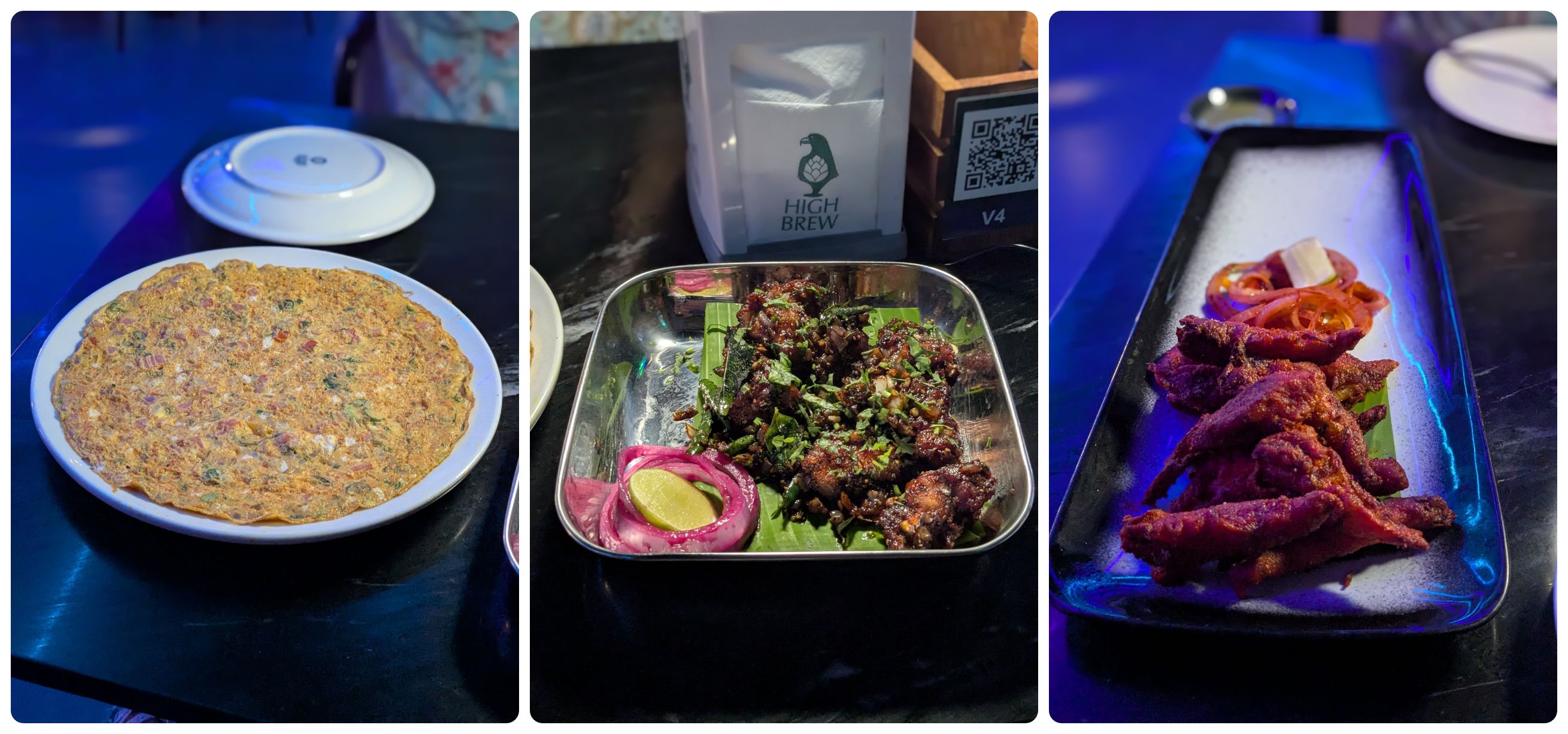
    In one of the rare cases of the mountain making the trip to Mohammed, Kuuraku, which first opened on Brigade Road, manifested in Nexus Shantiniketan, Whitefield. I think this was where Smokehouse Deli used to be.

    We loved the ambience – cosy, but somehow managing to fit in lovely nooks, outdoor seating, long tables for large groups, and kitchen-facing seats too.

    Kuuraku Whitefield
    (more…)
  • The Drama of the Gifted Child: The Search for the True Self

    Alice Miller

    I discovered The Drama of the Gifted Child via a fantastic conversation on the Tim Ferriss podcast in which Dr. Gabor Maté spoke about his life and work. This was one of the books that was brought up when the latter spoke about the question that drove his life’s work – what is it that makes people be the way they are? Apparently, the German title of the book when translated is Prisoners of Childhood, which I think is more apt, but probably ‘darker’! 🙂

    Through logic and anecdotes of patients, Miller explores the complexity of childhood and the impact it has on us as adults. The title of the book makes sense because of some focus on the gifted child, who is more intelligent/ sensitive/ emotionally aware than someone their age. These children understand their parents’ expectations so well that they often develop a “false self” by suppressing their own emotions, needs, and authenticity to gain love, approval, or validation from their parents. This process often leads to emotional numbness, perfectionism, and low self-esteem, as the child grows up detached from their authentic self.

    (more…)