Author: manuscrypts

  • Logicomix

    Apostolos Doxiadis, Christos H. Papadimitriou, Alecos Papadatos (Illustrator), Annie Di Donna (Colorist)

    I have to confess I gamed this a little. This is my 300th review on goodreads, so I wanted it to be a special. So I chose a unique book – a graphic novel whose title also includes “an epic search for truth”. And thankfully, it was a fantastic experience. 

    While the story is based on the life of Bertrand Russell, it is presented through the different perspectives of its makers too. In a sense, we get to see the debates they had and how they progressed on the storytelling. Self-referential is a multi-meta when we’re talking of logic, and paradoxes! Russell is a mathematician but mathematics is also his language to engage with philosophy and thus “the truth”. Indeed, it is difficult to draw clear lines between the two deep subjects, and it only gets deeper when you add logic into the mix. The journey is as spiritual as it is scientific. And many believe it is solvable. To quote Hilbert, “In Mathematics, there is no Ignorabimus (Latin for “we shall not know”). As Russell continues to work on his Herculean task of establishing a logical foundation for all mathematics, he crosses paths with some of the foremost thinkers of the era, and probably of all time. Kurt Gödel, Ludwig Wittgenstein, Alfred North Whitehead, Henri Poincaré and so on. (the creators note that some instances have been created for narrative purposes)

    The story is rendered in flashback mode, as Russell is asked to lend his voice to those who oppose US involvement in WW2. I found it a perfect setting as he practically narrates his life thus far, and in the end, his response to the protesters pretty much summed up what he learned from his life and his quest. Though the novel is primarily about Russell’s pursuit, it also gives the reader a view of his life in the real world – his lonely childhood, his many marriages, his friendships, his relationship with his student Wittgenstein, his passion to bring a sense of order, the connection between madness and logic, and his stance on the two world wars. All of this makes it a deeply layered book with some wonderful thoughts. “The tragic loneliness of every human being. The finiteness and profound futility of life”

    But I think the reason why I loved this book was also because it resonated a lot with my perspectives, my affection for logic, and the lessons I have learned when I have tried to bend reality to fit it. (“Sure, Frege, Russell, Whitehead were excellent map-makers, but maybe eventually they confused their reality with maps” “All the facts of science are not enough to understand the world’s meaning“) This also leads to a lot of over analysis. (As Russel writes, “Like me, he was constantly analysing everything, a habit deadening to the emotions“). And something about the genesis of it all – “Maybe what brings them to logic is a fear of ambiguity and emotion“. But of many moments, I think my favourite is when Wittgenstein survives a near-death experience and understands that”The meaning of world does not reside in the world“.

    Even if you’re not into graphic novels (I am not), this one is a must read.

    P.S. If you have read similar books, do share.

    Logicomix : An Epic Search for Truth
  • Next change

    This little phrase is from the PT classes of the 80s – the command to change the drill pattern. I was reminded of it as we started making our way back into the real world after 18 months.

    After a whole lot of deliberation, we began a hybrid model at work in mid- September. To be honest, I wasn’t exactly thrilled, primarily because of two reasons. One was the obvious one – the rigours of the daily commute. In addition, I felt that I was more productive at home. But it wasn’t so bad. Not so surprisingly, the time for commute has been cut by half as most folks are still WFH. I continued to read on the way to office, but instead of watching a show on the return journey, I chose a favourite pastime – people gawking. Maybe I’ll get back to shows after the initial days and/or when the commute time starts matching the episode times! And surprisingly, I found a strange comfort in being in office. Despite the chaos of many people in nearby cubicles being on different calls, getting to meet old friends, and new ones whom I had only met online, was very pleasant. Not to mention a certain reassurance of watching people work towards the same goal.

    Life had changed quite a bit too. D and I used to spend Saturday evenings discovering new eateries or revisiting favourites. But now, even though we have the option, we prefer staying at home with sundowners on the balcony, and ordering in. Thus, weekly excursions have become fortnightly. We still look forward to travel though, though we still don’t know when we will get back to it.

    I wrote this post for a couple of reasons. One, the usual premise – how would this read a decade from now? A good test to understand how my mind has remembered the return to civilisation. The other is to remind my later self about a few lessons learnt. One, while neurons that fire together might wire together, there is also a certain unpredictability of attitudes – as evidenced by my reaction to the return to office. The mind, in many respects, remains unfathomable, in its capacity to both resist change, and to normalise. Two, being able to change one’s mind is a superpower, especially as one gets older. And three, in many of the daily interactions one takes for granted, there is an inherent joy that sometimes gets obscured.

  • The Gollancz Book of South Asian Science Fiction

    Tarun K. Saint (Editor), Manjula Padmanabhan (Foreword)

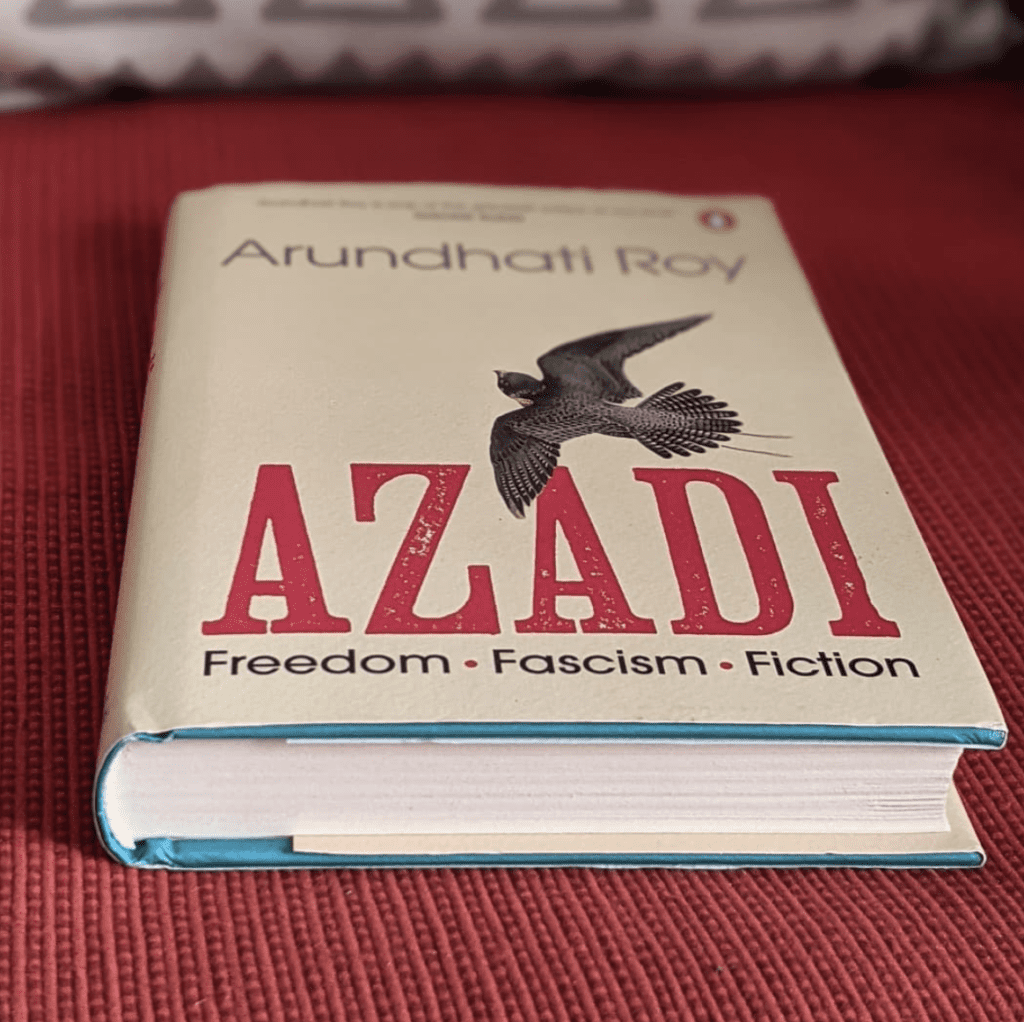
    Once upon a time, the only fiction I used to read were those written by Indian authors. The reason was a relatability to the contexts and references. The only exception was science fiction, in which the situation was exactly the opposite. After I read Strange Worlds! Strange Times!, I realised that a further exploration of Science Fiction from this part of the world was warranted. And that’s how I picked up this book. Though the title has ‘South Asian”, the entries are from only India, Pakistan, and Bangladesh. It’s a collection of 28 works – mostly prose, with some poetry, and many stories actually fall under the broader ambit of speculative fiction. As with other fiction, there was an immediate affinity for many of the contexts and references in this book too. While the premise in many were promising, I really liked only a handful. 

    Harishankar Parsai’s “Inspector Matadeen on the Moon”, translated by C.M. Naim, is satire on full throttle and takes some excellent digs on the police force, bureaucracy and attitudes of citizens. Anil Menon’s “Shit Flower” has wordplay in the title itself, and continues that trend all through the story. But set in a Mumbai of the future that has suddenly lost control of its “bowels”, it also has a wonderful take on life and memories, while taking jabs at organised faith. 

    Shovon Chowdhury’s “The Man who turned into Gandhi” imagines Gandhi in contemporary times and is packed with humour and irony. Tarun Saint, also the editor of the book, authors “A Visit to Partition World”, with the story set in a “Westworld” with a Partition theme. A very interesting idea that I think might actually happen at some point! Mirror-Rorrim by Clark Prasad is an exciting thriller with its protagonists trying to solve mysteries across both identity and time. And it has Star Trek references! Manjula Padmanabhan’s Flexi-time is an intriguing mix of “Arrival” and Indian idiosyncrasies. 

    “The Other Side” by Payal Dhar features a young girl who discovers family secrets in an authoritarian future. Aliens and railways collide in the racy 15004 by Sami Ahmad Khan. The inspiration for “The Last Tiger” is evident – “modelled on the Great Leader from the early 2000s”. A satirical tale on an unusual Republic Day event involving the last tiger. Rimi B Chatterjee’s “A night with the Joking Clown” has a cyberpunk feel to it but also has a view on genders and relationships. Vandana Singh’s “Reunion”, the last story in the book, introduced me to cli-fi (climate fiction!) and made me wonder if the scenario she describes is the future. 

    Overall, if you want to to get a sense of Science/Speculative fiction from this part of the world, give it a shot. 

  • Weapons of Math Destruction

    Cathy O’Neil

    Humans have had biases for the longest while. But they have come a long way from from the simplistic ones that helped the species band together and survive, or even the the heuristics we have applied and continue to use at an individual level. As search engines and social networks move from tools to utilities, we have now begun to see the dark side of “software is eating the world” – when biases and discrimination are being codified into systems, resulting in blind discrimination that widens inequality by preventing people from climbing out of poverty, unemployment, homelessness and all the things that we as society should be ashamed of. 

    The author, thanks to her education and experience, is well placed to write on the subject. She calls the mathematical models or algorithms WMDs – Weapons of Math Destruction. They have three common characteristics – scale, opacity and damage. To elaborate, they typically use data sets to create scoring systems that evaluates people in various ways. Most of these systems are proprietary. The scale at which these systems operate is really large, and therefore the damage they cause is also equally massive. Most of the people affected don’t even realise they’re being discriminated against and sent on a downward spiral. And most importantly, there is no feedback loop to make the system better. 

    The author frames it very well through examples across life stages – how teachers and students are evaluated in schools and universities, how employees – potential and existing – are screened, how online ads for predatory services like payday loans are targeted, how insurance premiums are decided, how law and order systems end up “creating” criminals simply based on location data, and perpetrates injustice, how scheduling software destroys any sense of work-life balance. These are not dry, statistical examples, but backed by stories of actual humans devastated by an unfeeling algorithm, with nearly no chance to work their way out of it.

    In the future, what really stops us reaching “Minority Report” scenarios? Arresting people because they could be potential criminals, screening applicants based on health issues they could have in the future, and so on. And since everything is based on users sharing data, it seems certain that privacy will come at a price. In the past, when greed and business “progress” began to have harmful effects on society, the government stepped in and put laws in place to safeguard us. But now governments themselves use these systems! We still have a chance to work our way out of this and bring back dignity. For instance, the European model, in which data collection must be approved by the user and is opt-in, and the reuse of data is prohibited. 

    But will we? In our efforts to remove biases, we have ended up creating systemic monstrosities that lack empathy, and only focus on efficiencies. Those who learn to game the system profit. Winners keep winning, losers keep losing, as fairness is forgotten because entire business models are built on them. As the author rightly points out, “The technology already exists. It’s only the will we’re lacking.” And that, really, is the problem, because “Algorithms are opinions embedded in code”. An important book for the times we live in, and the future.

  • Subjective Objectification

    D and I watched Crime Stories: India Detectives on Netflix a few days after it was released. The episode that saddened both of us was “Dying for Protection”, which was based on the murder of a sex worker. Not surprisingly, it turned out to be the subject of discussion on a Saturday late evening, which these days are spent on the balcony, in the company of spirits, watching the sun and the world part ways. Yes, that is privilege.

    (more…)