Author: manuscrypts

  • The crowd in my head

    Two wonderful posts I read a while back – one which I could completely identify with, and the other, such a complete antithesis of what I do that it was almost like a mirror I was forced to look into- but something I could utterly understand.

    Amit Varma’s ‘Society, You Crazy Breed‘, which is about many inter-related things -the need to escape the clutter, even of our own thoughts, the want of validation and acceptance, the human interaction that will take us away from “the terror of [our] own singular thoughts.” (from) It also talks about debate on the internet, but while that makes a large part of the ‘clutter’, especially the micro-debates, the ‘must comment’ social obligation is something I’ve written about earlier, so I was more interested in the first part.

    I used to absolutely love solitude earlier, and it was easier to access too. But now what’s easily more accessible is a crowd. It slowly becomes a sort of addiction, despite me wanting to stay away. Its no longer easy to be objective enough to separate a want from a need, and its quite easy to fool the self. When one has never been the particularly confident type and has barely gotten out of a constant validation requirement, its particularly difficult. An RT on Twitter is easy validation, and as I’ve said before, the vicarious ‘living’ is easy and fun. Its good to be connected, and be a carefully moulded version of ourselves that is acceptable to those we would like to be connected to. The trick, of course, is to be a version  true to our own selves, something we are comfortable with, in solitude, or in a crowd. But that’s not easy.

    That brings me to the second post, “One for the time capsule” wonderfully written by The Restless Quill, about living life on one’s own terms, fighting the battles inside, the arguments outside, and ‘inhabiting a life’, which can create a ‘light-band of memories’. Chances are, choices such as those, would be made with minimum validation. Its also, I think, a lot to do with confidence and an understanding that perhaps comes from listening to oneself, in solitude.

    Its easy to guess which post I could identify with, and which one is the anti-thesis. There are times when my destiny stared at me in the face, and I looked away furtively, as though looking would mean acknowledging, and then accepting. I can dimly sense these. The ability to make those ‘difficult’ choices and keep walking, joyous in the consciousness of what one has learned and the comfortable understanding of what one has lost out on, it must be liberating. I have a feeling, and unfortunately, a feeling only, that it must really be wonderful.

    until next time, a crowdsourced time capsule

  • Chesapeake

    James A Michener

    From 1583 to 1978 the saga rolls, tracking the lives of individuals, their families, the society they live in, and most importantly the place where all of this happens. Chesapeake is as much about a way of life, as it is about the place and its people.

    The book is typical Michener, and uses individual stories across generations to show the way a place and its society has evolved. Even as each generation’s story is read, it is difficult to realise the passage of time, since sometimes the changes are too subtle to be noticed.

    As many of the place’s characteristics remain unchanged, despite human efforts, it becomes easier to acknowledge the transience of man, and the things he builds, not just boats, buildings etc, but even the constructs of the society he lives in.

    The book captures the plight of the Indians who were the original inhabitants of the area, the arrival of the first conquerors, the American war of Independence, the slave trade, the Civil War, World War 2, Watergate, some of them in the foreground, and some in the background, as the fortunes of individuals and families rise and fall.

    Humans, nature, and human nature – a good mix. 🙂

  • All I have to do is dream…

    Yes. Quite liked the movie – Inception. Mostly because I found the concept  (dream incubation, lucid dreaming) interesting and because it forced me to pay attention. Sometimes, movies like that can be refreshing. Of course, it helped that the visuals were very watchable too, and the last shot added to the charm.

    For those who haven’t seen the movie, not to worry, the post only refers to it in terms of concept. At a very basic level, its about planting an idea (Inception) inside a person’s head. Only, he shouldn’t know it was planted by someone else, he should think it’s his idea.  In a world where a lot of people anyway falsely claim an idea as their own, you might wonder why this is interesting, but  ignore that for now. 🙂 Meanwhile, since the person needs to think its his idea, a basic version of the idea is planted in a dream state, in the subconscious.

    Like the movie maker has said about the end, its whatever you want it to be, so here goes. The other reason I liked the movie was because of the ‘life subtext” – the part that makes comparisons to The Matrix inevitable. I thought many acts of ‘Inception’ happen to us too, over a period of time – sometimes done by others, sometimes by ourselves – conditioning. And since we don’t really contemplate why we choose to do a certain thing/in a certain way, we end up thinking that what we’re doing is what we really want.

    Half my life
    Is in books’ written pages
    Lived and learned from fools and
    From sages
    You know it’s true
    All the things come back to you

    And just like how in the movie, the ‘projections’ (things and people used by a dream-architect to populate the dream world) turn hostile when the person detects an external presence in their sub conscious, in life, the problem starts when we suddenly realise the existence of the conditioning, and realise that perhaps, much time has been spent on chasing an ‘inception’.

    Every time that I look in the mirror
    All these lines on my face getting clearer
    The past is gone
    It went by, like dusk to dawn

    And yet, some would say that their lives have been made better by pursuing that one idea. So how do we really know? In the movie, the people who carry out ‘inception’ and the lower forms of the art (extraction) have a totem that helps them distinguish dreams from reality. I wonder if we have something comparable, but then, I wonder, if life would be as interesting as it is if I did have a spinning top or a rolling dice to give me a better grip on reality. 🙂

    until next time, deception 🙂

    Lyrics: Dream On, Aerosmith.

  • Mirror Images

    I came across this passage while reading Kiran Desai’s “The Inheritance of Loss”. The context is of a young girl, who, because of a new found romance suddenly becomes conscious of herself.

    “But how did she appear? She searched in the stainless-steel pots, in the polished gompa butter lamps, in the merchants’ vessels in the bazaar, in the images proffered by the spoons and knives on the dining table, in the green surface of the pond. Round and fat she was in the spoons, long and thin in the knives, pocked by insects and tiddlers in the pond; golden in one light, ashen in another; back then to the mirror; but the mirror, fickle as ever, showed one thing, then another and left her, as usual, without an answer.”

    I found that I could also identify with it in the context of our encounters with the social platforms around – Orkut, Twitter, Facebook, LinkedIn.. and how slowly the ‘Like’ and RTs seem to be defining the interactions and affecting even perceptions and understanding of the self. Its not as though people and comments never existed before, but the sheer mass of people we come into contact with, thanks to the social platforms is unprecedented. Through the conversations and responses, we see a bit of ourselves, a self colored by the other person’s perceptions. As the voices around us continue to increase, at some point, is there a danger of losing touch with what we really are? Yes, you could ignore or be selective, but then we’d just get back to an objectivity argument.

    “The biggest danger, that of losing oneself, can pass off as quietly as if it were nothing; every other loss, an arm, a leg, five dollars, a wife, etc. is bound to be noticed.”

    I read that, thanks to @aanteadda‘s share on Twitter – an excellent take on the Ramayana,(do read it) and in a completely different context – that of dharma, it happened to arrive around the same place. Rama, having lived his entire life by what he considered his dharma, is distressed by what he must do with Sita after the end of the war with Ravana, irrespective of what he personally wants. The author thinks that this is Rama’s tragedy, and that of every person who lives by ‘impartial and abstract principles’, which don’t take into account ‘individuals as persons,’ and can’t see the difference between a situation and a personal situation’, and it can only lead to the destruction of the self.

    And so I wondered, whether its people, or a moral code that one follows, whatever dictates what we do, is there really a difference – between the reflections from others and ourselves? Is there one right answer for what should define us and the way we live. I think not.

    We must prioritise, I guess, based on what we think will give us happiness, and just like this neat article on addiction (the internet in particular) ends, “we will increasingly be defined by what we say no to”, all thanks to an abundance of choices, from within and without.

    until next time, you always have a choice, but do you always want a choice?

  • Under the Mango Tree

    This review was first published in Bangalore Mirror (yes, yes, we got our name in the papers n’ all) 😉 Have reworked it to suit the blog’s regular format. 🙂

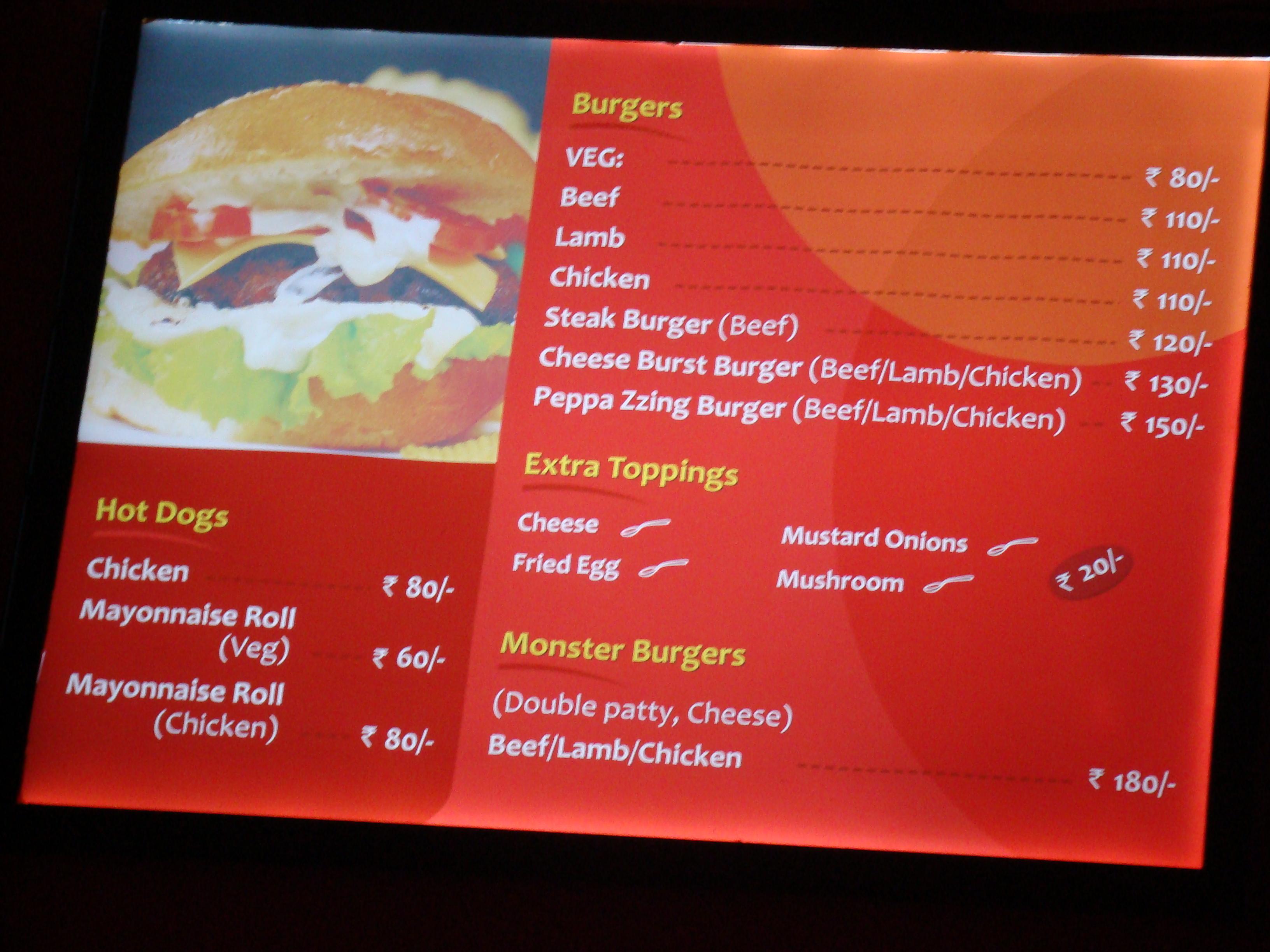
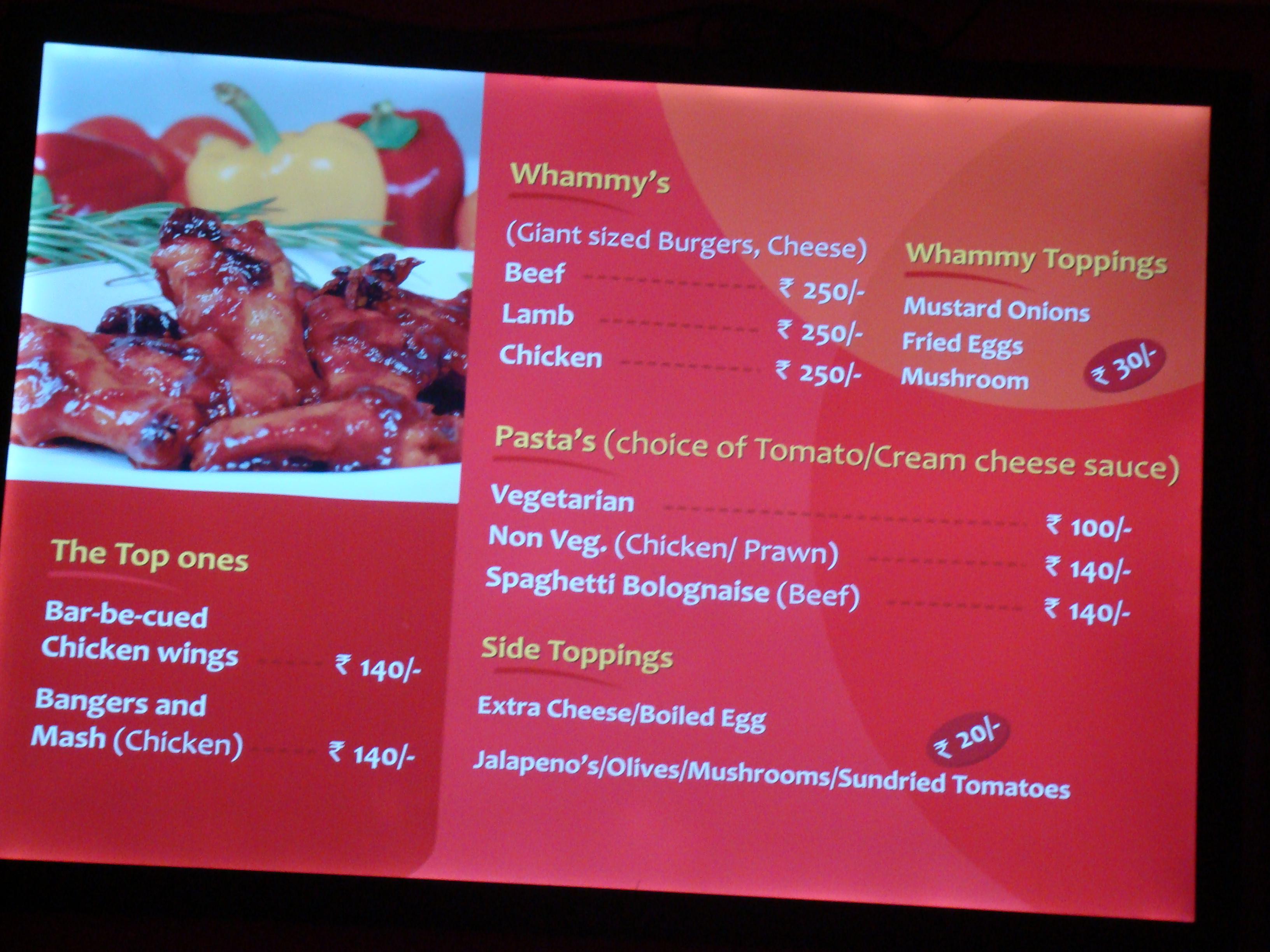
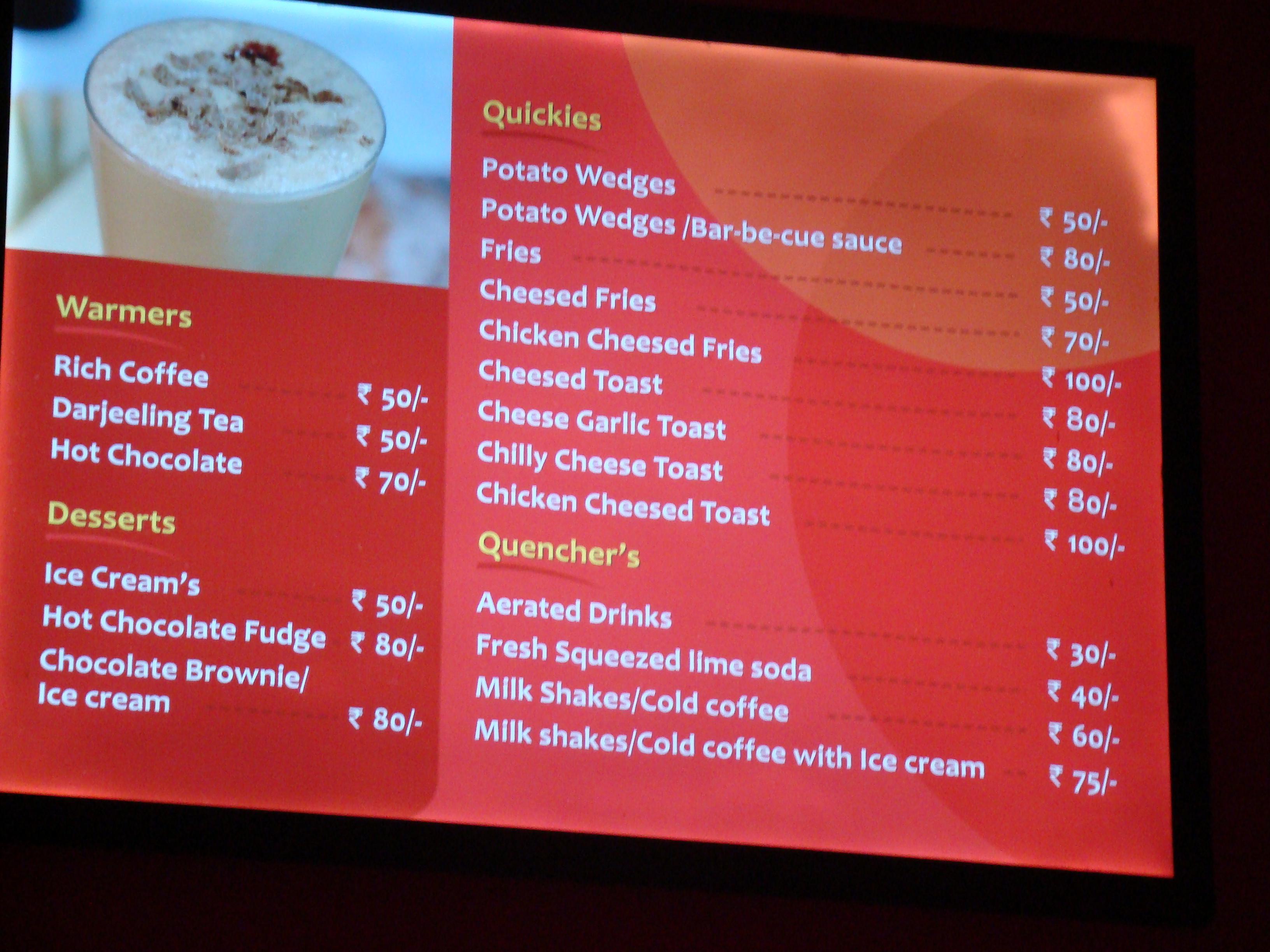
    Remember Cornucopia in Richmond Town. (map) Its now got a new owner and a new name – Under the Mango Tree. The set up has been modified ever so slightly, the mango tree remains, and the erstwhile elaborate menu changed completely, though it still serves Continental and Italian. Here’s the new menu. Meanwhile, this time, my company consisted of Gautam, Radha, Karthik and Prmod.

    (click to enlarge)

    I started with a Cream of Mushroom and Leek soup, which turned out to be the best among its kind. Karthik’s Cold Melon soup was a bit of a disaster, and Gautam had still not come to terms with the existence of a vegetarian French Onion soup. The Goan sausages made a pretty decent starter.  The Pita and Hummus were only just ok.

    The ‘King Size sausages’ was what I chose for the main course, and again got lucky, because it was quite a good dish, with its caramelised onion sauce. Prmod’s Veg Lasagna also turned out to be tasty enough. The Sea Bass was quite a disappointment  – Karthik was sure it was mackerel, and both the Pepperoni as well as the Mozzarella – Hot Pepper pizzas one were only average.

    On to desserts. The Chocolate Mousse is not something a chocoholic ever complains about, but this one could’ve been better. The Mango mousse cake tried to be the saviour and just about managed to succeed despite some essence extravagance. The chocolate mousse with caramelised banana could’ve been a winner if the mousse had been allowed to be strong enough, it would have worked well with the banana, I thought.

    In essence, some hard work needs to go into the place. The aambiance is pleasant enough, and the owner, Nirmala, helps with the order as well as some amount of customisation. Cost for two people would be about Rs.1000, which would get you a couple of soups, a starter, main course dishes and a dessert. So, drop in, if you’re in the neighbourhood, and give it a shot.

    Under the Mango Tree, # 3, Laurel Lane, Richmond town, Bangalore. Tel: 9686601021

    PS: If you’re in Bangalore, and would like to be featured in a review, drop me a line with your favourite cuisine or new restaurant you’ve noticed – manuscryptsATgmailDOTcom, and we’ll figure something out 🙂