The review first appeared in Bangalore Mirror.
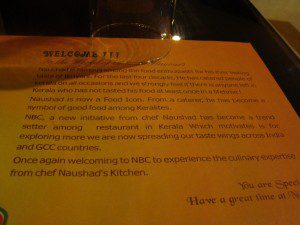 Until a few months back, the domain after Barista on 1st A Cross could very well have been called Keramangala, thanks to the proliferation of Kerala food joints. But when Paramount shut shop, after finding that it really could not be true to its name as long as Empire was around, and the spot immediately after Barista turned into Coconut Grave, courtesy the deep pit that appeared in place of the similar-sounding restaurant, Kerala was beginning to lose its gastronomic hold over Koramangala. But a new hope soon arrived in the form of NBC – not the television network- but Naushad, the Big Chef. For those in the habit of watching Malayalam channels, Naushad would be a familiar figure, rattling off easy-to-make recipes from across the world into the airwaves, for about seven years now. He has a Bangalore connection too – he did a hotel management course here. From a catering origin, NBC now has branches across many cities in India and plans to expand in the Mallu homeland across the waters too – the Gulf. I have been to one of the restaurants in Cochin. Though the menu does vary a bit across the outlets, keeping in mind local tastes, the biryani, which has found great favour in Kerala, is a common factor.
The restaurant is just before Empire, (map) on the right. Parking is on the street, but the parking lot next to Empire is a short walk away too.
 The starters section is predominantly North Indian and Chinese and the one item that caught our attention – the Chilli Fish NBC style was still in its natural habitat, and therefore unavailable. We took this opportunity to test out the North Indian representatives in the menu and asked for a Chakori Kabab and a Nilgiri Kabab. The former was a chicken kabab with a mutton mince filling but was a bit too sour for our liking. The Nilgiri Kabab –chicken again, was much better – tangy and mildly spicy. The Prawns Pepper Fry was the best of the starters, with juicy, succulent prawns and a very spicy masala.
Just like the starter section, this one too has quite a lot of North Indian and Chinese items, but we were quite focused. The fish continued to give us the slip even when it came to the biryani. The Chicken Biryani, NBC’s signature dish arrived first and was very good – flavourful, non sticky rice, just the right amount of masala, and well cooked chicken. It seemed more Travancore style than Malabar, in terms of taste as well as the conspicuous absence of the boiled egg. The other dish that gave it good competition for the top spot was the Chicken Ulathiyathu, a dry dish with some excellent spicy masala. Try it with the soft and fluffy appams. The (Mutton) Brain Roast is quite unlike the versions you’d find elsewhere, both in texture and taste. But it lost its impact thanks to the oily aftertaste. We finally got the fish in the curries – Alleppey and Malabar – both coconut based, and if you like a sharp tang, you should try the former. Watch out for the fish with a swollen head though – mostly bone.
The Meen Pollichathu though, was quite a disappointment with an uncharacteristic bordering-on-bland masala and a pomfret that seemed to have extra bones in its body. The Dosas and Kerala Porottas performed their role reasonably well. The latter was quite crisp but lacked that hint of butter that has now become a characteristic of the Dosa based combination.
In addition to the various items listed on the menu – mostly standard fare, they also have a juice and ice cream counter. We thought it was very unfortunate that they had chosen not to have any Kerala representation in this section. But we decided to try out the Date Pancake, which unfortunately, not only had an overdose of sesame, but was deep fried enough to be called a Date Poori! The Rasgullas turned out to be overly rubbery and rather insipid in terms of flavour. The Gulab Jamoon were probably the only item that we were not totally disappointed with, though it would be wise to check its temperature before swallowing it whole, since one of us was ready to spew smoke after this stunt.
For Rs.550, you could share a non-veg starter, a biryani, a couple of Kerala Porotas and a non veg dish for the main course, and a gulab jamun for dessert.
Many dishes were unavailable and the service swung from helpful to chaotic, the excuse being that there was some party in another section of the restaurant. In essence, the signature dish was the only redeeming factor in what turned out to be an otherwise botched experience. Unless there is a significant improvement in the quality of the dishes, especially the Kerala cuisine, and the overall levels of service, the Empire need not bother striking back.
Naushad Big Chef, #125/A, KHB Colony, 5th Block, Koramangala, Ph: 080-41465252

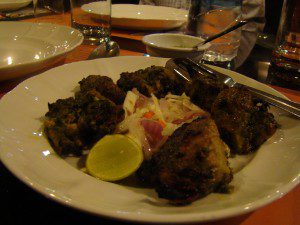
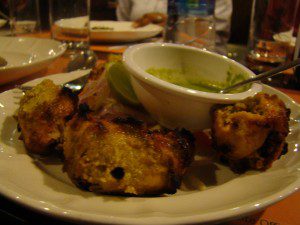 The starters section is predominantly North Indian and Chinese and the one item that caught our attention – the Chilli Fish NBC style was still in its natural habitat, and therefore unavailable. We took this opportunity to test out the North Indian representatives in the menu and asked for a Chakori Kabab and a Nilgiri Kabab. The former was a chicken kabab with a mutton mince filling but was a bit too sour for our liking. The Nilgiri Kabab –chicken again, was much better – tangy and mildly spicy. The Prawns Pepper Fry was the best of the starters, with juicy, succulent prawns and a very spicy masala.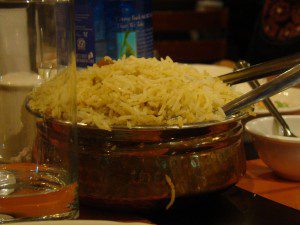
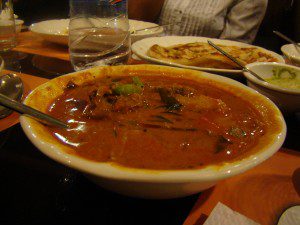 Just like the starter section, this one too has quite a lot of North Indian and Chinese items, but we were quite focused. The fish continued to give us the slip even when it came to the biryani. The Chicken Biryani, NBC’s signature dish arrived first and was very good – flavourful, non sticky rice, just the right amount of masala, and well cooked chicken. It seemed more Travancore style than Malabar, in terms of taste as well as the conspicuous absence of the boiled egg. The other dish that gave it good competition for the top spot was the Chicken Ulathiyathu, a dry dish with some excellent spicy masala. Try it with the soft and fluffy appams. The (Mutton) Brain Roast is quite unlike the versions you’d find elsewhere, both in texture and taste. But it lost its impact thanks to the oily aftertaste. We finally got the fish in the curries – Alleppey and Malabar – both coconut based, and if you like a sharp tang, you should try the former. Watch out for the fish with a swollen head though – mostly bone.
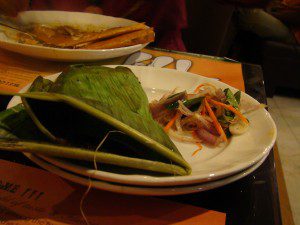 The Meen Pollichathu though, was quite a disappointment with an uncharacteristic bordering-on-bland masala and a pomfret that seemed to have extra bones in its body. The Dosas and Kerala Porottas performed their role reasonably well. The latter was quite crisp but lacked that hint of butter that has now become a characteristic of the Dosa based combination.