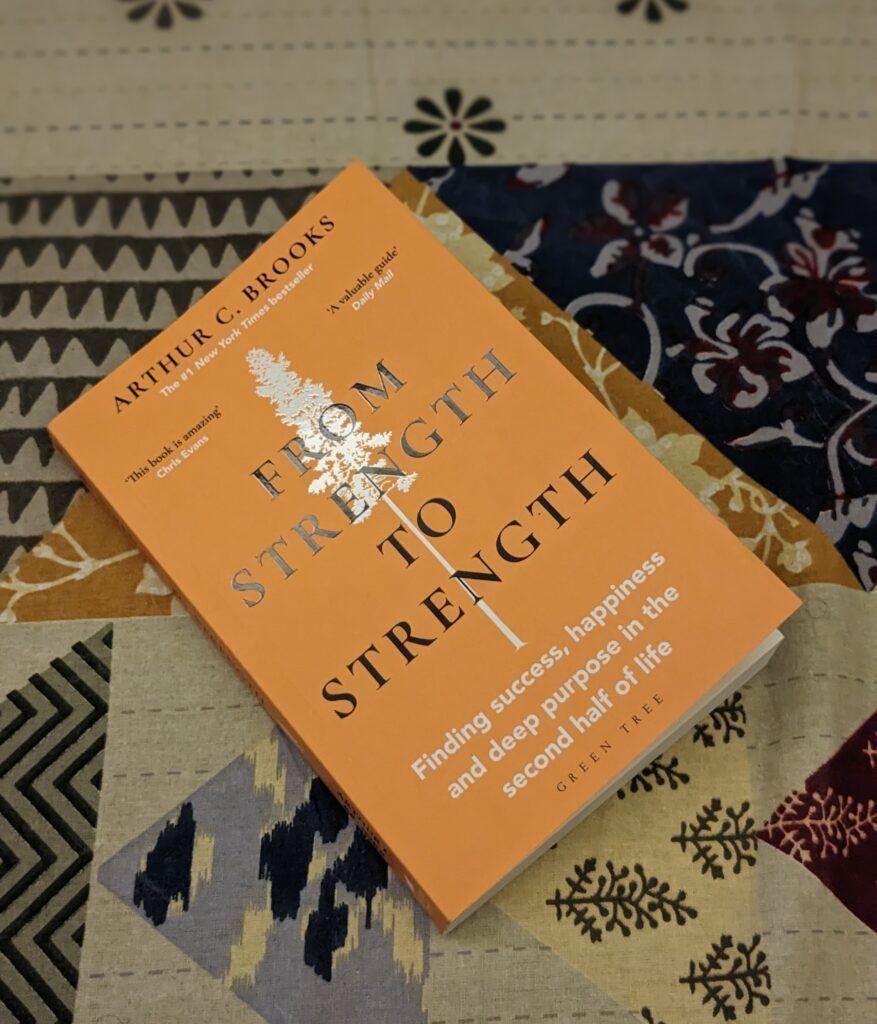
Quite a few of Arthur C. Brooks’ columns have resonated with me and also been thought-starters for some of my blog posts, so I was looking forward to ‘From Strength to Strength’. The premise is that in the first half of their lives, (most) people single-mindedly strive to be successful, often at the cost of health, relationships etc. But with age, many of the abilities that made them successful start to decline. They resent and resist this, leading to frustration and dissatisfaction. The book is about navigating the second half of one’s life when there are changes in mind and body, and the rules by which one worked and lived no longer seem to make sense. How does one get through this liminality, and thrive?
The book begins with one of his articles I had particularly liked – Your Professional Decline is Coming. I found this chapter very interesting thanks to the concepts that appear in it. For instance, “the principle of psychoprofessional gravitation”, the idea that the agony of decline is directly related to prestige previously achieved, and to one’s emotional attachment to that prestige. Also, the two kinds of intelligence – fluid intelligence, defined as the ability to reason, think flexibly, and solve novel problems, and crystallised intelligence, the ability to use a stock of knowledge learned in the past. The former is high in early adulthood, and starts to diminish in the thirties and forties. The latter starts growing from then on. Simplistically put, intelligence, and wisdom. The trick is to jump off from the first curve and on to the second in the later stages of life.
The book then moves on to how we objectify ourselves at work, and are addicted to the success it brings, making the jump to the second curve difficult. Many things are involved – pride, fear, social comparison, and a loss aversion that focuses on well, losing things like wealth, power, and fame one has amassed through hard work.
The rest of the book offers perspectives on how to get off the treadmill – mindfulness, finding friends and meaningful relationships, focusing on companionate love in marriage (rather than passionate love), facing one’s fear of death, distinguishing between intrinsic and extrinsic goals and focusing on the former, starting vanaprastha and understanding how to detach, finding a faith. I found this part not entirely different from things I have read in other books. I think I expected a bit more, but on hindsight, that’s an unfair expectation, since this is something one has to figure out independently, books and other people can only offer perspectives.
Having said that, ‘From Strength to Strength’ is a great start if you’re feeling the waves of midlife hit you. It provides context and perspectives to help you start framing the second half of life.
Notes Fear of death: “thanatophobia.”Whether paralyzing or mild, the fear of death has eight distinct dimensions: fear of being destroyed, fear of the dying process, fear of the dead, fear for significant others, fear of the unknown, fear of conscious death, fear for body after death. and fear of premature death. Edsel problem: The famous car that Ford executives loved, but consumers hated. They sell what *they* like, instead of what the consumers wants and needs. (in the context of helping people at our convenience and in our way) “The worst thing about death is the fact that when a man is dead it is impossible any longer to undo the harm you have done him, or to do the good you haven’t done him.They say: live in such a way as to be always ready to die. I would say: live in such a way that anyone can die without you having anything to regret.” Leo Tolstoy
Turns out, if one uses a specific time window, ORR is not too bad to negotiate on a Saturday evening. That’s how I was tempted to Mannheim Craft Brewery at The Bay Food Court in RMZ Ecoworld. Craft beer obviously sweetened the deal. You’ll have to walk right till the end, but the good news is that it is closer to the loo!
Mannheim is quite elegant with multiple kinds of seating for different-sized groups. If you’re in early enough, you obviously get to pick seats. We choose high stools (with back support, yay!) that gave us a nice vantage point to observe modern humanity in one of their preferred ecosystems – food courts.
P.S. I think that mural belongs to Irish House but whatever.
Not all the beers were available, something I observed during a second visit as well, so do beyond the menu and ask what else they have. We tried the Mead, the Ambrosia and the Amber Ale (samplers are priced quite high) and finally went with the Helles Lager and the Hefeweizen. Both Bavarian, but the former is a light, crisp lager that is not too bitter, and the latter is fresh and fruity.
We tried the Kozhi Vepudu – fried chicken in buttermilk sauce , which did offer some spice. But the Murgh Malai Kandhari (sic) Chicken despite the promise of bird’s eye chilli was rather bland. Or rather, inconsistently spicy, depending on whether your piece had a chilli in it or not.
When there is Korean cream cheese bun, one must have it. Unfortunately, our high bar on this is the one at Roxie. This one isn’t close. Mains was Spaghetti Mamma Rosa. Closer to browna than rosa, but not bad in terms of taste.
The thing about the menu at Mannheim is that though it seemingly provides options, it is pretty limited especially when it comes to mains. Probably because the beer-only crowd prefers only starters.
The service is quite pleasant and prompt, and we felt lighter by around Rs.3000. The beer isn’t bad, but you don’t have to travel for it. Only drop in if you’re in the vicinity.
Mannheim Craft Brewery, The Bay, Ecoworld Bellandur Ph: 096633 95482
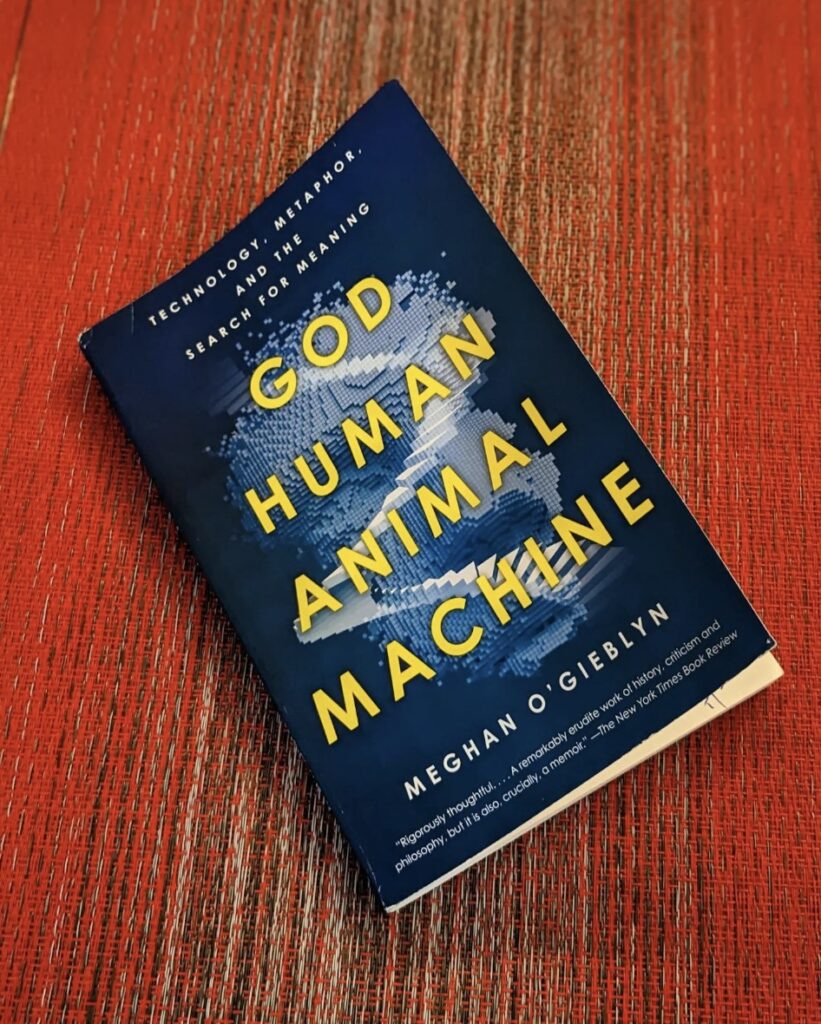
It is difficult to slot God, Human, Animal, Machine: Technology, Metaphor, and the Search for Meaning. Meghan O’Gieblyn sets us off on a thought-provoking exploration of the intersection of faith, technology, and the human experience, and traverses many interesting paths to understand what makes us human, and our search for meaning. Descartes started us on the path to the Enlightenment by ‘separating’ the material world and our ‘soul. From then, we took pride in using scientific temperament and technology to systematically solve nature’s puzzles. And now, when the same toolkit has created machines whose learning and thinking models are increasingly ‘black boxes’, there is fear, uncertainty and probably a bit of ego.
Through chapters that are at once seamless and disparate, she navigates philosophy, technology, and theology and our different ways of understanding God, ourselves, and the world we are creating through technology. The metaphors of our time are built around technology, and AI and tech are raising questions that have for long been asked by philosophers – free will, immortality, the relationship between mind and body. Science by definition requires an objective perspective, and consciousness can only be felt, and measured inside. I can never know what it feels like to be another person. While there are many hypotheses, this is an area which science has been unable to really crack.
In ‘Pattern’ it is interesting to see the many parallels between the Bible and the belief systems of technologists, despite many of the latter being atheists. Transcendence through the Singularity and trans-humanism, just as through the Book of Revelation, the resurrection and rapture, for instance. I really liked Kurzweil’s idea of consciousness as a pattern of information that persists over time. Essentially like a stream that rushes past the rocks in its path. The actual molecules of water change, but the stream remains the ‘same’. In a letter to the author, he shares a wonderful insight that “the difference between so-called atheists and people who believe in ‘God’ is a matter of the choice of metaphor, and we could not get through our lives without having to choose metaphors for transcendent questions.” From (divine) clockmakers to computers.
In the chapter ‘Network’, the idea of emergence is discussed in the context of consciousness, and so is the work of many scientists to recreate that – experimenting with robots to see if they evolve complex behaviour from simple rules. It hasn’t really worked thus far, but I did wonder about the amount of time evolution took to ‘produce’ us.
In ‘Paradox’, there is mention of the parallels between quantum mechanics and eastern mysticism, and the idea of us being in a simulation, and/or a multiverse. It is interesting to note that all paths require a reasonable dose of faith! There is a very intriguing part that uses video games to illustrate how the first-person view makes it look like a world that is always complete as things appear when you move. But were they around when the player was not looking? Does the world “only render that which is being observed”?
‘Metonymy’ moves into materialism (science and its ability to reduce everything to causal mechanisms), dualism (mind-body), panpsychism (all things have a mind-like quality) and finally idealism (the physical world is wholly constituted by consciousness). The mind serving as a microcosm of the world’s macroscopic consciousness reminded me of Aham Brahmasmi. Towards the end of this chapter, she quotes Hannah Arendt, who wrote about scientists who believed that computers can do what a human brain cannot comprehend.
That paves the way for ‘Algorithm’, which begins with Chris Anderson’s 2008 view that data deluge has made our scientific method obsolete. It has now gotten to a state where we will accept the algorithm’s perspective probably more than our own mind’s! But as Nick Bostrom has pointed out, there is no reason for a super intelligence to share our values including benevolent concern for others. The algorithm does not necessarily worry about downstream consequences or collateral damage. And yet, even as algorithms are plagued by errors and the biases we have fed it, ‘dataism’, as Yuval Noah Harari states, is the new ideology. That if we have enough data, we can know everything, thereby increasing surveillance and tracking.
The end of this chapter has a chilling, and yet fascinating observation – “What we are abdicating, in the end, is our duty to create meaning from our empirical observations — to define for ourselves what constitutes justice, and morality, and quality of life — a task we forfeit each time we forget that meaning is an implicitly human category that cannot be reduced to quantification. To forget this truth is to use our tools to thwart our own interests, to build machines in our image that do nothing but dehumanize us.” In ‘Virality’, the final chapter, she discusses how in the digital domain, quantitative measures of success like clicks and likes have overtaken the virtue or validity of the content. There is also the funny (and yet quite true) part of how, when we treat Trump as an algorithm which has mastered social media, it all makes sense!
God Human Animal Machine is intensely thought-provoking, and O’Gieblyn manages to balance curiosity and a healthy skepticism, distilling thoughts from various streams and thinkers, to provide a coherent narrative that fuels more thinking. For all of this, the book is also deeply personal and extremely accessible. Highly recommended.
Robert A. Heinlein wrote Stranger in a Strange Land in 1961, and that’s where I met Jubal Harshaw, though he has apparently featured in other books by the author. He is described thus – “Jubal E. Harshaw, LL.B., M.D., Sc.D., bon vivant, gourmet, sybarite, popular author extraordinary, neo-pessimist philosopher, devout agnostic, professional clown, amateur subversive, and parasite by choice.”
Also, “Dr.Jubal Harshaw, professional clown, amateur subversive and parasite by choice, had an almost Martian attitude towards “hurry”. Being aware that he had but a short time to live and having neither Martian nor Kansan faith in immortality, he purposed to live each golden moment as eternity – without fear, without hope, with sybaritic gusto. To this end he required something larger than Diogenes’ tub but smaller than Kubla’s pleasure dome; his was a simple place, a few acres kept private with electrified fence, a house of fourteen rooms or so, with running secretaries and other modern conveniences. To support his austere nest and rabble staff he put forth minimum effort for maximum return because it was easier to be rich than poor – Harshaw wished to live in lazy luxury, doing what amused Harshaw.”
Some reviewers consider him to be the author’s mouthpiece. Whatever that might be, and from the little I know of him, I have been impressed by Harshaw’s philosophy. My favourites below.
“…most neuroses can be traced to the unhealthy habit of wallowing in the troubles of five billion strangers.”
“I believe in everyone’s working out his own damnation but that is no excuse to give a dynamite cap to a baby”
“Do-gooding is like treating haemophilia – the real cure is to let haemophiliacs bleed to death… before they breed more haemophiliacs.”
“You go into a man’s house, you accept his household rules. That’s a universal rule of civilised behaviour.”
“Love is that condition in which the happiness of another person is essential to your own.”
It’s really heartening to see how a worldview can resonate after decades. From there flows the idea of focusing on things that do not change.