Author: manuscrypts

  • What remains…

    Kathavasheshan means ‘The Deceased’, and it’s one of my favourite Malayalam movies. In my mind though, I split it in a different way (inaccurately) – what remains of him after the story. I watched it on TV after a long time. Meanwhile, such was the magic of Devdutt Pattanaik’s Jaya that I used the ad breaks to continue my reading. Though I consider myself fairly well versed with the epic, the book was an eye opener at many levels – new interpretations and back stories, philosophy, and the narration that immensely adds to the tale’s relevance.

    After the Mahabharata, as Yudhishtira is conducting the Ashwamedha and is called upon to settle a dispute, Krishna asks him to postpone his decision by 3 months as the situation would undergo a sea change, because 3 months later, the Ashwamedha will conclude and the Kali Yuga will begin. Only a quarter of the values instituted by Prithu at the dawn of civilisation will survive. Man will live for pleasure, children will abandon responsibility, woman will be like men, men like women. Humans will copulate like beasts. Power will be respected, justice abandoned, sacrifice forgotten and love ridiculed. The wise will argue for the law of the jungle. Every victim will, given a chance, turn a victimiser. Values. Dharma. As the epic explains, dharma is not about winning. It is about empathy and growth. Dharma is work in progress, and cannot be seen in the isolation of one life.

    (movie spoiler) Kathavasheshan‘s protagonist is a sensitive person who has empathy for everyone around him. The story begins with his suicide and his fiancee’s search for the reason. The story progresses through the perspectives of various people whose lives he has touched and his effect on them. It finally turns out that it is this very empathy and his inability to live in a society that allows the Gujarat atrocities to happen that is the reason for his suicide. (there is a personal connection for him too)

    It led me to wonder if the manifestations of the Kali Yuga were such that they could not be fought within the ‘constraints’ of dharma, and escapism was the only way.  It is only a movie and a character, but I’d like to think that he remains – in the minds of the people he touched – and continues his growth and the pursuit of dharma in his next life.

    until next time, the post continues.. 🙂

  • Maria’s Room

    Shreekumar Varma

    I’m still not sure whether I could ever describe Goa as languid, despite siestas and feni, but this book did make me consider that possibility, and for that, Shreekumar Varma’s way with words can take credit.

    The protagonist, Raja Prasad, an author from Chennai, reaches a Goa that seems to echo his own ‘broken down’ self. The sun takes an extended break as rains lash Goa, and the narrative alternates between the introspective author, willing himself to break from his past and his concerned/nagging father, and work on his new book, and his observations of life, people and places. Its in these initial sections that we see a Goa that’s rarely captured – heavy rains instead of sun and sand, decrepit hotels replacing swanky resorts and a local life relatively less centered around tourists.

    We then seem Raja get acquainted with another guest in the resort – Fritz, and later shifting to “Maria’s Guesthouse”, where he falls in love with Lorna, and gets interested in the story of Maria, the girl’s aunt, after whom the guesthouse is named. As Raja’s romance progresses and he follows the mystery of Maria’s life, and death, it seems as though the two stories are just different in rendition.

    What didn’t work for me was the inconsistent pace of the plot and a narrative in which we’re forced to follow the extended wanderings of the protagonist without facts that would indicate a plot in progression. There’s a limit to what descriptive prose can do to stretch curiosity.

    However, the book itself is a bit like Goa in pace, if you can get adjusted to it, you will perhaps begin to like it. Even the deluge of ‘loop closing’ in the end is a bit like you’ve been idling and suddenly realised that there are some places to see and things to be done before you bid Goa goodbye.

    I got the feeling that the author enjoyed giving Raja Prasad the freedom to carry the plot at his own pace and create his own subtext that some readers would enjoy.

  • Halve nots

    During N’s last visit to Bangalore, the final minutes of our conversation was around rights and wrongs. Zeros and ones. Black and white. At some point in our evolution, we created halves – half rights, grays. Who’s to say your gray is grayer than mine? It becomes subjective, contextual. For argument’s sake, we could say that rights and wrongs themselves are such. But each time we make that gray decision, we know, and we pretend not to notice that little voice.

    Many years ago, as I sat eating an ice cream at the Cream & Fudge Factory in Koramangala (it no longer exists) an old man’s eyes met mine for a few seconds. He probably didn’t mean it, but as I took in his frayed but neat clothes, and his gaze that somehow conveyed that he couldn’t afford what I was having, I was suddenly struck by the unfairness of it all. These days, I wonder if I just imagined it all, and it was just my sub conscious conveying something to me. In any case, it’s like that subtext that once is known, is impossible to clear.

    We have to live, and make a living, N said. He was kind, and gave me various ways to assuage my feelings of guilt. But every time I make a choice – across life’s various scenarios – an extravagant meal, a new pair of jeans, a movie – I know I’m watching myself, and judging. It is easy to allow myself things, but who’s to say where the allowance ends. How objective can I be about myself? Every time I ignore that little voice, I add to the imbalance, blur the lines in my own eyes. A life has to be lived after all.

    until next time, live long and proper..

  • Toscano

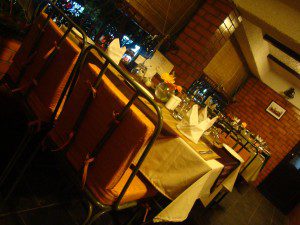
    Between the Diesel 50% sale and the fact that I’ve heard so many diverse comments about Toscano, the decision was swung in favour of a UB City visit. (as opposed to a special event at Benjarong) Toscano is at one end of the food court on the 2nd floor, and opposite Soul City. As almost all the eateries here go, the seating includes an al fresco option too, an excellent choice on a windy Bangalore night.

    8.30 pm on Saturday is around the time that Bangalore behaves as though it hasn’t eaten all week. So we did reserve, but still had to wait for 10 minutes for a table. It might have been more if I hadn’t pointed out a free table. :\ There’s no real waiting area, so it wasn’t  the greatest of beginnings.

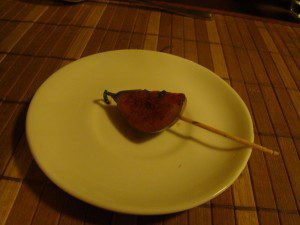
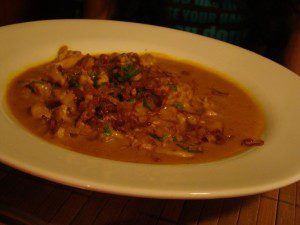
    But thanks to the wait, we had the time to decide what we wanted to eat. Yes, I’d have preferred doing that sitting down, but let me not nag now. 🙂 You can take a look at the menu here. Also take a look at the wine list and watch out for the day’s specials! A complimentary bread basket arrived before the Minestrone (chicken) soup we ordered. Two dips, one seemed to be herbed butter with olives, and the other had a chilli flavour. The soup was thick, with a tasty, mildly spicy broth base, and yes, chicken pieces were spotted along with pasta and cheese! (the photos were taken using the  phone camera, that would explain the worse-than-the-usual-bad visuals) 😉

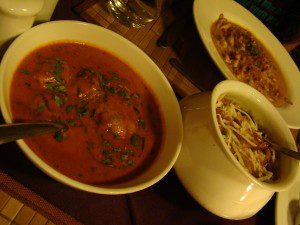
    For the main course, D ordered a Linguine Chicken Aglio e olio Peperoncino and I asked for a Fettuccine e Salsiccia Piccante. (yes, just point to them on the menu card!) The former was a tad bland (for our palate, of course) despite the promise of chili in the description. But a huge dose of chicken cubes slightly made up for it. I quite liked the fettuccine though, lots of spicy sausages and a mild tang to it.


    Despite appearances, the dishes were quite filling, and we didn’t have space for desserts. The service was quite prompt and all the above cost us just over Rs.1300.

    Toscano, UB City, The Collection, 2nd Floor, Vittal Mallya Road, Ph: 4173 8800

  • Realty Check 3

    The location was right, and strangely, so was the price. In fact, almost everything was right and she told the current owner so. To make it perfect, she decided to ask him anyway. After all, they had done it before with soups at restaurants. “Excuse me, can you make it a three bedroom from two?”

    until next time, Part 1, Part 2