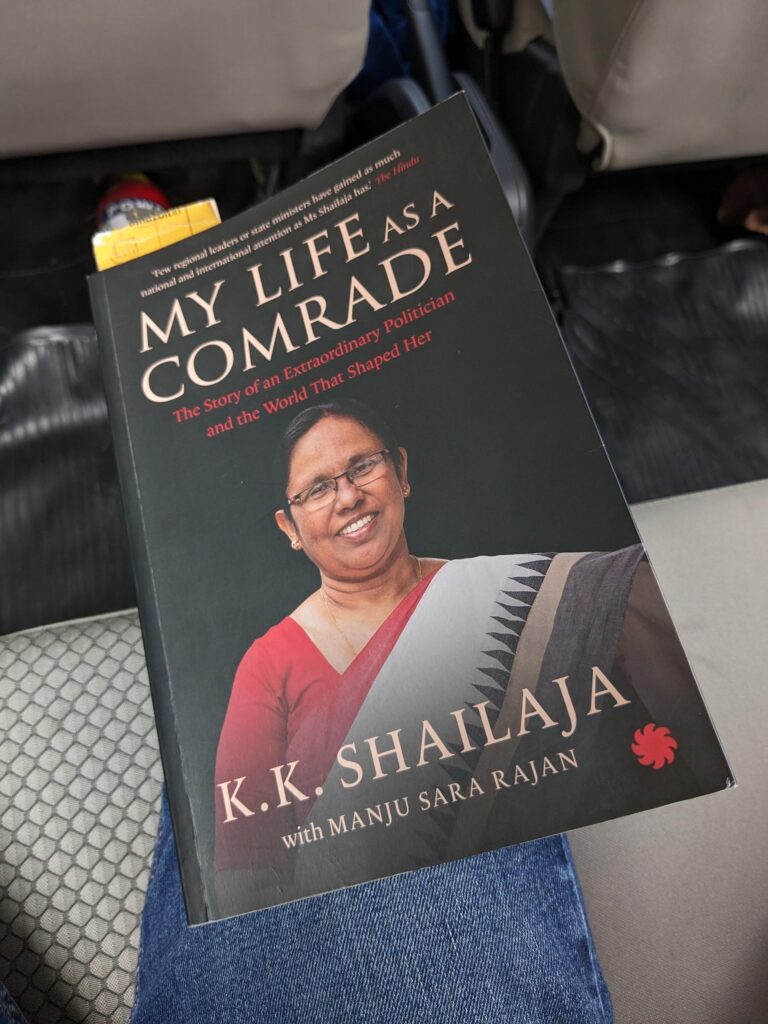
Most Malayalis, as Shailaja teacher points out, are socialists at heart. That, combined with the fact that I was an active member of the SFI in college, meant that My Life as a Comrade was a book that I had to read.
The book proved interesting to me on multiple counts. The first part is an excellent primer into the milieu that shaped the communist movement in the northern part of Kerala that she belongs to. This is presented not just as history beginning in the colonial era, but also as the living history of a land and its people, with many examples of her own family and neighbours being part of the societal struggle from its early days. In terms of structure and narrative, I liked this part of the book the most.
My Life as a Comrade then moves on to her own political life – from the grassroots level to becoming a part of the state cabinet as Health Minister. This section provides a good behind-the-scenes look of what it really means (and takes) to have an active political life, specifically for a woman. Towards the end of the book, she also provides her perspectives on why she wasn’t part of the cabinet in its second term, despite winning her seat by the highest-ever majority. It also gives us an idea of how a ministry functions, and the combination of political will and bureaucratic hands-on knowledge that is required for it do good for the public.
With a cyclone, floods, Nipah, and COVID, hers was an eventful tenure. My Life as a Comrade gets into great detail on how planning, co-operation, and a sharp focus on serving public needs was what led to Kerala becoming a role model for disaster management of all sorts. It has been said many times before, but the way in which the state managed the virus storms by practically creating its own playbook is nothing short of amazing.
There is an excellent section on what makes the ‘Kerala model’ work, despite low budgets. The social contract between the government and the governed that focuses on quality of life, a transparent and combinatorial system of administration, the willingness of folks across the political spectrum to put aside differences in times of need, and an active community that’s always ready to support each other, that’s what makes the model work.
The more I read about the different initiatives, the more I was convinced that old age is perhaps best spent in Kerala, despite the climate scares. Not all the infrastructure might be ready, but there is a mindset that is focused on getting there. I have to say that there is a mix of gratitude of pride that I feel in having such an option.
Having said all that, a couple of things that could have been done better. The first is language – the quality of translation, or rather, transliteration is rather poor. Given the persona, I think the publisher could have put in a lot more effort into this. The second is editing – while it follows a linear narrative, I think the book could have been structured much better.
But despite that, this is a fantastic read for many lessons – how the power of a state that works on socialist principles (allegations of corruption notwithstanding) can effectively and efficiently improve the quality of life of citizens, the life of a woman politician, and the excellent leadership and managerial aptitude in handling crises.
There is nothing quite like death to shake a worldview. There is a reset that happens in one’s head, and the relationship or even lack of it, changes this only in degree, not kind. There is no immunity either, by now, I’d know.
This one took me out of my comfort zone, in terms of physical location. In the last year or so, especially since the previous time I encountered death, I’ve felt myself become a tad more dispassionate about Cochin as relationships seem a lot more fragile. I am myself much to blame, decades of muscle memory of holding others at arm’s length is hard to shake off. And this is beyond Cochin, and in a place where I have avoided staying for more than a night. Each time I have tried to tell myself that my creature comforts can be skipped for a few days, there has been a rebellion within and I’ve been forced to say “I can’t.”
I brace myself this time too, and stood in a corner, observing others. I think we all are capable of projecting an aura of “do not approach” when we so want. Mine is at full blast. And yet, one child (whom I first knew as literally a child, and is now about to become a CA) breaks through it, and asks me if I I am ok, if I need anything. Maybe it is that, maybe it is the death gut punch, or maybe it is my newfound willingness to look at (at least some of) the world without a ‘transaction alert’ warning, but the next evening, I am at the table for evening tea, doing stuff I do when I am comfortable with people – pulling their legs, except these are people I had never even said a decent hello to. The day after, I am pushing someone to accept something the family feels he should take, and he is reluctant. They’re all crying, I think I might have forgotten how to. Says a lot.
But the larger facade broke before that evening at the table, as I watch folks of all forms walk through the door to catch a last glimpse of the one who had passed. It strikes me that I didn’t know more than a few people who would care to drop in to see me before I went up in smoke. The image of an old man, barely able to move a few steps, break down in grief, is still alive in my mind. Sometimes, I realise, it takes death to understand the meaning of life.
A few days later, I am back in Bangalore. I see the unhindered adulteration in packaged food, in the things that restaurants do, and in general, the greed in every seller, I wonder if that is what has been lost when faceless people sell things to faceless others. It is easier to not care when you don’t see the people you harm. That is not an option in a smaller community or at least it gets punished faster.
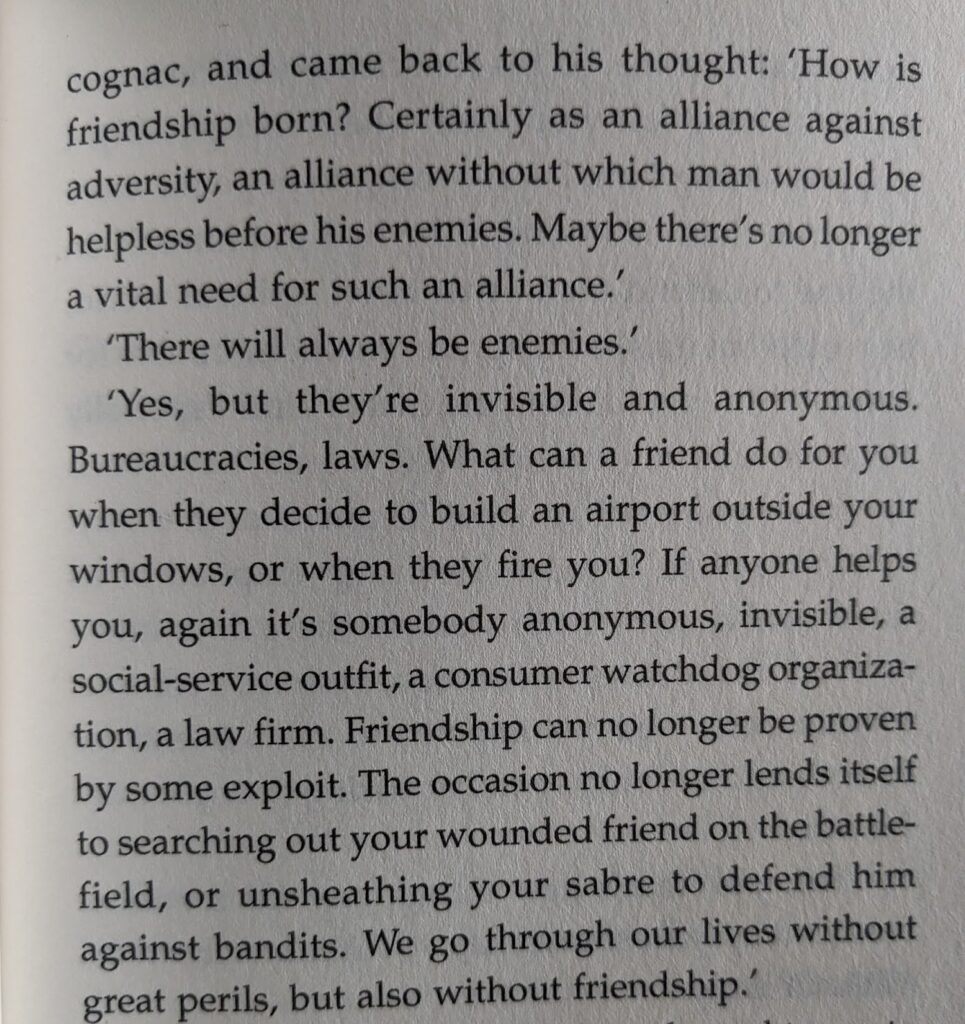
I am also reminded of what else family and community can do when I read Milan Kundera’s brutal take (in Identity) on why friendship isn’t in vogue these days.
When I zoom out of my individualistic approach, I realise I had seen community the way it was meant to be. Life savings in cooperatives, because it’s a world in which everyone still knows everyone else or is just a degree of connection away. Local cable over OTT because births and deaths and important local news is covered in the former. It isn’t perfect, and I won’t romanticise it because I know I wouldn’t be able to tolerate the scrutiny beyond short bursts, but its manifestations are revelatory. As the insightful narrator in Gullak says, yeh trauma bhi hai aur therapy bhi. And I wonder what the proverbial middle path is.
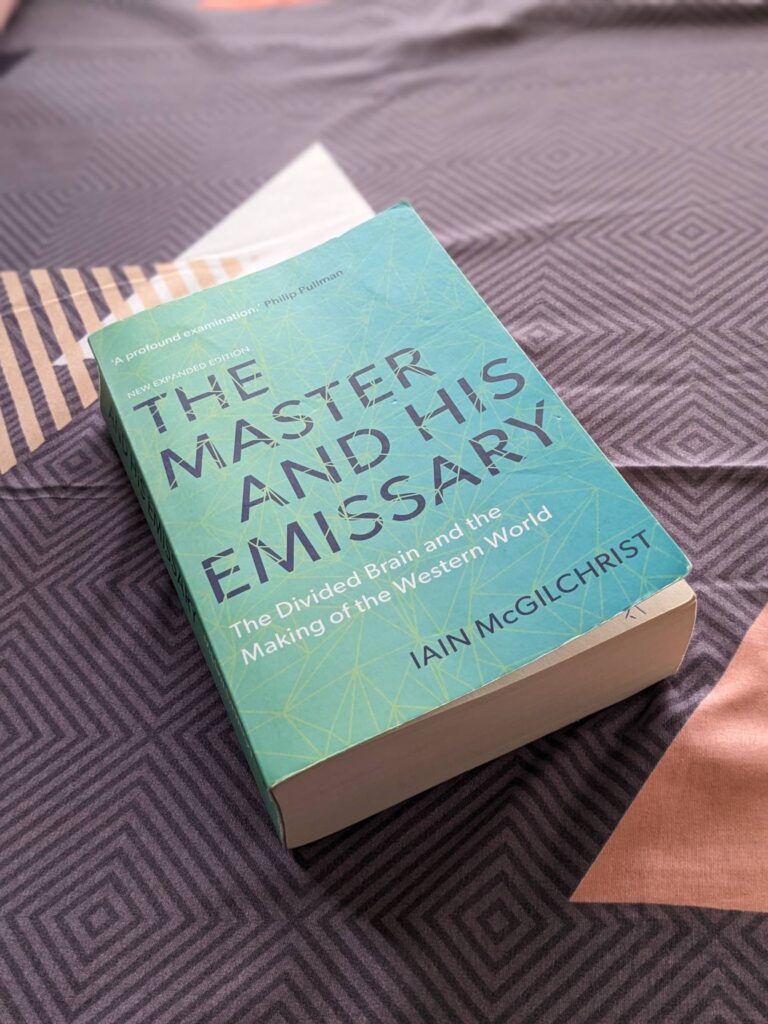
As is the case most of the time these days, I discovered The Master and His Emissary thanks to a podcast. Iain McGilchrist’s concepts seemed extremely intriguing, and now I have to admit (as he mentions early in the book) maybe intuitively consistent with my lived experience, and I had to read the book soon. Turns out that it goes directly to my all-time favourites, and was in my Bibliofiles 2023 list.
As the subtitle suggests, the book is divided into two parts – the divided brain, and the making of the Western World, each with half a dozen chapters. The first part deals with the brain itself – the asymmetry of the right and left hemispheres, their collective and individual roles, how their functioning actually leads to different perspectives, how this affected the evolution of music and then language (which can be seen as a key component in the progression of the species), the primacy of the right hemisphere, and how its emissary – the left hemisphere – has now usurped control.
The heuristic ways of looking at the hemispheres, e.g. left analytical, right creative etc, is replaced by a nuanced view. The differences between them are less about what they do and more about how they approach something. The left’s utilitarian ability to ‘grasp’ (look at how the metaphor applies to thoughts), its ability to provide simple answers and articulate them well, have all enabled it to grab control at an accelerated pace since the Industrial Revolution, and create a world where it prizes precisely these capabilities in individuals, institutions, and culture at large.
This is in many ways opposed to the right, which takes more holistic views, understands ideas and metaphors, perceives emotions better, specialises in non-verbal communication, and is humble about what it knows. The right deals with whatever is implicit, the left is tied to more explicit and more conscious processing. The right is present and pays attention to the world outside, the left re-presents. We need both hemispheres, and the right knows it, but the left thinks it knows everything. The left creates a world, and when it stops communications with the right, will not even accept reality if it counters the ‘truth’ of the world it has created. Its role was to provide a map of reality, it now thinks the map is reality, and if not, it will remake reality to fit the map.
The second part then digs into how this has manifested in the world around. It begins with the concept of mimesis (my favourite part) and how it was the crux of our leap into what we now call culture. The meta-skill that enables all other skills – imitation – possibly explains the rapid expansion of the brain in early hominids. Through the next five chapters, Iain takes us through history – from the early Greeks to the post-modern world, and how, though history has seen a see-saw in terms of the dominance of the hemispheres – Renaissance, Reformation, Enlightenment, Romanticism, and the Industrial Revolution – the impact of the last one was such that we are now in a world where a swing towards the right seems near impossible. Much like an addict, who is not even conscious that his next dose is not just another dose. ‘There is a vicious cycle between feelings of boredom, emptiness and restlessness, on the one hand, and gross stimulation and sensationalism on the other’.
The research is deep, in both sections, as evidenced by over a hundred pages of notes and bibliography. I especially appreciated the decision of not having same-page notes – it really does help the flow of reading. Iain has painstakingly tried to make a large number of diverse topics as accessible as possible. The first half is based on conclusions from scientific research and experiments across history, and various domains. The second half is itself an accordion of topics across centuries – arts, music, politics, language, and everything we call culture.
I think my bias for this book and its argument is based on my own experience. As a person and a professional who has to balance both hemispheres, I have been pulled to the left for the longest while. And in many workshops, the recommendation to me has been to let my right side ‘play’. It is only very recently that I have been able to start doing that, and I have to say that I am much happier. The Master and His Emissaryis a book I hugely recommend. It is not the easiest of reads, and I deliberately slowed down my reading speed so as to not gloss over it (though I still did in some of the arts discussions!) but it will open up how you think – the narrative you have made about yourself, and the world around you.
Quotes and ideas from The Master and His Emissary There are four main pathways to truth – science, reason, intuition, and imagination “The question is not what you look at, but what you see” ~ Henry Thoreau Attention changes what kind of thing comes into being for us : in that way it changes the world. Whether they are humans (say, employer vs friend) or things – a mountain is landmark to a navigator, a source of wealth to the prospector, and a dwelling place of gods for another. There is no ‘real’ mountain which can be distinguished from these, no one way of thinking which reveals the true mountain. Manipulospatial abilities may have provided the basis for primitive language. Function gestures become manipulative, syntax developed to form language, expression of our will. (p 111) Even in left handers, grasping actions controlled by left hemisphere, thus right hand. Language’s origin in music. Language originates as an embodied expression of emotion, that is communicated by one individual ‘inhabiting’ the emotional world of the other. A process that could have been derived from music. Grooming – music – language, all picked up by imitation. (p 123) Adam Zeman’s three principal meanings of consciousness – as a waking state, as experience, as mind (p 187) The river is not only passing across the landscape, but entering into it and changing it too, as the landscape has ‘changed’ and yet not changed the water. The landscape cannot make the river. It does not try to put a river together. It does not even say ‘yes’ to the river. It merely says ‘no’ to the water – or does not say ‘no’ to the water, whatever that it is that it does so, it allows the river to come into being. The river does not exist before the encounter. Only water exists before the encounter, and the river actually comes into benign the process of encountering the landscape, with its power to say ‘no’ or not to say ‘no’. The idea that the ‘separation’ of the two hemispheres took place in Homeric Greece. (voices of gods) (p260 -275) Gnothi seauton – know thyself In sooth I know not why I am so sad, It wearies me, you say it wearies you; But how I caught it, found it, or came by it, What stuff ’tis made of, whereof it is born, I am to learn. ~ Shakespeare, The Merchant of Venice The difference between reason and rationality. The former depends on seeing in things in context – right hemisphere. Latter is left, context-independent. Kant described marriage as an agreement between two people as to the ‘reciprocal use of each others’ sexual organs’ ‘Life is a progress from want to want, not from enjoyment to enjoyment’ ~ Sam Johnson Modern consumers everywhere are in a ‘permanent state of unfulfilled desire’ Certainty is the greatest of all illusions: whatever kind of a fundamentalism it may underwrite, that of religion or of science, it is what the ancients meant by hubris.
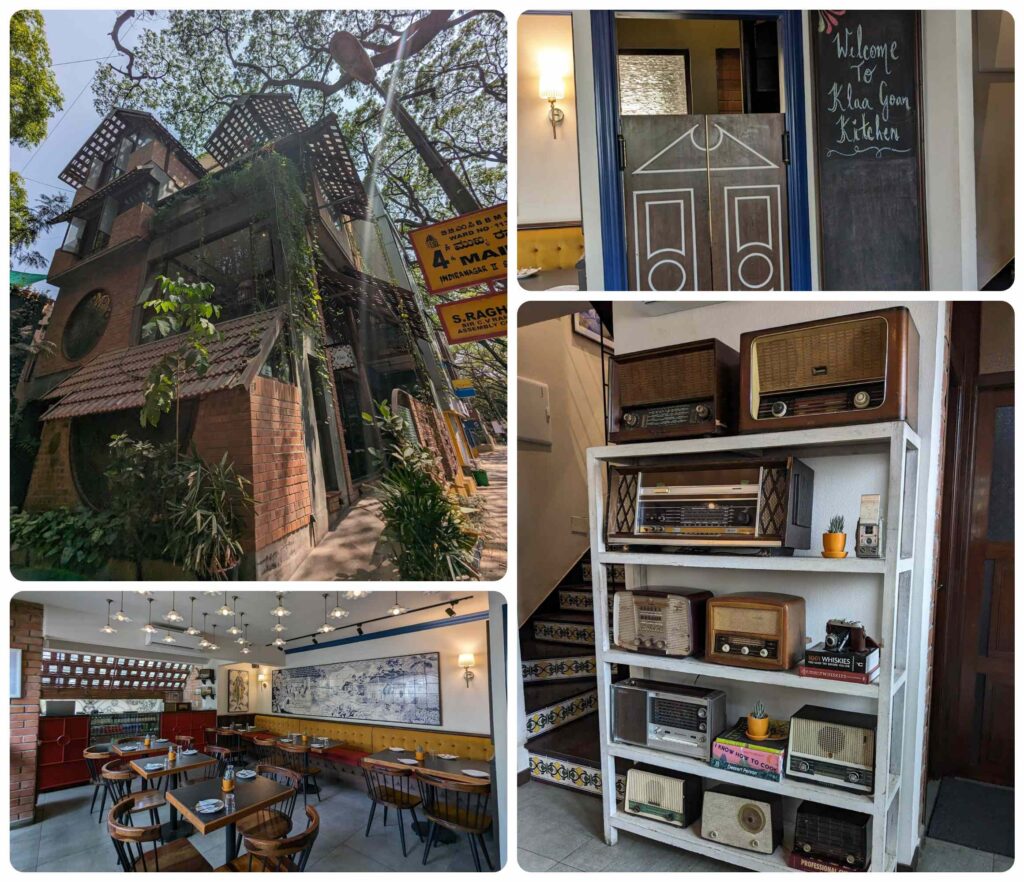
This was how D surprised me for my birthday. I hadn’t heard about this, but given my love for Goan cuisine, she somehow dug this out. 🥰 And that’s how we landed up in Indiranagar on a Sunday afternoon.
I had this feeling that I have been to this building before, but housing another eatery. I think it was Cafe Terra, which I had visited in 2016 but I cannot be sure because Cafe Terra’s current version, located slightly away, also looks similar! Anyway, the decor is elegant, pretty and has that amazing set of radios! I really should have asked where they got it from. We chose a table on the balcony upstairs to watch the world go by.
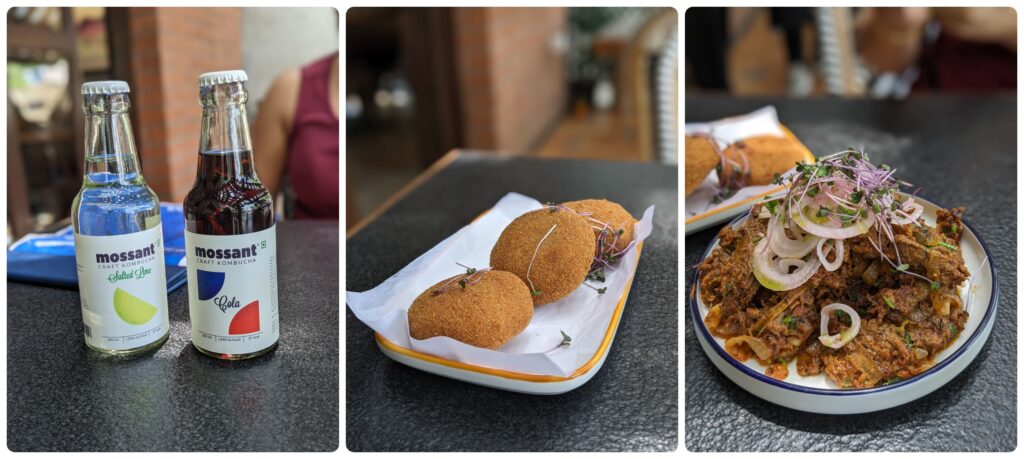
We hadn’t seen this brand of Kombucha before, so we tried two flavours. I obviously loved my cola flavour, but D didn’t mind the salted lime either. We tried the chicken cutlets, and really liked it. Great texture. Mary’s Beef Fry that followed was quite good too, though as all good Keralese people do, we think our version is the gold standard.
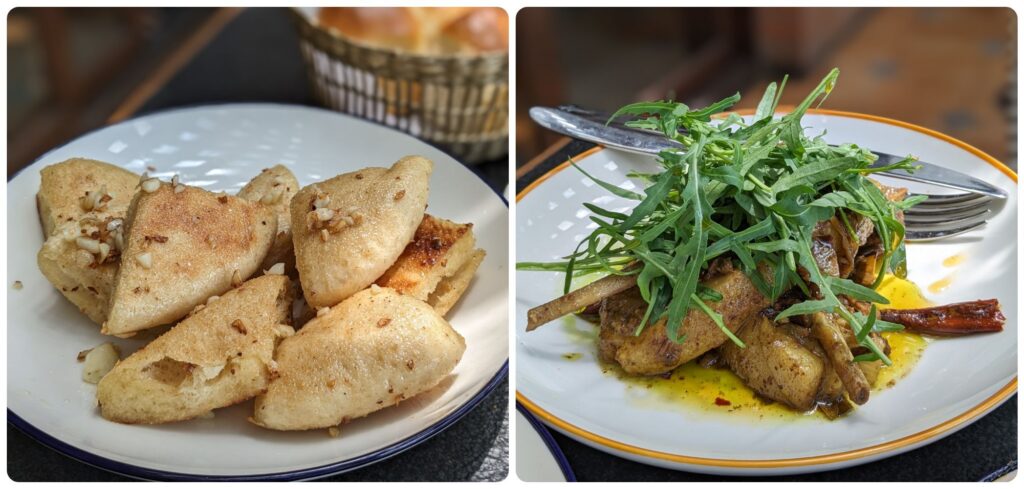
The Garlic Poee was excellent but quite heavy! The Pav was not too bad so that is an option as well. I think the only disappointment was the Goan Pork Roast. For all the looks, the flavours were quite insipid.
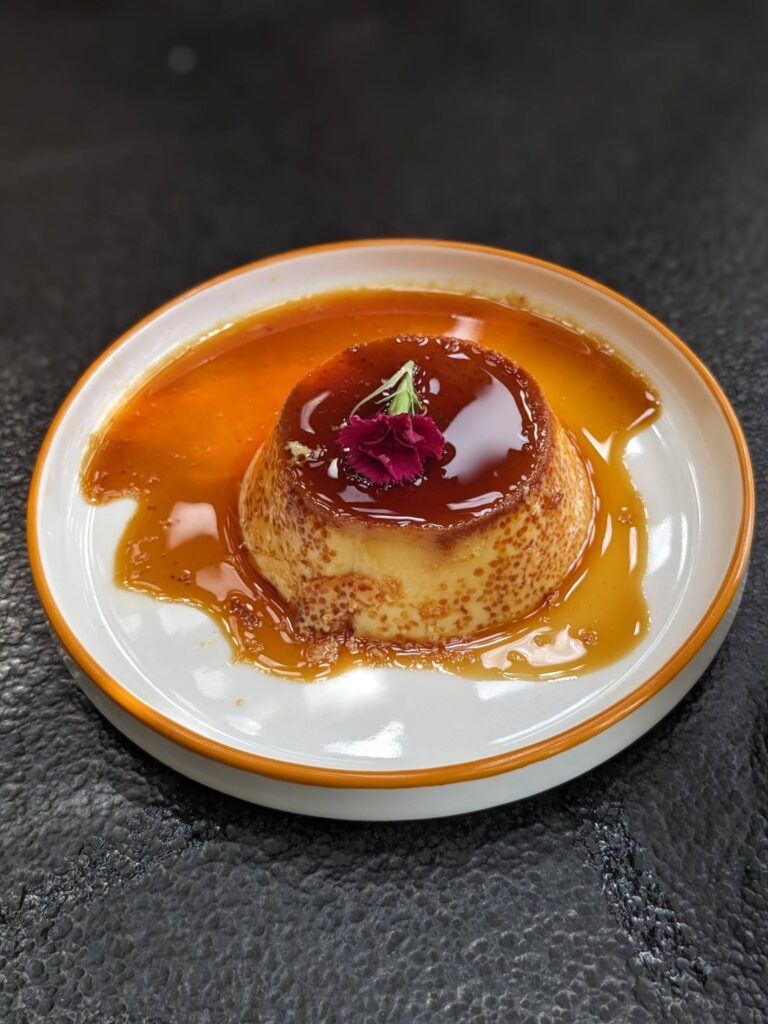
Thankfully, the caramel custard made up for it to some extent.
In terms of Goan food, I still prefer the thalis at Carnival De Goa, but for some strange reason, it’s only available on weekdays now. Klaa is good in its own way, and definitely worth a visit if you’re around those parts.
The bill came to a little over Rs.2700. The service was prompt and courteous.
Klaa, #846, Ground and First Floor, 4th Main, Paramahamsa Yogananda Road (Double Road), Indiranagar Ph: 9561711497
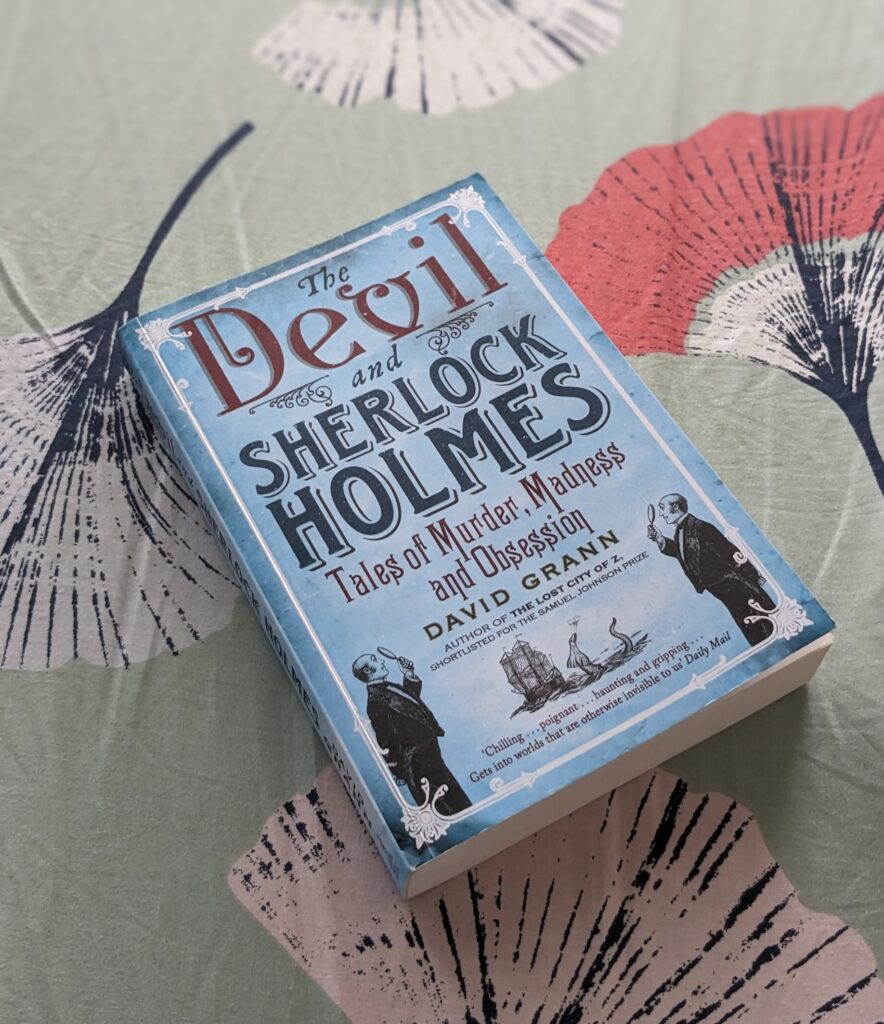
The Devil and Sherlock Holmes is a fascinating book, but how much it interests you depends on how curious you are. Grann mentions in his introduction that all the ‘stories’ are true, but I thought it was a gimmick to add to the effect. (like say, The Bridges of Madison County) When I got to the third chapter, I actually got really curious and googled. He wasn’t bluffing.
The book begins with the death of a Sherlock Holmes (or rather Conan Doyle) expert, the mystery surrounding it, and the existence of a ‘curse’. The last chapter is about ‘Toto’ Constant, a Haitian warlord, who founded a death squad, terrorised a democratically elected president’s supporters, and when the chapter starts, is a real estate agent in the US! He was nicknamed ‘The Devil’. That is as far as the connections with the title will go.
The book is divided into three parts. The first is made up of mysteries, ranging from arson investigation to a grown man who masquerades as a child, to a Polish detective trying to figure out whether an author has written a post-modern novel based on a crime he himself committed. The second part is about ‘a strange enigma is man’ – people (and in one case, generations) who are devoted to a specific calling and just won’t quit. The last part is about the ‘wicked in the universe’ – organised prison gangs that are practically beyond the reach of law, a city in love with the Mob and yes, Toto.
This is actually a superb work of investigative journalism. It exposed me to people, lives and worlds that seem so out of the realms of possibility that it is difficult to believe that they exist. A thoroughly interesting read if you’re so inclined.