Author: manuscrypts

  • Plan C

    This post has been pending for a while, the date of publishing of the article that inspired the post is evidence enough. It is about people who leave their jobs to follow their passion, but instead of the success stories we are used to, it focuses on the difficulties on that path. Even if you’ve not taken that path already, it’s quite possible that you have contemplated it. It’s romantic – the freedom, being your own boss and doing the thing you like – Plan B. But it’s not easy, and it begins as early as even identifying one’s passion. (must read)

    Interestingly, NYT themselves had an article almost a year later that asked “What Work is Really For” and answered that with an Aristotle quote “we work to have leisure, on which happiness depends.” Though I didn’t know about this quote until recently, this is a perspective that I have often used to debate with people who say those who do not like their jobs should quit. There are many reasons why people don’t, and one of them is consciously making a choice to work (possibly on things they don’t enjoy) for the 2 days (and vacations) when they are able to spend their resources – money, effort and time – on things they enjoy.

    The reasons people don’t scale up those 2 days could be many, including the difficulties involved in the early stages of setting up, and then maintaining a positive balance – of money and life. Money is after all an essential resource. It buys things, it opens doors. But when your passion becomes your work and your principal source of money, does it feel the same? Or does it become a job?

    I liked the second NYT article also for its last 3 paragraphs. It addresses the money conundrum. It talks about how right from when we are born, we are taught to be consumers, thanks to capitalism, which though calls itself an open market where we have the freedom to buy is actually a system unto itself.  The choices are not really independent. It points out that education should be meant to make us self determining agents. True freedom requires that we take part in the market as fully formed agents, with life goals determined not by advertising campaigns but by our own experience of and reflection on the various possibilities of human fulfillment. But that’s not an easy path either. It calls for independent thinking and a subjective view of fulfillment and happiness. And that brings us to the familiar “to each his own”

    until next time, work it out 🙂

    Bonus Read: Six Rules to guide your career

  • Between the assassinations

    Aravind Adiga

    Halfway between Calicut and Goa lies Kittur, the scene of Aravind Adiga’s collection of stories, set in the seven year period between the assassinations of Indira and Rajiv Gandhi. But then, despite some very 80s characteristics, the timeframe hardly matters, this could’ve been set in contemporary years too, for as a character says “Nothing ever changes. Nothing will ever change.” One instant comparison I could make was with Malgudi Days. That however ends with the similarity of multiple characters in the same town that is described in great detail – you can picture yourself in the town walking along its roads and identifying places and people.

    As the book summary says, the stories slowly bring out the moral biography of the town with its diverse set of characters – from the Dalit bookseller whose kosher relationship with the police is disrupted when he is caught selling ‘The Satanic Verses’ to the ‘sexologist’ who ends up supporting a boy with a venereal disease, and from the ‘mosquito man’ who tries to set limits for the relationship between a servant and his mistress to the mixed caste boy who detonates a bomb in his school.

    The book worked for me because the author has managed to flesh out his characters superbly across financial class, religion and schools of thought (political, philosophical) and use the friction between them to drive the stories. In that sense, each story is probably a different style, but the subtext of pent-up fury tinged with sadness cuts across.

    An excellent read both as an exploration of a microcosm of India as well as the different shades of human relationships and morality.

  • Balance Wheel

    Somewhere between the need to belong and the constraints of conformity lies that Utopian state. I am beginning to realise that this is applicable across all modes of social interaction, whether they be real or virtual.

    It begins with people finding a common interest or ‘wavelength’ and sharing great vibes. School/college cliques, blogs and microblogs, workplaces, interest groups and so on.  Startups are fun places to work in the initial years because rules are made on the go, blogs and microblogs in their early days were sparsely populated and everyone was discovering their own voice and community norms.

    I have always wondered what breaks the utopian state – time or an increase in the group size. These days I am beginning to be convinced that it is the latter. As each new member is added to the initial set, the needle begins to slowly shift from the erstwhile average. The addition of new members also changes the dynamics of the group and slowly the earlier common sense of belonging changes even as a new one is created. Some adapt, others refuse to conform and break away.

    But what I have also realised recently is that there is a middle path – refusing to conform but refusing to go away either. It is a tightrope walk, and best done without baggage. And that’s the walk I am trying to learn, across my worlds.

    until next time, walking schtick

  • Bow Barracks

    The good news is that you don’t have to go as far as Kolkata. There is no bad news. A little away from our regular Indiranagar haunts is 2nd Main, near the BDA complex. The last time we were on this road (On Double Road, take a right just before you hit Old Madras Road when coming from the CMH Road direction) was years back, and that restaurant has been replaced by a safer Punjabi outlet. In fact, the road now sports several food options including Chettinad, Punjabi and a few others! The map as well as the menu can be found on Zomato. Parking for 2 wheelers is easy and there are lanes around for 4 wheelers in case you don’t find space in front of the restaurant. A brick building with a doorway that makes you feel as though you’re entering a home. 🙂

    The interior too has a cosy feel to it with just the right amount of buzz. We chose the less crowded 1st floor and by the time we left, that too was fairly full, and people were being taken to the next floor. I think that’s where it ends, but can’t be sure. In addition to the splendid ambiance, watch out for the knickknacks. The clock, the old kind of switches, some wonderful photographs on the brick wall, all add to the personality of the place.


    The menu has Anglo Indian, Continental as well as Indian sections, but we were clear in our intent. We were even reasonably sure of 3 out of 4 items we planned to have, but we still needed to decide the 4th. As we sat debating that, an amuse-bouche made its way to the table. A fig with vinaigrette. I popped it in without giving it much thought until the flavour explosion hit me – tangy and sweet at the same time, with a crunch that will definitely make you sit up and pay attention.

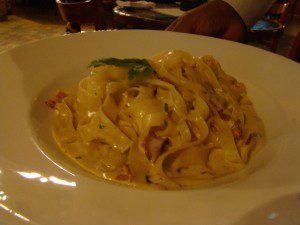
    We started with the Pantheras – the beef version. The beef mince was superb, and the crumbed, deep fried crepes wrapped it up very well indeed. But what made us completely forget to add that lime twist was the sauce that came along with it. In terms of taste, it reminded us of a local favourite – sauce that came with the Delicacy momos – but this one was more suave! For the main course, we ordered the Khow Suey – Chicken, and in the battle between the Fish Moilu and the Chicken Ball Curry, the latter won. We also ordered Coconut Yellow rice to go with the curry. The Khow Suey is a favourite and they did complete justice to it – the Anglo Indian rendition doesn’t really vary from the original Burmese and the coconut milk, noodles, cumin, turmeric etc with the help of a twist of lime made up an excellent mix as always. The Chicken Ball curry also has coconut milk flavour in the background, but it’s only to add that little extra to the tomato base (consistency and taste) and to the chicken mince that is made into koftas. The Coconut Yellow rice – basmati – worked beautifully with the curry and for our Mallu palates, this overdose of coconut felt just divine! :))


    We were almost full, but the bread pudding had already booked itself space, though it was more mind and spirit than body! Served with mild custard sauce, I felt it could’ve been slightly less watery. But thankfully, it didn’t take away much from the taste. An excellent meal in a perfect setting! The service was prompt, helpful and altogether smooth. The meal made us poorer by Rs.1276 (including a service charge) but it was thoroughly worth it. This one goes into our favourites, and with so many more dishes to try, we’ll raid again soon!

    Bow Barracks, 618/1, 2nd Main, HAL 2nd Stage, Indiranagar. Ph: 42072555, 9739601015

  • Jaya Indeed

    I didn’t attach much significance to the words on the jacket – High above the sky stands Swarga, paradise, abode of the gods. Still above is Vaikuntha, heaven, abode of God. The doorkeepers of Vaikuntha are the twins, Jaya and Vijaya, both whose names mean ‘victory’. One keeps you in Swarga; the other raises you into Vaikuntha. In Vaikuntha there is bliss forever, in Swarga there is pleasure for only as long as you deserve. What is the difference between Jaya and Vijaya? Solve this puzzle and you will solve the mystery of the Mahabharata. But it was only after I finished ‘Jaya’ (by Devdutt Pattanaik) that I realised this was what the complex and layered epic was all about. While swarga is considered an afterlife phenomenon, the dichotomy above is significant for life as well.

    (spoiler)

    Vijaya is material victory, where there is a loser. Jaya is spiritual victory, where there are no losers. The tale ends when Yudhishtira attains Jaya, not when the Pandavas achieve Vijaya over the Kauravas. That is the significance. Jaya is victory over the self. Only when there is undiluted compassion for everyone including our worst enemies, is ego truly conquered.

    Janamejaya, probably on behalf of all of us who would like to attain Jaya, asks what insight eluded his forefathers, and Astika replies “That conflict comes from rage, rage comes from fear, fear comes from lack of faith.” He does not expand much. I’d have to assume that here, the faith is in the self, the true self that is intrinsically connected to the larger consciousness. Thanks to material advances, Vijaya itself is a moving target and difficult to achieve. With all the distractions, Jaya is even tougher. Thus very few would even attempt it, and thus the entire concept of dharma spiraling downwards across yugas is very logical.

    The book provides many examples in humility. For me, the new things I learned and the increased awareness of the epic and its layers was a lesson in humility in itself. Even more humbling is the concept of Jaya.

    until next time, #epic #win