Author: manuscrypts

  • The Diary of an Unreasonable Man

    Madhav Mathur

    Many of us could identify with Pranav Kumar, the advertising executive who suddenly thinks out of his cubicle and realises the perils of this generation’s materialism driven existence. But he’s an aspiring author too, so he quits his job and tries to change the world through his writing. But the publishers aren’t really interested in the social commentary and opinions of an unknown person. And that’s when he decides to really do something.

    With a little help from his friends, he treads the anarchist path and tries to shock the system into taking notice of what he’s trying to say. The creativity of his campaigns ensures he gets all the attention from the media and the public, and then some that he didn’t really ask for – the cops and the underworld, because he has managed to disrupt the lives of many important people.

    The book reminded me of the film ‘A Wednesday’ in terms of the basic premise – the common man shocking the system. But the author treats anarchy with the same irreverence that the protagonist has for consumerist society. The plot is fairly simplistic, despite the creative disruptions, and so is the climax. It is perhaps this simplistic approach that takes away from the believability of the book. But it still is a fun read.

  • Remember the feeling?

    The subject of Augmented Humans has come up regularly on the blog. (see) Sometime back, I saw this short film (via) which featured a dystopian version, in a world where augmentation was the norm. The range of ideas that have been shown in the movie is amazing.

    TRUE SKIN from H1 on Vimeo.

    <spoiler> The most fascinating portion for me was the ‘memory insurance’ concept at the end, which would “implant your memories into a new you” if something happened to your physical self. Essentially, your ‘self’ would be immortal. Can you imagine living for thousands of years, with your memories intact? I have always wondered what it would be like to have memories, and not feel them.

    until next time, brain vs mind?

  • Bakasur

    First appeared in Bangalore Mirror

    For those unfamiliar with mythology, Bakasur appears in the Mahabharata as a glutton who pioneered home delivery, bless his soul. Not only did he force a village to send him enormous quantities of food, he also ate the person who brought it – an extreme version of ‘bite the hand that feeds’. That was until the Pandavas arrived on the scene and Bhima decided to help the village. One day he took the food for Bakasur and not finding him, began eating it. Bakasur finally arrived, saw that there was hardly any food left and questioned Bhima. Bhima said something to the extent of ‘first-come first-served’ and in the fight that ensued, killed Bakasur. But in the annals of gluttony, the legend of Bakasur lived on. The current version of Bakasur, on Outer Ring Road (just before the IBP Petrol Pump on the Service Road when coming from Koramangala – map) has its soul right going by the quotes “Now serving in L, XL and Bakasur” size. Spread over two floors, with the one above offering semi-open seating, the quirky theme carries across the menu, coasters, and other messaging, including the ‘toilet club’. On one corner, I could see a cart wheel. If it was a hat tip by design, it was a stellar job – the village in the myth was called Ekachakra. Speaking of wheels, there’s valet parking.

    The menu is not really Bakasur size; it literally fits into a plate, but the options are quite unique. There’s also a liquor menu. We started with the Malai-wala Lassi, Zeera Chaach and a Virgin Bakasur! The Lassi and the Chaach were served in slightly larger-than-normal earthen mugs. The Chaach was particularly refreshing and the Lassi got the sweetness just right. The mocktail turned out to be just the standard Virgin Mojito and not the best we’ve had.


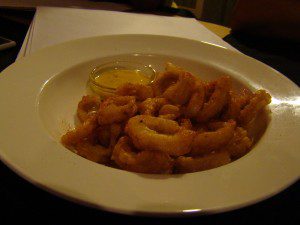
    The first starter to arrive was the Top Secret Gosht Kastoori Tikka – the meat was cooked well and the subtle fenugreek flavours did a reasonably good job, though it would’ve been better if it were served hot. The Mushroom Galauti, served on an ulta tawa paratha, had a smoky flavour that might not find favour with many. From greenery, we shifted to aquatic life – the Tandoori Panja Prawns was mildly spicy, succulent and had a tasty ginger garlic flavour. But the pick of the starters was the Beera Murg, 4 chunky pieces of spicy chicken that we couldn’t get enough of. The wind kept us company throughout and often sent tissues flying. Also present were flies, which seemed to take our frantic waving as a sign of friendliness!


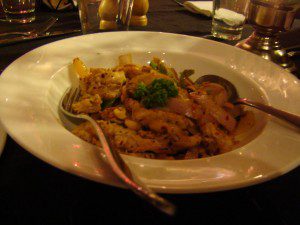
    The main course took its time to arrive, but the good news was that the flies became tired of waiting and left. The dishes arrived in huge vessels, as though meant for bottomless appetites, but appearances were deceiving – they turned out to have false bottoms. We started with the Paneer Saag, Doodh Kalimiri Murg and the Palak Puri. Combined, there was enough oil to warrant a WMD search. The Paneer Saag, in particular, was a heavy dish and was tasty enough to make us just pile it on! The chicken dish was more subtle, with mild explosions of pepper. The Palak Puri was another oil factory but well worth the calories. The Tandoori Ragi Roti was a unique bread that turned out to be surprisingly good, a chocolate hero look helped. The Taash Gosht was a bit of a disappointment – though the masala was spicy and well appreciated, the meat itself was tough and we were in no mood to wrestle. The other let down was the Keema Naan that turned out to be more bland than expected. Though we had also asked for a Dum Apricot Pulao, we were told much later, when we asked for its whereabouts, that it was over. Probably there’s a Bakasur in the kitchen?


    Though we expected the Ghee Jalebi with Doodh Kurchan to be the dessert star, it was the Pista Kulfi that actually stole the show. The crisp, cloyingly sweet jalebis were no match for the subtler, creamy kulfis.


    Bakasur is definitely a unique experience – large tables, an open, relaxed feel and an ambiance that’s enjoyable despite the strong wind and the flies. For about Rs.1600, you could share a non-alcoholic drink, a non veg starter, a couple of rotis, a non-veg gravy, and end with a dessert.  (Inclusive of taxes and charges) The food, except for a few items, was quite good. The pricing though, is debatable, and though it isn’t the “bakwasur” it was made out to be on review sites, it probably needs to figure out a better price-quantity proposition before laying on the Bakasurcharge!

    Bakasur, Surami Plaza, Outer Ring Road, Next to Shobha Hibiscus, Bellandur, Ph: 9916076720, 8095501980

  • A life less rich…

    On Quora, there is a question which has been getting some very interesting answers – “Is getting rich worth it?” I remembered my post “Halve Notes” from sometime back when I saw it. Rich is of course a very relative term – relative not just in terms of comparison with others, but dependent on time, one’s location etc. Also, factors like one’s health, emotional well being etc have the potential to change the worth completely.

    I don’t think I want to get super rich. I still ride an Activa, live in a rented apartment and  my consumption patterns do not really conform to my income, or as some say, my age. 😀 I have been trying to analyse why. I do like to spend on things I enjoy doing – books, movies, food, travel to name a few – and would not want to forego these for lack of money. But I also do not want to get used to things/habits I might find difficult to sustain later without compromising on my belief systems. So it’s a balancing act, with a bias towards caution thanks to my middle class upbringing perhaps.

    My dystopian future is an old age where I cannot live life on my own terms. That’s probably why I found this story -of one Mr. PM Sahay – so distressing. It’s part of The Delhi Walla’s commendable 130000 portrait project. Mr.PM Sahay is a 74 year old retired bank manager who is forced to sell puppets in Connaught Place to  sustain his family. (I am hoping none of his Rohtak neighbours happen to see all this on the web!) He travels 50kms from his town every day. His legs ache, he says and he has to support himself on the columns and sit on manhole covers near rubbish bins. He is a victim of circumstances. The best laid plans can go wrong, after all. Being rich at least takes care of some things, it would seem.

    until next time, a rich life…

  • Under the Dome: A Novel

    Stephen King

    (ex) Captain Dale Barbara is about to leave town when a gigantic, transparent dome envelops the town of Chester’s Mill. He could consider himself lucky since he survived the arrival of the dome. Several animals and people didn’t, as they crashed into the indestructible, impenetrable dome.

    The dome gave an electric shock when a person first touched it, but saved its disastrous results for those with pacemakers and hearing aids. The first victim on that count was the police chief Howard “Duke” Perkins, and that gave the town’s First Selectman ‘Big Jim’ Rennie to assert his superiority with First Selectman Andy Sanders serving as a willing puppet.

    He soon appoints his man as the new police chief and begins machinations to seize complete control. He pays special attention to Barbara, whose reason for leaving town was an altercation with Rennie’s son Junior, and his friends. The only people who can see through Rennie’s game are notably Barbara, Julia – the editor of the local newspaper, ‘Rusty’ – a physician’s assistant, and Howard’s widow Brenda.

    Even as the military reaches the town’s borders to address the ‘situation’, and the media update a stunned nation, Big Jim manipulates the town’s people into believing what he wants them to believe, despite television channels broadcasting his nefarious schemes for making money. The town and its people meanwhile, remain trapped under the unrelenting dome, like ‘ants under a magnifying glass’

    With a huge supporting list of characters, and spanning close to 900 pages, the author has tried to highlight a multitude of things – from human transactional relationships to environmental hazards. Unfortunately, the book didn’t really work for me, it was just too long to hold my attention, especially towards the end. The character snippets, the descriptions of town life and the jarring differences of climate inside and outside the dome, all gets repetitive after a point, and even the vast array of characters, interesting though some of them are, become too tiresome, despite the messages they seem to be carrying for the author.