Author: manuscrypts

  • The Small House

    Timeri N. Murari 

    The Small House, in terms of name as well as the overarching premise of the book is based on a socially accepted norm in Tamil Nadu – the ‘chinnaveedu’, where the husband houses his mistress. Though the back cover blurb would indicate that the novel is about two friends, both of whose spouses they suspect to be straying, the focus is very much on Roopmati Malhotra than her friend Tazneem.

    Roopmati, the sole surviving heir of the Krishnarangam royals, is shown as a history-obsessed character who is only mildly curious about her husband’s infidelity. She is convinced that she only represents a trophy for her husband, a suave businessman, who finds solace in the arms of Maya, a television anchor. On the other hand, Tazneem, an art filmmaker finds it difficult to handle the fact that her husband is cheating on her, and that he is a bisexual.

    Many narratives make up the novel. Roopmati’s conversations with her (almost) namesake and confidante Rupmati, a historical character who charmed Sultan Baz Bahadur and finally swallowed poison when she was captured. Her relationship with her dead brother Tommy, who supposedly drowned much earlier. Though friends, the two characters’ situations do offer contrast. While Tazneem’s marriage was her own choice (though she is still close to her father to whom she turns to for comfort), Roopmati’s seems almost like Khris bought her from her father, who died later. The author also unfolds layers from the perspectives of different characters as the story moves forward. This gives the reader a peek into why they are the way they are, but sometimes these narratives are like a cul de sac, with abrupt endings that force the author and the reader to pick up the thread from a principal character.

    In the end, it almost seems like the author was in a hurry to close the loose ends, and as a reader, I was forced to wonder whether many characters suffered from a compromised ‘end’ that has the author hinting that one must make peace with the past and choices made, and move on. I also wondered why the Rupmati character existed, unless it was a ploy to make the reader imagine a different ending. But the book has a fair share of things that make it a good read – the author’s keen eye for detail, especially of society and its players, manifests itself in the manner in which he has built and portrayed his characters – there are subtle traits that one can easily identify in all the characters, especially the supporting ones. Brief glimpses of Chennai also show the author’s interest in history. The pace is good and there are many nuanced conversations – between Khris and Roopmati’s father, Roopmati and Rupmati that offer food for thought. In essence, not stellar, but worth a read.

  • ..the question remains

    It has been more than a couple of years since I wrote on the subject of planning – the acceptance of destiny vs free will in The Uncertainty Principles and the balance between change and stasis in its follow up. In my mind, the debate continues to rage, with flash points on a regular basis, thanks to various life scenarios and the things I read. I also realised that the recent narrative posts (1,2) are also a different way of framing this debate. Like I wrote in the posts, some narratives are already chosen for us, and some we choose, but these are all our attempts to fulfill our sense of belonging. In other words, our endeavour to find the reason for our existence – our purpose. Does one find it by working towards something or by dealing with life on a real time basis?

    A few days back, I read an article in HBR titled “It takes purpose to be a billionaire“, in which the author classifies ‘purpose’ into three buckets. Not that everyone’s idea of ‘purpose’ is to become a billionaire, but this is very clearly a planned path to achieve something that contributes to the sense of purpose. While the article does not mention it, the category I have always wondered about consists of people who have followed their passion – sports people, artists etc who have worked on a skill and honed it to near perfection. A very interesting perspective I read on that premise is the Scott Adams’ “Practice and Genes“, which takes a look at the theories on the subject and finally states that the critical element is luck. The most important skill involved in success is knowing how and when to switch to a game with better odds for you.

    Which brings me back to purpose and how we find it, and my introspection. “Who looks outside, dreams; who looks inside, awakes” ~ Carl Jung. (via) I thought about the ‘living in the moment’ perspective that finds a place in Buddhism texts and several other works of wisdom. At first, I thought it supported the destiny and real time approach, specially because it is difficult not to have baggage associated with the plans one makes. (literally and otherwise!) But then I realised that it was less to do with the planning aspect and more to do with how we deal with scenarios. Even if one works on a plan, how one deals with a setback to it is where the advice has value. In essence, that won’t help solve the debate.

    collage

    There are profound statements that support both ways of looking at it. I continue to rack my brains to find the path that will fit me, or make it. I think there is an element of subjectivity involved. That does not make the job easier, in fact, it probably makes it tougher. After all, “He who knows others is wise. He who knows himself is enlightened.” Lao Tzu

    until next time, the clock ticks away in real time

  • Holmes Of The Raj

    Vithal Rajan 

    Similar to the other Holmes fan fiction I read earlier, (The Curious case of 221B –http://www.goodreads.com/review/show/…) this book is also set up on the premise of the author receiving hitherto forgotten papers of Sir Arthur Conan Doyle.

    The setting is late 19th century India, a crucial arena where ‘The Great Game’ was being played out. Holmes and Watson get involved in 5 cases set in various parts of India – Madras, Hyderabad, Delhi, Bombay, Nainital to name a few, and then return 25 years later for a swansong adventure. What is interesting about the book is the way the author weaves in historical characters and events, and shows a different perspective to discoveries and personalities associated with them – Ronald Ross, Ramanujan, to name a couple. And it’s not just science, but literature (Kipling, his character Kim and another that would serve an inspiration for Mowgli; Rabindranath Tagore) and sports (Dhyan Chand). The same trend continues for political events too, with Motilal Nehru, Lala Lajpat Rai, Lord Ripon all featuring in various storylines.

    What didn’t work for me was the narration and mystery moving away from the original Holmes adventures. Very often, the focus is on how Holmes and Watson had played crucial parts in actual historical events, and many a time, these seem a laboured fit. The book concentrates more on the cultural and political aspects of the colonial rule (with the Notes section providing enough evidence that the author has done a lot of homework) and tries to draw our attention to the kind of thinking and behaviour that laid the framework for everything that has happened since. Unfortunately, that means that Holmes and Watson are relegated to being props in a larger canvas. So, it would be good to set your expectations clearly before you start out. This is a commentary, and a very interesting one, on the socio-cultural ethos of the Raj. Regard Holmes and Watson as just another couple of characters, and you’ll do just fine.

  • Blimey

    Blimey had been making quite a few appearances on Facebook and outside and that meant that we chose a lazy Sunday afternoon to drop in. For those not yet aware, Blimey is an Irish Gastro Pub on the 5th floor of 1, MG. (map) The mall has parking at rates that would make you go ‘Blimey’ in a not-so-positive way. It also has these strange escalators that allow you to see alternate floors (2,4) like stations where the train doesn’t stop! Thankfully, Blimey is on the 5th floor along with a few other restaurants, and can be reached without a step-by-step instruction guide. 🙂

    It’s spread over 2 floors, including a rooftop (I’m told) but we were fascinated enough by the view from the lower floor to not even explore further. The place has quite a funky ambiance – musical instruments hung from the roof, trunks and posters, coaster-text, bar games, and of course, a fantastic view of Ulsoor Lake and surroundings!

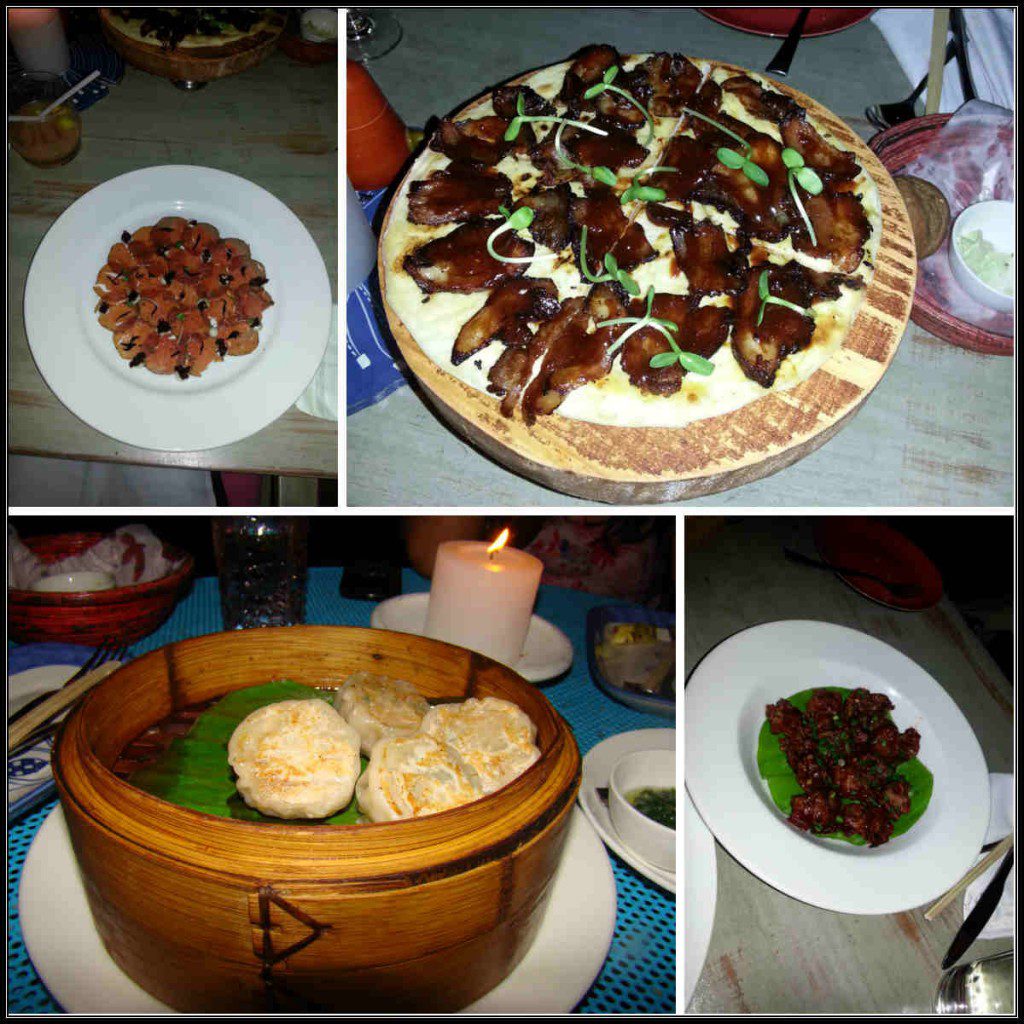
    collage1

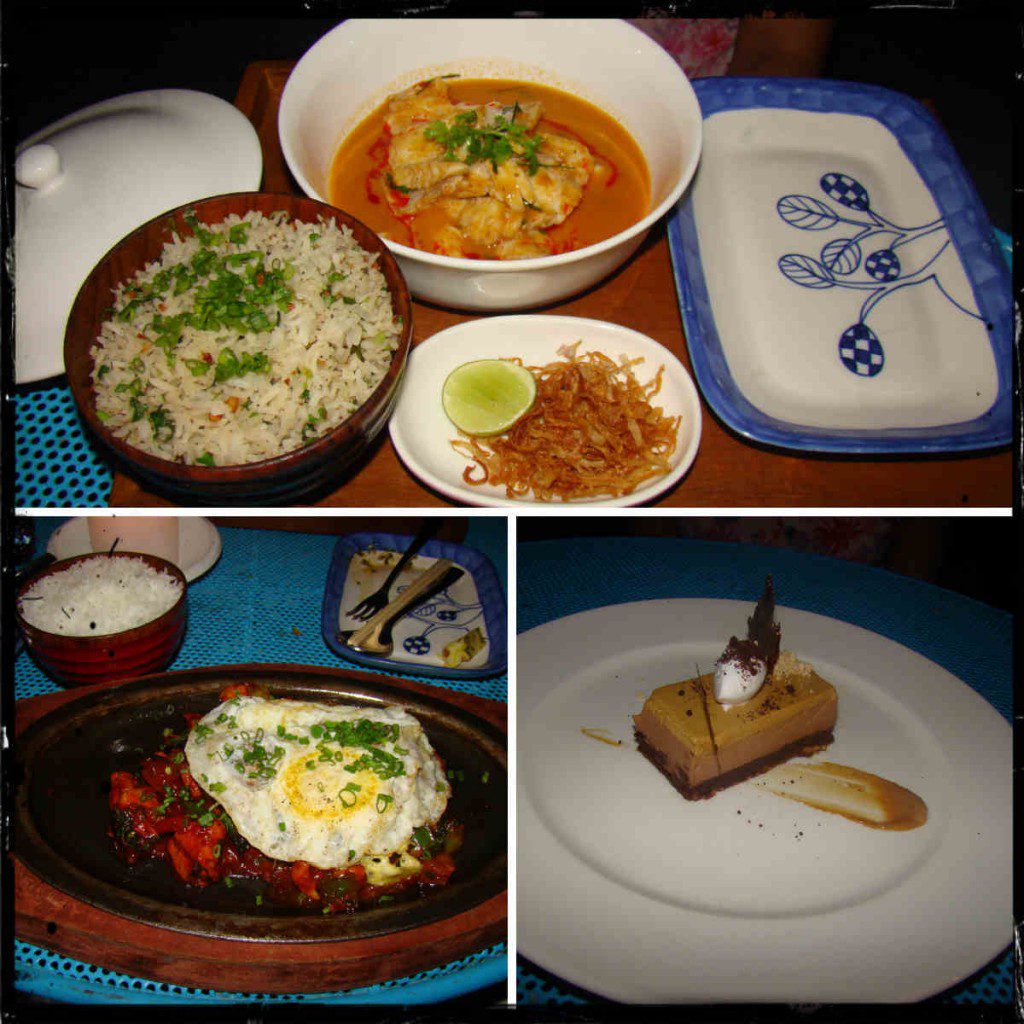
    We decided to start with an Irish Dublin, and an 1886, and from the food menu, a Sausage Four Ways. The Irish Dublin was the relatively better drink, with its banana flavour. The 1886 was spicy enough, but it didn’t really work for me. My biggest problem was with the glasses which seemed to have a default fish flavour! (smell) The sausages were the meal’s saving grace, and in a rare show of unity, the combined German, Irish and English forces gave us something to really cheer about. This one is highly recommended! For the main course, I asked for a Chicken Crock Pot, and D took a Shrimp & Scallop Pasta. The pasta arrived first and though it wasn’t really bad, the marinara sauce had a very feeble presence and the shrimp wasn’t as cooked as D would’ve liked. The chicken came with a complimentary bread basket and a superb gravy. But it was actually made for two, I’m sure, and after a while, I found it too tiresome to finish! That also meant that we had to skip dessert. 🙁

    collage2

    The service was quite prompt and cheerful. The bill came to more than Rs.2600 and I checked to see if we were also sponsoring some Irish cause! We weren’t, and I felt it was quite a lot, despite the location!

    Blimey, The New Irish Gastro Pub, 5th Floor, 1 MG Road. Ph: 08022086777, 9886587930

  • The narratives that we drive

    It probably started with the ‘narrative’ post, but a few things I read later made me wonder about our choices of narratives and where this could be leading to. Some narratives happen to us depending on our circumstances – time, geography etc, and some we choose of our own volition, or so it seems. Continuing from the earlier post, I think it’d be safe to say that with a more connected world, our ability to choose narratives has been heightened. Abundance of creation, and consumption. I think this was the related fantastic little piece of content that triggered this entire line of thought. It has some thoughts on material consumption, and though delivered differently, it has some profound insights as well.

    Partly thanks to that abundance, the noise around us has also increased, and has found better ways of being amplified. To quote Clay Shirky,

    It is our misfortune, as a historical generation, to live through the largest expansion in expressive capability in human history, a misfortune because abundance breaks more things than scarcity.

    In fact, one could argue that compulsive consumption (material, and otherwise) is one of the reasons for our ‘emptying out‘. (do read) As I was writing this, I had a sense of deja vu, and some searching pointed me to this, written 3 years back, in which I tried to figure out whether there was a middle path between a self that was driven by others’ perceptions and one that was driven by a moral compass dictated by few external stimuli. In that post, I had quoted from Paul Graham’s ‘addiction’ post,“we will increasingly be defined by what we say no to” I think that still holds true.

    In this era of abundance, what narratives should we choose to be part of? How can one be objective, is one even right by being objective? An excellent post whose advice I hope to implement more is this. I really couldn’t disagree with any of the 30 things mentioned, it just seemed intuitively right. But I think this would serve as an excellent first lesson..

    (via)

    until next time, an open and shut existence