Author: manuscrypts

  • The Non Fiction Collection: Twenty Years Of Penguin India

    Celebrating Penguin’s twenty years in India, this book has a collection of 46 non-fiction works, (chapters from published works) and since there’s no specific theme that links every one of them, I’ll just list my favourites. Devdutt Pattanaik’s Myth = Mithya is probably the best way to begin the book with its premise of creation (as per Hindu mythology) and its take on the complementary forces at play in the universe. Gita Piramal’s “the old fox” gives us the ringside view of the Ambani – Goenka war that played out in the eighties. Humra Quraishi’s “from Kashmir” offers us a glimpse of today’s Kashmir, and the life of the people there, a far cry from the times when Kashmir was described as heaven on earth. Vikram Seth’s “From Heaven Lake”, in addition to its vivid description of travel in China, shows in its last page a snapshot of the human condition that remains unchanged across the globe. Amrita Shah’s “Launching Into Space” is one of those reads that take across time, and space, with its chronicling of the early days of India’s space research programme. Khushwant Singh’s “Village in the Desert” is a very personal recollection of the author’s own childhood in a village that now stands in Pakistan, and shows how people across the line really can go beyond the lines drawn on a map. Sanjay Suri’s “Near Mrs.” (that title is a good example of the humour involved) is a brilliantly funny respite from the serious content in the rest of the book, involving a bride-search in London.

    Roopa Swaminathan’s “Extras” is a poignant piece of writing on the life of extras who come to Mumbai/Chennai with the hopes of becoming the next star, but who find that their life has passed them by even as they clung on to hope. Giles Tillotson’s Jaipur Nama has an account of the East India Company’s activities in the context of Rajasthan. Even as Mark Tully’s “No Full Stops in India” gives an excellent perspective on ‘development’ in India, Pavan K Varma’s “Being Indian” has a fantastic take on how India’s own way of getting things done still survives. Abraham Verghese’ “My Own Country”, while set in the US, touches upon, among other things, the idea of a home.

    Pinki Virani’s “Home as hell” informs us about sickening cases of child abuse in India. John Wright’s “Indian Summers” gives us a behind-the-scenes look as well as a non-Indian’s perspective on the game that unites India, even as S. Hussain Zaidi’s “Black Friday” shows how communal forces and the merchants of terrorism try to break this unity.

    There are also very interesting pieces like the Veerappan based “Face to Face” by Sunaad Raghuram, former PM Narasimha’s Rao’s version of what happened at Ayodhya in 1992.

    The book also had quite a few excerpts from works that are already my favouries – Mishi Saran’s “Chasing the Monk’s Shadow”, Shashi Tharoor’s “India: from Midnight to the Millennium” and Arundhati Roy’s “The Algebra of Infinite Justice”.

    The book is a few years old, and some of the works, even more so, but they are in some ways, timeless pieces too. I read them because they not only give me clues on interesting books to read, but also offer me a glimpse of worlds that I probably might not travel to in the course of my normal reading journey.

  • Guided by fear

    live1

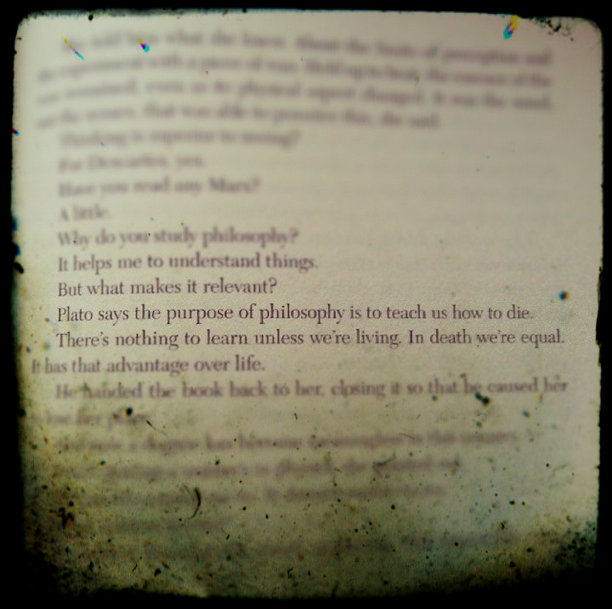
    I have this habit of adding a bookmark fold at the bottom of the page when I want to refer to it again. It is quite a task when I have to figure out much later what line in the page I’d originally bookmarked for! These days, Instagram solves it. At some point, I’m sure I can search my feed with a #quote hashtag and retrieve all the ‘bookmarks’ easily. Yay!

    “And the Mountains Echoed” had many such bookmarks. (still an unconscious habit despite the Instagram method) But this one has to be my favourite – “..but most people have it backward. They think they live by what they want. But really what guides them is what they are afraid of. What they don’t want.” I can easily confess that a large share of my actions is to preclude some dystopian version of my old age. (one) Many a time, this leads me to choose cautious paths over (what I think might be) more emotionally fulfilling ones, and even ones that I think might be leading me to my purpose.

    But when I thought about it a bit more, I realised that it can be read positively too – after all I am afraid of being switched off without knowing why I was here, and that’s what makes it an obsession! Also, the ‘afraid-don’t want’ factor often drives me to do things that are out of my comfort zone, so it’s possibly even pushing me towards my purpose, albeit from a different direction. Just a form of reduction? 🙂 It’s probably not a coincidence that my second favourite quote from the book is “When you have lived as long as I have, you find that cruelty and benevolence are but shades of the same colour

    until next time, fear off

  • Evening Is the Whole Day

    Preeta Samarasan

    Preeta Samarasan’s debut novel begins with the kind of prose that actually seems like poetry in disguise – with a description of a part of Malaysian geography. The narrative begins in 1980, on Kingfisher Lane in Ipoh, in the Big House, owned by the Rajasekharans – Raju (Appa) a leading lawyer and a pillar of the community, erstwhile socialist; Vasanthi, his wife, from circumstances far below his; their children Uma, Suresh and Aasha in that order; Paati, the matriarch whose disapproval of her daughter-in-law endures time, and the servant girl Chellam brought in to take care of her. A wealthy, dysfunctional family, with each member fighting their own demons.

    We see a lot of the story through Aasha’s eyes in the beginning. Aasha, who talks to ghosts and will do anything to get back the affections of Uma. Uma, whose sole desire is to escape to the US. And in between, Suresh, who tries to make sense of the world with humour. The narrative then sets out to unravel layer by layer, not just digging deeper into what happened earlier, but also wider, giving the reader, through characters and events, a view of Malayan society, with its own undercurrents, ethnicity issues and rules that attempt harmony between the Chinese, Indians and the natives. A brief glimpse of a country coming to terms with its freedom, and the responsibilities therein.

    As the layers unfold, the perceptions of characters and their behaviour that the reader has built up slowly begin to undergo changes, as the past – from a few days earlier to half a lifetime away – shows its influence on the present and future. We also see how the relationships between people change with time, sometimes over years and sometimes in a few minutes. There are some very interesting secondary characters too, like Uncle Ballroom who evokes a sense of poignancy, Vasanthi’s mother whose sudden turn to asceticism makes you wonder about the nature of the human psyche, or Kooky Rooky, whose variations of her own past points us to stories that we build for ourselves. And then there’s Chellam, whose past, and lack of future brings a lump to the throat.

    Somewhere in the book and its use of words and the wit employed (brotheROARsister, Stopping At Nothing…) I could see Arundhati Roy. Somewhere in the way the human condition is expressed I could see Kiran Desai. But neither takes away from a distinctive style – vivid prose, edgy humour, and an ability to draw the reader right in. This one goes into my favourites.

  • Time Vault

    bottle3

    This was my ‘water bottle’ at Myntra, and the victim of many of my colleagues’ jokes, mostly thanks to its size. It is really tiny, and you could finish all the water in it in one gulp. It has been disfigured many a time, courtesy its battles with hot water. But it bears its scars with dignity, even though it wobbles a bit. It also seems to have a fair amount of stature, since at least three of my colleagues asked me if they could take the bottle after I left. I refused, but now that I’m ready to join the new workplace, I don’t know if I should use it anymore. But I don’t want to throw it away either, since it holds a lot of memories and in future, will probably be the only unchanged remnant of some good times. I wish I could store it somewhere, but I’m also trying to get rid of my hoarding habit!

    That’s what led me to think of this concept – since we’re in the era of 3D scanning and 3D printing, theoretically it should be possible to construct a 3D scan of the bottle with its basic dimensions, exact contours, texture of material etc and store it. I should then be able to print out an exact replica using a 3D printer. These technologies are not yet mainstream, but I’m wondering if this could be a way of storing memories. We can store images, text, sounds easily now but not smell, taste and touch. This could at least take care of the touch aspect.

    At some point in the future, I’m hoping if it’ll be possible to store such treasures as a file and print them out whenever I feel like it. An entire folder full of memories – of different times in my lives, that I can easily bring to life. It would be like a time vault. Vault as a noun -storehouse – and vault as a verb – leaping, in this case across time thanks to ‘physical’ memories. Maybe, in the future, we could live in the past for a day, and come back.

    until next time, the future of memories

  • Grill Maximus

    D sulked when she heard that I’d gone to Grill Maximus for lunch with friends, so this was really a firefighting exercise. The first visit went quite fine, so I wasn’t really complaining. The restaurant is in HSR on 17th Cross – the road opposite McD. (map) It’s a fairly wide road, so parking is not a major problem. Judging by the crowd, the place seems to be a favourite, but we reached before 8, so we didn’t have trouble getting the table we wanted.

    The menu is a mix of Arab and Continental, with a smattering of other cuisines – most importantly a supposedly special Biriyani. During my earlier visit, we had tried the guava based Peru Pyala and found it to be quite good, but since Bangalore was at its windy best, we opted for a Spicy Seafood soup – D, that is, since seafood is allergic to me and tries to escape really fast. I had to make do with a Kibbeh. The soup was tasty (sigh) but the fried lamb meat balls and the dip proved to be an exercise in blandness.

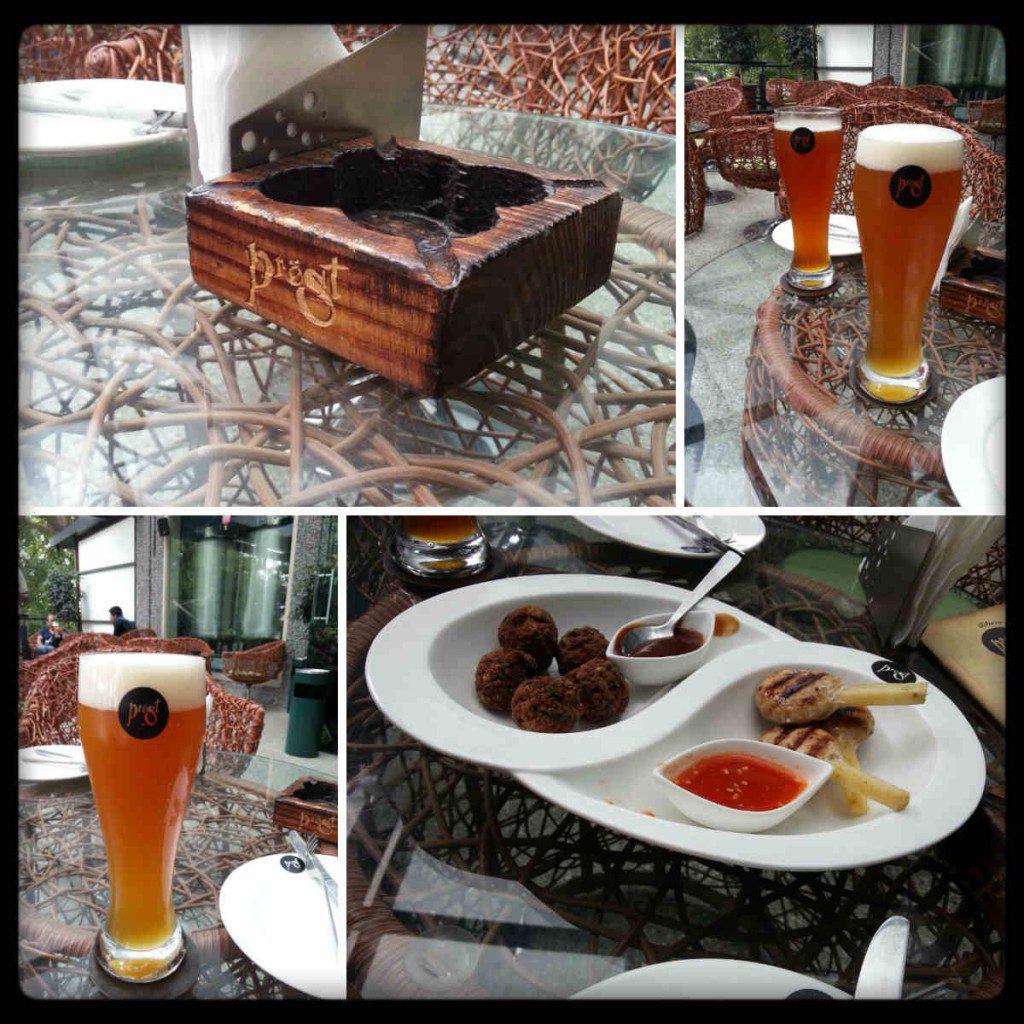
    collage1

    For the main course, I recommended the Kafta Meshwi, despite the meh experience with lamb. During the previous visit, I had also tasted the Lahem Meshwi, Chicken Charmula and the Charcoal Grilled English Vegetables. Except for the last, the sauces were similar, so I opted for a Creamy Rose pasta (chicken and penne)  The Kafta Meshwi’s pepper mushroom sauce turned out to be spicy and tasty, only slightly marred by the somewhat more-than-normal rough texture of the minced lamb skewers. The pasta was a disappointment, thanks to a capsicum overdose. This was unfortunate because the sauce was quite good. We’d thought that we’d test out the biryani if we had space, but we were reasonably stuffed and therefore opted for desserts. I did check out the Biryani (pic on Instagram) on another visit, and it was reasonably okay, except it had no pickle, raita, gravy etc on the side! The cake of the day wasn’t available for the day, so we chose the Znoud el Sit. It wasn’t chocolate based so needed to be stellar to elicit any kind of praise. Unfortunately,  it didn’t even fit the description on the menu. (wasn’t creamy on the inside!)

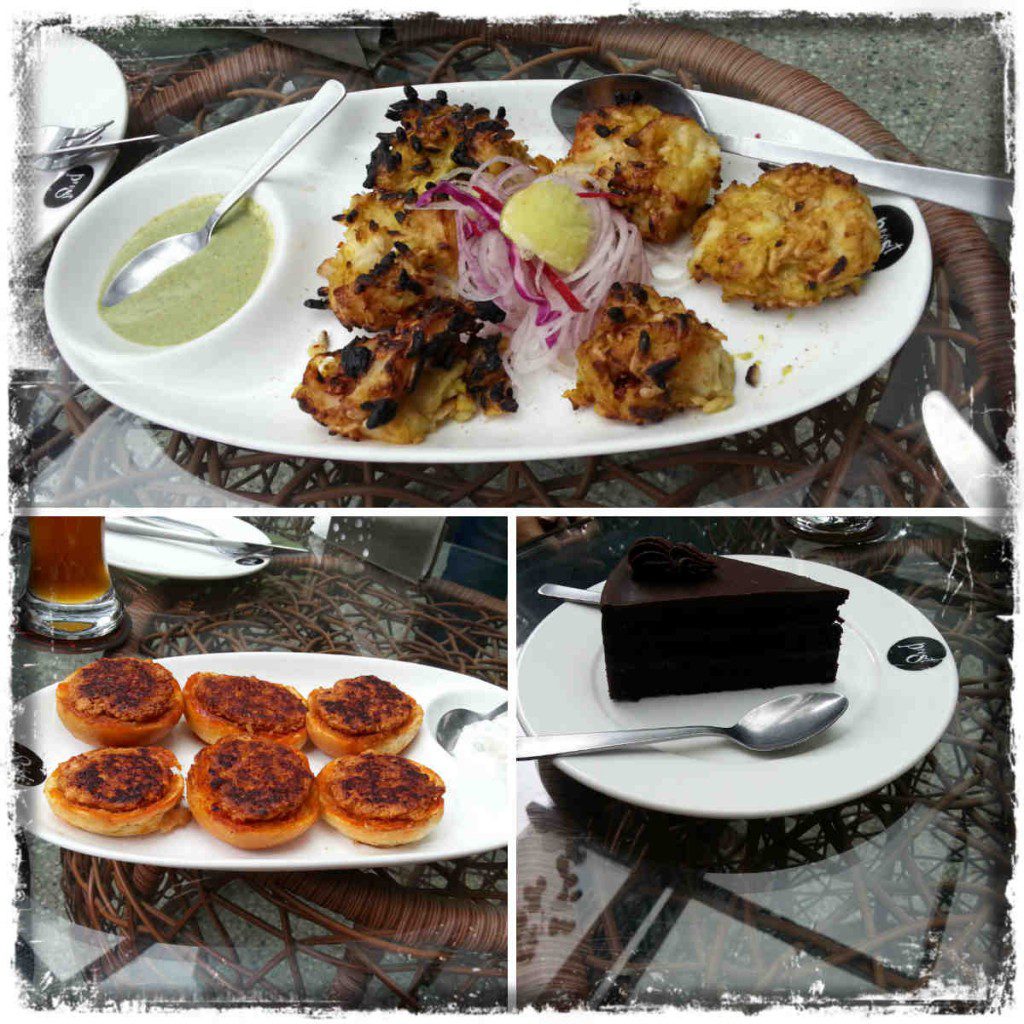
    collage2

    The service was reasonably prompt, except towards the end, by when the place was full. The wallet was lighter by about Rs.1300. Some of the dishes we had weren’t so great, but it’s quite decent for at least one visit.

    Grill Maximus, Shop No:450, 17th Cross, 4th Sector, HSR Layout Ph: 08197939437