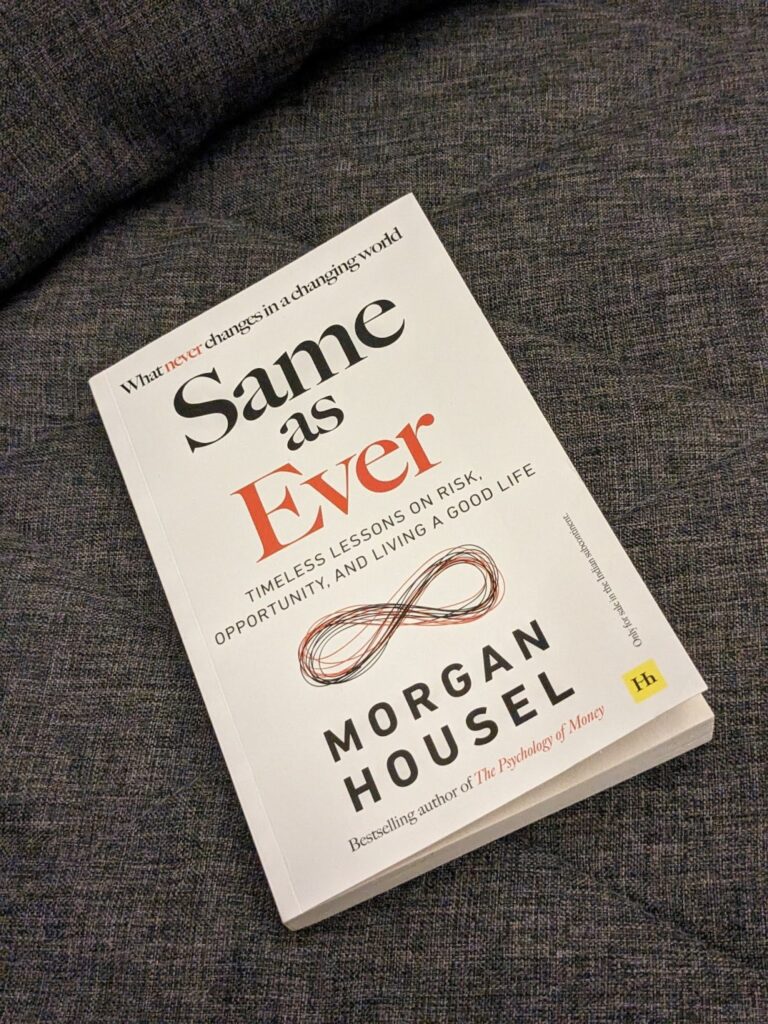
“The Psychology of Money” is acknowledged as a game changer. It gave me fresh perspectives, validation, and the confidence to continue on the path I had set out on financially. So it wasn’t surprising that I was looking forward to Same As Ever.
To begin with, I think you shouldn’t expect the refreshing sense you’d get from the previous book. This is even more so if you’ve been reading the Collab Blog. The book’s cover promises ‘timeless lessons on risk, opportunity, and living a good life’ and to some extent, delivers on all. There are many extremely good insights and the pithy ways in which Housel articulates profound truths continue to be a source of ‘aha’.
What I missed though was the smooth flow of the previous book. It doesn’t help that many of the chapters seem to be force fitted into a narrative, and many anecdotes and other content are from the blog. Housel does go for a structure but I think it might have helped if this were presented as just a series of essays. He does say that these are standalone but then also proceeds to try connections at the end of each chapter. The overall experience therefore is a little jarring.
Having said that, Same As Ever is a useful book to read, with some great but lesser-known anecdotes, and indeed, timeless insights.
Notes and Quotes “Risk is what’s left over after you think you’ve thought of everything” ~ Carl Richards “Invest in preparedness, not in prediction” ~ Nassim Nicholas Taleb Money brings happiness the same way drugs bring pleasure: incredible if done right, dangerous if used to mask a weakness, and disastrous when no amount is enough. “The majority of Americans were likely than their descendants to be dogged by the frightening sense of insecurity that comes from being jostled by forces – economic, political, international – beyond one’s ken. Their horizons were close to them.” ~ Frederick Lewis Allen (1900) People don’t want accuracy. They want certainty. If you have the right answer, you may or may not get ahead. If you’ve the wrong answer but you’re a good storyteller, you’ll probably get ahead (for a while). If you’ve the right answer and you’re a good storyteller you’ll most certainly get ahead. “Humour is a good way to show you’re smart without bragging” ~ Mark Twain “The higher the monkey climbs a tree, the more you can see his ass” ~ T. Boone Pickens “A mind that is stretched by new experience can never go back to its old dimensions” ~ Oliver Wendell Holmes
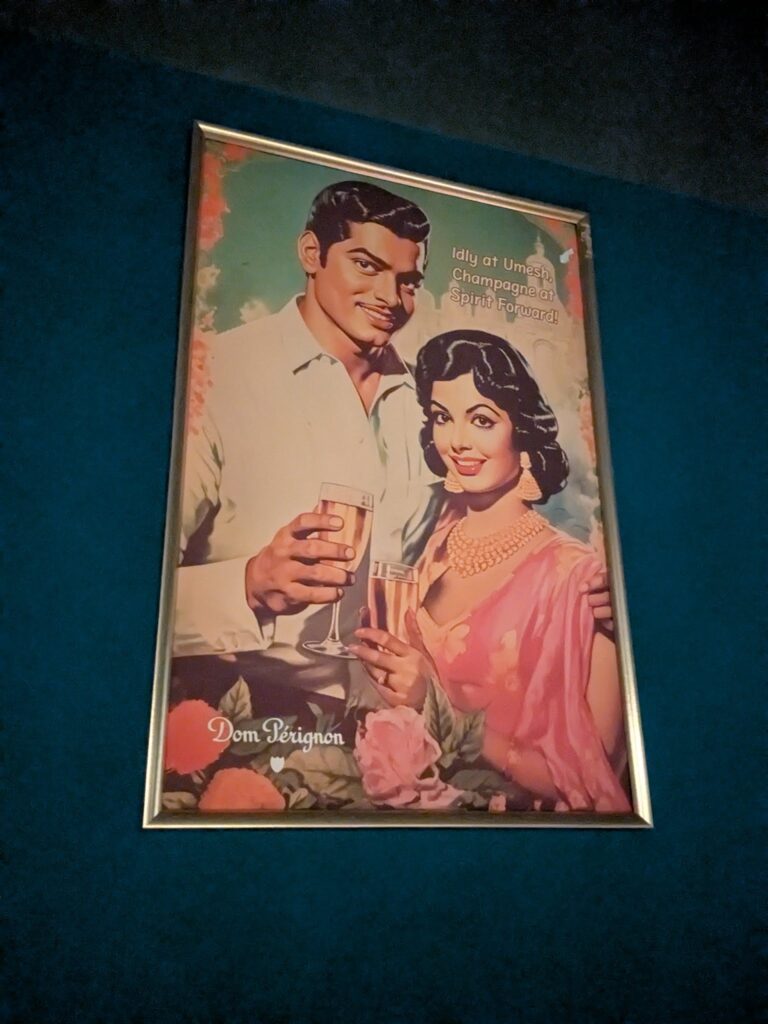
Let’s just say that at some point, the presence of Bar Spirit Forward on my feed became intense enough for it to outweigh the laziness of transporting ourselves from Whitefield to Lavelle Road. The place is housed next to a nostalgic favourite from almost a couple of decades ago – The Rice Bowl. The entrance is subtle enough to make you wonder if you’re in the right place. It’s all part of the play.
Make sure you reserve in advance so you get a warm welcome. 🙂
The decor is all world charm and sophistication, with the wicker and plush leather giving it the well-heeled elegance it’s probably aiming for.
That being said, it helps to also have tongue firmly in cheek lest we take it all too seriously.
An Umami Old Fashioned is what I began with. The ingredients were a mouthful – Jim Beam ,Vermouth, Amaro, Cherry Brine, Brown Koji Boy Cacao Miso, Bitters – but thankfully, those many cooks didn’t spoil the broth. I’d rate it high amongst the OFs I’ve had.
D had a 3 Gin Vesper which had gin heavyweights – Monkey 47, Tanqueray 10, Greater Than with Short Story vodka, Lillet Blanc, Dry Vermouth – which came frozen and poured straight from an icy bottle, served with blue cheese stuffed olive.
We didn’t begin well in terms of food. Not that there was anything particularly wrong with the Dak Bulgogi, but the smokey grilled chicken with scallions and sesame wasn’t something that gave you a foodgasm either.
The surprise package was the Lemony Roasted Cashews. Spicy and insanely addictive. Not to mention phenomenally good value for money. No, I’m not nuts, give it a try!
The Chicken Della Vittoria was a creamy, slurpy, wholesome affair and we throughly enjoyed the flavours and texture of the hot chicken stew.
Show me a person who can resist that Bailey’s Hot Chocolate Cake, and I’ll happily take their share. A great loaded dessert to end the meal.
The service is pleasant enough, one must expect a certain level of snootiness. The place was surprisingly a bit noisy thanks particularly to a loud middle-aged party of three, who were unfortunately at a table near ours. Thankfully they left in a bit. We loved the ambience and the food and didn’t grudge the Rs.4000+ bill we got. I’d recommend at least one visit.
Bar Spirit Forward, Lavelle Road, Shantala Nagar Ph: 077956 54575
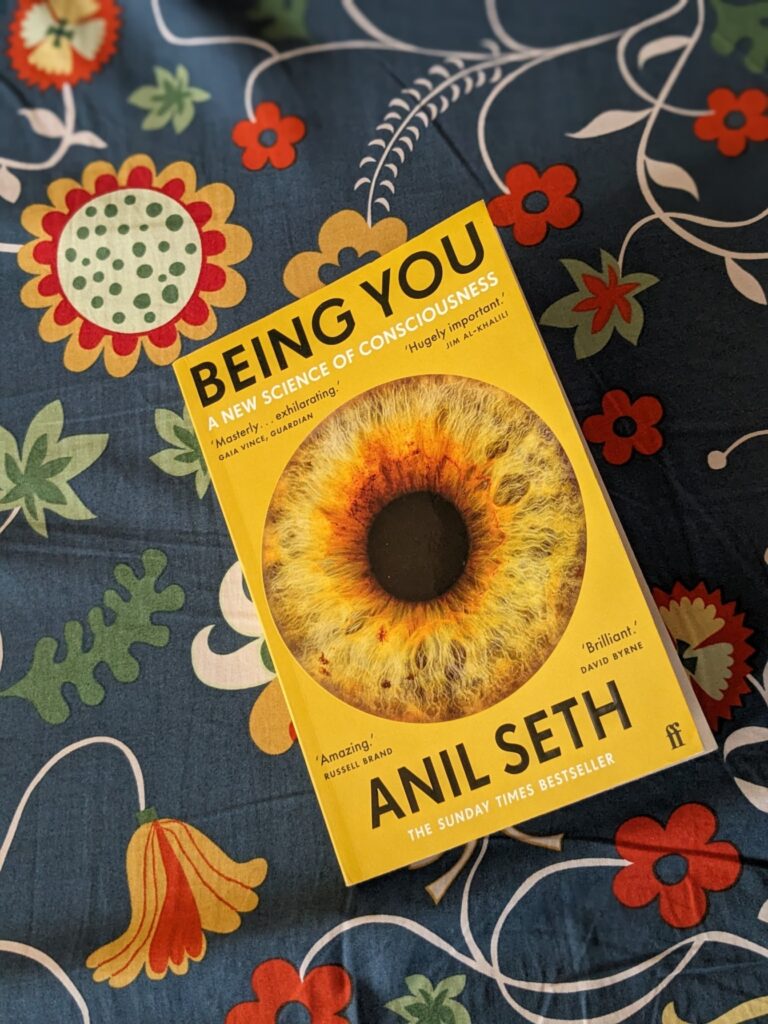
I have to confess, I will need to read this again. I also want to. For two reasons. First, the subject is something I feel is important – understanding consciousness through the lens of a scientific method. Second, grasping all of the material in Anil Seth’s fascinating exploration, I feel, is impossible with a single read. Having said that, the first read of Being You is indeed enlightening.
Being ourselves is not something we are always conscious of.* Anil Seth sets out to explore how billions of neurons within the brain end up creating a conscious experience – a uniquely personal, first person experience. Being You is divided into four sections – defining the ‘problem’ and showing the approach to the scientific exploration of consciousness, looking at it through how it relates to ‘content’ and external phenomena, and then going inwards to the experiences of conscious selfhood, and finally applying the learning to non-human entities – animals and AI.
In the first section, Seth brings up the ‘hard’ and ‘real’ problems of consciousness. The first (David Chalmers) is focused on how consciousness happens, how it is related to our biophysical machinery and how it is connected to the universe at large. On the other hand, the ‘real’ problem is how the ‘primary goals of consciousness science is to explain, predict and control the phenomenological properties of conscious experience.’ i.e. why is a particular experience the way it is, and what is its relation with what is happening with the brain and body. In other words, deeply understanding the connection between mind and matter. The latter approach would need measurement.
This begins with understanding ‘conscious levels’ – complete absence (e.g. coma) to light sleep to waking states. Conscious content is what we are conscious of – sights, smells, emotions, moods, thoughts, beliefs – all sorts of perception. There is a very interesting part on how psychedelic states are at a conscious level well above waking state, and have the maximum algorithmic complexity (a measure of the diversity of signals). Another interesting proposal is how all conscious experiences are informative and integrated, (red ball vs red and ball separately) leading to the integrated information theory (IIT) of consciousness, an axiomatic approach that starts with theories and use them to support claims on what properties the mechanisms underlying the experiences will have.
The next section is about conscious content and then the experience of a conscious self. Here’s where the idea of perception gets upturned. Perception is a ‘controlled hallucination’ (phrase by Chris Frith), an active construction as opposed to a passive registering of an external reality. The brain constantly makes predictions about the causes of its sensory signals through a Bayesian process in which the sensory signals (also) continuously rein in the brain’s various hypotheses. Perception is a continual process of prediction error minimisation (reducing the difference between what the brain expects and what the signal provides).
Reality is an interpretation, and the entire process is not optimised for accuracy, it is designed for utility. ‘We perceive the world not as it is, but as it is useful to us.’ A mechanism of making it seem real so we respond to it. Not to know the world, but to survive it! There is the fascinating part on colour – an object is not objectively ‘red’, redness is just the way in which it reflects light, and how the brain perceives it. And this applies to all of our perceptions. Mind effing bending! A great distinction here (John Locke) is on why that train is not just a perception and you shouldn’t jump in front of it. Objects have primary qualities that exist independently of an observer (e.g. space it occupies, movement, solidity), and secondary qualities that depend on the observer (e.g. colour)
The self, as shown in the next section, is also a perception, a controlled hallucination. To begin with, selfhood is divided into an embodied (being a body), perspectival (having a first-person perspective), volitional (having ‘free will’) and narrative (personal identity and deep emotions), social (how I perceive others perceiving me). The link between perception and the body and its physiological processes exist in all these forms. When we flip the learning from the previous section inwards, we understand that we do not perceive ourselves to know ourselves, we do it in order to control ourselves’. The entire panorama of experience and the mental life and thus its perceptions and cognitions stems from a deep-seated biological drive to stay alive.
I found the part on why we think we are stable and unchanging over time, very interesting. Perceptual inference is about finding out things about the outside world. Interoceptive inference is about controlling things – physiological regulation. In the latter, the prediction error minimisation happens by acting to fulfil top-down predictions of the brain. The brain, for survival, desires predicted ranges of physiological viability and thus the need for strong, precise and self-fulfilling predictions. And if it comes to that, the brain will (and does) systematically misperceive.
The end of the section also brings in the complex but fascinating FEP (free energy principle) and specifically how it applies to living systems and consciousness. In this context, it boils down to this – being alive means being in a condition of low entropy. Any living system, to resist entropy, must occupy states which it expects to be in. Free energy here approximates sensory entropy, and apparently, it amounts to the same thing as prediction error. Broadly, that connection with physics and the universe, and the brain’s regulation of the perception of the worlds outside and inside! Appealing, but they’re still ironing out many wrinkles.
I found the last parts – free will, and consciousness in animals and AI to be areas which are still under much (more) debate, and therefore more descriptive than insightful. That is not to say that it does not merit a read! It is just that the 200+ pages before were so rich and intense that on a purely relative scale, this seemed less so.
As I said, Being You is most definitely not an easy book, but it does such a fantastic job of providing that glimpse and promise that we might actually get answers to our most basic and profound questions that one automatically cheers for the understanding that each chapter provides. Also the kind of book that makes me wish I were smarter – to really grasp the entirety of it! It also made me think of how science and spirituality seem to converge – the latter’s approach to reducing wants and desires, and increasing mindfulness as a means to prediction error minimisation. 🙂
This was part of my Bibliofiles 2024 list, and in fact, my favourite read of the year.
Notes and Quotes “The essence of selfhood is neither a rational mind nor an immaterial soul. It is a deeply embodied biological process..” “Wherever there is experience, there is phenomenology, wherever there is phenomenology there is consciousness.” Deductive (reaching conclusions by logic), inductive (extrapolating from a series of observations) and abductive reasoning (the best explanation from a series of observations)
*now that I have read the book, I am analysing this sentence!
It has been almost exactly 4 years since I wrote Default in our Stars. I ended that post with
A question I asked myself while writing this was, when there is no agency, what happens to morality? My own first answer was worrying – maybe you just become numb to life’s deeper questions because there’s always an algorithm to give you something you didn’t know you wanted. And that’s the panacea that this age warrants. And hence default in our stars, and an artificial existence.
Sometime back, a comment on an advertisement I had shared on LinkedIn on World Suicide Prevention Day led me to think again on the subject. I had a bunch of thoughts, and after I had framed it myself, I took the help of everyone’s favourite assistant to break it into byte sized points.. Given my (lack of) expertise, it’s a reach, but I love my curiosity. 🙂 So here we go, picking up specifically from the point of societal impact – reduced interactions, as algos increasingly recommend everything.
1. Human Interaction Decline: Before the Industrial Revolution, getting things done required relatively more human interaction. Since then, it has been declining. From real marketplaces to supermarkets to telephone operators to a faceless internet and so on.
2. App-Driven World: Now, apps have taken over many tasks that previously required a human touch — answering a question, booking a cab, planning vacations, ordering a meal, buying from the local shop — are all done with increasingly reduced human involvement.
3. Command & Gratification: Apps obey without asking for explanations, giving us control and instant gratification. “Click to order”. In parallel, social media provides gratification through validation – likes, comments etc, again something that formerly happened only IRL
4. Centre of the Universe Mindset: This on-demand gratification makes us feel like the centre of our own universe, where every gratification is possible and tailored for us, fast and friction-free. A perception that everything is my way on the information highway.
5. Human Interaction = Tedious?: As human interactions inherently involve alternate perspectives and unpredictability, they can seem more ‘tedious’ in comparison to seamless app transactions.
6. Natural Selection’s Role: Here’s where natural selection comes in. Entropy is relentless, and the one force that is equally relentless in trying to stop it, is natural selection. Evolution thus tries to increase order in successive iterations. That’s also how humans got here.
7. Tech’s Push for Efficiency: In general, app interactions are more predictable than human ones, aligning with this drive for less entropy. For instance, Urban Company/Uber have automated much of this already, helping us choose predictability and efficiency over complexity in daily transactions.
8. Tech & Relationships: Something I missed in the original post is another connection between biology (nature) and tech. In their book The Molecule of More, Daniel Z. Lieberman and Michael E. Long describe two kinds of relationships. “Agentic” relationships orchestrated by dopamine – formed to accomplish goals, very purpose-driven, and in contrast, “affiliative” relationships – formed for connection and enjoyment, driven by oxytocin. We all know the connection between tech and dopamine, and that’s probably why we are increasingly pushed to transactional agentic relationships.
9. Blockchain’s Faceless Trust: So, where is this going? As D pointed out when I chatted with her on this, blockchain takes this further with its “faceless, trustless” system of certainty. It’s arguably the next step in reducing unpredictability.
10. AI and the Future: AI, despite its hallucinations, will likely bring even more predictability in both outputs and outcomes. But what does that mean for our place in this increasingly transactional world? Honestly, I’m still figuring that part out. 🤷♂️
The WEIRD mindset has moved beyond its original strongholds and is becoming increasingly dominant across the globe. Money, society’s favourite currency, demands it. Munger has famously said “Show me the incentives and I will show you the outcome“. It is ironic that at a species level, there might be a desire to survive, but that, at an individual level, the WEIRD penchant for autonomy and predictability is overriding it. Natural selection will have no qualms about its means of reducing entropy coming at the cost of an entire species.
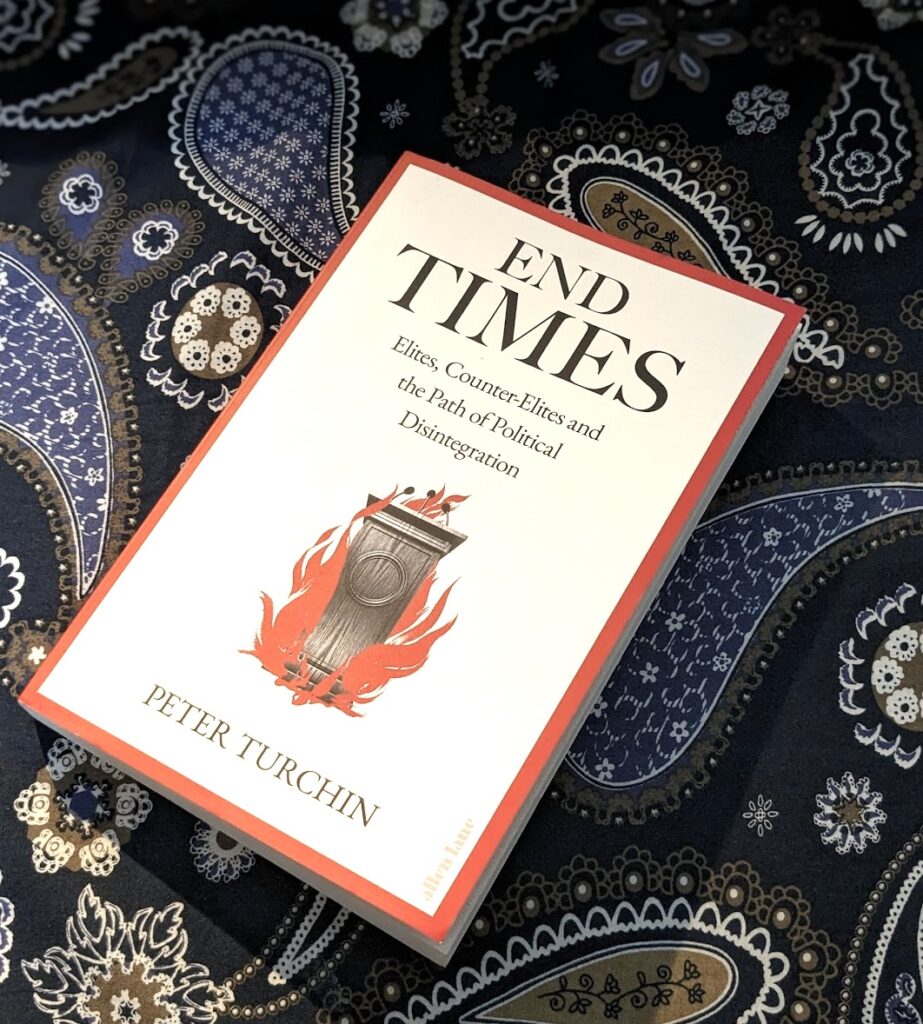
If you’ve read Asimov’s Foundation series, you’d know psychohistory – the ‘science’ that predicts the future of humanity at large. Peter Turchin’s End Times is on a similar path, though he does call out the underlying methodology of psychohistory as pseudoscience and in his version, attempts to do it with a lot of data and actual science. The field is cliodynamics, focusing on political integration and disintegration, and state formation and collapse. He and his colleagues have discovered recurring patterns in history over the last ten thousand years, and some common underlying principles on why this happens.
The book begins with a look at the sources of power and its correlation with wealth. The former is of at least four types – force, wealth, bureaucratic, and ideological. It then takes a quick look at contemporary America, and specifically the reasons for the rise of Trump. I found the parallels with the 1850s, Lincoln, and the Civil war that his election triggered, quite insightful. (it really wasn’t just about slavery, the business and economic interests were the much broader canvas)
And how does this power dissipate? From his research, the lessons history teaches is that there are four structural drivers of instability – popular immiseration (impoverishment of the working class) leading to mass mobilisation potential; elite overproduction (too many elites vying for too few seats of power and wealth) leading to intraelite conflict; Failing fiscal health and weakened legitimacy of the state; and geopolitical factors. The second is the most reliable predictor.
With this context, he delves into each of these factors in the subsequent chapters. An interesting point in the popular immiseration is the impact of immigration – how it drives down wages because of the overabundance of labour. In the second- elite overproduction, he quotes Guy Standing on the so-called ‘precariat’-
It consists of people who went to college, promised by their parents, teachers, and politicians that this will grant them a career. They soon realise they were sold a lottery ticket and come out without a future and with plenty of debt. This faction is dangerous in a more positive way. They are unlikely to support populists. But they also reject old conservative or social democratic political parties. Intuitively, they are looking for a new politics of paradise, which they do not see in the old political spectrum or in such bodies as trade unions.
And David Callahan –
As the ranks of the affluent have swelled over the past two decades, so have the number of kids who receive every advantage in their education. The growing competition in turn, has compelled more parents to spend more money and cut more corners in an effort to give their children an extra edge. Nothing less than an academic arms race is unfolding within the upper sections of U.S. society. Yet even the most heroic – or sleazy – efforts don’t guarantee a superior edge.
He then points to how the two parties in the US have moved away from their original audience and stance, and how ideological fragmentation has progressed so far that any classification has become impossible. And we’re now dominated by radical politics. America is now a plutocracy – economic elites who are able to influence policy with its “structural economic power”. The issues in which they are in disagreement with the common folks always get decided in the elites’ favour. Plutocrats are able to create a vulnerability in democracies because they use their wealth to buy mass media, to fund think tanks, and handsomely reward those social influencers who promote their messages. A three part way of controlling public perceptions of practically anything! The chapter ‘Why is America a plutocracy’ also has an insightful section on why the US didn’t turn out like Denmark despite being at roughly the same place at the beginning of the twentieth century.
In the last section, he looks at history to understand the possible outcomes for the US in the future- how the trajectory of post USSR Slavic states – Ukraine, Belarus – and Russia differed. He also goes further back to look at examples of states that have survived by taking measures to prevent collapse – England in the Chartist period, Russia in the Reform period. In the US now, the Democratic Party is a now of the 10 percent and the 1 percent. And the 1 percent is losing its traditional vehicle – the Republican party, which is increasingly being taken over by right-wing populist factions. Once upon a time, American elites successfully adopted reforms to rebalance the social system. It’s either that or they get overthrown.
While Turchin does get technical, the narrative is coherent and insightful. It also brings science to the many signs of decay we see around us. Overall, an excellent read, if you’re interested in the broad subject.
Notes 1. George RR Martin based Lannisters in GoT on Lancasters in the 1400s 2. Just as physical contagions were a driver in empires collapsing, idea contagions are in today’s environment (Arab Spring) 3. After the Civil War, there was Reconstruction, and then the Gilded Age (excess) followed by the Progressive Era (reforms). For two generations after the 1930s the elite proactively did things for improving the conditions of the masses, but from the 1980s, the concentration of wealth began again.