
Cat Bohannon
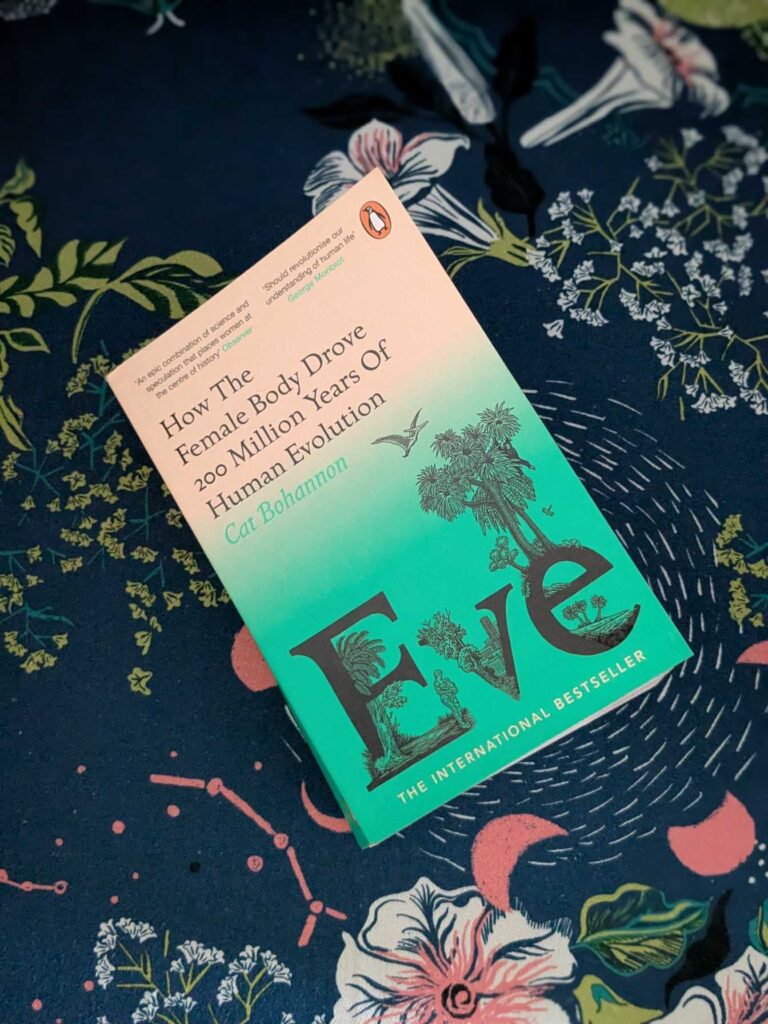
There is a choice we make when we use the word ‘mankind’ when we should be using humankind, or even better, humanity. ‘Eve’ is a good reminder, and the sub-heading – How the Female Body Drove 200 Million Years of Human Evolution – is exactly what the book is about. Cat Bohannon gives us a lot of insights into the pivotal role of the female body in the evolutionary story, in a sweeping and provocative narrative that questions the ‘male bias’ in science and medicine at large, and offers the story of human evolution as told through the female body.
The book is structured chronologically across 200 million years, and drives the story through the story of specific body parts, processes, and mechanisms. ‘Eve traces the evolution of women’s bodies, from tits to toes, and how that evolution shapes our lives today.’ In that process, we get insights on why women live longer, why they menstruate, are female brains different, and the very interesting question of whether sexism is useful for evolution.
The chapters are titled Milk, Womb, Perception, Legs, Tools, Brain, Voice, Menopause, and finally Love. Each with a representative Eve. From tiny lactating mammals in the era of dinosaurs to human birth and menopause in the contemporary era, Eve deep dives into the biological and physiological traits that distinguish the female of our species and their ancestors, and how these shaped the evolution of our species. The book blends research and insights from multiple disciplines – evolutionary biology, anthropology, neuroscience, medicine, and towards the end, even socioeconomics.
The fundamental theme of the book is the idea that female-specific traits are not side notes in evolutionary history, as it might seem when seen through a male-focused lens, but are in fact, central forces that drove innovations and adaptations, which helped the species survive and thrive. This includes things like extended gestation, concealed ovulation, and how unique and challenging human childbirth is – courtesy a big head to house the brain, and the mother’s narrow pelvis. These managed to shape not just our bodies but our cognitive development, social structures, and thereby culture. An excellent example of the last two is how the metabolic demands and processes of pregnancy and nursing might have been the basis for cooperative parenting and social bonding.
Eve is engaging because the author is able to present complex ideas and scientific data and logic in an accessible manner, using irreverent humour, anecdotes, and ELI5 techniques, especially useful when the content is full of anatomical terms and references! Having said that, I wonder if in the process, she has also done a Harari on details – being glib for the sake of narrative coherence. But my biggest bugbear – the usage of * in every other page with (usually) a long sidetrack written in tiny font! Always a momentum-killer for me!
Having said that, this is an essential book. It’s both enlightening and empowering, questioning the narratives about female bodies that our species has been taught. To me, the book is successful in reorienting the crucial role of the female and her body in the story of humanity’s evolution.
P.S. With Eve, Figuring, and Broadband, I think there is an excellent trilogy for the story of the species as seen through the female experience.
Notes and Quotes
1. Modern human milk is mostly water. It is less about nutrition and more about hydration and infrastructure. For instance, a lot of the material in the milk is for the bacteria in the infant’s stomach.
2. Milk is an interactive process. Lining the mother’s milk ducts, from the nipple all the way to the glands, are an army of immuno-agents. And depending on what happens to be in the baby’s spit that day, the mother’s breasts will change the particular composition of her milk. If the baby is fighting an infection, for example, various signals of that infection will be in the spit. When that gets sucked up into the mother’s breast, her immune systems will produce agents to fight the pathogen and send it via the milk into the baby’s body.
3. Among humans, the muscles on the left side of the face are slightly more adept at social signalling, and 60-90% of women preferentially cradle infants towards the left side of her face. The right hemisphere of the adult brain is largely responsible for interpreting human social-emotional cues, and it receives these signals through the left eye. The mother’s left eye watches the infant’s face, interpreting the emotional state, while the infant gazes up to her more expressive side, learning how to read her emotions and respond.
4. Men’s and women’s ears respond differently to different pitches. The latter are specially tuned to frequencies corresponding to babies’ cries. But that also forces them to be more aware of other sounds like the hum of electricity in fridges.
5. In mammals, there are two strategies for eye placement. Prey animals like hare, deer on either side and predators like eagle, dogs on the front. It has to do with the kind of vision they need- wide field, or focus respectively.
6. Mallard ducks are constantly raping each other. As a result, female mallards have trapdoor vaginas, which traps unwanted sperm in a side funnel and gets rid of it.
7. Abortion is common across mammals. Some spontaneous and some deliberate. In the presence of a male who isn’t the father, a pregnant mouse will abort. It’s called the Bruce effect. rodents, horses, lions, primates all do it.
8. Foals not only do sneaky sex, they also do cover up sex!
9. Armadillos can control when they get pregnant, sometimes as long as eight months. Embryos float around after fertilisation, before implantation. Helpful when there is scarcity of food or water.
10. Founder effect – when a migrating group is reproductively isolated and their offspring becomes less genetically diverse than expected.
11. The word ‘hysterical’ comes from the Greek word for uterus, which was believed to be the cause of disruptive emotional outbursts.
12. “And a human being whose life is nurtured in an advantage which has accrued from the disadvantage of other human beings, and who prefers that this should remain as it is, is a human being by definition only, having much more in common with the bedbug, the tapeworm, the cancer, and the scavengers of the deep sea.” ― James Agee, Cotton Tenants: Three Families
13. In people who encounter threat every day, the HPA axis is overactive. They’re waking up with higher cortisol levels than people who aren’t stressed in this way. After a certain amount of time, chronic stress causes knock-on effects in many different parts of the body. But in the brain, especially, you’ll see that classic pattern: difficulty with memory access, generally slower processing, and higher distractibility.
You can see similar patterns in people who suffer from chronic pain or depression, and in refugees who’ve recently had to flee a conflict zone. Too much cortisol every morning. Too many random bursts of epinephrine. Too much, and too frequent, vigilance.
Then, if you experience enough low-grade stress over enough time, you’ll tend to develop emotional and perceptive detachment. Such numbness is essentially what happens when the brain itself adapts to be less responsive to its own signals: cortisol has a lesser effect and to get a boost, those brains require more epinephrine.
14. Forty-eight of fifty states in the United States do allow child marriage with the “permission” of the parents to child abuse (Ochieng, 1020). Unfortunately, the United States allows parents to do all sorts of things to their children, usually under the mantle of “religion” or “cultural preference. For example, in twenty-one of our fifty states, it is legal to force one’s daughter-no matter her age to go through with a pregnancy when she clearly doesn’t want to or, even worse, is simply too young to be able to understand the physical and existential consequences of doing so (AGI, 2023). If you’re eleven years old and your parents tell you to give birth to a baby because they have a pre-established cultural belief, are you really going to be able to say no? And if you do, will you be able to run away and cross state lines and somehow get yourself an abortion within a time frame that allows the procedure to be simple and safe? No adult will be legally allowed to help you do so. Besides those twenty-one miserable places to be a girl, another sixteen states require the parents be notified about such a procedure, which is wonderful if you happen to live in an abusive household (often the case for a pregnant eleven-year-old). You may be able to petition a judge to get around them if you have the resources and chutzpah to pull that off-but you’ll have no guarantee that the judge will agree. The judge option exists only because the U.S. Supreme Court demanded a judicial bypass be provided, and even that might go away now that Roe v. Wade is gone.
14. A pregnant woman’s brain will, quite reliably shrink in volume by as much as 5% during her third trimester, notably in areas strongly related to how we build emotional attachments, general learning and memory. This is followed by steady rebuilding during the first few months after giving birth. This is an extra phase of brain development similar to the ones in childhood, and adolescence. Not unique, but specialised for human females. A deep pruning before hormonal shifts and massive social learning- caring for a needy human newborn, understanding its needs, communicating with it, and continuing to raise it in deeply social setting for a long time. This is also a time when some of the mother’s other relationships, like her social network, changes. Also whom to trust, whom to lean on for help.
Leave a Reply