
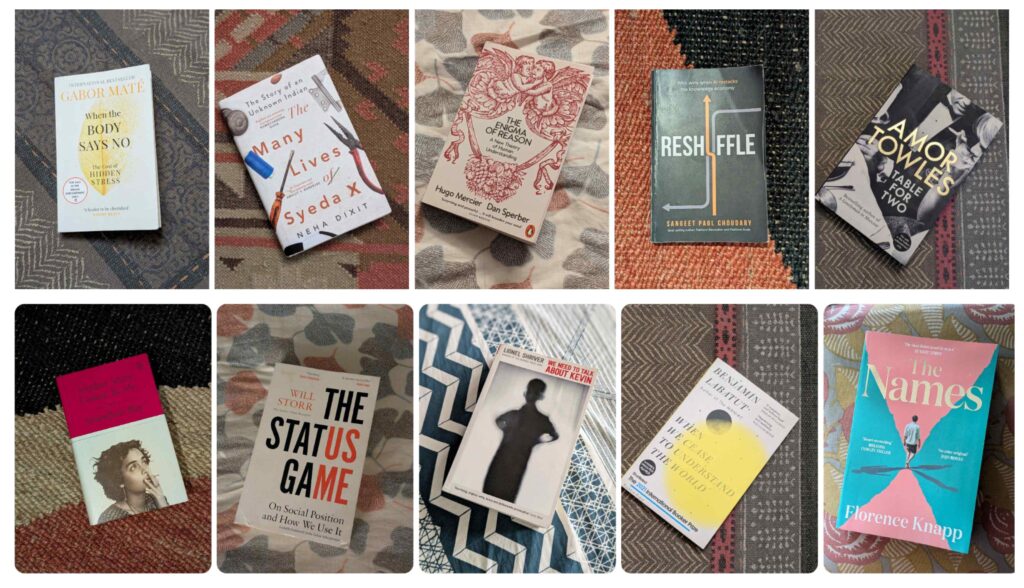
Compared to the last couple of years, I read fewer books in 2025, but I think the variety was higher. That probably explains the highest number of fiction books in a long time.
And so, once again, like 2019, 2020, 2021, 2022, 2023 , and 2024, presenting #Bibliofiles 2025’s list of ten (plus the long list). From the 58 books I read this year…
1. When the Body Says No by Gabor Maté was the result of listening to many podcasts featuring him. I can probably be accused of a validation bias on this one because courtesy the lived experience, I had begun connecting the dots and this book gave the whole thing a logical framing and rationale. Another reason for the bias is his systems thinking approach to solving the problem. Stress – a complicated cascade of physical and biochemical responses to powerful emotional stimuli – transmutes to illnesses. Psychoneuroimmunology.
No disease has a single cause. Even where significant risks can be identified such as biological heredity in some autoimmune diseases or smoking in lung cancer-these vulnerabilities do not exist in isolation. Personality also does not by itself cause disease: one does not get cancer simply from repressing anger or ALS just from being too nice. A systems model recognizes that many processes and factors work together in the formation of disease or in the creation of health. We have demonstrated in this book a biopsychosocial model of medicine. According to the biopsychosocial view, individual biology reflects the history of a human organism in lifelong interaction with an environment, a perpetual inter-change of energy in which psychological and social factors are as vital as physical ones.
The book has years of experience, anecdotes and sharp thinking behind the thesis. Even if you don’t want to read the whole book, read my longer summary and review (linked above) – I am certain that it will give you useful perspectives.
2. The Many Lives of Syeda X by Neha Dixit is the kind of book that forces one to look at one’s privilege at an individual level, and holds a mirror to all of us at a societal level. Neha Dixit has researched this book for nine years, and the breadth and depth of her 900+ interactions, and her thinking, is evident in the structure and narrative of the book.
It is, as the cliche goes, the voice of the voiceless – the people whose desperate toils to survive we deliberately look away from or pretend not to see, because it is a reality we will find difficult to face if we consider ourselves human. I call it sub-human because, from our gated vantage point, in a nation whose GDP chest-thumping and gleaming malls and fancy consumer goods belies the struggle of the large majority of its population, people like Syeda exist in conditions that are perilous in terms of income, health, and safety. A poor, Muslim, woman. The book is a dogged and unflinching portrayal of lives at the intersection of gender, poverty, and religion, it is a brutal but necessary gut punch for the reader and the society we are part of.
3. The Enigma of Reason by Hugo Mercier, Dan Sperber felt like a book-level exploration of a statement I originally read in ‘The Case Against Reality’ (2024 list) – ‘We did not evolve our ability to reason in order to pursue the truth. We evolved it as a tool of social persuasion.‘
I, like most others, have considered our species’ power of reasoning to be *the* superpower that got us here. And yet, when I think about, it seems paradoxical because our decisions also tend to have a lot of biases, and are flawed.
The Enigma of Reason seeks to resolve this. In doing that, it challenges one of our deepest assumptions about human thinking: that reason evolved to help individuals make better decisions and discover truth. Instead, it argues that reason’s real purpose is social. It evolved not to make us smarter in isolation, but to make us more persuasive and cooperative within groups. Through five parts, the authors propose an interactionist approach to reason as against the (above) intellectual approach.
4. Reshuffle by Sangeet Paul Choudary is a book I had been looking forward to reading ever since I started seeing excerpts and related posts. It offers great perspectives on dealing with the influx of AI in work – at an individual and business level.
This is another book for which I have a bias – because of a few reasons. One (as before) , it follows a clear systems thinking approach, and the logic and reasoning is robust. Two, it is a strategic and framework-driven exploration, which means it offers tools to think about this in one’s own contexts. Three, it’s not just theory. The book provides sufficient examples that can serve as starting points on how to think through this. That, as you’d notice is an elegant why-what-how approach.
Reshuffle is about how generative AI and systems-level automation are not simply replacing tasks but remapping where value, power and expertise live inside organisations and markets/ecosystems. Very useful perspectives for the years ahead.
5. Table for Two by Amor Towles, an author I am happy to see back here (after 2019, 2021, long list 2022). The book has six short stories, and a novella featuring Evelyn Ross, from his earlier book Rules of Civility.
The stories are classic Towles – interesting tales that are witty, erudite, and with an old world charm and values that continue to remind me of Jeffrey Archer. Collectively they evoke all sorts of emotions – from a sense of irony to poignancy. The novella works for those who like complex backstories and are ready for a slow burn.
6. Mother Mary Comes to Me by Arundhati Roy, of whom I have been an unabashed fan for a long while now. The book is a memoir, but I’d say it’s her love letter to her mother, and to some extent, others whom she loves, including characters in her works of fiction.
It is also very Arundhati Roy – poignant and visceral to the point of tear-jerking, and yet funny – sometimes with wit – both the scathing and irreverent as well as the loving kind, and sometimes with the inherent hilarity of situations. With a fantastic soundtrack to boot.
Though not strictly chronological, the book covers the many chapter of Arundhati Roy’s life. A disturbing childhood, the rebellious teen and a little beyond, an actress and scriptwriter, the firebrand activist and author (not activist author :)) and overall, a wonderful, compassionate human being who feels the pain of those who are fighting the battles that all of us should be fighting, and does what she can to help. In all this, the towering influence of Mary Roy.
A sentence she highlights in the book about Mrs. Roy (the mother) is “She was my shelter and my storm“. The book plays out very much like that too, with anecdotes of hate and love. “I wanted to hug her and reassure her that everything would be OK. But you can’t hug a porcupine. Not even on the phone.“
7. The Status Game by Will Storr has been on my reading list for a long time, and I am glad to have gotten to it this year. Though there were a few perspectives that I had already read about in other books, most notably Joseph Henrich’s The WEIRDest People in the World (2024 list), and to some extent Wanting by Luke Bergis (2022 list), I found the overall narrative compelling and insightful.
Will Storr explores the deep-rooted human drive for status, which has existed since our hunter-gatherer days, and makes a case for how it is one of the fundamental motivators of human behaviour, and how status-seeking influences everything from our personal health, happiness and identities to cultural and societal structures.
Pretty much everything of consequence in civilisation – from art and innovation to cults and genocides, has a link to status. The Status Game is structured around the different ways in which status is pursued and how this pursuit shapes human psychology, history, and social dynamics. By understanding these dynamics, Storr suggests we can better navigate social interactions, recognise harmful status traps, and use status games to improve both our personal lives and society at large.
8. We Need to Talk About Kevin by Lionel Shriver is a hard-hitting work of fiction about a school massacre, presented as a first-person narrative by Eva, the mother of the teenager who committed the crime.
Having given up her successful career as a writer and business woman to raise the son, Kevin, she is unable to bond with him, and from early on, feels that he doesn’t like her, and that he has psychopathic traits.
The book is in the form of several letters to her husband, in which we understand the years preceding the event, and her attempts to come to terms with her emotionally detached son.
The core theme itself – a mother unable to love her child – is a gut punch, and in addition, the book also brings up and challenges various assumptions in parenting. If you thought Adolescence (Netflix) was good, this one goes deeper.
(recommended by an Insta friend)
9. When We Cease to Understand the World by Benjamín Labatut, (translated by)Adrian Nathan West (translator) is one of the most unique books I’ve read in a while. Though it can broadly be classified as historical fiction, that would fail to capture the essence of the book, because the subject is science, mathematics and the deep mysteries underlying reality. Almost philosophy.
Featuring real historic figures and events, it could even be non-fiction as it explores the lives and discoveries of scientists and mathematicians who changed the way we understood the world. More interestingly, it also puts focus on the moral consequences of their work, the effect it had on themselves, and the impact it had on the world. Apparently, the scientists and their discoveries are all factual, the personal lives include some fiction.
The General Theory of Relativity and the quantum world, paint and poison and their link, the attempts to find a unifying theory of mathematics, and the fascinating lives and coincidences that exist in the stories, all make this a superb read.
10. The Names by Florence Knapp is another fantastic work of fiction, based on a seemingly simplistic premise of what-if scenarios. In this case, three scenarios based on a single choice – registering the naming of a baby. From there, three pathways open – parallel lives of different people in the family that follow separate trajectories across three decades.
In terms of narrative, the book is structured as the state of the characters in the starting timeline and then taking seven-year leaps. This did force me to go back a few times to reorient myself, but it didn’t really bother me a lot. In fact, it helped me pay attention and recollect the small touches that show patterns, and sometimes notice a version of what happened in some other timeline.
The book somehow manages emotional depth while maintaining a brisk pace, and balancing it with a natural amount of unevenness across three different timelines in terms of character depth and arcs. The subject is not a pleasant one, and that requires some complicated work across the internal dialogues of all concerned (x 3). Not to mention getting the involvement of characters other than the key ones just right. Neither are easy tasks to accomplish.
What I really liked about the book is that in addition to being a great story, it is also a thoughtful, mindful and emotionally aware reflection on choice and consequence.
The Long List
Freedom at Midnight by Larry Collins, Dominique Lapierre, whose review turned out to be my #400th on Goodreads. For the fantastic journalistic depth and the gripping narrative of a thriller.
Humankind by Rutger Bregman for making a strong and coherent pitch for kindness being our default, despite everything we see around, and for reminding me of David Graeber – to see each other as humans without labels, the call to stand against injustice, and the meticulous research that bursts quite a few myths fuelled by authors who were less conscientious.
Nexus by Yuval Noah Harari even while accepting the irony of him writing about information and truth after bring rebutted by experts on agricultural revolution and various other things he is not an expert on, and despite the sluggish first hundred pages.
The Story of China by Michael Wood for its staggering depth in terms of history, people, culture and landscapes of a country very few people know much of.
Eve by Cat Bohannon for an engrossing and insightful read on how the female body drove 200 million years of human evolution (and we still say ‘mankind’). The chapters are titled Milk, Womb, Perception, Legs, Tools, Brain, Voice, Menopause, and finally Love. Enough said.
Life as no one knows it by Sara Imari Walker, because though I thought I would get a deep-dive on consciousness, the curve ball to answer “what will really be alien are examples of life (biological or technological) that have traversed a completely different evolutionary trajectory than we have” was quite a journey.
River of Consciousness by Oliver Sacks for ten essays across diverse subjects such as botany, chemistry, evolution, medicine, neuroscience, and even the arts, collectively an exploration of how the river of consciousness has moved through evolution, and how it continues to manifest itself in ways beyond what we normally look at
Heart Lamp by Banu Mushtaq , (translated by Deepa Bhasthi) for its poignant capture of the lives of the women in the Muslim community in southern India.
Gods Guns & Missionaries by Manu Pillai for its staggering amounts of research (220 pages of this 549 pager consist of Notes) to write what should have been called Bharat Ek Khoj – the Hindu Nationalism edition.
Stasiland by Anna Funder for nailing why I keep reading about (and visiting) Eastern Europe. She calls it horror-romance. The romance comes from the dream of a better world the German Communists wanted to build out of the ashes of their Nazi past: from each according to his abilities, to each according to his needs. The horror comes from what they did in its name.
The Elsewhereans by Jeet Thayil for combining travelogue, memoir, photography, Kerala families and many other ingredients, to make a poignantly, lovely avial that made me laugh and cry
A Psalm for the wild built by Becky Chambers for that warm cup of tea on a day that you really need it. 🙂 And for these two –
What is wrong with me that I can have everything I could ever want and have ever asked for and still wake up in the morning feeling like every day is a slog?
You’re an animal, Sibing Dex. You are not separate or other. You’re an animal. And animals have no purpose. Nothing has a purpose. The world simply is. If you want to do things that are meaningful to others, fine! Good! So do I! But if I wanted to crawl into a cave and watch stalagmites with Frostfrog for the remainder of my days, that would also be both fine and good. You keep asking why your work is not enough, and I don’t know how to answer that, because it is enough to exist in the world and marvel at it. You don’t need to justify that or earn it. You are allowed to just live. That is all most animals do.


Leave a Reply