
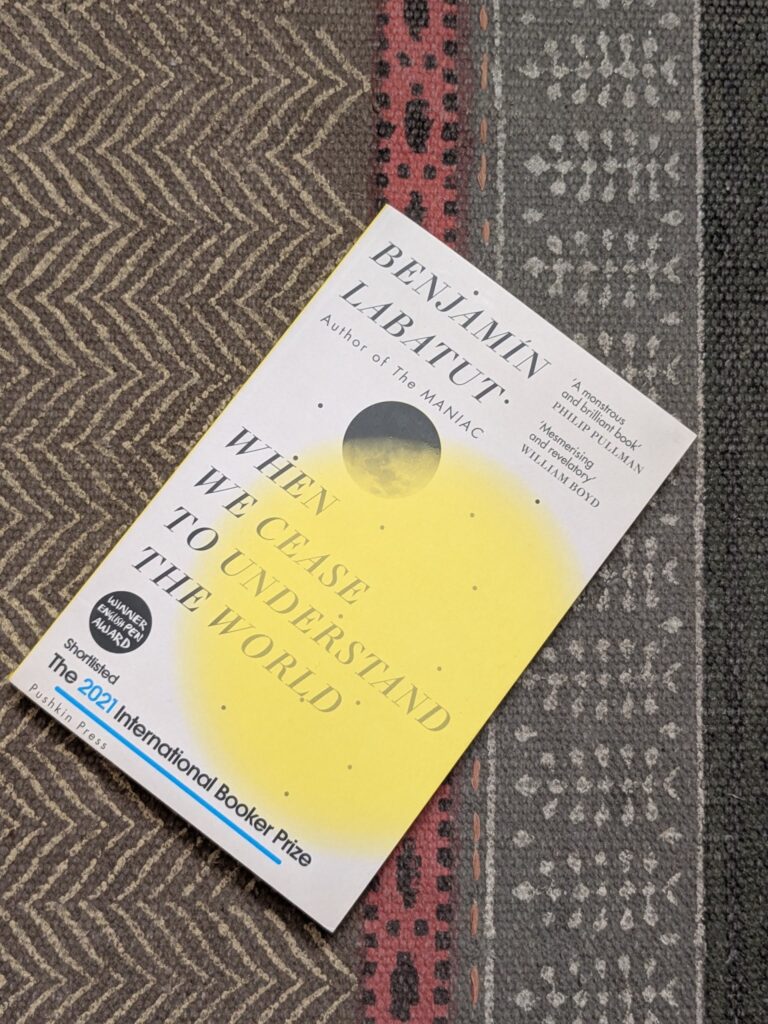
Benjamín Labatut (translated by Adrian Nathan West)
When we cease to understand the world is one of the most unique books I’ve read in a while. Though it can broadly be classified as historical fiction, that would fail to capture the essence of the book, because the subject is science, mathematics and the deep mysteries underlying reality. Almost philosophy.
Featuring real historic figures and events, it could even be non-fiction as it explores the lives and discoveries of scientists and mathematicians who changed the way we understood the world. More interestingly, it also puts focus on the moral consequences of their work, the effect it had on themselves, and the impact it had on the world. Apparently, the scientists and their discoveries are all factual, the personal lives include some fiction.
The book has five stories, with the longest being When We Cease to Understand the World that features one of my favourite reading subjects – the quantum world. It is fascinating to read about the actual lives and thinking behind the names I only knew in the context of theories/ principles – Bohr model, Heisenberg’s Uncertainty principle, Schrödinger’s wave equation, their rivalries and arguments, the people they were, and what drove them. The book also highlights people about whom we don’t hear much, but did play a role. In this case, Louis de Broglie, whom Einstein thought could stop Heisenberg’s line of thinking on the quantum world. We also get a ringside view of the fifth Solvay Conference, how the Copenhagen Interpretation came about, how Einstein became the greatest enemy of quantum mechanics, and how he came to be admired by, but alienated from the next generation of scientists.
While this was my favourite, I really liked the other stories too. I think of ‘Prussian Blue’, the first story, as a sort of a partial biography for poison. Labatut traces the history of cyanide, starting with the discovery of Prussian Blue (Johann Conrad Dippel), a pigment that revolutionised European art. Its chemical composition led to the isolation of cyanide in 1782 by Carl Wilhelm Scheele, and its later use in the development of Zyklon B, a poison gas used in the Holocaust. On another front, Fritz Haber, a German chemist, harvested nitrogen from air, which led to the development of synthetic fertilisers, saved millions from famine and fuelled our overpopulation. He was also the first man to create a weapon of mass destruction – chlorine gas, used in WW1.
The second story “Schwarzschild’s Singularity” explores the life and work of Karl Schwarzschild, who discovered the first exact solution to Einstein’s theory of general relativity, revealing the concept of a black hole and its implications for our understanding of the universe. His calculations showed that a collapsing star would compress, increasing its density until the force of gravity distorts space and time, creating an “inescapable abyss” where nothing, not even light, can escape. this discovery, and what it implied, coupled with his experiences during World War I, deeply troubled Schwarzschild, who grappled with the incomprehensibility of his own discovery and its potential consequences. Einstein wrote a eulogy for him after his death, but fought hardest to exorcise the demon of this singularity, but the proof for it was published on the day the Nazis crossed the Polish border, by Robert Oppenheimer and Hartland Snyder.
“The Heart of the Heart,” is based on Alexander Grothendieck who tried to find a unifying principle for all of mathematics, but finally retreated to the life of a recluse. His story (almost) echoes in the life of Shinichi Mochizuki, a contemporary scientist.
In all the stories in When we cease to understand the world, there are connections between individuals/events that almost seem like providence. And that’s what makes the narrative fascinating because Labatut recreates the story to instil a sense of awe, probably trying to mirror our ignorance of how reality works.
This is expressed in the last story – The Night Gardener (#3 in Notes below), which provides a poignant and personal (for the author, since he uses the first person here) connection to some of the earlier stories.
What I really liked was how the essence of the complex mysteries of science and mathematics have been made accessible even to the average reader. The writing is vivid and sublime, drawing you into some of the greatest minds that have lived among us. Some have described it as a book against scientists, but I think it shows us a mirror of what science can do if we don’t proceed with caution. To scientists, and humanity.
Notes and Quotes from When we cease to understand the world
1. The effects of cyanide are so swift that there is only one historical account of its flavour, left behind in the early twenty-first century by M.P.Prasad, an Indian goldsmith, 32 years old, who managed to write three lines after swallowing it. “Doctors, potassium cyanide. I have tasted it. It burns the tongue and tastes acrid”
2. Niels Bohr’s response to Einstein’s “God does not play dice with the universe” was “It’s not our place to tell Him how to run the world”
3. The Night Gardener’s sudden realisation that it was mathematics – not nuclear weapons, computers, biological warfare or our climate Armageddon – which was changing our world to the point where, in a couple of decades at most, we would simply not be able to grasp what being human really meant. Not that we ever did, he said, but things are getting worse. We can pull atoms apart, peer back at the first light and predict the end of the universe with just a handful of equations, squiggly lines and arcane symbols that normal people cannot fathom, even though they hold sway over their lives. But it’s not just regular folks; even scientists no longer comprehend the world. Take quantum mechanics, the crown jewel of our species, the most accurate, far-ranging and beautiful of all our physical theories. It lies behind the supremacy of our smartphones, behind the Internet, behind the coming promise of godlike computing power. It has completely reshaped our world. We know how to use it, it works as if by some strange miracle, and yet there is not a human soul, alive or dead, who actually gets it. The mind cannot come to grips with its paradoxes and contradictions. It’s as if the theory had fallen to earth from another planet, and we simply scamper around it like apes, toying and playing with it, but with no true understanding.
Leave a Reply