
Will Storr
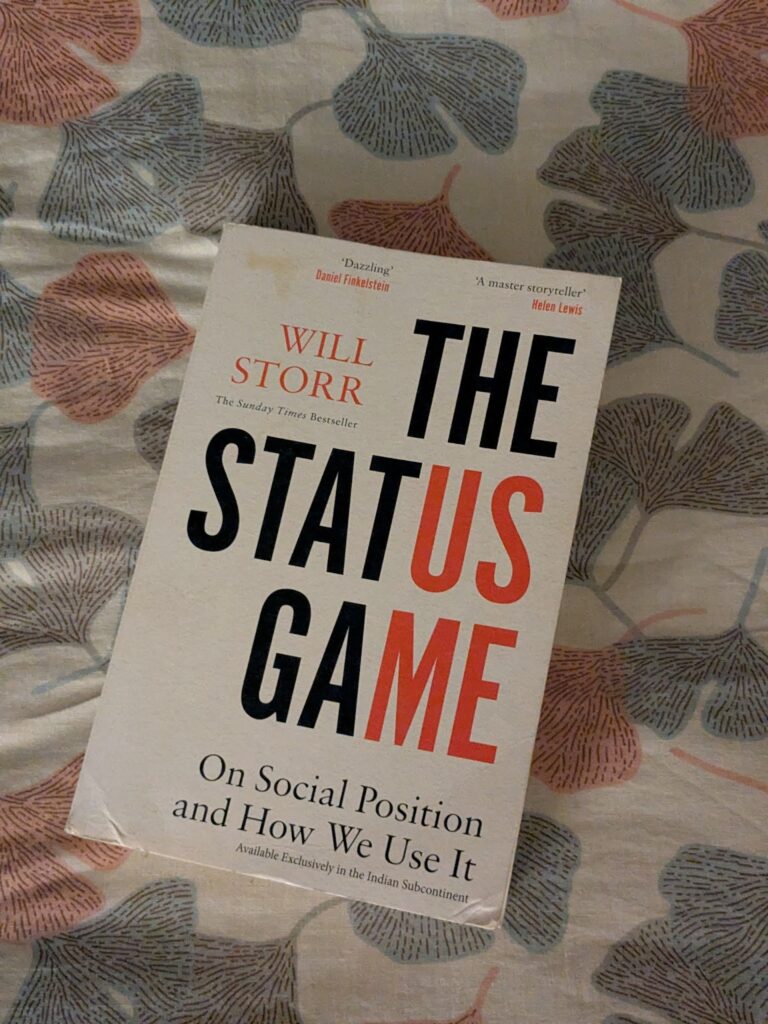
The Status Game had been on the list for a long while before I managed to get to it. Though there were a few perspectives that I had already read about in other books, most notably Joseph Henrich’s The WEIRDest People in the World, and to some extent Wanting by Luke Bergis, I found the overall narrative compelling and insightful.
In The Status Game, Will Storr explores the deep-rooted human drive for status, which has existed since our hunter-gatherer days, and makes a case for how it is one of the fundamental motivators of human behaviour, and how status-seeking influences everything from our personal health, happiness and identities to cultural and societal structures.
Pretty much everything of consequence in civilisation – from art and innovation to cults and genocides, has a link to status. The Status Game is structured around the different ways in which status is pursued and how this pursuit shapes human psychology, history, and social dynamics.
Storr begins by outlining how status is an intrinsic part of human nature, explaining that our brains are wired to detect and respond to hierarchical structures. He describes status as not just a desire but a need because it is closely linked to survival and social belonging. Back in the Stone Age, higher status meant access to better mates, more food and greater safety for the self and offspring. That hasn’t changed much, so we’re driven to connection and ranking – to be accepted into groups, and win status within them. What has changed is the amount and variety of status games we play – politics, offices, sports fandom, fashion, race, gender, nationalism and so on.
The great stretching of the game began when we moved from campsites to settled farming and herding communities. We now have games we play throughout our lives, often unconsciously, to gain respect, admiration, or influence within groups. Status is in a way a ‘dark pattern’ that fuels the story our brains tell us. Our status games are embedded in our perception and we experience reality through them. Even the morals we abide by are a component of our status game. We are thus the sum of the games we play.
The Status Game then goes into the three primary types of status games that humans play. Dominance games – rooted in power and coercion, dominance-based status is often associated with aggression, violence, and force. Historically, this has been the primary way early human societies established hierarchies, but it continues to manifest in modern settings, from politics to corporate power struggles. Virtue games revolve around moral superiority and ethical standing. Storr explains how religious, ideological, and activist movements often rely on virtue-based status, where individuals or groups seek recognition for their righteousness or adherence to a set of moral principles. Cancel culture, social media outrage, and ideological purity tests are modern manifestations of this game. Success games are focused on competence and achievement, this game rewards people for skills, intelligence, or accomplishments. Scientists, artists, and entrepreneurs typically seek status through this avenue, gaining prestige by excelling in their respective fields.
Storr then examines how these status games influence cultural and historical events. They were designed by evolution to generate cooperation between humans to force (dominance) or convince (success, virtue) us to conform. Storr goes through history and argues that much of it – from the rise of religions to the development of capitalism – can be understood as the outcomes of competing status games. He highlights how political revolutions, scientific breakthroughs, and social movements often emerge from shifts in status hierarchies. The ultimate purpose of all status games is control.
While status games can be constructive, driving progress and innovation, Storr also explores their dangers. He discusses how status-seeking can lead to destructive behaviours such as fanaticism, exclusion, and even genocide. Groups that perceive a loss of status may react with aggression, leading to societal conflict.
Status is a never ending game, because we always want more. In the final section of The Status Game, Storr offers advice on navigating status games in a healthy way. He suggests that recognising the games we are playing, choosing constructive rather than destructive games, and seeking status through meaningful work and relationships can lead to a more fulfilling life. Broadly, the seven rules are an infinite game approach to life.
By understanding these dynamics, Storr suggests we can better navigate social interactions, recognise harmful status traps, and use status games to improve both our personal lives and society at large. The Status Game is extremely accessible even as the subject is tackled through the lens of a variety of sciences. I’d highly recommend it, and maybe you could also follow it up with David Marx’s Status and Culture.
Notes from The Status Game
1. As per social genomics, the basic idea is that when we’re not doing well in the game of life, our bodies prepare for crisis by switching our settings so we’re ready for attack. It increases inflammation, which helps heal any of the physical wounds we might be about to suffer.
2. The status detection system even reads symbolic information in sounds we can’t consciously hear. When speaking, we emit a low frequency hum at around 500 hertz. When people meet and talk their hums shift. The highest status person in the group sets its level and the rest adjust to match.
3. We’re used to think of money and power as principal motivating powers of life. But they’re symbols we use to measure status.
4. We shifted away from fist and fang when we began playing games with symbols in the communal imagination. Accounts of how and why this happened can only be speculative and are debated hotly. Some believe that, after we came down from the trees, the threat from predators huddled us into protective groups. As living became denser, males found themselves with more rivals to fight off, so began shifting their mating strategy towards one of pair-bonding, in which they’d offer meat and protection to females in return for preferred sexual access. These emergent families became extended, with grand-parents, uncles and aunts building sustained relationships and sharing childrearing responsibilities. When women pair-bonded with males from different families, loose tribes or clans formed. Close-living meant close-learning and the ability for rules and symbols to be communicated down the generations.In this communal, nested world, brute ferocity by alpha males was unwelcome and un-useful. Getting along and getting ahead meant winning the cooperation of others. Hyper-violent males who attempted to dominate the tribe would increasingly find themselves ostracised or executed. More peaceable and socially intelligent men began to gain status. Slowly, a novel breed of human came into being, one that had subtly different patterns of hormones and brain chemistry regulating their behaviour. Our skeletons changed, our brains changed and our ways of living changed too.
5. Humiliation has been described as researchers as ‘the nuclear bomb of emotions’
6. Fogg Behaviour Model – ” a toll booth for entrepreneurs and product designers on their way to Facebook and Google
7. Copy-flatter-conform is our go-to model to get and retain status
8. Prince Charles paradox, in which the person can be simultaneously high and low in status. High in formal status, but low in true status because of low popular appeal
9. For humans, ideology is territory
10. Britain’s success attributed to its many members in the Republic of Letters (success games as opposed to the Church’s virtue games) and their institutions (Parliament, Bank of England, legal innovations such as patents and secure property) which allowed people to earn wealth and celebrity status. The Industrial Revolution was a status goldrush.
11. In tight cultures that include Pakistan, Germany, Malaysia, Switzerland, India, Singapore, Norway, Turkey, Japan and China – players dress more similarly, buy more similar things and possess superior self-control: they tend to have lower rates of crime, alcohol abuse and obesity. Their citizens are more punctual, and so is their public transport: Swiss trains have an average 97 per cent punctuality rate, in 2014, fourteen trains in Singapore arrived more than 30 minutes late; in 2013, Japan’s Shinkansens had an average delay of 54 seconds. Even the time shown on public clocks across tight nations is more likely to be in sync.
People raised in tight cultures are also greater respecters of hierarchy and authority. Tight players are more likely to earn status from precisely correct moral behaviour, to a sometimes comical extent. In Germany, where rules mandate certain hours of the week as quiet one resident complained about a barking dog: in court the judge permitted the animal to bark for thirty minutes per day in ten-minute intervals. They’re more interested in moral purity, more likely to have the death penalty, less welcoming to outsiders and prefer dominant leaders. Tight players also show a greater vulnerability to believing the wild, sacred dreams of their game.
11. Psychologists have a name for people with a heightened sensitivity to signals of failure: perfectionist. There are various forms of perfectionism: self-oriented perfectionists’ have excessively high standards and often push themselves harder and harder in order to win; narcissistic perfectionists already believe they’re number one and experience anxiety when the world treats them as less; neurotic perfectionists suffer low self-esteem and often believe with the next victory they’ll finally feel good enough. But there’s one species of perfectionism that’s especially sensitive to the neoliberal game: ‘social perfectionists feel the pressure to win comes from the people with whom they play, They’ll tend to agree with statements such as, ‘People expect nothing less than perfection from me’ and ‘Success means that I must work harder to please others’ Social perfectionists are highly attuned to reputation and identity. They’ll easily think they’ve let their peers down by being a bad employee, a bad activist, a bad woman. An especially hazardous quality of social perfectionism is that it’s based on what we believe other people believe. It’s in that black gap between imagination and reality that the demons come.
12. Status is relative : the amount we feel depends on how much we perceive others have
13. The drug of morality poisons empathy
Leave a Reply