
Gabor Maté
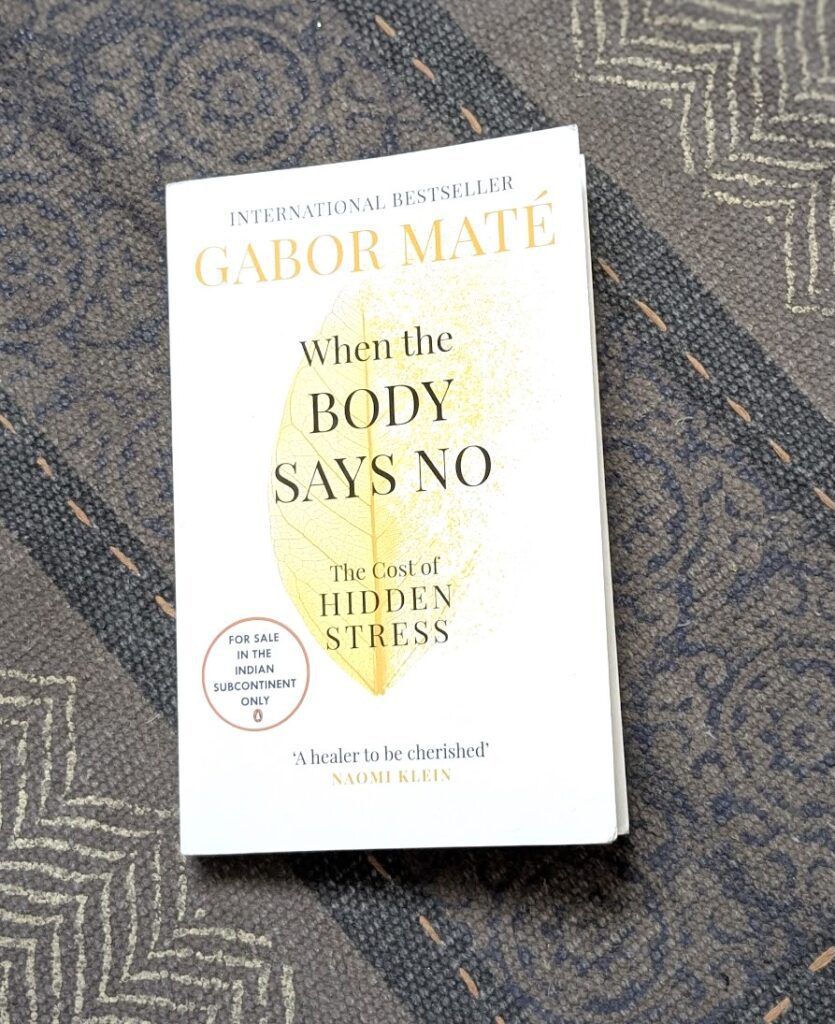
At the outset, let’s just say that I am a believer when it comes to Gabor Maté’s philosophy. That’s because I first had the lived experience, then started connecting the dots, and finally came across ‘When the Body Says No’ which gave the whole thing a logical framing and rationale. I’ve had stress sequentially give me migraines, a heart attack, back pain, IBS and I suspect, even a (yet to be connected) BPPV. Most doctors I went to tried to cure the symptoms, only a couple of them pointed to stress. After I systematically began reading more (Robert Sapolsky, Lisa Feldman Barrett etc) and knocking off stress points, I reached a place where stress was my only stress! And I wondered why I have that stress in the first place. Enter Maté, with a systems thinking approach that I wish doctors would really look at! It is strange that they don’t because even a Roman physician in the second century, Galen, had pointed out that “any part of the body can affect any other part through neural connections.“
“No disease has a single cause. Even where significant risks can be identified such as biological heredity in some autoimmune diseases or smoking in lung cancer-these vulnerabilities do not exist in isolation. Personality also does not by itself cause disease: one does not get cancer simply from repressing anger or ALS just from being too nice. A systems model recognizes that many processes and factors work together in the formation of disease or in the creation of health. We have demonstrated in this book a biopsychosocial model of medicine. According to the biopsychosocial view, individual biology reflects the history of a human organism in lifelong interaction with an environment, a perpetual inter-change of energy in which psychological and social factors are as vital as physical ones.”
Through a methodical approach to identifying stress, its manifestations through various types of diseases using anecdotes and studies, and its origins – which go beyond parents and into previous generations and the social and societal environments, Maté educates us on psychoneuroimmunology (PNI) – an individual’s emotional makeup interacting with the nervous system, the immune system, and then the endocrine system – which provides systemic answers to diseases ranging from cardiovascular to cancer to Alzheimer’s (there is a fascinating chapter on ALS with perspectives on personalities such as Morrie Schwartz and Stephen Hawking).
Stress, but how? Stress occurs when an organism perceives a threat to its existence or well-being. ‘Perceived’ is the keyword. It has three components – the physical or emotional event – stress stimulus/stressor, the processing system (in our case, the nervous system), and finally, the psychological and behavioural adjustments – stress response.
“When people describe themselves as being stressed, they usually mean the nervous agitation they experience under excessive demands-most commonly in the areas of work, family, relationships, finances or health. But sensations of nervous tension do not define stress-nor, strictly speaking, are they always perceived when people are stressed. Stress, as we will define it, is not a matter of subjective feeling. It is a measurable set of objective physiological events in the body, involving the brain, the hormonal apparatus, the immune system and many other organs. Both animals and people can experience stress with no awareness of its presence.”
“How may stress be transmuted into illness? Stress is a complicated cascade of physical and biochemical responses to powerful emotional stimuli. Physiologically, emotions are themselves electrical, chemical and hormonal discharges of the human nervous system. Emotions influence and are influenced by the functioning of our major organs, the integrity of our immune defences and the workings of the many circulating biological substances that help govern the body’s physical states. When emotions are repressed… this inhibition disarms the body’s defences against illness. Repression – dissociating emotions from awareness and relegating them to the unconscious realm- disorganizes and confuses our physiological defences so that in some people these defences go awry, becoming the destroyers of health rather than its protectors.”
Chapter 7 specifically packs a punch, starting with “Smoking no more causes cancer of the lung than being thrown into deep water causes drowning.” It’s a case of Nasruddin searching under a streetlight for the keys he left at home, because there is no light at the latter place. To be clear, smoking vastly increases the risk of cancer, but is not the sole factor. A logical conclusion because if that were not true, all smokers should have cancer. They don’t. This chapter is a masterclass on the the hypothalamic-pituitary-adrenal (HPA) axis, a hormone system that helps the body manage stress, and its connection to cancer. While answering “Is there a cancer personality”, Maté also educates us on some broader personalities-
“Type A individuals are seen as “angry, tense, fast, aggressive, in control” and more prone to heart disease. Type B represents the balanced, moderate human being who can feel and express emotion without being driven and without losing himself in uncontrolled emotional outbreaks. Type C personalities have been described as “extremely cooperative, patient, passive, lacking assertiveness and accepting. The Type C individual may resemble Type B, since both may appear easygoing and pleasant, but while the Type B easily expresses anger, fear, sadness and other emotions, the Type C individual, in our view, suppresses or represses ‘negative’ emotions, particularly anger, while struggling to maintain a strong and happy facade.” Type C are seen to have links to cancer. Traits which were adopted in childhood to cope with the environment (most importantly parents and specifically the mother) then become personality traits in adulthood. Personality traits – physiological stress because emotions are not expressed – hormonal imbalance that messes with the natural culling of cells – disease.
When The Body Says No is full of anecdotes of patients, their past, their traits, their diseases and in many of them, I could see shades of myself. IBS for instance – “When there are too many “gut-wrenching” experiences, the neurological can become oversensitized. Thus, in the spinal cord the conduction of pain from gut to brain is adjusted as a result of psychological trauma. The nerves involved are set off by weaker stimuli. The greater the trauma, the lower becomes the sensory threshold. A normal amount of gas in the intestinal lumen and a normal level of tension in the intestinal wall will trigger pain in the sensitized person.“
Another interesting chapter is 13, which details the response of the immune system and how stress affects it. “When our psychological capacity to distinguish the self from non-self is disabled, the impairment is bound to extend to our physiology as well. Repressed anger will lead to disordered immunity. The inability to process and express feelings effectively, and the tendency to serve the needs of others before even considering one’s own, are common patterns in people who develop chronic illness. These coping styles represent a blurring of boundaries, a confusion of self and non-self on the psychological level. The same confusion will follow on the level of cells, tissues and body organs. The immune system becomes too confused to know self from other or too disabled to defend against danger.“
The subsequent chapters are on the impact of parent-child relationships and the effects of generations before. The final chapters offer perspectives on how to mitigate the effects of all we have read thus far – both in terms of managing our perceptions including “negative thinking” (being more pragmatic, discarding beliefs and nature of relationships dangerous to health) as well as healing – the seven A’s (Acceptance, awareness, anger, autonomy, attachment, assertion, affirmation).
The message is clear. In the words of Joann Peterson whom Maté quotes, “we experience life through our bodies. If we are not able to articulate our life experience, our bodies what our minds and mouths cannot.” As I said, my lived experience and my intuition tell me this is true. I cannot recommend this book enough. It is insightful, accessible, all while being sensitive.
Notes from When The Body Says No
1. Emotional responses are of three types – the subjective experience, emotional displays with/without us being aware of them, and the physiological changes triggered by the emotional stimuli.
2. This was scary. “Characteristic of many persons with rheumatoid diseases is a stoicism carried to an extreme degree, a deeply ingrained reticence about seeking help. People often put up silently with agonizing discomfort, or will not voice their complaints loudly enough to be heard, or will resist the idea of taking symptom-relieving medications.“
3. The partner who must suppress more of his or her own needs for the sake of the relationship is more likely to develop physical illness as well-hence the greater incidence, for example, of autoimmune disease and of non-smoking-related cancers among women. “The existence of a mind-body link and a person-person link means that it is possible for anxiety in one person to be manifested as a physical symptom in another person,” Dr. Kerr writes. “As is the case with the emotional dysfunctions, the one prone to develop symptoms is the spouse who adapts most to maintain harmony in the relationship system.”
4. Nature’s ultimate goal is to foster the growth of the individual from absolute dependence to independence-or, more exactly, to the inter-dependence of mature adults living in community. Development is a process of moving from complete external regulation to self-regulation, as far as our genetic programming allows. Well-self-regulated people are the most capable of interacting fruitfully with others in a community
5. Anyone who has ever tried to force a baby to swallow foods he disliked or to induce a toddler even to open her mouth when she did not wish to eat can testify to the young human’s inherent capacity to resist coercion and to express displeasure. So why do we start swallowing food we do not want or feelings our parents do not want? Not out of any natural inclination but from the need to survive.
6. One cannot be autonomous as long as one is driven by relationship dynamics, by guilt or attachment needs, by hunger for success, by the fear of the boss or by the fear of boredom. The reason is simple: autonomy is impossible as long as one is driven by anything. Like a leaf blown by the wind, the driven person is controlled by forces powerful than he is. more His autonomous will is not engaged, even if he believes that he has chosen his stressed lifestyle and even if he enjoys his activities. The choices he makes are attached to invisible strings. He is still unable to say no, even if it is only to his own drivenness. When he finally wakes up, he shakes his head, Pinocchio-like, and says, “How foolish I was when I was a puppet.”
Leave a Reply