
Rory Sutherland
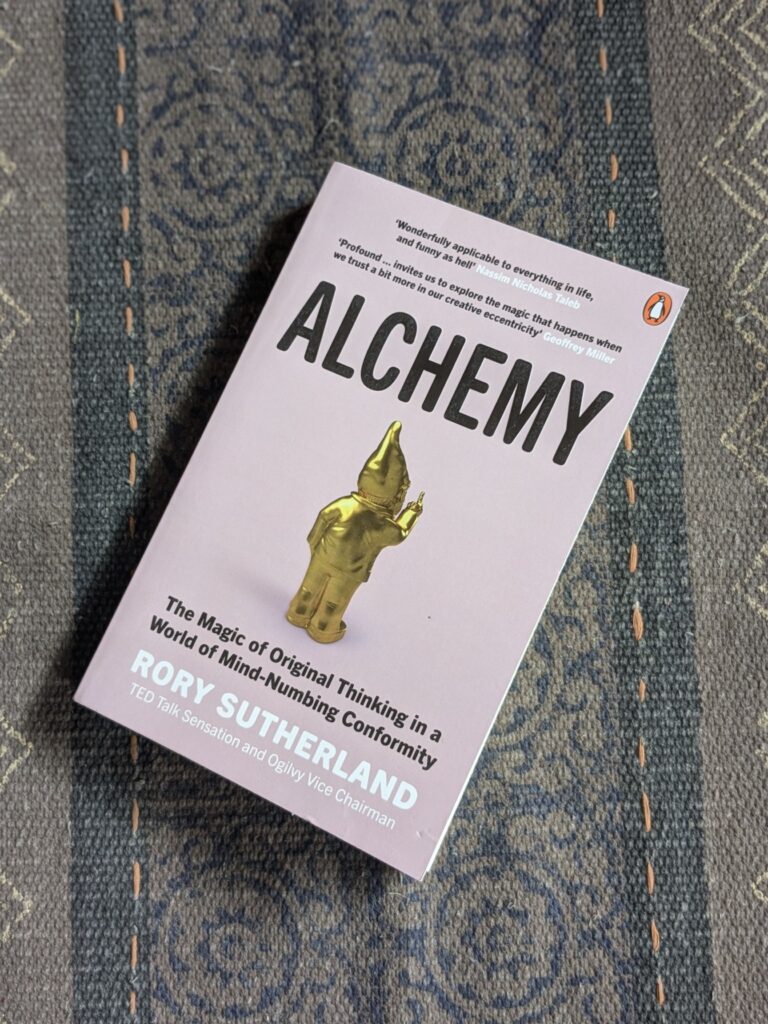
I think Alchemy is the first book I’ve read by anyone associated with marketing/advertising. For anyone involved in selling anything, I’d say this is a must-read. You should also read this if you’re intellectually curious, because in essence, this is a behavioural science book. It is even more relevant now because of the obsession with data. It isn’t that you should not look at data, but as Rory says, if you’re only using data, it’s like playing golf with only one club. “Logic should be a tool, not a rule”. This book is about the magic, which I think we’re forgetting in the fixation for data. Rory calls it psycho-logical, which is the way we make decisions in daily life.
Thanks to books like Donald D. Hoffman’s The Case Against Reality and Andy Clark’s The Experience Machine, the hypothesis is that our entire biological system (body and mind) are built to navigate the world, and we only see a version of reality. The brain predicts based on its experience and hypothesis and we fill in the details. When we do not have a complete understanding of decisions we ourselves take, it is hubris to think that we completely understand the motivations of others. Especially without considering nuances beyond data. “By using a simple economic model with a narrow view of human motivation, the neo-liberal project has become a threat to the human imagination’.
Alchemy makes important concepts very accessible, and Rory’s humour and anecdotes make it a very engaging read. Highly recommended, and part of my 2024 favourites.
Notes
If you’re wholly predictable, people can learn to hack you
We consider the appendix a vestigial organ, but a certain colon infection is 4 times more prevalent in people without it.
Offering people money when they do something you like makes perfect sense to economic theory, and is called an incentive, but this does not mean you should try to pay your spouse for sex. (context!)
In logic 10 x 1 is the same as 1 x 10. Now apply it in a Russian roulette in real life. In a world before ‘reviews’, you could run an eatery as a tourist restaurant (10 people, 1 time) or a pub (1 person, 10 times)
They ask still or sparkling, because we’d then find it difficult to say ‘tap’
Steve Jobs had koumpounophobia, a fear of buttons
A hypothesis is that reason appeared not to inform our actions and beliefs but to explain and defend them to others
Scarcity. Frederick the Great tried compulsion to make farmers grow potatoes. When that didn’t work he made a it a royal vegetable, established a royal potato patch and kept guards so no one could steal it. Easy to guess what happened next.
Affordances are cues that indicate how a user can interact with an object, whether it’s physical or digital.
“We notice and attach meaning to those things that deviate from narrow, economic common sense, precisely because they deviate from it. The result of this is that the pursuit of narrow economic rationalism will produce a world rich in goods, but deficient in meaning”
“There is a good evolutionary reason why we are imbued with these strong, involuntary feelings: feelings can be inherited, whereas reasons have to be taught, which means that evolution can select for emotions much more reliably than for reasons” (e.g. fear of snakes – for survival – easier to exist as emotion than waiting to be taught)
Bravery placebos – parades, uniforms, trumpets, brothers-in-arms, fictive kin (regiments) – illusion to make people willing to sacrifice their lives
People want cheap, abundant, nice-tasting drinks, right? RedBull
Satisfice is satisfy and suffice (Herbert Simon) ” We buy brands to satisfice. People do not choose Brand A over Brand B because they think Brand A is better, but because they are more certain it is good.”
The Japanese Premier’s response to the Allies’ Potsdam resolution was mokusatsu. Derived from silence, he meant it as ‘withholding comment’. It was translated by media as ‘not worthy of comment’. Within days, the decision was made to drop the atomic bomb.
Leave a Reply