
Andy Clark
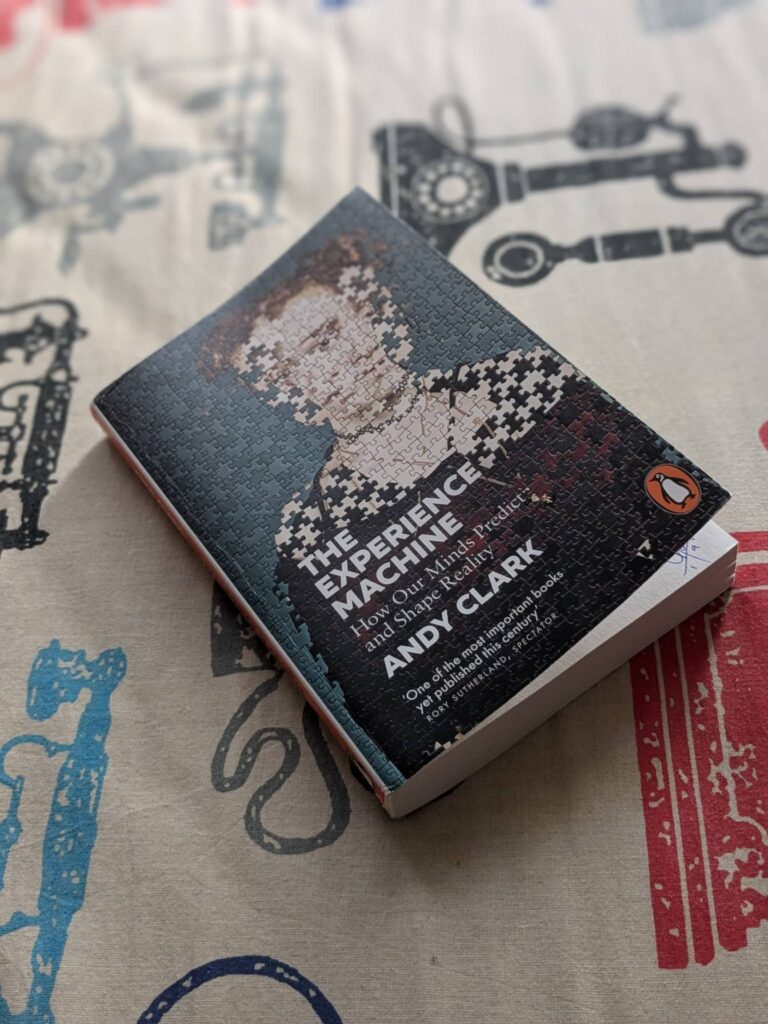
The subtitle of The Experience Machine is “How our minds predict and shape reality”, and that’s what the book is about. The conventional notion of cognition, at least to me, is that it begins with sense organs perceiving and providing inputs from what we experience, and the brain quickly piecing it all together to present me a coherent picture of what is, and what I should do next. But if we go by the “predictive brain” thesis, the brain doesn’t just passively interpret the world but is constantly predicting, shaping, and refining our reality based on sensory inputs.
Back in the 19th-century, the scientist Hermann von Helmholtz posited that there must be some underlying (unconscious) process of logical reasoning that is inherent in optical and auditory perception. Now, cognitive science agrees – a large part of our experience is guided by the predictive brain, which constructs a simulation, thus already shaping our understanding of reality, but then sometimes iterates its own understanding based on inputs from the world, and sometimes makes us act in ways to reduce the prediction error, depending on error dynamics. This means that nothing in our experience arrives unfiltered – from basic pain to ego, everything is a construct. “We are what predictive brains build”.
The predictive brain has four primary elements – a ‘generative’ model that has some existing data and knowledge about our world at large, the constant predictions that come from it, the ‘prediction errors’ that arise when incomplete or incorrect predictions meet sensory evidence and account for it, and the precision weighting (estimates) that define the impact of sensory stimulations and predictions. It is amazing how the underlying process of perception and action are the same, and only the direction differs. In fact, our actions are also self-fulfilling predictions, and in both short and long term, there are ways in which we can make it work in our favour. There is some scientific backing for ‘manifestation’, it would seem that the brain orchestrates a series of actions to fulfil its predictions. No, you can’t wish things/experiences into existence, you still have to work for it! 🙂
This predictive processing helps explain not only ordinary perception but also phenomena like chronic pain, mental health disorders, and even illusions – these experiences may be due to our brain’s predictions going slightly awry. A great example is chronic pain, which can be seen as a misfiring of this predictive system, where the brain expects pain, thus “creating” it even when no external cause remains. This insight means that potentially, the treatment method could be about recalibrating these predictive mechanisms rather than solely addressing physical symptoms.
What this thesis also does is question the duality of things like self and world, mind and body, and so on. Clark quotes Lisa Feldman Barrett – “every thought, memory, emotion, or perception that you construct in your life includes something about the state of your body. Your interoceptive network, which regulates your body budget, is launching these cascades.” A mix of inward-looking, outward-looking, and action-guiding to construct and control a controlled hallucination. Fascinating!
Another interesting part was how nature has played it such that we also have openness and exploration to inform the predictive brain. Error dynamics estimations track how well the brain is doing at minimising prediction error. Being ‘in the zone’ is thus a mix of reduced prediction error and handling any error fluently. Those sensitive to their own error dynamics will seek out learning environments, so in the long game, the prediction errors can be further reduced.
Cognitive philosophy seems to have become a theme this year for me, and Andy Clark references my favourite read on the subject this year – Anil Seth’s Being You, as well as another from four years ago – Lisa Feldman Barrett’s How Emotions are Made. The Experience Machine is a great addition to this ‘series’ – philosophy, cognitive science, and practical implications. It has given me me more perspective as I watch my brain! And that’s why The Experience Machine is part of my Bibliofiles 2024 list.
Leave a Reply