
Eula Biss
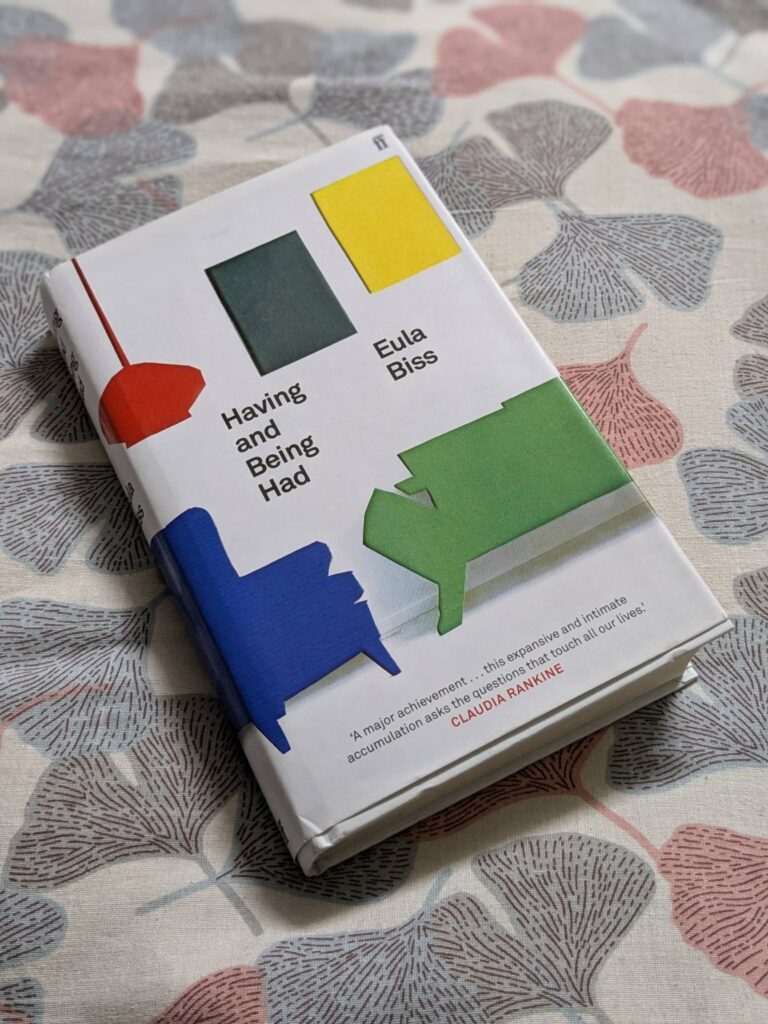
If I had to sum up Having and Being Had, it is Eula Biss having a conversation with capitalism -trying to understand its origins, its ethos, and its insidious and pervasive role in our lives. The only hint of structure are broad sections – consumption, work, investment, and accounting. But really, everything flows into everything else. I made up the narrative that she has ‘consumed’ her home (or the other way), she needs her work to pay for it, but also needs to make investments for her future – each piece complex in itself, their mutual relationships, and their relationship with her, and this is her account, and she has to account for everything. Everything is connected by capitalism. Having and Being Had reminded me of God, Human, Animal, Machine, which was reflections about consciousness itself.
The inputs are of many kinds and formats – books, art, conversations, observations of life around, lived experience – and we get glimpses of many characters around her- friends, mother, husband, child, neighbours, not to mention philosophers (Karl Marx ,John Kenneth Galbraith, David Graeber), and writers (Emily Dickinson, Joan Didion, Virginia Woolf). The neighbourhood she lives in, which is going through a gentrification process, as well as her home, which she owns but seems to have mixed feelings about since it needs to be paid for and maintained, also play substantial roles in the narrative.
The stream of consciousness style of reflections allows a range of topics to be covered both explicitly and implicitly – from race and white privilege, the role of art, work and labour, economics and money to Pokemon, IKEA and Beyonce.
I don’t think Having and Being Had will work for everyone, but that doesn’t make it any less interesting. Nor does it take away from all the thought-starters it provides for our own meditations and conversations. Part of my ‘extras’ in Bibliofiles 2024
Notes & Quotes from Having and Being Had
“One of the main things Marx noticed about capitalism,” she writes, “is that it really encourages people to have relationships with things instead of with other people.” ~ Elizabeth Chin, My Life with Things : The Consumer Diaries
On consumption – Food is destroyed by your consumption, but silverware is not, though the metaphor behind this word suggests that we eat up even or on silverware and dishes too. “We should think about how far we want to extend the metaphor,” Graeber warns. Yes, we consume fossil fuels in the “eat up, devour, waste, spend” sense of the word. But we don’t consume music. Music becomes part of us as food does but it isn’t destroyed in the process.
Modernisation was supposed to fill the world – both communist and capitalist – with jobs, and not just any jobs, but ‘standard employment ‘with stable wages and benefits. Such jobs are now quite rare; most people depend on much irregular livelihoods. The irony of our times, then, is that everyone depends on capitalism but almost no one has what we call a ‘regular job.’”
A game can be played with these cards, supposedly, but none of the kids understand the rules. Their end is accumulation – collecting cards for a game they don’t know how to play.
The barriers that prevent people from entering the middle class are the defining feature of the middle class, according to one way of thinking about class. While members of the middle class acquire education and skills, for instance, we exclude others from acquiring education and skills. Opportunity Hoarding is the term for this and it takes the form of admissions, procedures, testing, tuition costs, licensing, ranking and all sorts of credentialing. Conveniently, we don’t need to think of these barriers as a means of protecting our class status, but as necessary measures to gauge intelligence, or ability or commitment, or excellence or hard work.
And then there is the Marxist approach to class, which focuses on how economic status gives some people control over the lives of others. The middle class, in this approach, lies between the capitalists who have control and the workers who were controlled. The middle class includes small-business owners, who are both capitals and workers, salaried managers and supervisors, whose financial interests are entangled with the corporations they serve, and educated professionals who have enough capital to make investments. This is a middle class with capitalistic aspirations. And that is why Marx considered this class dangerous. It is a class of conflicting religions and internal contradictions.
Most people, Wright observes, prefer not to think of class as a means of control or exclusion, but as a collection of things that can be acquired like property and education. Your class, in this approach, is determined by how much you have of three kinds of capital, economic capital, cultural capital and social capital, or what you want, what, you know, and who, you know.
…the etymology of scholastic… It’s from the Greek….it means “to be at leisure to study.” The Greeks in value work like we do. Work was for slaves and women – but they did value study. Leisure meant something different in ancient Greece. It was the opposite of being busy, but it wasn’t rest or play. It was time spent on reflective thought and wonder. To be at leisure, to live a life of study and contemplation, was to enjoy true freedom. But that freedom depended on the work of women and slaves.
Pigouvian tax, a tax added to the price of a thing because of the social cost of the thing. Like the tax on cigarettes.
Middle age is really all about maintenance, my mother once said. You spend your life accumulating things, she said, and then you have to maintain them. Your house, your car, your body. You have to maintain your children, too, and your parents.
“Intellectual freedom depends upon material things”, she wrote In a room of One’s Own.
The reward of art is not fame, or success, but intoxication.
“…depending on the will or pleasure of another was the original meaning of precarious, and that it comes from the Latin for prayer. Precarity is everywhere, it seems. Maybe it is, as Anna Lowenhaupt Tsing writes, the condition of our time. It is also the defining feature of an entire class of people, the precariat.
Illness or disability can force somebody into the precariat as can divorce, war, or natural disaster. The precariat is composed of migrant workers and temp workers and contract workers, and part-time workers. People who work unstable jobs that offer “no sense of career.” There are few opportunities to advance in these jobs, and no way to bargain for better terms.
Capital, the investor tells me, is something women didn’t have until recently. We couldn’t even carry our own credit cards until 1974, she reminds me. We didn’t amass capital, we didn’t understand it, and we didn’t learn how to manage it. We didn’t have mothers and grandmothers teaching as about capital. But here’s the thing- she circles her womb with her hand – we are capital. We are the means of production. I had three children, she says. I’ve been the means of production. Now I want to own the means of production.
Leave a Reply