
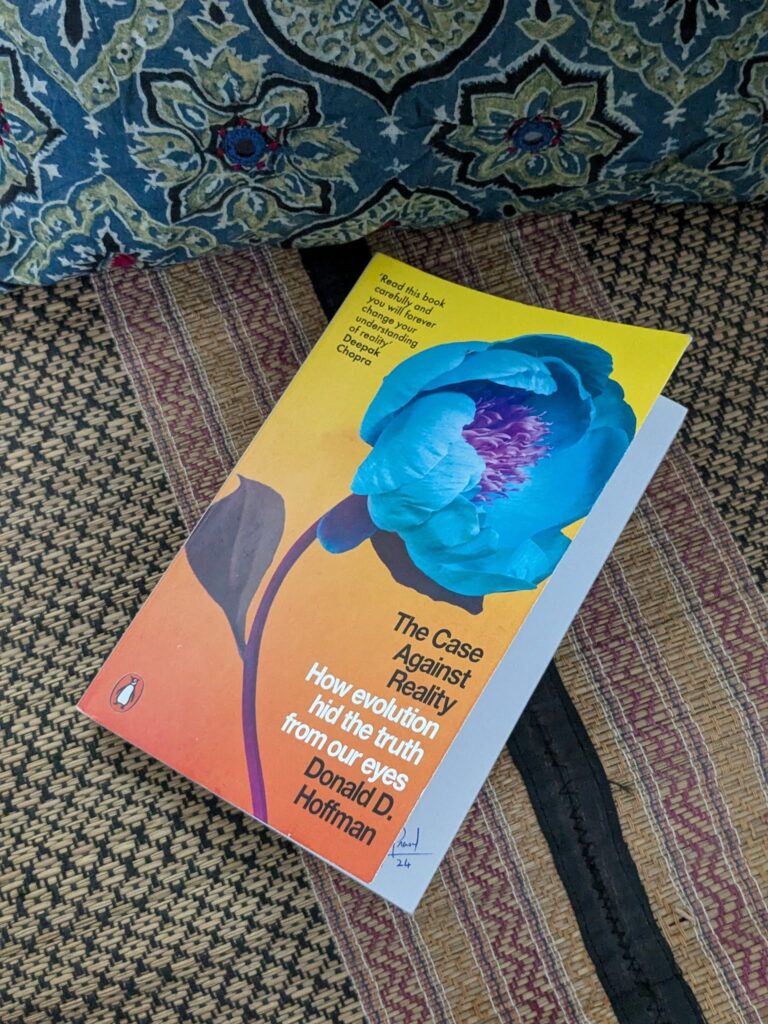
Donald D. Hoffman
Before getting to The Case Against Reality, we need to talk about my favourite read this year – “Being You“. The second half of that book has some reality-shattering theses. One of them is ‘We perceive the world not as it is, but as it is useful to us.’ Reality is thus an interpretation, and the entire process is not optimised for accuracy, it is designed for utility. A mechanism of making it seem real so we respond to it. Not to know the world, but to survive it! The end of the book also brings up the fascinating FEP (free energy principle) and specifically how it applies to living systems and consciousness. In this context, it boils down to this – being alive means being in a condition of low entropy. Any living system, to resist entropy, must occupy states which it expects to be in. Biology meets physics. Why am I bringing this up? Because The Case Against Reality touches upon both of these aspects I was fascinated by.
Donald Hoffman posits that “some form of reality may exist, but may be completely different from the reality our brains model and perceive.” Why is that? Fitness-Beats-Truth (FBT) theorem. Natural selection optimises for fitness payoffs, and thus organisms develop sensory systems and internal models of reality that increase these fitness payoffs but don’t offer a correct perception of reality. In fact, natural selection doesn’t just not favour true perceptions, it routinely drives them to extinction, and instead, favours perceptions that hide the truth and guides useful actions.
He compares this to icons on our screens that are a way of interacting with the system but don’t look/feel/behave like the system underneath. They are a user interface that spares you tiresome details on software, transistors, magnetic fields, logic gates etc. And everything we perceive around us through our sensory organs and mind is just like that – icons that help us navigate. Our perceptions don’t even have the right language to understand/describe reality. And on this line of thought, even spacetime and the objects/ smells/ sounds/ texture/ motion etc we take for granted in it, crumble. They are just the data formats which have evolved and survived eons of tradeoff between knowledge and utility. Each species creates its own interfaces to deal with reality. Hoffman calls it the interface theory of perception (ITP).
There are several experiments and illustrations to help you get over the “so that tomato that both my friend and see is not real” and “so I can grab a rattlesnake and nothing will happen” and “there is no spoon” questions one is bound to feel. Broadly, when you delete a useful icon, the underlying system remains. But your access to that might be limited/difficult. So even though you don’t take it literally, you do take it seriously. Amazing that Galileo got an early idea of that a while ago, though he didn’t go further.
My intuition resisted it for a while until two things happened. One, moving the discussion from visual from things we see to things we taste. The taste of vanilla in no way describes the molecule. Plato’s allegory of the cave! Second, I realised that we use heuristics and short cuts for practically everything. Our biases are our own and different from others’ – our way of dealing with our life. I thought we were the first to do that, but maybe we do that because at a fundamental level, natural selection has been playing with the wiring to develop the mechanism that gets the best fitness payoffs. How humbling!
Natural selection is the only process we know that pushes organisms thermodynamically uphill to higher degrees of functional order to try and delay entropy if not offset it completely. We are arguably a milestone in that. Maybe the intelligence we create – AI – can help us analyse the UIs of multiple species and get a better sense of reality as is.
Hoffman invokes the red pill/ blue pill early on, and I must admit, the book does deliver on that. It is reasonably accessible and but a tad closer to ‘truth’ than ‘fitness’ on a scale of zero to Harari’s Sapiens. 😉 But it did expand and take forward my thinking in the quantum theory – evolutionary biology direction that I am now even more interested in! The Case Against Reality easily makes it to my Bibliofiles 2024 list.
Quotes
Science is not a theory of reality, but a method of inquiry.
We did not evolve our ability to reason in order to pursue the truth. We evolved it as a tool of social persuasion.
Leave a Reply