Month: February 2025

  • Unidentity-fying

    A theme has been emerging, even more stronger since I wrote “Living a life of Intentionality“. Pithily summarised as “At this age, I prefer an identity that provides the least friction and regrets in the life I want to lead.” How do I get there? A key factor I identified for myself is acknowledging the difference between my wants and likes, and deeply questioning my wants. Where does that get me? From that post, Intentionality helps you have your needs and considered likes as anchors. When that happens, a whole lot of clarity emerges – what you spend time and money on, people whom you will go overboard for, how you plan your days, weeks and months, and what can get you out of those lil twinges of envy and seemingly deep pools of a mid-life crisis.

    But while I was trying to get there, I encountered a strong opponent – myself, or rather, my identity. I first brought it up in Marshmellowing. The key point in the first was how in my approach to getting what I needed/wanted, my larger desire for ‘freedom’ led me to optimising for optionality – a huge bias for scenario planning. I think the identity I created thanks to this is aptly called the Marshmallow mind (by Frederik Gieschen), and its best expression is a poem I read in Poor Charlie’s Almanack: The Wit and Wisdom of Charles T. Munger, attributed to A.E. Housman

    The thoughts of others

    Were light and fleeting,

    Of lovers’ meeting

    Or luck or fame.

    Mine were of trouble,

    And mine were steady;

    So I was ready

    When trouble came.

    In Marshmellowing – The Prequel, I wrote about my path to this identity/self image from childhood. A great description of it appears in Robert M. Sapolsky’s Why Zebras Don’t Get Ulcers. In the personality section, Sapolsky practically described my (former) Type A personality down to a behavioural “time-pressuredness” (research by Meyer Friedman and colleagues), default hostility, and a persistent sense of insecurity, the last being a predictor of cardiovascular problems. Add to it disciplined, discomfort with ambiguity, and (formerly) repressive in terms of emotional expression, and you have my profile! Damn!

    My self image, and increasingly my identity was the kind of person who thought in a certain way and behaved in a certain way. While its origins was my ‘responsible child’ identity that possibly repressed my freedom of emotional expression in favour of (parental) attachment, in adulthood, it transformed into a “responsible adult” self image that ironically optimised for freedom and optionality, and underplayed the need for attachment. It became an identity, and many of my decisions were biased in that direction.

    It is only in the very recent past – through reading and reflection, that I have begun to be at least a little fine with unplanned-ness. As I wrote on LinkedIn, the universe’s tendency is randomness! An excellent read in a different context was The Tao of Physics. I realised that In both quantum field theory and eastern philosophies, physical phenomena (including us) are mere transient occurrences in an underlying entity. How humbling that is!

    I think I have made progress by moving from fixed goals through fixed strategies to fixed goals through flexible strategies. I hope, after we are confident of financial freedom, that I can move to flexible goals and flexible strategies. Meanwhile, the biggest task in all this is the mindset. Mindset made the identity, and now it has to dismantle it. Erich Fromm wrote this a long time ago – “Life, in its mental and spiritual aspects, is by necessity insecure and uncertain…The psychic task which a person can and must set for himself, is not to feel secure, but to be able to tolerate insecurity without panic and undue fear“. Decades later, we have a pithier version.

  • Doppelganger

    Naomi Klein

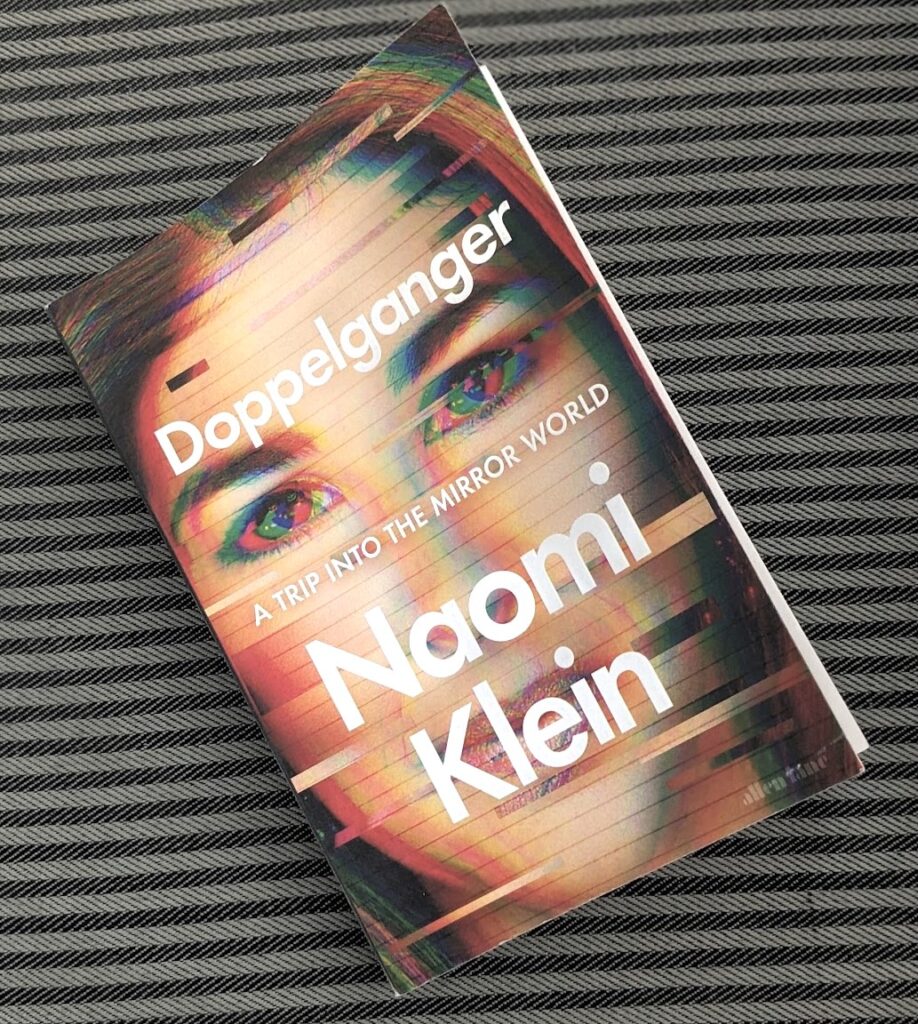
    Quite eerie that I read this immediately after I read Carol Roth’s “You will own nothing”. Here’s why. Doppelganger’s starting premise is how the author (Naomi Klein) gets confused for Naomi Wolf, both being ‘white Jewish women’, increasingly helped by the overlap in the subjects they comment on. The former is a left-leaning writer and social activist while the latter is a third wave feminist who turned from centre-left to becoming a right wing conspiracist. It is fascinating how Roth’s views largely align with Klein (Davos, Big Tech) but also agree with Wolf in others (Canadian truckers, for instance)

    In her new avatar, Wolf’s argument – with a full endorsement from none other than Steven Bannon (once Trump’s chief strategist) – during Covid was that vaccines and public health measures were a conspiracy by a global cabal to sterilise, and in general, undermine the constitution. People increasingly began believing that these were Klein’s views. At one point, after it goes beyond being just a joke, Klein decides to dive into the rabbit hole of the universe that Wolf inhabits – the Mirror World is how Klein describes it.

    While this is where the book starts, and also spends pages drawing out the different worldviews, approaches etc, the narrative then expands its scope to cover the title – Doppelgangers – in general. Not just at an individual level but a societal level. For instance, today the simplistic left vs right categorisation is almost devoid of meaning. Even the horseshoe theory of left and right being similar the extremes isn’t nuanced enough. With big tech, Covid lockdowns, and a plethora of social media influencers, most people have very little trust in anything mainstream media, or what politicians say or do. The difference is only in their own perspectives of who is lying and for what. Wolf and Klein, for example, agree on Bill Gates being a force for evil. While the former goes on about tracking people, the latter is against how he sided with big drug company patents on life-saving Covid medicines.

    Klein decodes how issues remain the same but how Bannon & Co spin it to stoke common underlying tensions and use it to further their agenda. For example, blue collar workers who felt betrayed by Democrats when the latter signed trade deals that accelerated factory closures, Bannon pitched Trump as a radically different Republican who promised to make the rich pay. This modus operandi was an echo of what I had read in Peter Pomerantsev’s ‘This is not propaganda’, in which he pointed out how Trump and his ilk could create coalitions of people who agreed on some topics, while the left/liberals would argue on the tiniest of nuances. There is a name for the former – diagonalism.

    There is also an interesting section on how our personal brands are our doppelgangers – what happens to our self when we create for social media? What is real, and what is for camera? “Which of our opinions is genuine, and which are for show? Which friendships are rooted in love, and which are co-branding collabs? Which collaborations don’t happen that should because individual brands are pitted against one another?” What doesn’t ever get said, or shared, because it’s off-brand?” What does it do to our capacity for internal dialogue and deliberation?

    The focus on doppelgangers allows Klein to apply it to diverse contexts – wellness influencers who became anti-vaccine propagandists, parents of autistic children (and their belief that this was something that had to be cured instead of accepting the child and its unique ways), to Nazis (and the fascinating view that European colonists had been on genocide sprees long before Hitler, and that it was only the scale and more importantly, that it happened in Europe that shocked the West into retaliating; also how the Australian Aborigines League saw this coming way back in 1938 and wrote a protest letter against persecution and handed it to the German Consulate) to Israel (and how the Palestinians had become the victims’ victims).

    Towards the end of the book, the narrative switches back to personal, with lovely anecdotes on how Klein was originally inspired by Wolf, and also how today, with Wolf uttering all sorts of things in public, Klein believes she is freed from her own public self and how it’s an “unconventional Buddhist exercise in annihilating the ego”.

    This is a fascinating read which prompts us to look within ourselves and at the society we inhabit, forcing us to acknowledge the doppelganger within us at both levels.

    Quotes
    “Ms. Wolf is the moral equivalent of an Armani T-shirt, because Mr. Gore has obscenely overpaid for something basic” ~ Maureen Dowd

    “The accelerated need for growth has made our economic lives more precarious, leading to the drive to brand and commodify our identities, to optimise our selves, our bodies, and our kids” Naomi Klein

    “In the Mirror World, they… rile up anger about the Davos elites, At Big Tech and Big Pharma – but the rage never seems to reach those targets. Instead it gets diverted into culture wars about ant-racist education, all-gender bathrooms, and Great Replacement panic directed at Black people, nonwhite immigrants and Jews.” Naomi Klein

    Doppelganger
  • Idyll

    This is far from our village, but thanks to the metro, if we get out early, it is quite a breeze getting to Indiranagar. And that is how, one Saturday evening, we broke our rustic idyll to visit Idyll, about whose fusion fare we had heard good things.

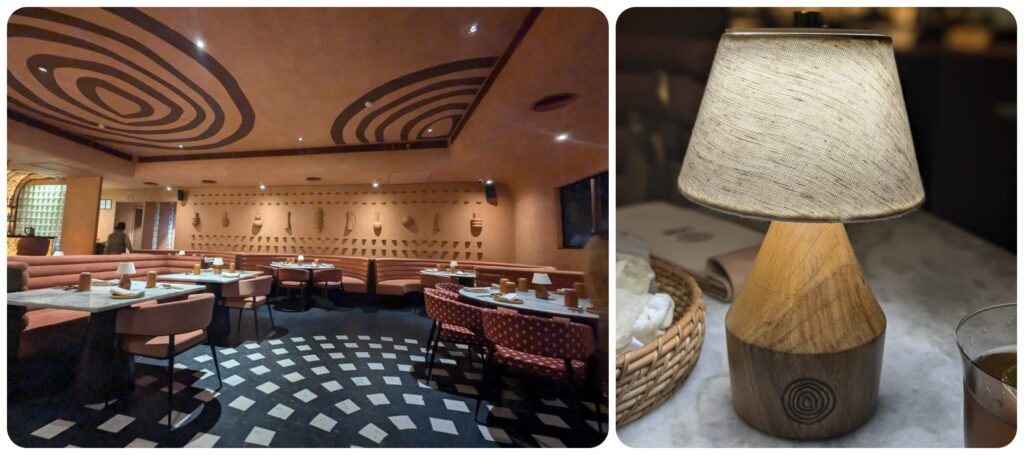
    Idyll has two floors. The top floor is the one with the pounding music and cool bar. Relatively, the ground floor is the more ‘boring’ one, almost like the family room, and that’s where we chose to sit. That ‘maze’ symbol on the lamp (that we loved) is everywhere and kept reminding me of the Westworld maze. See that ceiling again?

    Idyll Indiranagar Bangalore

    The Kashmiri Old Fashioned was what I came for. Roasted raisin infused bourbon, spiced Demerara almond syrup, and in-house Kashmiri bitters was how it differentiated itself from the standard version. I enjoyed it because it didn’t go overboard on the sweetness and they didn’t scrimp on the alcohol.

    Idyll Indiranagar Bangalore

    D tried the Kerala Mango Pachadi – tequila based, with strained mango pachadi and a few other ingredients, which turned out to quite good. As always, looked prettier than my drink too!

    Idyll Indiranagar Bangalore

    We started with a Pandi Pork Bao – slow cooked pork belly in Kachampuli vinegar with fermented Thai chilli. We loved the spice level, the well cooked meat, and the superb flavouring.

    Idyll Indiranagar Bangalore

    Meen Moilee Dimsum made us very curious. River sole, coconut milk and fermented chili oil. I think, once you get used to the idea of the weird combo, it is tasty enough. 🙂

    Idyll Indiranagar Bangalore

    The last dish we tried was the Chorizo Kachori Chaat, which is your typical chaat with Goan chorizo. It wasn’t bad, but this, I thought, was the one that did the fusion the least justice.

    Idyll Indiranagar Bangalore

    The bill came to a little over Rs.3700. Indiranagar pricing, but hey. Excellent food and drinks, prompt and helpful service, and a peaceful ambiance if you get there early.

    If you like a little bit of experimentation, try Idyll when you’re around next.

    Idyll, 608, 12th Main Road, HAL 2nd Stage, Indiranagar, Ph 6364315734

  • You Will Own Nothing: Your War with a New Financial World Order and How to Fight Back

    Carol Roth

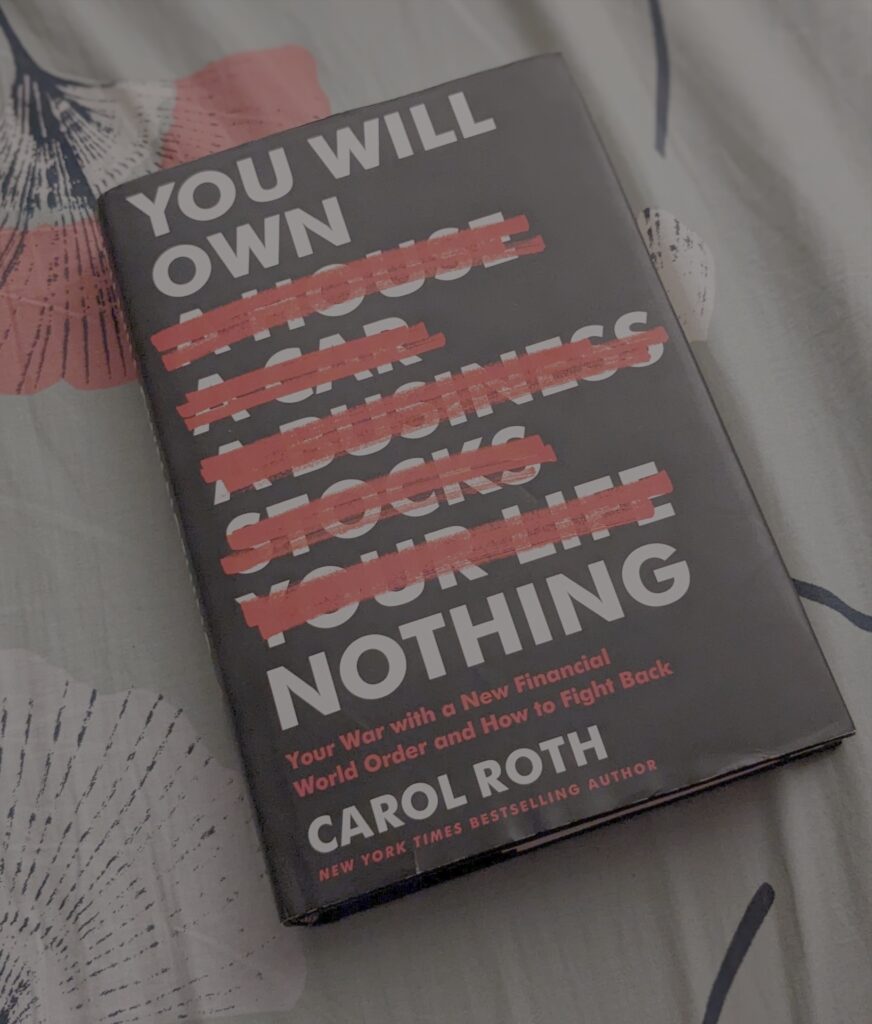
    Carol Roth does a great job of using the title to shock the reader, but once you read the book, you might agree that it is justified. It was at the World Economic Forum that she first heard the prediction that in less than a decade, private ownership would be dead. The book is her research on “You will own nothing and be happy“.

    She calls this a war where three kinds of forces – government and government-related forces, elite power-grabbers and bad actors, and Big Tech are colluding to ensure that they remain on top for the new financial order that will come up. Owning wealth and power.

    She begins with how frontline forces who risked their lives during the pandemic were punished, their livelihoods taken away, for non-compliance with a vaccine mandate. Moving quickly from social acceptance to social credit. Judged by public approval than a court of law. In China, they have already gone quite deep into the Social Credit System, where you’re watched and rewarded (red list)/penalised (black list).

    She uses the history of empires to show the cycles of rise and fall, and how war is usually a catalyst for change and a new financial order. The US began its ascent after WW2, and according to Roth (and data), we are now seeing a decline in the US financial system, which is likely to lead to a shift in power, and or economic and geopolitical chaos. And if we go by GoT, “Chaos is a ladder”.

    She also discusses Peter Thiel’s framework of how good ideas cause bad outcomes through a believers (idea)- racketeers (ROI) – Useful Idiots (ROE, e for ego). Think of climate change and read it as genuine activists – ESG sellers – regular people pandering to their desire for validation and ego by sharing posts/emojis/slogans without really understanding the discourse.

    The next chapters expand on the debasing of the dollar (some insightful charts on its decreasing purchasing power) and the huge concerns on turning it digital – CBDC (central bank digital currency) and how it can be used against the common person’s rights and freedoms. This allows a neat segue into Big Tech and how they have made us dependent, and infringed on our basic rights. Think of getting locked out of mail, social media, payments etc with no easy means of recourse. Most of us don’t really own anything digitally, it’s all on a company’s servers. They would serve as great allies of the government, possibly even overshadowing them with their technical superiority. Wars are almost more cyber than real, after all.

    She then does a deep dive on the various power and money grab mechanisms already underway. ESG, (thanks BlackRock!) for instance, played a crucial role in tanking Sri Lanka’s economy. The increasingly unattainable home ownership in US thanks to corporations, who are helped by cheap capital enabled by the Fed, competing against the common man for real estate. And city administrations who are happy to go along with AirBnB because they pay taxes. Add to this billionaires like Gates and institutions like Harvard (enabled by endowments) buying up farmland, including things like water rights. Now think about it, why wouldn’t private investors start moving water to say, nearest cities, because they think it’s the most efficient use of water?

    Another example is the crazy cost of education and the increasing lack of ROI, thereby creating a population that is always in debt. And guess who’s the one providing these loans – the government! And despite their ‘loan forgiveness’, ultimately it’s the taxpayer footing the bill! A transfer of money from the working class to the college-educated class.

    The final chapter is on how the common man (in the US context) can fight back against all this. While the context is the US, the ideology of capitalism and the alliance of government-corporations-BigTech is a global phenomenon, soon coming to a country near you.

    What was super insightful to me is the nuance of arguments. I had broadly supported the vaccine mandate, Biden, and was not fond of Joe Rogan, but I was forced to think deeply on all this. This is a fantastic read, and I absolutely recommend it.

    Quotes
    “When a social moral code replaces a legal code and gains acceptance it is only a matter of time before those in power want to leverage that dynamic to secure more power for themselves”
    ‘We hang the petty thieves and appoint the great ones to public office’ ~ Aesop

    You Will Own Nothing