Month: January 2025

  • Marshmellowing – The Prequel

    In Marshmellowing, I wrote about how a life spent optimising for predictability (or at least optionality) is probably what is keeping me from the life I want to live. And the person I want to be.

    At a proximal level, I understand why I am the way I am. The marshmallow mind (delayed gratification) is not only a muscle that automatically plans for the future, but is also the custodian of a self image it created. But I am still figuring out why it came to be that way. What is that self image in this context? And how did it get created?

    A bunch of my reading, listening, and reflecting in the last couple of years has been to understand why I am the way I am – at macro and individual levels. At the macro level, I have been able to synthesise a bit, this post is an attempt to track the evolution of my self image.

    In one of my favourite podcasts – Dr. Gabor Maté on the Tim Ferriss Show, the former mentions how outside of physical needs, the two other critical needs humans have is attachment and authenticity. We need attachment because without the care of parents or vice versa we would die. Back in the savannah, we had to go by gut feel because there was no social learning mechanism. We therefore needed authenticity – connection to the self. He then shares a fantastic insight on how our authenticity gets suppressed right from childhood, with a great example.

    When I look back, I can see at least four elements that make up my current self. As a marketer, I have to alliterate. So here goes.

    Responsibility

    I don’t remember that far back, but my 10 year old self has a version of what Dr. Maté was referring to. Some of my earliest memories are about studying hard. If I did that, mom wouldn’t be angry and I would be spared a beating. She was driven by the fact that she didn’t have much time (she was diagnosed with leukaemia around the time I turned 10). At school too, being a good student meant the admiration of peers and the affection of teachers. I gradually built a self image of a responsible person. From an authenticity perspective, I was probably more creatively inclined, and terribly shy. But between my academics, music and things like quizzing, I was thrust into some level of limelight at my first school.

    Rebellion

    Somewhere in my teens, and it is no coincidence that it was around the time of mom’s passing, I developed quite a sense of humour. Maybe it began as a coping mechanism, but soon after, its underlying theme was a rebellion against any perceived injustice and authority. I think that is my authentic self, and it drew people to me. It does now too. Everyone likes someone who takes a stance and in the process, make them laugh. But back then, it wasn’t enough to dislodge the lesson that being responsible was what helped attachment. I need to be grateful that my authentic creative self found outlets and kept itself alive.

    Relationships

    While I was in engineering college, my grandmother, who was probably the most influential person in my life and someone I deeply loved, left our home to live with my uncle. A few years later, after engineering, I ended up having to figure out my own higher education because there was no one who gave me perspective. Maybe I could have asked. But these experiences led me to a mindset that relationships as a means to attachment was a dead-end. This got accentuated when D and I arranged our own marriage. When I look back, my dad and D’s parents were gracious in their acceptance. But a mindset had been created. Attachment would come with success, and that would come from taking responsibility of my own life. It is ironic that the responsibleness that was originally meant for attachment then moved me away from people.

    Relevance

    Relevance as a means to advance the career, and make some money. I am thankful that another facet of my authentic self – curiosity (reading, figuring out)- played its part, though not by active design. Between this, my sense of responsibility (at work), and the sense of humour that is sometimes weaponised as sarcasm, I got myself a sufficiently differentiated personality to reasonably succeed in my career. Relevance continues to be a way of making sure I am employed in some form and my FU Money target is met sooner than later.

    And that sums me up, or at least the self image. Now, we are a year or two from our FU Money, and I can still crack a joke. What is the problem?

    There are three, actually. My marshmallow mind is the result of ‘responsibility’ winning. It comes with costs. The marshmallow mind continues to plan the future and make predictions. In this other phenomenally good podcast on Hidden Brain, Lisa Feldman Barrett talks about how the brain can get trapped in its own predictions. When the predictions don’t work out, the result is stress.

    As she elaborates, it operates at a different level too. The brain is an energy budgeting machine optimised for survival and reproduction. Apparently, the suppression of authentic emotions can potentially result in chronic stress, contributing to a bankrupt body budget. Over time, this could predispose individuals to depression, as the brain repeatedly predicts and conserves energy to cope with unresolved internal conflicts. Feldman Barrett describes depression as a state where the brain, faced with chronic energy deficits, prioritises conserving resources. This manifests as fatigue, lack of motivation, and inability to update predictions or engage with the environment. Exactly what I want to avoid.

    And finally, it doesn’t help when predictability becomes the objective in all situations across life. It perpetuates a stress response even in non-threatening situations. Relationships are frowned upon by my predictive mind because humans increase complexity and reduce the accuracy of predictions. The loss of relationships is also a suppression of authenticity, because relationships are the biggest component of who I want to be.

    And that’s why all my efforts now are to regulate my marshmallow mind!
  • The Lost Pianos of Siberia

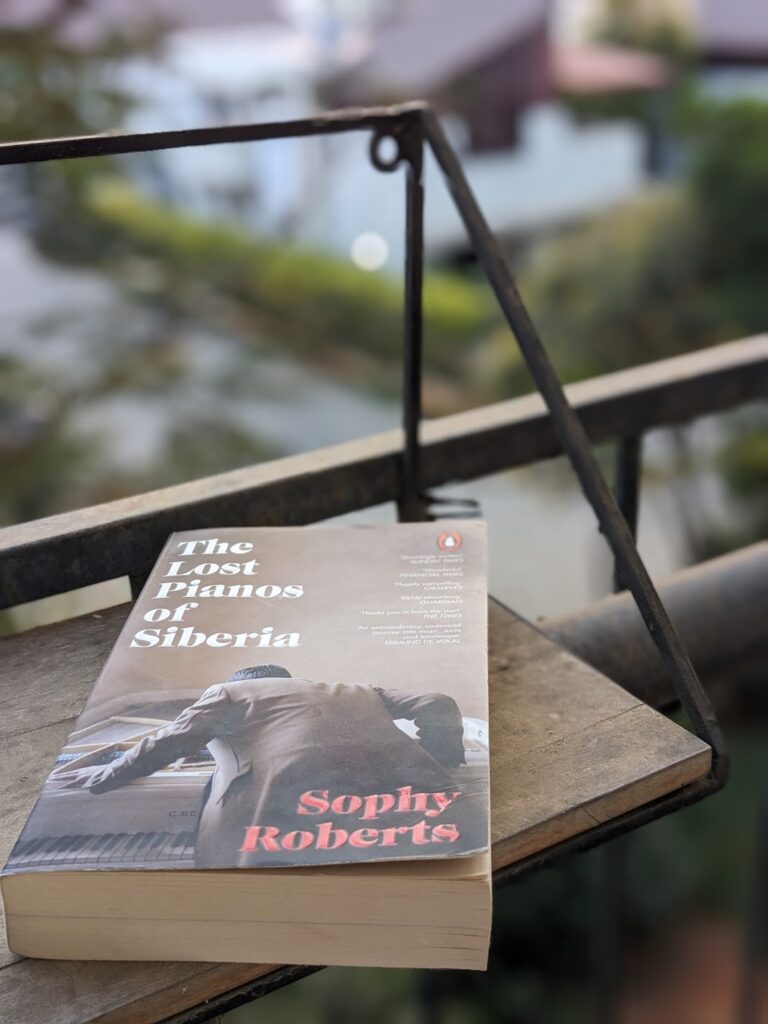
    Sophy Roberts

    In the epilogue of The Lost Pianos of Siberia, Sophy Roberts quotes Fyodor Tyutchev – “You cannot fathom Russia with the mind… You can only believe in it.” Once you really pay attention to the map and figure that it has Finland and Ukraine on its western borders and China and Japan in the south/east, it is easy to nod in agreement. For a lark, I tried to calculate the distance/time taken from Moscow to Vladivostok, and gave up on any dreams – 7 days, 7 time zones, 30 cities and almost 10000km!

    Sophy Roberts’ Siberian journey is the hunt for a piano for her friend Odgerel in Mongolia, but for a reader if offers far more – a fantastic trip through time and space in one of the remotest parts of the world. The book is divided into three portions – 1762-1917 (from Catherine’s the Great’s ascension to the February revolution when Tsar Nicholas II abdicated and was taken to Siberia with his family), 1917-1991 (when the Soviet became the Russian federation) and 1991 – present. We see the region not just through the political changes, but primarily through the lens of music and culture. In fact, the music remains the constant.

    Siberia is 1/11th of the world’s landmass, with the Urals, the Pacific, the Arctic Circle and Mongolia serving as its borders. The Tsars made it a penal colony early on, and it played host to a variety of famous folks – politicians to writers to artists. But it was also home to pianos, starting from the nineteenth century, thanks to Catherine the Great’s penchant for collecting new technologies. Chasing these lost pianos, we go across Siberia from Tobolsk and Irkutsk and Tomsk to Sakhalin, Harbin (now in China, but with a very Russian past), the Dead Road (one of Stalin’s crazy projects where the track was being built in temperatures 50 degrees below zero and where people’s hair froze on to their neighbour’s skin when they slept close for warmth), Kolyma, Akademgorodok and Kamchatka, Kurils and Khabarovsk. Names on a map, but now rich in my mind with character.

    But what makes this all come to life are the people and their poignant stories. A family that retreated into the Siberian taiga in 1945 , living in total isolation in the Sayan Mountains, until someone discovered them in the 70s. They only possessed a spinning wheel and a bible and refused to believe the moon landing. Dmitri Girev, who had accompanied Robert Scott to the South Pole. The ordinary yet moving story of Lidiya in Duė Post, where the infamous coal mines used to be. Anatoly Lunacharsky whose efforts made sure pianos weren’t completely lost during the Revolution, the last days of the Romanov dynasty, the 2500 year old Ukok princess’ mummy in the Atlai mountains.

    Leonid Kalsohin, an Aeroflot navigator who gave up that life to settle in a remote village called Ust-Koksa, where he is trying to build a concert hall. “The world is very remote. We are at the centre“, he says with a twinkle in his eye. The stunning concert during the Leningrad siege, when people braved the cold and the enemy fire just for the music. The Lomatchenko family in Novosibirisk, whose room in the basement of the Opera House contained musical treasures (‘It’s not much“, said Igor, ‘but it is my life.’) Mary, the 80-year-old birder, whom Sophy meets on a cruise to Commander Islands (‘neither of us had come for the certainties, but for the outside possibility that a little marvel might appear‘).

    You don’t need to enjoy music to love The Lost Pianos of Siberia. Because this is about places and people, who even in this hyperconnected world are outside the radar of most of us. Sophy Roberts’ prose is vivid and deeply moving, and takes us on a fantastic tour of a unique part of the world.

    The Lost Pianos of Siberia
  • Maize & Malt

    There is a reason why I have a particular dislike for breweries on Sarjapur Road and ORR – they follow a fixed template of a hugeness, a dirty pool, bad beer, and barely-teen young adults posing for Insta reels. Just to be clear I don’t have a problem with the last one, it’s actually quite hilarious.

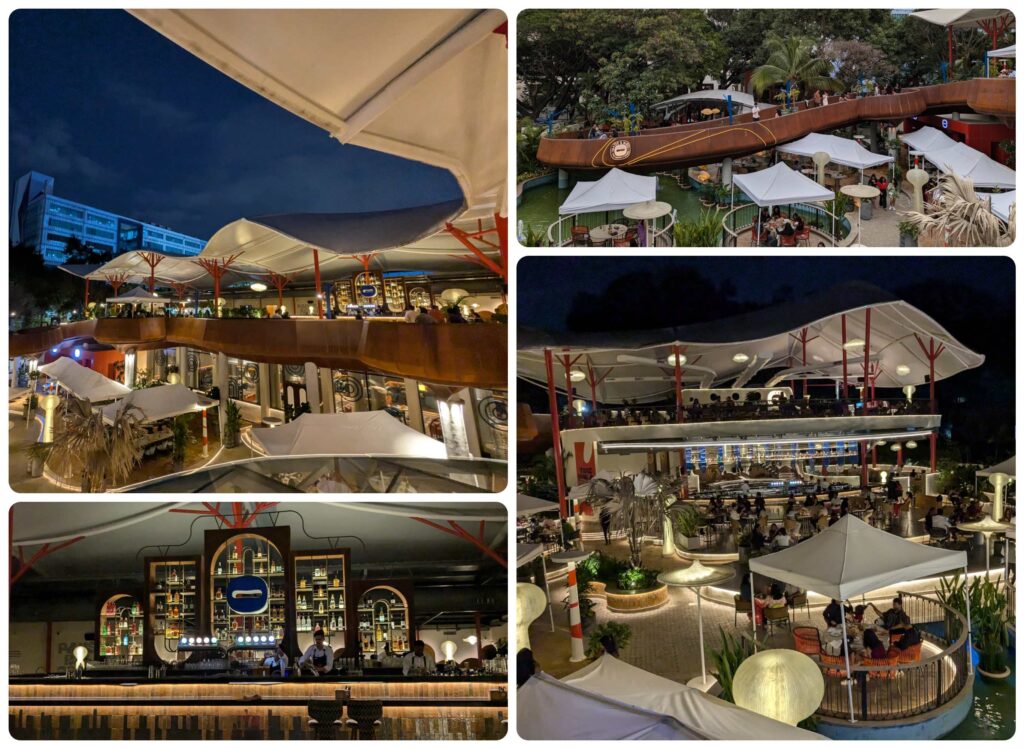
    But it’s my unfortunate duty to inform you that our hamlet of Whitefield is now being invaded by these kind of breweries. BLR Brewing Co being another recent example. Maize and Malt follows the same template as you can see from the image below, and to add insult to injury, they even claim to have an Anglo Indian theme to their menu. A misconceived hat-tip to Whitefield, I guess.

    Maize & Malt

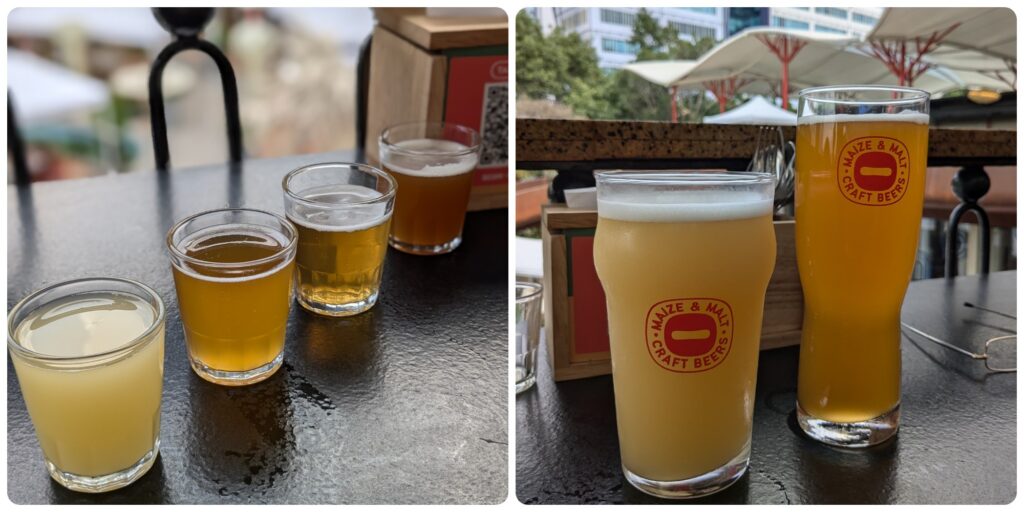
    And now for the second bit of bad news. We tried all the beers available, and in what is truly a tragic scenario, had to choose the least worst because they were all bad! Belgian Wit and Hefeweizen.

    Maize & Malt

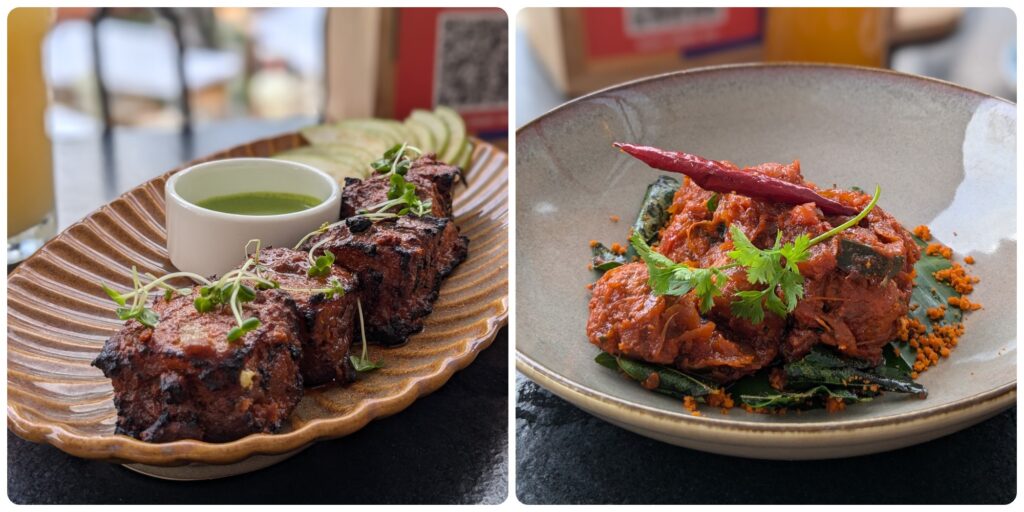
    The only reason to cheer turned out to be the starters. Their Mama’s Special Tangy Pork is excellent, though I wonder who decided to tandoorise (yes, they do write Anglo Indian Tandoor in the menu!) it with a mint chutney. The Mutton Kaima Unde Fry is also very good, though they took the ‘small plate’ very literally.

    Maize & Malt

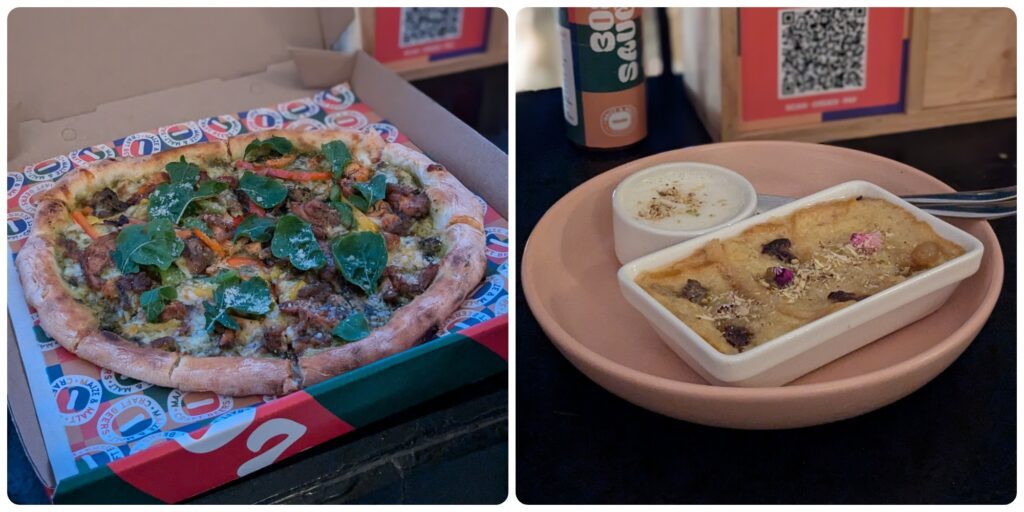
    We then tried the Wild West Chicken Flatbread with caramelised onions. It wasn’t as bad as it sounded though they decided to serve it in a takeaway box. And finally, the easy test for any semblance of Anglo Indian expertise is the Bread Pudding. But don’t even bother.

    Maize & Malt

    The service was par for the course, though thanks to people moving around chairs and their table system being not very agile, we had our food taken to others and vice versa. I even considered taking things if they looked good, but didn’t really see anything worth that effort. We deeply felt the loss of a little over Rs.2600 thanks to this misadventure.

    Maize & Malt, 3, 4th Cross Rd, Vigneshwar Nagar, Kaveri Nagar, Krishnarajapuram (it’s behind Decathlon)

  • #Bibliofiles : 2024 favourites

    Bibliofiles 2024

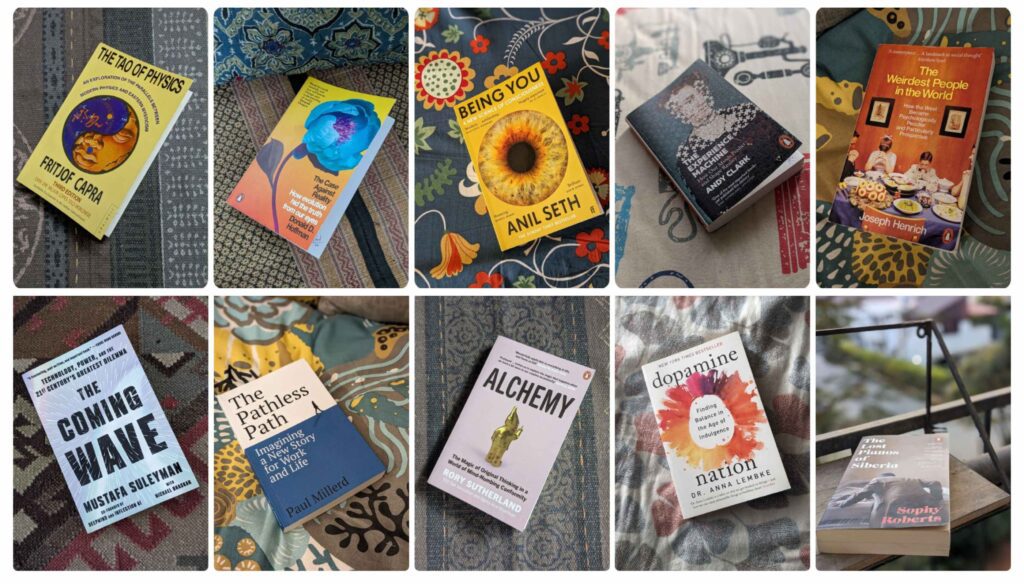
    In 2024, the mind seemed to be obsessed with the mind and the reality it perceives, and that’s a good thing because I was able to take a shot at some synthesis on why I am the way I am. When you see the books, you’ll know why/how. And so, as per tradition – from 2019202020212022 and 2023 – we have this year’s list of ten (plus a few extras 🙈). From the 63 books I read in 2024…

    (more…)