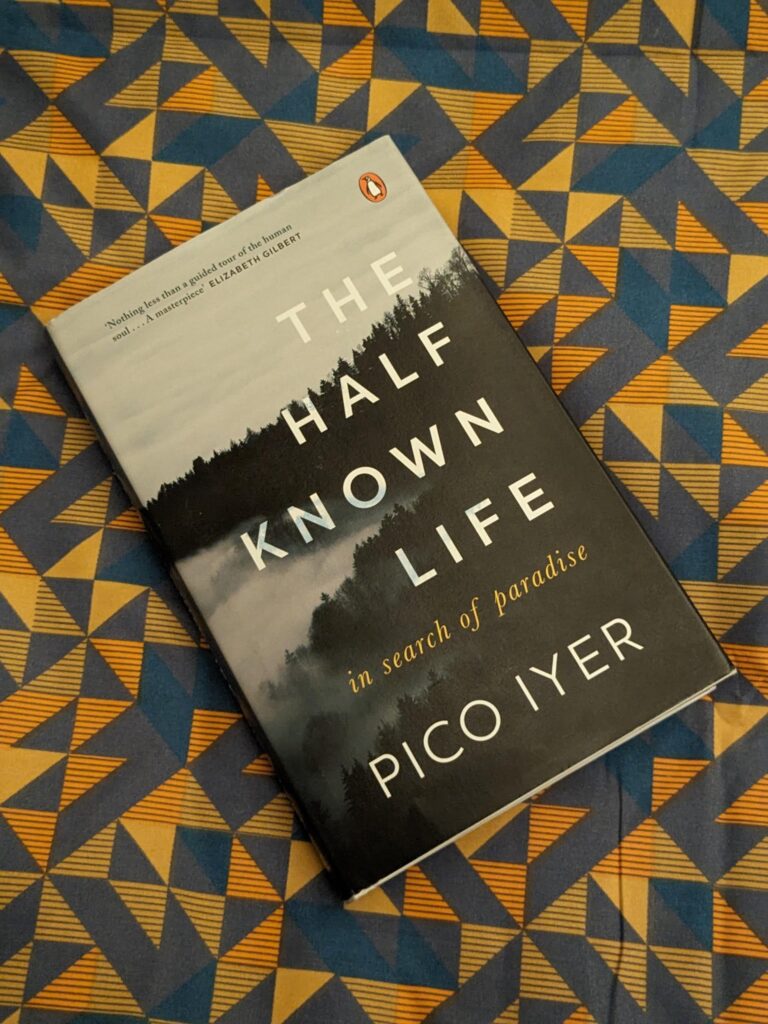
I always have a bias for Pico Iyer’s writing, and many a time I end up reading his books at times when I need an alternate perspective. In The Half Known Life: In Search of Paradise, the search is for what different people define as paradise – a place with no worry or anxiety. Except, for some it is a particular place, for others a moment in time and something that can be accessed if we put our mind to it, and for some others it can only be enjoyed after death.
From Jerusalem to Benaras, and Japan to Ladakh, Pico explores these concepts and the people who believe in the different definitions. As is usually the case with his writing, it is as much introspection as it is travel, and written in wonderful prose. He blends his personal experiences with philosophical musings seamlessly. Through the people he meets, and his encounters with those from varied backgrounds, he reflects on the nature of life, and its many meanings.
In solitude and contemplation, he reaches out to thinkers before him- from the Stoics to William James to Henry David Thoreau, in an effort to decipher the complexities of our existence. Each essay is a meditation, and amidst the noise and chaos of this busy world, I’ll probably pick it up again later in life to get a different rendition of the half-known truths that lie deep inside all of us.
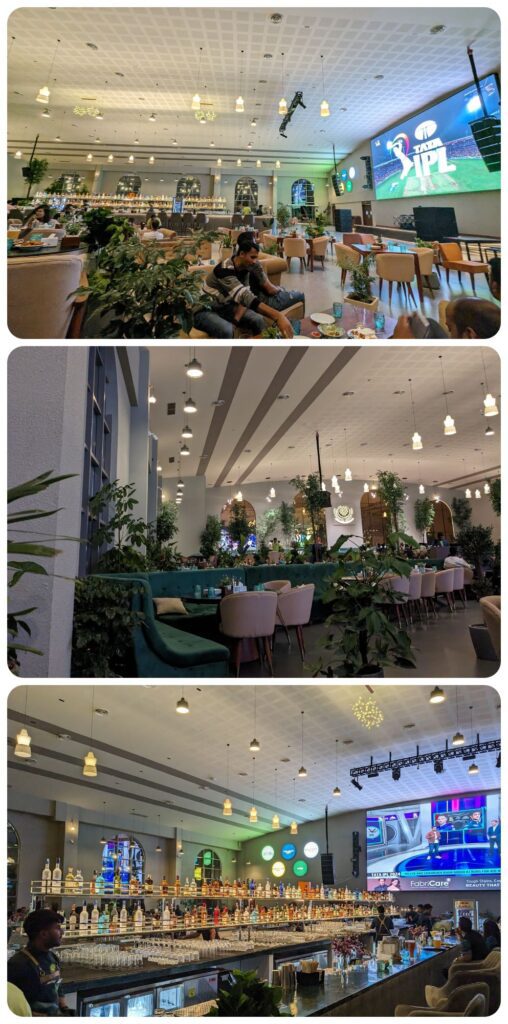
In the spirit of ‘Who has a bigger schtick?’ Prime Golf, in Whitefield, has apparently overtaken Ironhill as the largest brewpub in Asia. Who cares about the beer and food? For those wondering, I suspect the golf is mini golf.
It’s pretty vast, apparently a seating capacity of 1500. There are multiple seating options – indoor and al fresco and for various group sizes. Unfortunately, they have designed it in such a way that the outdoor view is pretty much dead on arrival. As is characteristic of such places, there is a gigantic TV screen so you can dine out and do the same thing that you do at home anyway. Yay.
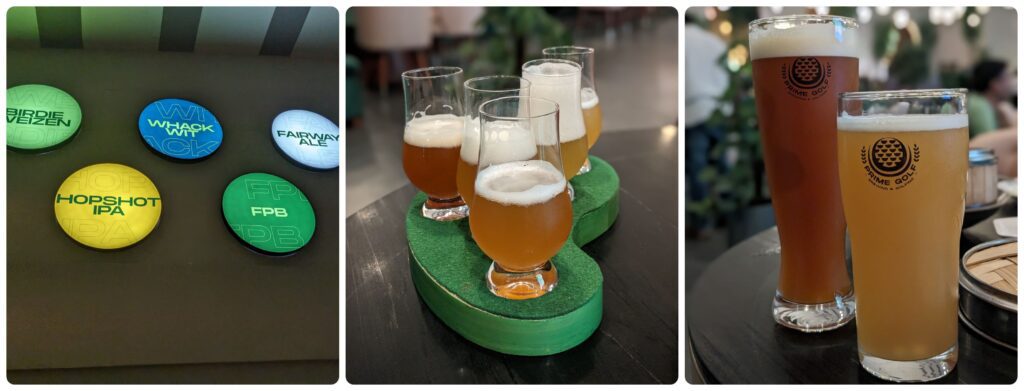
One of the beers in the list was unavailable, and what they had instead was a Weizenbock. We tried out the samplers, and chose the least of all the evils – Whack Wit and Weizenbock. The first is a Belgian style wheat beer and the second is essentially a hybrid of the Weiss beer and the German Bock (close to a Dunkelweizen). That was the technical understanding, our friends have made their own interpretations.
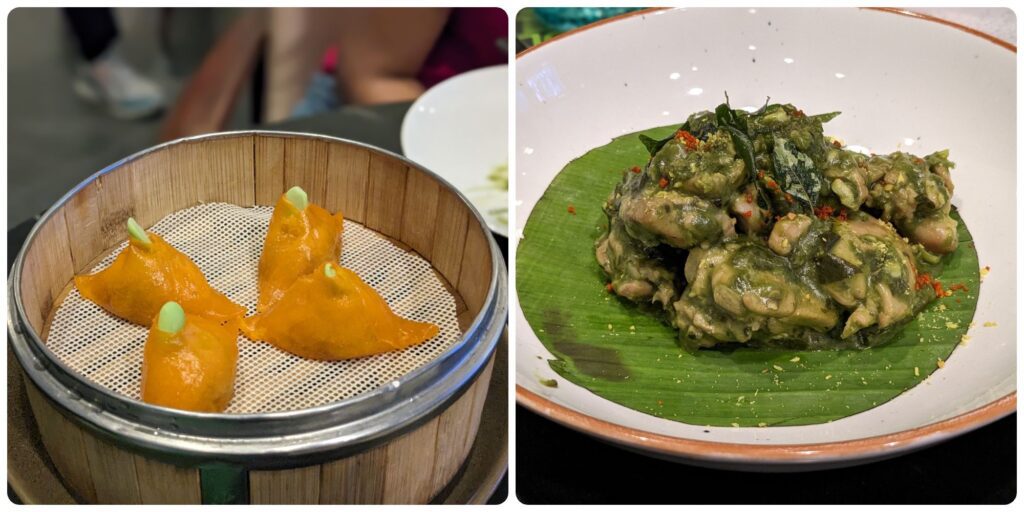
The Chicken & Celery dumpling wasn’t too bad, and they got the Andhra Chilli Chicken fairly right, though I do still prefer their neighbour’s (Red Rhino) version.
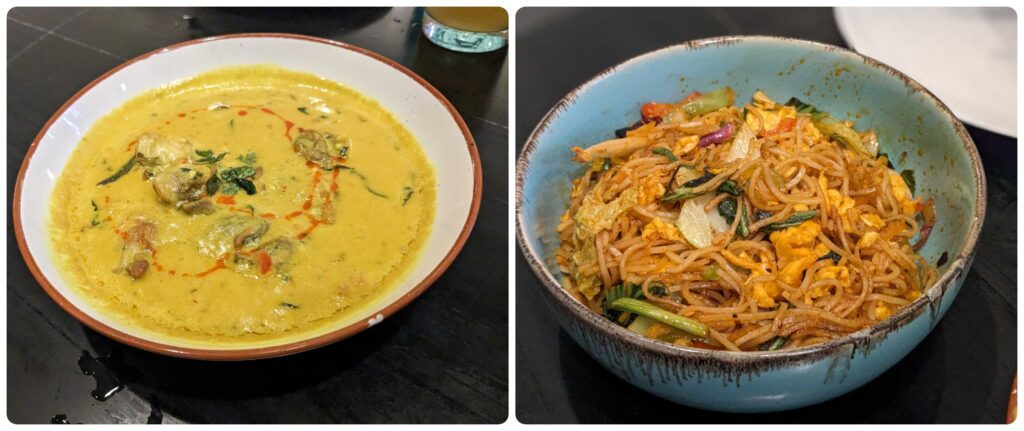
Mapas Manok sounded interesting (Manok seemed Filipino – turns out it’s chicken, and Mapas reminded me of Kerala) This isn’t like the Kerala dish, but it definitely has coconut milk, so we didn’t mind. The only problem was the late realisation that we were still a little hungry and should have ordered something with it. We asked for what we thought would be simple to do – Wok Tossed Chili Garlic Noodles, but either chef was busy or didn’t anticipate people ordering Chinese. Whatever that might be, it took ages to come to the table. I suspect they plan for seating but don’t think of these people ordering!
Overall, as you might have noticed, I was mightily unimpressed. That could be the excitement of a new brewery in the neighbourhood having turned into a meh ambience and experience. But that crowd that likes Ironhill will like this one too. And that tribe is the dominant one. Sigh. The bill came to a little over Rs.3000 and I think that’s money I could have put to better use.
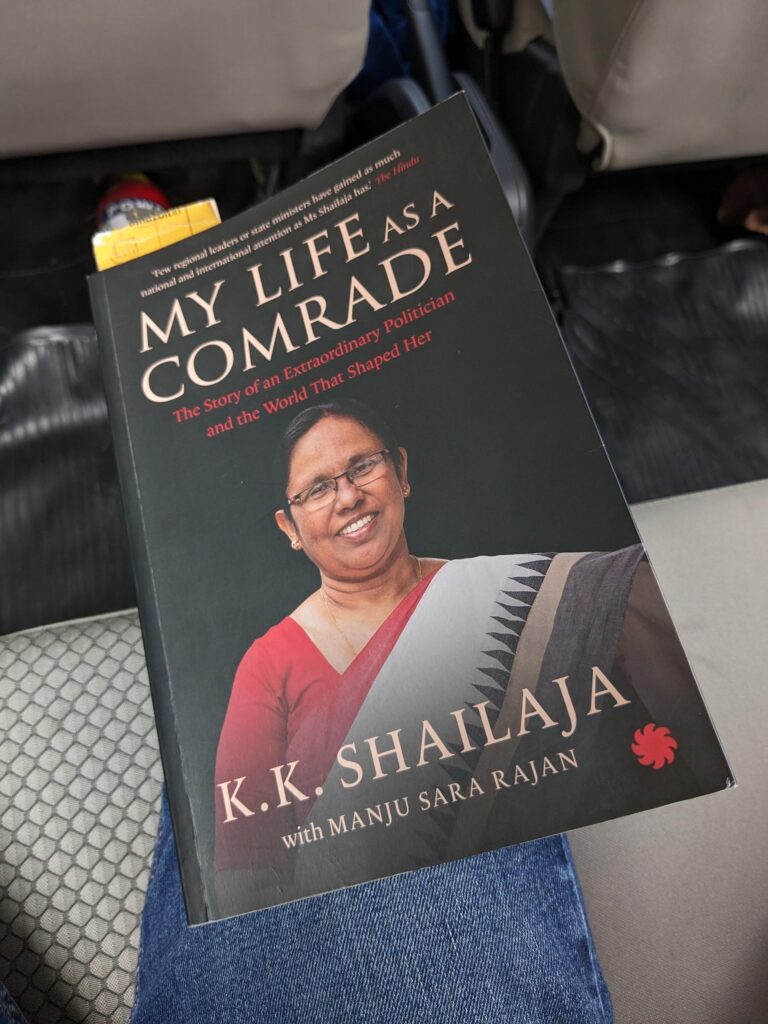
Most Malayalis, as Shailaja teacher points out, are socialists at heart. That, combined with the fact that I was an active member of the SFI in college, meant that My Life as a Comrade was a book that I had to read.
The book proved interesting to me on multiple counts. The first part is an excellent primer into the milieu that shaped the communist movement in the northern part of Kerala that she belongs to. This is presented not just as history beginning in the colonial era, but also as the living history of a land and its people, with many examples of her own family and neighbours being part of the societal struggle from its early days. In terms of structure and narrative, I liked this part of the book the most.
My Life as a Comrade then moves on to her own political life – from the grassroots level to becoming a part of the state cabinet as Health Minister. This section provides a good behind-the-scenes look of what it really means (and takes) to have an active political life, specifically for a woman. Towards the end of the book, she also provides her perspectives on why she wasn’t part of the cabinet in its second term, despite winning her seat by the highest-ever majority. It also gives us an idea of how a ministry functions, and the combination of political will and bureaucratic hands-on knowledge that is required for it do good for the public.
With a cyclone, floods, Nipah, and COVID, hers was an eventful tenure. My Life as a Comrade gets into great detail on how planning, co-operation, and a sharp focus on serving public needs was what led to Kerala becoming a role model for disaster management of all sorts. It has been said many times before, but the way in which the state managed the virus storms by practically creating its own playbook is nothing short of amazing.
There is an excellent section on what makes the ‘Kerala model’ work, despite low budgets. The social contract between the government and the governed that focuses on quality of life, a transparent and combinatorial system of administration, the willingness of folks across the political spectrum to put aside differences in times of need, and an active community that’s always ready to support each other, that’s what makes the model work.
The more I read about the different initiatives, the more I was convinced that old age is perhaps best spent in Kerala, despite the climate scares. Not all the infrastructure might be ready, but there is a mindset that is focused on getting there. I have to say that there is a mix of gratitude of pride that I feel in having such an option.
Having said all that, a couple of things that could have been done better. The first is language – the quality of translation, or rather, transliteration is rather poor. Given the persona, I think the publisher could have put in a lot more effort into this. The second is editing – while it follows a linear narrative, I think the book could have been structured much better.
But despite that, this is a fantastic read for many lessons – how the power of a state that works on socialist principles (allegations of corruption notwithstanding) can effectively and efficiently improve the quality of life of citizens, the life of a woman politician, and the excellent leadership and managerial aptitude in handling crises.
There is nothing quite like death to shake a worldview. There is a reset that happens in one’s head, and the relationship or even lack of it, changes this only in degree, not kind. There is no immunity either, by now, I’d know.
This one took me out of my comfort zone, in terms of physical location. In the last year or so, especially since the previous time I encountered death, I’ve felt myself become a tad more dispassionate about Cochin as relationships seem a lot more fragile. I am myself much to blame, decades of muscle memory of holding others at arm’s length is hard to shake off. And this is beyond Cochin, and in a place where I have avoided staying for more than a night. Each time I have tried to tell myself that my creature comforts can be skipped for a few days, there has been a rebellion within and I’ve been forced to say “I can’t.”
I brace myself this time too, and stood in a corner, observing others. I think we all are capable of projecting an aura of “do not approach” when we so want. Mine is at full blast. And yet, one child (whom I first knew as literally a child, and is now about to become a CA) breaks through it, and asks me if I I am ok, if I need anything. Maybe it is that, maybe it is the death gut punch, or maybe it is my newfound willingness to look at (at least some of) the world without a ‘transaction alert’ warning, but the next evening, I am at the table for evening tea, doing stuff I do when I am comfortable with people – pulling their legs, except these are people I had never even said a decent hello to. The day after, I am pushing someone to accept something the family feels he should take, and he is reluctant. They’re all crying, I think I might have forgotten how to. Says a lot.
But the larger facade broke before that evening at the table, as I watch folks of all forms walk through the door to catch a last glimpse of the one who had passed. It strikes me that I didn’t know more than a few people who would care to drop in to see me before I went up in smoke. The image of an old man, barely able to move a few steps, break down in grief, is still alive in my mind. Sometimes, I realise, it takes death to understand the meaning of life.
A few days later, I am back in Bangalore. I see the unhindered adulteration in packaged food, in the things that restaurants do, and in general, the greed in every seller, I wonder if that is what has been lost when faceless people sell things to faceless others. It is easier to not care when you don’t see the people you harm. That is not an option in a smaller community or at least it gets punished faster.
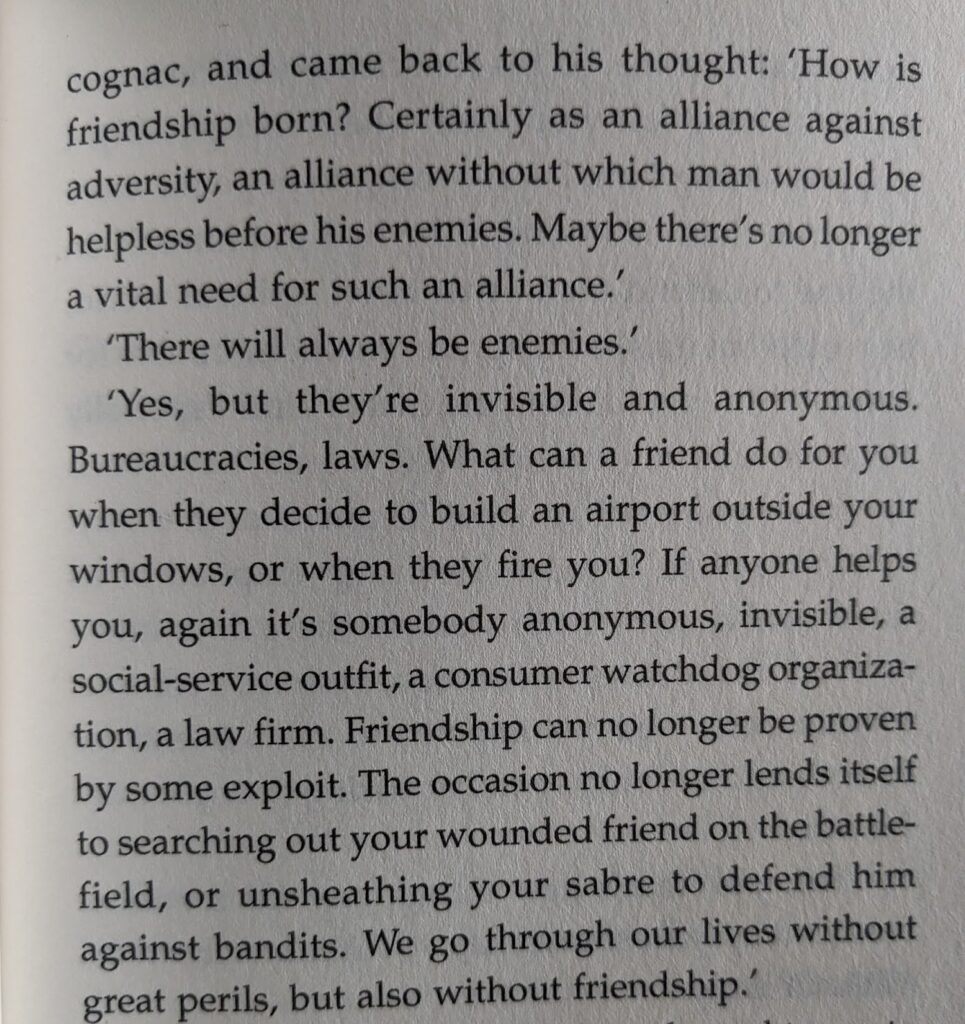
I am also reminded of what else family and community can do when I read Milan Kundera’s brutal take (in Identity) on why friendship isn’t in vogue these days.
When I zoom out of my individualistic approach, I realise I had seen community the way it was meant to be. Life savings in cooperatives, because it’s a world in which everyone still knows everyone else or is just a degree of connection away. Local cable over OTT because births and deaths and important local news is covered in the former. It isn’t perfect, and I won’t romanticise it because I know I wouldn’t be able to tolerate the scrutiny beyond short bursts, but its manifestations are revelatory. As the insightful narrator in Gullak says, yeh trauma bhi hai aur therapy bhi. And I wonder what the proverbial middle path is.