For a change, D had already visited once, but she hadn’t tasted the jamun beer that had been recommended to me. And that was how, we ventured to ORR for an evening out, deviating from my policy of avoiding anything from Brookefield onwards!
Deck Of Brews is a little away from the main road (ORR) and resides in a large industrial-meets-Total Environment building. There are multiple seating options – al fresco, and at least two floors of indoor seating. One reason I was lured was the terrace, but that apparently is open only during weekdays, which is when their main crowd (from the IT parks nearby) frequents the place. The next best spot for a pleasant Bangalore evening was the al fresco area.
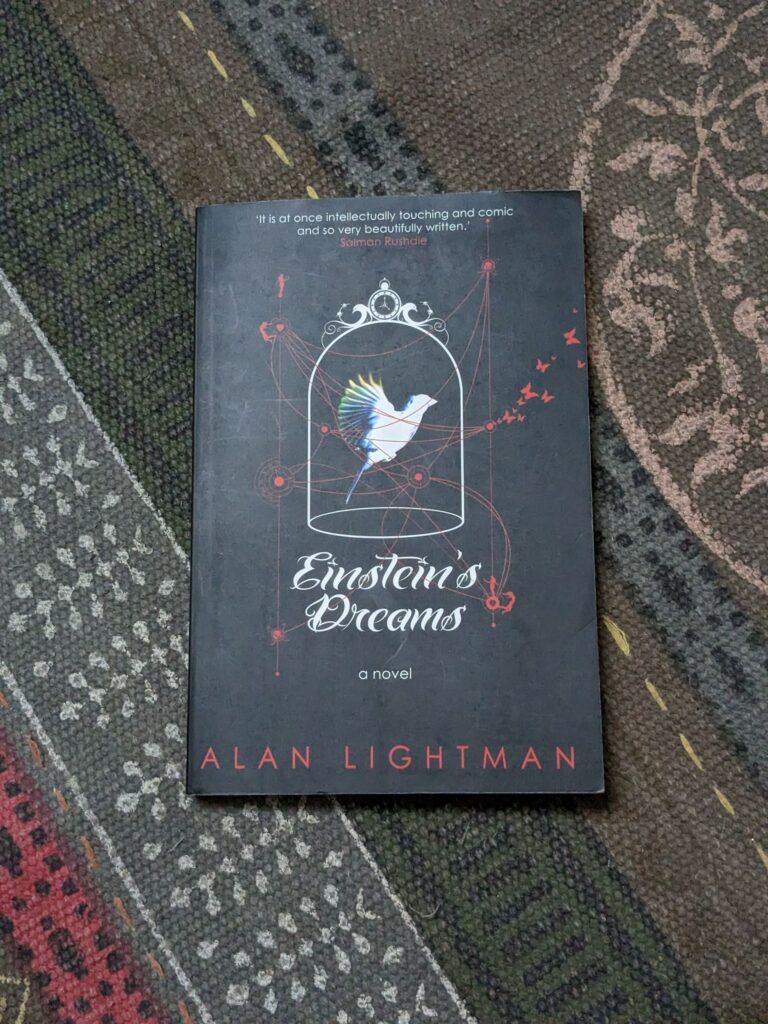
What an absolute classic Einstein’s Dreams is. I began reading, got lost, and then wanted to somehow stretch it to at least another day, and completely failed!
The book is a collection of 30 stories, set as dreams in the (fictional) mind of a young Albert Einstein as he works in the patent office in 1905, and in parallel, pursues the theory of relativity. The book also has a prelude, interludes and an epilogue featuring his friend Michele Besso.
Each story is a theme, an array of what-ifs built around the concept of time. Some of them are definitely connected to relativity but most of them are speculative fantasy. But all of them are concepts one could spend hours thinking over, exploring the nature of time and our individual and collective relationships with it.
I don’t really want to spoil the reading but some of my favourites were body time vs mechanical time, the world where cause and effect is erratic, the texture of time, the world in which some get fitful glimpses of the future, the one in which people live forever, and the world in which no one can imagine the future. The joy is as much in the prose as it is in the concepts. It reminded me of the many ways we take time for granted. And got me thinking of the many different ways in which it could have played out. The book is art and science, and as profound as it is relatable. An instant favourite, and in my Bibliofiles 2023 list.
P.S. It also somehow reminded me of Tales from the Loop.
Some favourites A world in which time is absolute is a world of consolation. For while the movements of people are unpredictable, the movement of time is predictable. Consider a world in which cause and effect are erratic…. It is a world of impulse. It is a world of sincerity. It is a world in which every word spoken speaks just to that moment, every glance given has only one meaning, each touch has no past or future, each kiss is a kiss of immediacy. If a person holds no ambition in this world, he suffers unknowingly. If a person holds ambitions, he suffers knowingly, but very slowly. The tragedy of this world is that no one is happy, whether stuck in a time of pain or joy. The tragedy of this world is that everyone is alone. For a life in the past cannot be shared with the present. Each person who gets stuck in time gets stuck alone.
After Kovalam and many trips to Kochi, the toss up was between going to the north (of Kerala) or discovering a bit more of the south. We chose the latter and specifically Varkala for now, but need to get moving in the other direction soon! “Keral Pradesh ke Varkal mein vacay” was how my Insta reel went. But yes, playing tourists in our homeland is now an annual practice.
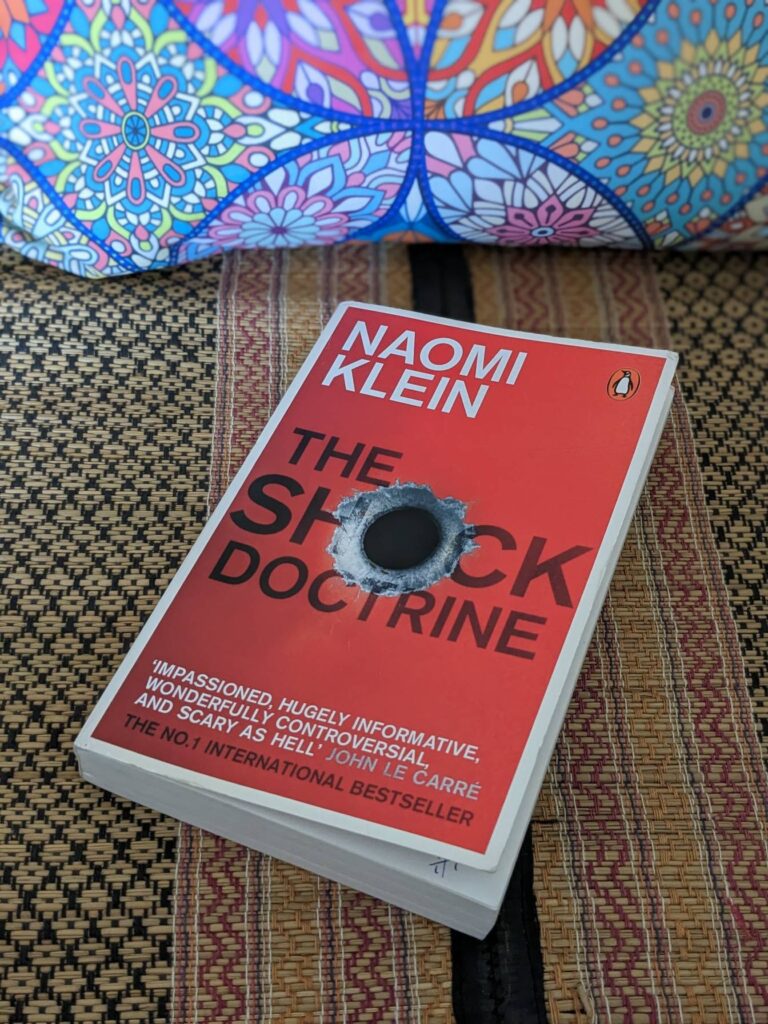
One would think that when a disaster happened, everyone would do their best to help the victims. But it turns out that there are many who seek to profit. And such is the greed that sometimes disasters are created so that profits can be made. Naomi Klein calls it disaster capitalism, and this book is its ‘biography’ to date.
She begins the narrative in New Orleans after Katrina struck, referring to an an op-ed penned by the high priest of the fundamentalist version of capitalism – Milton Friedman. His school of thought earned him disciples that consisted of everyone from IMF chiefs and Fed chiefs to Russian oligarchs and the Chinese Communist Party. The shock doctrine is simple – when a crisis occurs, there is an opportunity to effect change, because people are disoriented. Act decisively and administer economic shocks i.e. radical free-market “reforms” that will advance capitalism.
The shocks and their perpetrators abound in history- Augusto Pinochet in Chile in the 1970s, Margaret Thatcher and the Falklands War in 1982, Tiananmen Square in 1989, Boris Yeltsin in 1993, NATO attack on Belgrade in 1999 against Yugoslavia, the ‘War on Terror’ and even a homecoming in America after 9/11! And these days, the shocks go beyond the economic.
Klein begins at an individual level, when in the 1950s and 60s, Ewen Cameron, with CIA backing, set out to find a way to erase the human mind and then remake it, using physical and mental shocks. (Now available in Guantanamo Bay and Iraq!) This led to a training manual to be used against enemies, called Kubark Counterintelligence Interrogation. Around the same time, in the University of Chicago’s Economics Department, Friedman dreamt of its scaled version – de-patterning entire societies and taking them back to pure capitalism – free of regulations, trade barriers and public interests.
Milton’s belief was that history got off on the wrong foot after the world wars when politicians listened to Keynes and started building the welfare state. The path to true freedom, according to him, was free markets. The original version had three conditions – governments should remove regulations that stand in the way of profits, they should sell off state assets to corporations who could make them profitable, and they should cut back on state subsidies and social programs. This was the Chicago School of thought, the Chicago Boys then set about implementing across the globe, helped by institution-building assistance from the likes of Ford Foundation! (Klein does a great little deep dive on this)
They got their first chance to implement his ideology of unfettered capitalism in the 70s in Latin America. Klein quotes Eduardo Galeano “The theories of Milton Friedman gave him the Nobel Prize; they gave Chile General Pinochet.” Pinochet toppled the democratically elected, socialist Allende and in a dictatorial regime, began implementing not just Friedman’s ideas, but Cameron’s as well, making torture an instrument of the state. In the 80s, Margaret Thatcher used the Falklands War as a political tool against unions, who stood between her and Friedmania, in the process proving that implementation did not require dictatorships. In 1985, Jeffrey Sachs one-upped this in Bolivia by helping create an economic transformation plan that was implemented right after elections. NYT described Sachs as an “evangelist of democratic capitalism”. Behind the scenes, regimes used Cameron’s methods to full effect to control uprisings.
Soon the IMF and the World Bank became allies to this ’cause’. Countries that were in an emergency needed to stabilise currencies. Financial bailouts came attached with strings of privatisation and free-trade policies. The Carvallo plan in Argentina is a classic example. Years later, Davison Budhoo turned whistleblower on this approach, disclosing that books were cooked to doom the economy of a poor but strong-willed country. This approach also provides context to Fukuyama’s “end of history” speech in 1989 in which he stated that free markets and free people were inseparable. (Personally, this was an eye-opener for me, as I had never read his books through this lens!)
Meanwhile, in China, this was being proven wrong as Deng was pushing free markets but not really ‘free people’. In addition, party officials were using the former to become business tycoons. Friedman, during his visit, asked the government to increase the shock therapy! This created a crisis of layoffs and unemployment, the background for the Tiananmen Square protests and the following massacre. On the same day, the socialist Solidarity Party won the elections in Poland, following which shock therapy was implemented, leading to a full blown depression that lasted years.
In 1994, the ANC in South Africa had a unique opportunity to reject free-market orthodoxy and create a nationalised economy. They even created a Freedom Charter, but their focus on removing apartheid and gaining political control caused them to underestimate the importance of economic control, which the white government, with support from IMF, World Bank, and GATT cannily seized. Meanwhile, in Russia, Yeltsin’s implementation of the playbook led to such protests that the regime became effectively dictatorial, leading to the rise of oligarchs and ultimately Putin.
Also in the early 90s, the Asian Tigers – Malaysia, South Korea, Thailand were all growing rapidly even with their protectionist policies. The big corporations wanted in, and in the mid 90s, the IMF and the newly formed WTO, pressured the governments into lifting barriers in financial sectors, leading to a surge of (legal) speculative investment. And a crisis. And the vultures started buying local giants at garage sale prices. Samsung, Daewoo, LG and so on were split up and parts were sold. 24 million people lost their jobs in 2 years, and its imprint is now evident in religious extremism to child sex trade.
And then it all came home to roost after 2001. Ironically, Rumsfeld’s speech on outsourcing all except war fighting to private parties happened on 10 September, 2001! In many ways, the privatisation of multiple government functions were the reason for the security failures behind 9/11. Abroad, ‘logistical support’ was extended until it reached a McMilitary experience, first displayed in the Balkans. Gated suburbs, movie experiences, fast food outlets, all part of fighting a war! Inside the US, Homeland Security is the classic example – politicians create the dead with rhetoric and policies, and private industry fulfils it. People like Cheney and Rumsfeld have made fortunes despite being supposed to serve the people.
In the guise of getting Saddam pay back the debts to Kuwait, the US created a corporatist state of Iraq, after putting its civilians and citizens through the shock process. This time, not just economic, but physical and mental torture. An anti-Marshall Plan. With temp agencies running the business of war, and making money. Lockheed makes both the weapons and fighter jets as well as owns healthcare companies that treat people injured from the use of these weapons! It writes more code than Microsoft since it handles IT divisions of the government and its data management.
Wars are not the only shocks. As shown in Sri Lanka, even tsunamis offer an opportunity for disaster capitalism. Fishermen turned out of their land so big hotels could get beachside properties for cheap and politicians and bureaucrats could make money.
The dystopian future is already playing out in Israel – a corporatist government and a market that rewards a climate of war, because there are companies that make weapons, security systems, surveillance systems and so on.
The good news is that societies are pushing back. Countries in Latin America, for example, are rejecting IMF and World Bank loans. People are electing politicians who are working on the common good. Naomi Klein does a stellar job of unveiling the thinking and execution of disaster capitalism. Thoroughly researched, well documented, and accessible, this book does provide a shock to the reader as well, because it shows how depraved humanity can be. But as she says, so long as we have the collective memory, our disorientation can be made minimal, and we can push back on vulture capitalism. And that’s why it’s important to read this book.